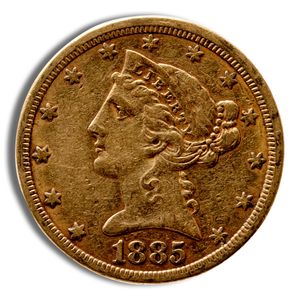
Buy $5 Gold Coins Online
Our catalog of $5 gold coins brings together some of the most historically significant half eagle designs ever produced by the United States Mint, spanning three distinct series across nearly two centuries of American coinage. Shoppers will find the Liberty Head, Indian Head, and Classic Head half eagles available across a full spectrum of grades, from circulated examples in VF and XF condition through professionally certified Mint State coins graded by NGC and PCGS up to MS65. Whether you're sourcing a raw circulated piece or a certified gem example in a tamper-evident holder, the selection here covers the full range of what the half eagle market offers.
All products in this section carry 0.2419 troy ounces of gold at .900 fine purity, consistent across every series and grade tier. Most listings are random-year offerings, which is standard practice in the circulated and bullion half eagle market and allows for efficient sourcing and fulfillment. Bullion Standard presents these products with transparent pricing tied to real-time market conditions, so buyers can evaluate what they're paying relative to spot without having to work through complex markups or opaque fee structures.
What Are $5 Gold Coins?
The $5 gold coin, formally known as the half eagle, is one of the oldest denominations in the history of United States coinage. Authorized by the Coinage Act of 1792, the half eagle was among the first coins produced by the original Philadelphia Mint and remained in continuous or near-continuous production until 1929. The $5 face value is purely nominal at this point, as the actual gold content commands a price well above that figure in any market environment.
Half eagles are distinct from modern bullion coins in that they were originally produced for general circulation rather than as dedicated investment products. Their gold content at .900 fine purity was set to conform to the monetary standards of the era, which is why the purity differs from the .9999 fine standard associated with contemporary issues like the American Gold Eagle or Canadian Gold Maple Leaf. For collectors and buyers specifically focused on pre-1933 U.S. gold coinage, the half eagle represents one of the most accessible and widely traded entry points in that segment of the market.
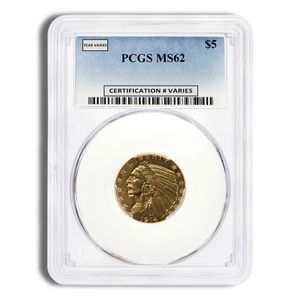
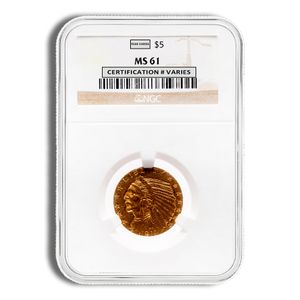
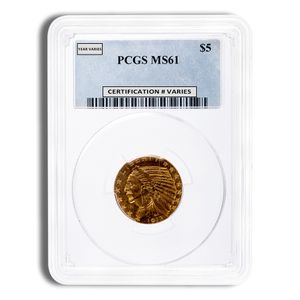
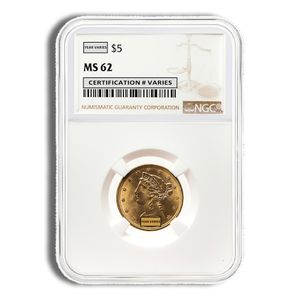
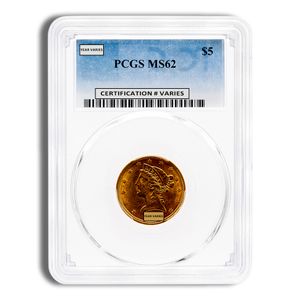
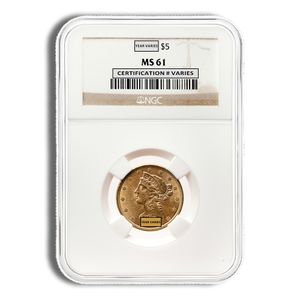
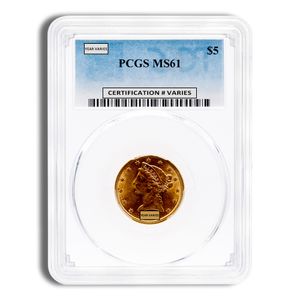
Buyers choose $5 gold coins for a variety of reasons: the historical character of pre-1933 coinage, the recognizability of classic American designs, the relatively modest gold content per coin compared to larger denominations, and the depth of the secondary market for graded examples. The certified market for Liberty and Indian half eagles is particularly developed, which is reflected in the availability of PCGS and NGC graded coins from MS61 through MS65 in our catalog.
History and Background
The Classic Head half eagle, designed by William Kneass, was produced from 1834 to 1838 and represented a significant shift in U.S. gold coinage. Prior half eagles had been hoarded due to their bullion value exceeding face value, prompting Congress to reduce the gold content. The Kneass redesign introduced a lighter standard that allowed coins to circulate more freely, and its relatively short production window of just a few years makes the Classic Head series historically notable among pre-Civil War coinage.
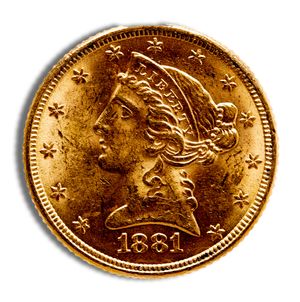
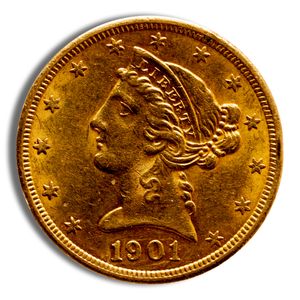
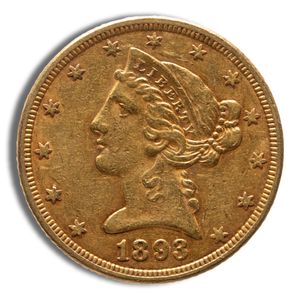
The Liberty Head design, created by Christian Gobrecht and later refined by subsequent engravers, defined American gold coinage for most of the 19th century and into the early 20th. Produced from 1839 through 1908, Liberty half eagles were struck at multiple mint facilities including Philadelphia, New Orleans, San Francisco, Carson City, and Denver, resulting in a broad range of dates, mintmarks, and survival populations across the grade spectrum. The series spans the Civil War era, Reconstruction, and the Gilded Age, making it one of the most historically layered of all American gold series.
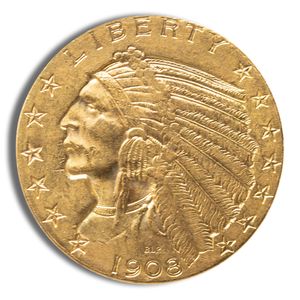
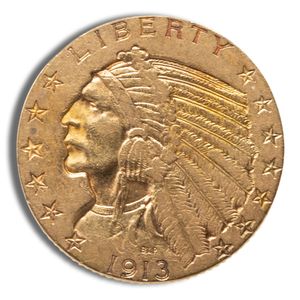
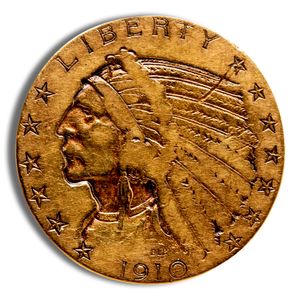
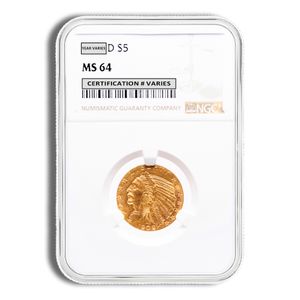
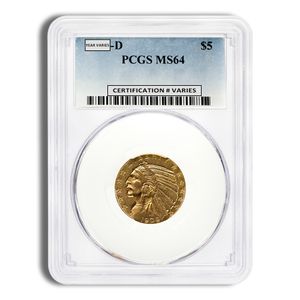
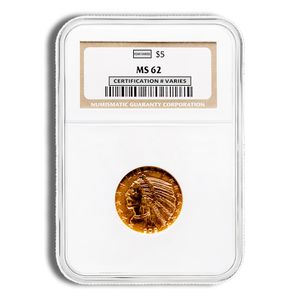
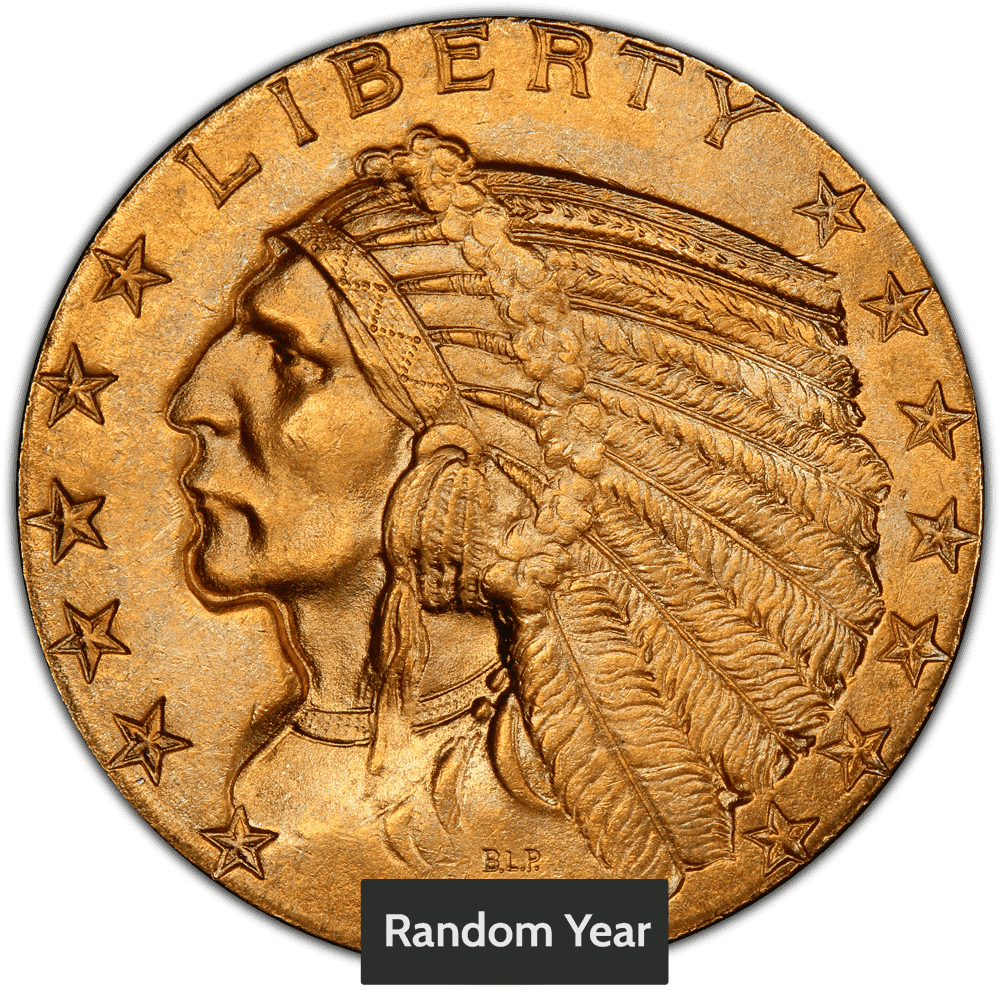
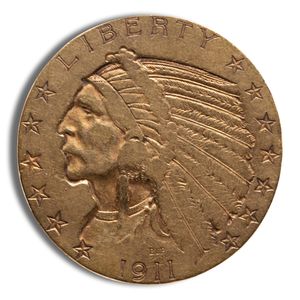
The Indian Head half eagle, designed by Bela Lyon Pratt under the direction of President Theodore Roosevelt as part of a broader beautification of American coinage, introduced an unconventional incuse design where the relief is recessed into the coin's field rather than raised above it. Struck from 1908 to 1929, the Indian series has a devoted following among collectors and represents the final chapter of circulating U.S. gold coinage before President Franklin Roosevelt's 1933 executive order ended domestic gold coin ownership for most Americans. Today, pre-1933 U.S. gold coins including all three half eagle series are fully legal to own and freely traded in the numismatic and bullion markets.
Purity, Weight, and Specifications
Every $5 half eagle in this section contains 0.2419 troy ounces of gold at .900 fine purity, also expressed as 90% gold and 10% copper alloy. This composition was the established standard for U.S. gold coinage throughout the production runs of all three series represented here. The copper alloy contributes to the coin's durability, giving circulated examples a distinctive warm tone that differs from the brighter finish of higher-purity modern bullion issues.
The coins have a gross weight of approximately 8.359 grams, with actual gold weight calculated at the .2419 troy ounce figure used for pricing and metal content comparisons. Unlike modern issues that often carry a reeded edge with consistent technical specifications tied to a specific production year, pre-1933 half eagles were produced across multiple facilities over many decades, so minor variations in strike quality and surface texture are normal and expected rather than indicative of any problem with a specific coin.
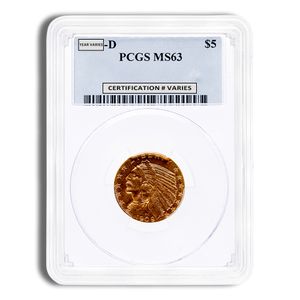
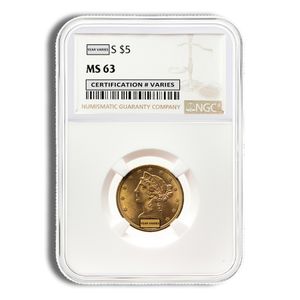
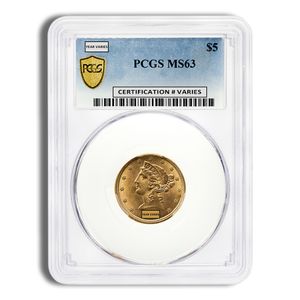
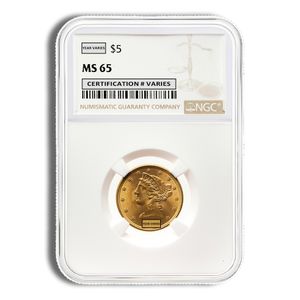
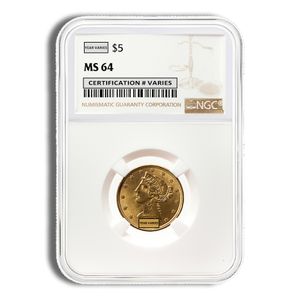
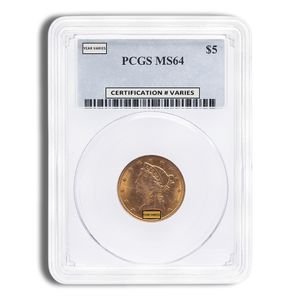
For certified examples, the NGC or PCGS holder provides the definitive reference for grade, authenticity, and identification. Grading designations such as MS61, MS62, MS63, MS64, and MS65 reflect the Sheldon numerical scale, where each point increase above MS60 reflects a meaningful improvement in surface quality, luster, and eye appeal. The difference between an MS63 and MS65 coin can be substantial in terms of both visual character and market pricing.
Available Brands, Mints, and Product Variations
All coins in this section were produced by the United States Mint, with individual pieces potentially originating from Philadelphia, San Francisco, New Orleans, Denver, or Carson City depending on the year. Because these are offered as random-year products, the specific date and mintmark will vary based on current inventory. This is standard across the pre-1933 U.S. gold market, where bulk availability by series and grade is more common than single-date offerings at most price tiers.
The Classic Head half eagle is available in circulated grades including VF, XF, and AU, as well as in cleaned condition for buyers focused primarily on gold content rather than numismatic grade. The Indian Head and Liberty Head series each offer a broader grade range, from cleaned and low-grade pieces through raw circulated coins in VF, XF, and AU, then into Brilliant Uncirculated territory and up through professionally certified examples graded MS61 through MS65 by both PCGS and NGC.
The distinction between PCGS and NGC certified examples is meaningful to many buyers. Both services are widely respected in the numismatic community, though some segments of the market assign slight preference to one service over the other depending on the series and grade tier. Bullion Standard carries certified examples from both services, and as an authorized dealer for PCGS and NGC, we can confirm the integrity of all slabbed products in our inventory. For buyers interested primarily in gold content rather than numismatic grade, the raw circulated and BU listings offer a more direct relationship between price and metal value.
Pricing, Premiums, and Market Factors
Pricing for $5 gold coins is driven by a combination of the underlying spot price of gold, the numismatic premium specific to each series and grade, and current supply and demand conditions within the pre-1933 gold market. Because these coins carry recognized collectible value in addition to their metal content, premiums can vary more significantly than they do for standard modern bullion products, particularly at higher Mint State grades where eye appeal and population data play a larger role in price discovery.
Circulated pieces in VF, XF, and AU carry premiums that are more closely tied to the coin's gold content and general market liquidity for pre-1933 U.S. gold. Certified coins from MS61 upward begin to reflect numismatic demand more heavily, with premiums at the MS63 to MS65 tier often reflecting considerable additional value beyond the bullion equivalent. Cleaned or improperly cleaned coins typically carry lower premiums and are generally valued closer to their metal content, which is why they're offered separately at their own pricing tier.
Bullion Standard's pricing reflects real-time spot price conditions and is structured to be transparent from the moment a buyer lands on a product page. The bid/ask spread displayed on each listing reflects current market dynamics rather than a fixed dealer margin, allowing buyers to evaluate both the acquisition cost and the expected resale relationship before committing to a purchase. This structure is particularly relevant for half eagle buyers weighing different grade tiers, since the spread characteristics can differ meaningfully between a circulated raw coin and a certified gem.
Condition, Packaging, and What to Expect
Raw circulated half eagles are offered loose without original mint packaging, which is expected for coins that are between 95 and 190 years old. VF examples will show clear but well-worn design detail, XF pieces retain most high-point detail with light wear on the most exposed areas, and AU coins show only the slightest signs of circulation with most of their original luster still intact. None of these grades come with assay cards or sealed packaging, and minor contact marks, toning, or surface patina consistent with age are entirely normal.
BU-graded raw pieces are offered without certification but represent coins showing no circulation wear. These coins may show bag marks, minor contact, or varying luster depending on how they've been stored over the decades since production. They are not the equivalent of a certified Mint State coin, and buyers interested in a guaranteed grade should look to the NGC or PCGS certified listings.
Certified coins arrive in tamper-evident plastic holders bearing the grading service's label, grade designation, and coin identification number. These holders protect the coin's surfaces and provide third-party verification of grade and authenticity. Cleaned or low-grade coins in this catalog are designated clearly and are priced to reflect their condition, making them appropriate for buyers whose primary interest is gold content rather than numismatic grade. All orders ship fully insured with packaging appropriate to the value of the product.
Authenticity and Verification
Pre-1933 U.S. gold coins including all three half eagle series in this catalog are among the most extensively studied and authenticated coins in American numismatics. Both NGC and PCGS maintain detailed population records, die variety databases, and reference libraries that allow their graders to identify authentic examples with a high degree of confidence. For certified coins, the holder itself provides the primary verification, and both services offer online verification tools that allow buyers to confirm a coin's certification details using the label number.
Raw circulated and BU coins sourced by Bullion Standard are examined for authenticity prior to listing. We source from reputable wholesalers, distributors, and the numismatic market, and our purchasing process includes standard authentication review. For buyers who want an additional level of assurance on a raw coin, submission to PCGS or NGC is always an option after purchase, and our team can provide guidance on that process.
Counterfeiting of pre-1933 U.S. gold coins does exist in the broader market, which is one of the clearest arguments for purchasing certified examples when authenticity is a primary concern. Buyers who prefer raw coins should ensure they are working with established, reputable dealers. Bullion Standard's A BBB rating, ANA membership, NCBA membership, and status as an authorized PCGS and NGC dealer reflect the standards we hold ourselves to across every transaction.
Liquidity and Resale Considerations
Half eagles are among the most broadly recognized series in pre-1933 U.S. gold coinage, and the Liberty Head and Indian Head varieties in particular carry deep secondary market recognition. This means that resale options tend to be meaningfully broader than they would be for more obscure or regionally specific numismatic items. Coin dealers, auction houses, online numismatic marketplaces, and direct-to-dealer buyback programs all regularly transact in half eagle coins across all three series and most grade ranges.
Certified coins in higher Mint State grades tend to trade within a relatively well-defined pricing structure supported by PCGS and NGC population data. This transparency helps both buyers and sellers understand where a coin sits within the broader market for that particular series and grade. Circulated pieces in VF, XF, and AU are traded more directly in relation to their gold content, though series-specific collector demand does influence pricing to varying degrees.
Liquidity for cleaned or low-grade pieces is generally more limited, as the buyer pool for these coins skews toward bullion-focused purchasers rather than numismatic collectors. Understanding this distinction before a purchase is made is part of the transparent approach Bullion Standard applies to pre-1933 gold products. Knowing the resale environment for a specific grade tier is at least as important as knowing the current purchase price.
Storage and Security
Certified coins in NGC or PCGS holders are already protected by tamper-evident plastic cases that provide a meaningful barrier against handling damage and environmental exposure. These holders should not be opened or broken out of their cases, as doing so will void the certification and typically result in significant loss of numismatic value. Holders can be stored in coin boxes, foam-padded trays, or archival-quality coin storage products designed for slabbed coins.
Raw circulated and BU coins should be handled by the edges to avoid adding fingerprints or contact marks to the coin's surfaces. Soft cotton gloves are a practical choice for handling pieces you intend to keep in top condition. For storage, individual coin flips, protective capsules, or archival-quality holders prevent direct surface contact and protect against environmental moisture or contaminants that can cause toning or spotting over time.
For buyers accumulating multiple pieces, a home safe rated for fire and theft resistance is a practical baseline. Those holding larger quantities or higher-value certified coins should consider professional vault storage or a custodial storage arrangement that provides full insurance coverage and climate-controlled conditions. The choice of storage should reflect both the total value being held and the frequency with which you expect to access the coins.
Selling and Buyback Options
Bullion Standard operates as a two-way market, meaning we actively purchase the products we sell. When you're ready to sell half eagle coins, our buying desk evaluates each product based on series, grade, certification status, current market conditions, and the specific coin's condition and presentation. Certified coins in NGC or PCGS holders typically move through the process more efficiently because grade and authenticity are already documented, whereas raw coins may require additional review before pricing can be confirmed.
Buyback pricing for circulated half eagles is influenced primarily by the current spot price of gold and the prevailing wholesale market premium for pre-1933 U.S. gold coins at the relevant grade level. Higher-grade certified pieces are priced with reference to current numismatic market conditions, recent auction realizations, and population data for that specific grade tier. Products in cleaned or low-grade condition are evaluated based on their bullion-equivalent value rather than numismatic criteria.
Understanding the bid/ask spread on each product page before purchasing gives buyers a real picture of what the round-trip transaction looks like under current market conditions. This transparency is intentional. Rather than presenting only the ask price and leaving the resale side opaque, Bullion Standard surfaces both sides of the market so buyers can evaluate the full cost of ownership from the moment they begin researching a product.
Why Buy $5 Gold Coins?
Half eagles appeal to a distinct segment of the gold market that prioritizes historical character alongside gold content. These coins represent a direct connection to the monetary history of the United States, and the three series available here span the better part of two centuries of American coinage. For buyers interested in pre-1933 U.S. gold specifically, half eagles are one of the most accessible entry points in terms of per-coin cost relative to other denominations like the $10 eagle or $20 double eagle.
The certified market for half eagles, particularly the Liberty and Indian series, is among the most developed and well-documented in American numismatics. PCGS and NGC population data allows buyers to understand how common or scarce specific grade-point coins are, which supports more informed purchasing decisions than you can make with generic bullion products. For buyers building a collection alongside their bullion holdings, half eagles offer the kind of research depth and market infrastructure that supports longer-term engagement with the coins themselves.
At the circulated end of the market, VF, XF, and AU pieces offer a way to own genuine pre-1933 U.S. gold at premiums that reflect their condition rather than artificially inflated collector demand. The gold content at 0.2419 troy ounces is fixed and consistent across every coin regardless of series or grade, so the buyer's decision comes down to how much additional numismatic value they want to pay for relative to the base metal content.
Why Buy from Bullion Standard?
Bullion Standard has been operating as a U.S.-based precious metals dealer since 2010, and our platform was built around a straightforward premise: that buyers deserve transparent pricing, clear product information, and access to both sides of the market from the start. We don't operate as a traditional high-pressure sales environment. Our goal is to give buyers the information they need to make decisions that make sense for their specific situation, not to push them toward the highest-margin product on the shelf.
As an authorized dealer for both PCGS and NGC, we source certified products through verified channels and maintain rigorous standards for product authenticity across all inventory. Our A rating with the Better Business Bureau and active memberships in the American Numismatic Association and the National Coin and Bullion Association reflect a commitment to industry standards that extends well beyond marketing language. Every certified coin we sell has been verified through the appropriate grading service, and our purchasing process for raw coins includes authentication review before products reach our catalog.
Checkout is designed to be secure and flexible. Buyers can complete purchases using Visa, Mastercard, American Express, Discover, PayPal, bank-connected payments through Plaid, wire transfer, paper check, or cryptocurrency payments through BitPay. Shipping is fully insured, and our customer support team is accessible throughout the buying and selling process. From the first product page view through post-purchase support and eventual resale, the experience is designed to be consistent, transparent, and reliable.
Get Near-Spot Pricing with Bullion Standard Pro
Bullion Standard Pro is designed for buyers who want to transact closer to the wholesale level of the precious metals market. Members gain access to live, executable wholesale bid and ask pricing across a broad range of products, including pre-1933 gold coins, without the additional dealer markups or fixed retail spreads that characterize the traditional dealer model. Premiums and bid/ask spreads reflect real-time supply and demand rather than static retail pricing structures, which means the pricing environment adjusts as market conditions change.
For buyers accumulating half eagles at multiple grade tiers or building meaningful positions in pre-1933 U.S. gold, the pricing efficiency available through Pro can represent a meaningful difference over time compared to standard retail purchasing. The platform also provides portfolio valuation based on live executable wholesale bid pricing rather than estimated retail values, giving members a more realistic picture of their holdings at any given moment.
Beyond pricing, Pro members have access to proprietary market intelligence tools that can include premium analysis, spread metrics, liquidity indicators, and historical market comparisons across products in our catalog. For buyers who want to move beyond making decisions based solely on current price and instead understand the broader market dynamics around pre-1933 U.S. gold coins, Pro provides the kind of analytical infrastructure that has traditionally been available only to wholesale market participants.

 (833) 278-4653