Buy British Gold Sovereigns Online
Our catalog of british gold sovereigns spans more than two centuries of Royal Mint coinage, from the early post-Napoleonic issues of King George III through the current reign of King Charles III. Each coin in this selection carries 0.2354 troy ounces of gold at 22-karat purity, with the exception of the half sovereign and the larger 2 sovereign and 5 sovereign denominations, which scale proportionally in metal content. Whether you're looking at a circulated XF-graded piece from the Victorian era or a brilliant uncirculated modern issue, the underlying specifications remain consistent with the standard set by the Great Recoinage of 1816.
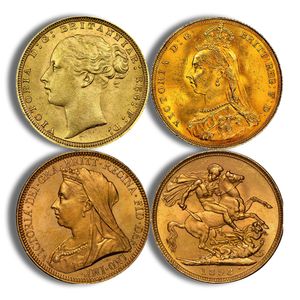
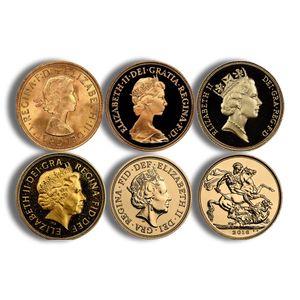
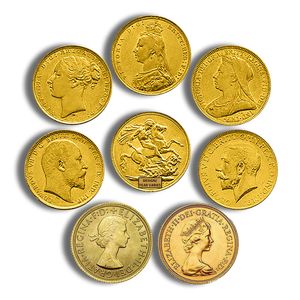
The product grid reflects the full breadth of what makes this series so enduring in the physical gold market. Circulated sovereigns are available across five distinct reign periods, including Queen Victoria (1838-1901), the Kings of the early twentieth century (1901-1952), and Queen Elizabeth II (1952-2022). Brilliant uncirculated options round out the selection in half, double, and quintuple sovereign formats, each produced by The Royal Mint and offered here as random year selections. This combination of historical depth and modern availability is rare in any single bullion coin series.
Bullion Standard sources these coins through verified wholesale channels, and pricing reflects real-time market conditions rather than fixed retail markups. Our transparent marketplace model means you can evaluate what you're paying against current spot prices and understand the full cost of ownership before committing to a purchase.
What Are British Gold Sovereigns?
The british gold sovereign is a government-issued gold coin struck by The Royal Mint of the United Kingdom to a precise standard of 22-karat gold, equivalent to a fineness of 0.9167. The full sovereign contains 0.2354 troy ounces of pure gold and has maintained this specification continuously since the modern series was standardized in 1817. It is denominated as one pound sterling, giving it legal tender status in the United Kingdom, though its intrinsic gold value far exceeds its face value in most market conditions.
The coin occupies a distinct position in the gold market because it sits between fractional and full one-ounce bullion coins. At just under a quarter ounce, it offers a relatively accessible entry point into gold ownership without the higher-per-ounce premiums often associated with tenth-ounce or quarter-ounce fractional products. Buyers who want gold in a format that is globally recognized, historically significant, and easy to handle in smaller increments tend to gravitate toward sovereigns for exactly this reason.
Beyond the standard full sovereign, the denomination structure extends in both directions. The half sovereign (0.1177 oz) provides a smaller, more affordable entry point, while the double sovereign (0.4708 oz) and quintuple sovereign, commonly called the five-pound piece (1.177 oz), offer larger holdings in the same trusted format. This range of denominations under a single, well-established design family gives buyers meaningful flexibility in how they structure their gold holdings.
History and Background
The sovereign has roots stretching back to 1489 under King Henry VII, but the modern bullion coin as it's recognized today traces directly to the Great Recoinage of 1816 and the first issues of 1817. This reform standardized British coinage after years of inconsistency caused by fluctuating silver prices and the demands of wartime currency. The result was a reliable gold coin that quickly became the dominant form of international trade settlement throughout the British Empire and beyond.
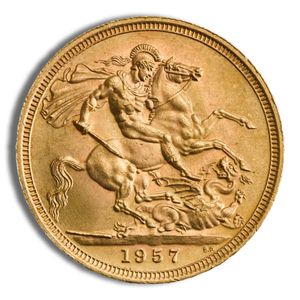
Through the Victorian era, sovereign production expanded dramatically as the British economy grew and gold discoveries in Australia opened new mint facilities in Sydney, Melbourne, and Perth. These branch mints struck sovereigns to the same specification as London, though identifying mint marks distinguish them from the main issue. Production slowed significantly after World War I as Britain moved away from the gold standard, and domestic circulation of sovereigns effectively ended by the 1930s. The Royal Mint resumed modern sovereign production in 1957 to meet international demand, and the coin has been struck continuously in various forms since that point.
By the time the modern bullion market developed in the late twentieth century, the sovereign already had a long track record as a traded gold instrument. Its consistent specification, government backing, and centuries of Royal Mint production history made it a natural fit for the growing bullion market alongside newer one-ounce programs like the Britannia and the Krugerrand. Today it remains one of the most widely traded gold coins globally, with active secondary markets across Europe, the Middle East, and North America.
Purity, Weight, and Specifications
Every standard british gold sovereign in our catalog is struck to a fineness of 0.9167, which corresponds to 22-karat gold. This alloy blends gold with copper to produce a coin that is more resistant to wear than fine gold, which made it well-suited to the centuries when sovereigns circulated freely. The gold content of a full sovereign is 0.2354 troy ounces, a figure that remains constant across all reigns and production periods.
The full sovereign measures 22.05 millimeters in diameter and 1.52 millimeters in thickness. These dimensions have remained effectively unchanged since the nineteenth century, which is one reason why sovereigns from different eras stack, store, and handle identically. The half sovereign carries 0.1177 troy ounces of gold in a smaller 19.3-millimeter diameter, while the 2 sovereign measures 28.4 millimeters and the 5 sovereign reaches 36.02 millimeters. All four denominations share the same 0.9167 gold purity.
Unlike many modern bullion coins, sovereigns do not carry a face value prominently on the obverse or reverse in most historical issues. The denomination is implicit in the coin's established weight and purity standard rather than stamped as a monetary figure. Modern issues identify the one pound sterling denomination more clearly, but the coin's market relevance is driven by its gold content rather than its legal tender designation.
Available Brands, Mints, and Product Variations
All products in this section are produced by The Royal Mint, the official mint of the United Kingdom and the institution responsible for sovereign production across its entire modern history. The Royal Mint carries one of the most recognizable and respected reputations in global numismatics and bullion production, and its coins trade with broad market acceptance in both retail and wholesale channels. Random year sovereign offerings reflect the standard trade structure for circulated historic coins, where the specific date is determined by availability rather than selection.
The circulated XF sovereign range is organized by reign period rather than specific year, which reflects how this segment of the market actually trades. A Queen Victoria sovereign dated 1885 and one dated 1898 carry the same gold content and broadly similar collector interest, so grouping by reign allows buyers to receive an authentic period-correct coin without requiring date-specific inventory management. The XF grade indicates a coin that retains clear design detail with only moderate wear, well above the heavily circulated grades seen in lower-tier circulation finds.
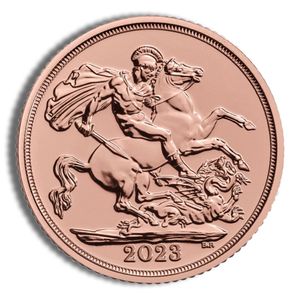
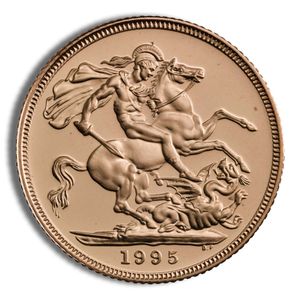
The brilliant uncirculated selections in the half, double, and 5 sovereign denominations represent the modern production side of this series. BU coins are struck to a higher standard of surface quality and are free from the handling marks and wear associated with circulated issues. These coins arrive in packaging appropriate for their grade and are sourced as random year modern Royal Mint issues. The 5 sovereign, in particular, is a commanding piece that stands apart from most standard bullion offerings in both size and visual presence.
Pricing, Premiums, and Market Factors
Sovereign pricing is driven by the gold spot price, but the premium structure above spot reflects several factors specific to this coin format. The sub-quarter-ounce size means the per-ounce premium on a full sovereign tends to be slightly higher than on a one-ounce coin, since the per-unit fabrication, handling, and distribution costs are spread over a smaller gold content. That said, sovereigns trade far more efficiently than most other fractional gold products because of their historical depth and the scale of the global secondary market that supports them.
Condition plays a meaningful role in pricing across the circulated reign-period issues. XF-graded sovereigns command premiums above heavily worn or cleaned examples, and Victorian-era coins can carry modest collectible interest beyond their bullion value depending on the specific date and mint mark. The BU denominations, including the half and the larger double and five-pound pieces, tend to track closer to modern bullion premiums, which are generally more stable and easier to compare against current market benchmarks.
At Bullion Standard, pricing is updated in real time to reflect current spot conditions, and each product page displays the bid and ask spread so you can evaluate the full cost of ownership transparently. Rather than obscuring the premium with complex pricing structures, our marketplace model is designed to let you see exactly what you're paying and how it compares to current market rates. For buyers transacting at greater frequency or volume, Bullion Standard Pro provides access to executable wholesale pricing that can reduce the effective spread on sovereign purchases.
Condition, Packaging, and What to Expect
Circulated XF sovereigns are sold as individual coins without assay packaging or plastic slabs unless otherwise specified. These are authentic historic coins that have passed through circulation, and while the XF grade ensures strong detail and moderate wear at most, individual pieces may show light contact marks, minor handling evidence, or natural toning appropriate to their age. Buyers should understand that cosmetic variation is normal and expected in circulated historic coinage, and it does not affect the gold content or authenticity of the coin.
Brilliant uncirculated sovereigns in the half, double, and five-pound denominations are typically shipped in mint-appropriate protective packaging, which may include tubes or individual coin holders depending on the specific product. Coins sold as random year selections will not be chosen based on date, and requests for specific years cannot be accommodated. The year received will fall within the date range listed for each product and will be authentic Royal Mint production.
Tubed quantities for several products in this catalog are available in inner packs of 25 coins, which reflects the standard trade packaging for sovereigns in the wholesale market. Orders placed in tube quantities may ship in sealed mint tubes where inventory allows, and larger quantities may qualify for different packaging configurations. Individual orders will be shipped securely with appropriate protective materials to maintain coin condition during transit.
Authenticity and Verification
Every sovereign sold through Bullion Standard is verified for authenticity, weight, and purity before it reaches the customer. Our sourcing network includes established wholesalers, authorized distributors, and institutional-grade suppliers who meet the verification standards required for market-grade product. Coins that do not pass verification are not listed, sold, or shipped under any circumstances.
The Royal Mint's sovereign series benefits from several centuries of well-documented production standards, making authentication more straightforward than many other gold coin formats. Experienced numismatic professionals can verify genuine sovereigns through a combination of weight testing, dimensional inspection, and surface analysis. Specific security features vary by production year and denomination, but the consistency of the sovereign's metal standard across its history means that deviations in weight or composition are immediately detectable with proper equipment.
Bullion Standard is an authorized dealer for both PCGS and NGC, meaning certified sovereign coins can be acquired through our platform with the additional verification and encapsulation services these grading companies provide. For buyers who prefer an added layer of third-party authentication, particularly on higher-value or collectible examples, PCGS or NGC certification provides an independently verified guarantee of authenticity and grade.
Liquidity and Resale Considerations
The british gold sovereign is among the most liquid gold coin formats available in the global market. Its consistent specification, government-backed origin, Royal Mint pedigree, and centuries of trading history mean that dealers and private buyers across Europe, the Middle East, and North America recognize and readily trade these coins. This broad market recognition is a meaningful practical advantage compared to less established mint programs or privately issued gold rounds.
Circulated sovereigns from the major reign periods trade actively in both wholesale and retail channels, and their historical familiarity means that dealers in most markets can assess and price them quickly. BU denominations like the double and 5 sovereign trade in a more specialized market, so buyers of those formats should expect a somewhat narrower pool of buyers compared to the standard full sovereign. That said, the Royal Mint's reputation ensures that all denominations in this series retain strong baseline market recognition.
Product condition and packaging integrity do influence resale pricing. A coin in XF condition that has been cleaned, artificially toned, or damaged will typically trade at a discount to a comparable unaltered example. Keeping coins in their original packaging where applicable and avoiding unnecessary handling helps preserve their resale position over time.
Storage and Security
Full sovereigns and half sovereigns are compact enough to store efficiently in a wide range of formats, from standard coin tubes and capsules to larger multi-product storage solutions. Individual coins can be held in 22mm coin capsules that protect against surface contact without restricting visibility. For buyers holding multiple sovereigns, a sealed tube of 25 coins provides a practical and space-efficient storage solution.
Home safe storage is a reasonable option for modest holdings, provided the safe is fire-rated and securely anchored. For larger positions or buyers seeking professional-grade security, third-party vault storage through a private vault operator or secure storage provider offers an alternative that removes the physical custody burden from the buyer. Bank safe deposit boxes are also an option for some buyers, though accessibility limitations and the absence of insurance coverage are factors worth considering.
The larger 2 sovereign and 5 sovereign pieces are better suited to individual capsules or custom coin trays given their larger diameter. The 5 sovereign in particular, at 36.02 millimeters, requires packaging specifically sized for larger coins to prevent movement and surface contact. Environmental factors including humidity, temperature fluctuation, and sulfur exposure can affect the surface quality of gold-copper alloy coins over time, so sealed storage in a stable environment is advisable for pieces where surface condition matters to the buyer.
Selling and Buyback Options
Selling british gold sovereigns back into the market is generally a straightforward process given the coin's broad recognition and established trade infrastructure. Dealer buyback programs, including Bullion Standard's own purchasing operation, evaluate sovereigns based on current gold spot prices, the applicable bid premium for the specific product, condition, and any packaging or certification present. Coins in original, unaltered condition typically achieve stronger buyback pricing than cleaned or damaged examples.
Bullion Standard operates as a two-way market, meaning the same platform where you purchase sovereigns is also where you can sell them back. Our buyback pricing reflects current wholesale bid levels rather than arbitrary dealer discounts, which is consistent with our broader commitment to pricing transparency. Buyers who understand both the acquisition premium and the expected bid price at the time of purchase are in a better position to evaluate the complete economics of the transaction, and our product pages are designed to provide exactly that information.
For sellers evaluating buyback options, the spread between the ask price paid at purchase and the bid price available at sale is the most relevant measure of the round-trip cost of ownership. Sovereigns, given their liquidity and global market recognition, tend to carry tighter spreads than less liquid fractional formats. Bullion Standard Pro members have access to live wholesale bid pricing that reflects real-time executable market levels rather than static estimates, which can be valuable when timing a sale or evaluating buyback terms against current market conditions.
Why Buy British Gold Sovereigns?
The sovereign's primary appeal is its combination of recognizability, historical depth, and a gold content that sits in a practical range for buyers who want gold in smaller, manageable increments. Because the coin has been produced consistently under the same specification for over two centuries, it carries a level of market familiarity that very few other gold coin formats can match. Buyers who want a gold coin that is recognized and traded broadly, without paying the higher per-ounce premiums of true fractional products, often find the sovereign's position in the market well-suited to their needs.
The range of denominations available within this series offers meaningful flexibility. A buyer who wants exposure to gold in a compact, sub-quarter-ounce unit can work with the half sovereign. Someone looking for a larger holding in a single, historically recognized coin format can look to the 2 sovereign or 5 sovereign without departing from the trusted Royal Mint standard that defines the series. This denomination flexibility within a single coin family is uncommon and genuinely useful for structuring a physical gold position across different size increments.
For buyers with an interest in numismatics alongside bullion ownership, the circulated reign-period sovereigns provide an additional dimension that purely modern bullion coins cannot. Holding a genuine Victorian sovereign or an Edwardian-era piece connects the owner to a tangible piece of financial and cultural history while maintaining a direct relationship to the current gold price. That combination of historical character and bullion relevance is a defining feature of the sovereign that keeps it relevant across generations of buyers.
Why Buy from Bullion Standard?
Bullion Standard was founded in 2010 and has grown into a nationally recognized precious metals marketplace by operating on a straightforward principle: transparency earns trust, and trust earns long-term customers. Based in San Diego, California, we've built our reputation by focusing on pricing integrity, verified sourcing, and a buying experience that feels more like a transparent marketplace than a high-pressure sales environment. Our A rating with the Better Business Bureau and membership in both the American Numismatic Association and the National Coin and Bullion Association reflect that commitment.
Every product sold through our platform is verified for authenticity, weight, and purity through established sourcing channels before it's offered for sale. We are authorized dealers for both PCGS and NGC, and we source from reputable mints, wholesalers, and distributors whose standards align with ours. Customers can pay through a wide range of methods including major credit cards, PayPal, bank-connected payments through Plaid, wire transfer, check, and cryptocurrency through BitPay, giving them flexibility without compromising security.
Our two-way market model is one of the clearest expressions of what sets Bullion Standard apart. Rather than functioning purely as a one-direction retailer, we actively publish buyback pricing alongside purchase pricing so that customers can evaluate both sides of the transaction before making a decision. Combined with our real-time pricing structure, educational resources, and responsive customer service, this model is designed to give buyers a more complete and informed experience from the first purchase through any eventual sale.
Get Near-Spot Pricing with Bullion Standard Pro
Bullion Standard Pro is designed for buyers who want access to wholesale-level pricing efficiency on physical gold purchases. Members transact at live, executable wholesale bid and ask prices rather than standard retail pricing, which means premiums and spreads reflect actual market conditions rather than fixed dealer markups. For a product like the british gold sovereign, where global market liquidity keeps spreads relatively tight in the wholesale market, this pricing model can represent a meaningful difference in the total cost of ownership over time.
Beyond pricing, Bullion Standard Pro provides access to proprietary market intelligence tools that are particularly useful for evaluating sovereign products. Historical premium analysis, spread tightness rankings, and liquidity metrics allow members to assess whether current pricing on a given product falls within a normal historical range or represents an outlier driven by short-term supply or demand shifts. These tools aggregate wholesale market activity across the bullion market, giving members visibility into pricing dynamics that are rarely accessible to individual buyers through traditional retail channels.
Portfolio valuation within Bullion Standard Pro reflects live wholesale bid pricing rather than estimated retail values, which provides a more realistic picture of what a holding is actually worth in the current market. For buyers managing positions across multiple denominations of the sovereign series, or across a broader mix of gold products, this real-time valuation capability offers a level of clarity that standard account tools in traditional retail precious metals platforms simply don't provide. The objective is to make the physical gold market more transparent and more efficient for the buyers who use it.

 (833) 278-4653