Buy Gold Krugerrands Online
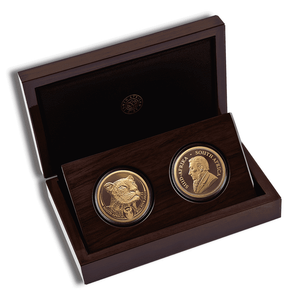
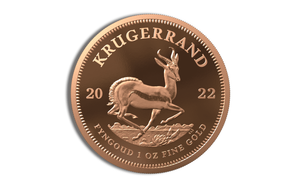
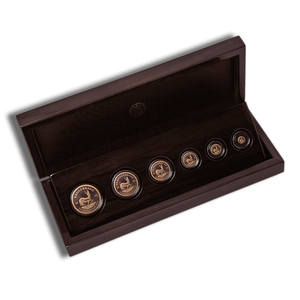
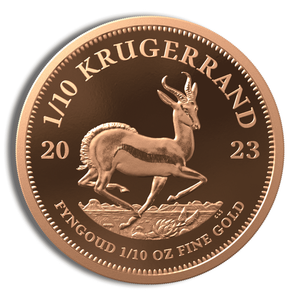
Our gold Krugerrand catalog covers the full range of sizes and formats that serious buyers are most likely looking for, from the classic 1 oz coin to fractional sizes including 1/2 oz, 1/4 oz, and 1/10 oz. You'll also find dated proof editions from 2022, 2023, and 2024, as well as the newly minted 2025 1 oz release and specialty sets such as the 2022 six-coin proof set and the 2023 two-coin Krugerrand and Big 5 Leopard proof set. All coins are struck by the South African Mint and carry the standard 91.67% gold purity that defines this series.
For buyers seeking flexibility, random-year bullion options are available in both brilliant uncirculated and circulated (cull) condition. These offer a more accessible entry point while delivering the same underlying gold content as their dated counterparts. Bullion Standard sources these coins through reputable wholesale channels and displays real-time pricing based on current spot market conditions, so you're always looking at a transparent, up-to-date number before making any purchasing decision.
Whether you're adding to an existing position or purchasing a specific dated proof for a collection, the range here is broad enough to serve both needs. Each product listing includes detailed specifications, condition disclosure, and current bid/ask pricing so you can evaluate the full transaction, not just the purchase price.
What Are Gold Krugerrands?
The Krugerrand is a gold bullion coin struck in 22-karat gold, meaning it contains 91.67% fine gold alloyed with copper to increase durability and give the coin its characteristic warm reddish-gold color. Unlike many modern bullion coins that are struck in .9999 fine gold, the Krugerrand carries a slightly lower purity but compensates with a copper alloy that makes it more resistant to wear and handling. Each coin is sized so that the total gold content remains precisely 1 troy ounce for the standard issue, with fractional denominations scaled proportionally.
Krugerrands are available in bullion and proof formats. Bullion issues are produced for the general market at higher mintages and typically trade at modest premiums above spot gold. Proof versions are struck to a higher standard using polished dies and specially prepared blanks, resulting in mirror-like fields and frosted design elements. Proof coins carry higher premiums and are often issued in limited quantities with Certificates of Authenticity, making them appealing to collectors and numismatic buyers alongside traditional bullion buyers.
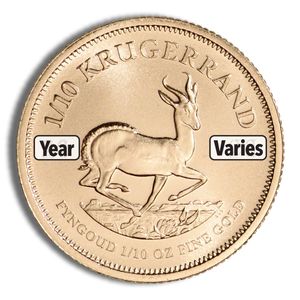
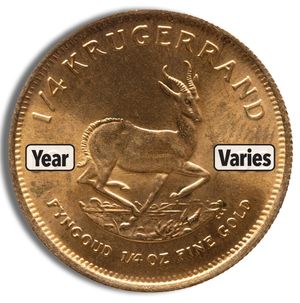
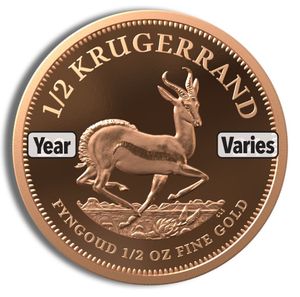
The fractional lineup, covering 1/2 oz, 1/4 oz, and 1/10 oz denominations, is produced to the same design and purity standard as the full ounce coin. Fractionals typically carry higher per-ounce premiums due to the increased cost of production relative to gold content, but they offer accessible denomination flexibility for buyers who prefer smaller unit sizes.
History and Background
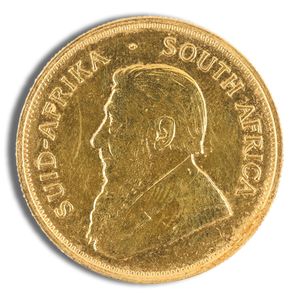
The Krugerrand was introduced in 1967 by the South African Mint in partnership with the Chamber of Mines of South Africa. Its purpose was to make ownership of gold accessible to private buyers by creating a coin whose legal tender value was tied directly to the prevailing gold price rather than a fixed face value. The name combines "Kruger," honoring Paul Kruger, the Boer statesman whose portrait appears on the obverse, with "rand," South Africa's currency. The reverse carries the springbok antelope, a national symbol designed by Coert Steynberg.
Through the 1970s, the Krugerrand dominated the global gold coin market and is widely credited with creating the modern bullion coin industry. Its commercial success directly influenced other sovereign mints to develop their own programs, including the Canadian Maple Leaf in 1979, the American Gold Eagle in 1986, and the Australian Gold Nugget series beginning in the same decade. By the early 1980s, Krugerrands accounted for the majority of all gold coin sales worldwide, a market position that established the format as a global standard for tradeable one-ounce gold coins.
Political conditions during the 1980s led to trade restrictions in several Western markets, which temporarily reduced their circulation in the United States and Europe. Those restrictions were lifted after 1994, and the Krugerrand has since remained a consistently traded and recognized gold coin in the global wholesale market. Proof editions and special sets have expanded the program over the decades, adding collector appeal alongside the core bullion series that continues to be minted annually by the South African Mint in Pretoria.
Purity, Weight, and Specifications
Standard bullion Krugerrands carry a gold purity of .9167, which corresponds to 22 karats. The 1 oz coin measures 32.77 mm in diameter and 2.84 mm in thickness. Fractional coins scale accordingly: the 1/2 oz measures 27.07 mm in diameter, the 1/4 oz comes in at 22.06 mm, and the 1/10 oz is 16.55 mm across with a thickness of 1.35 mm. Total gold content in troy ounces is consistent across the series for each denomination. The 2023 two-coin Buffalo set carries a purity of .9999, reflecting the different specifications of the Big 5 series coin included in that set.
Troy ounce is the standard unit of measurement across the global gold market and differs slightly from the avoirdupois ounce used in everyday commerce. One troy ounce equals 31.1035 grams. All gold content figures on Krugerrand products are expressed in troy ounces, which is consistent with industry-wide practice for bullion coins and bars. Buyers should confirm they're comparing products using troy ounce figures when evaluating per-ounce premiums.
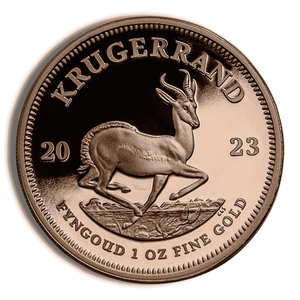
Proof versions of the Krugerrand are struck from the same purity alloy as bullion issues but are produced using a more refined minting process, typically with multiple strikes on polished planchets. The 2022 and 2023 proof coins available here carry the standard 1 oz gold content and the same 32.77 mm diameter as the standard bullion issue. Proof sets often include a Certificate of Authenticity and specialized presentation packaging, which is noted in the individual product listings.
Available Brands, Mints, and Product Variations
Every Krugerrand in our catalog is struck by the South African Mint, the official state mint of South Africa located in Pretoria. The South African Mint operates under the South African Reserve Bank and has been producing Krugerrands since the coin's debut in 1967, giving it a track record and production consistency that is well recognized across the global wholesale bullion market. Mint-struck coins carry the guarantee of the issuing government through the mint's standards, and the Krugerrand specifically carries no face value denomination, meaning its legal tender recognition is tied to its gold content rather than a fixed monetary figure.
The bullion lineup includes random-year coins in both BU and cull condition. Random-year BU coins are brilliant uncirculated examples that have not been matched to a specific production year and are typically sourced from existing wholesale inventory. Cull coins, sometimes referred to as "impaired condition," carry full gold content but show visible wear or surface marks from prior circulation or handling. These are priced accordingly and represent the most cost-efficient option for buyers focused purely on gold content. Dated BU options include the 2024 and 2025 1 oz releases for buyers who prefer a specific production year.
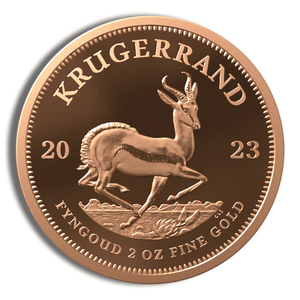
Proof and specialty sets expand the catalog significantly. The 2022 six-coin proof set totals 1.92 oz of gold and includes the full fractional range in proof finish with box and Certificate of Authenticity. The 2023 lineup includes a standalone 2 oz proof, a 1 oz proof, a 1/10 oz proof, and two separate two-coin sets combining the Krugerrand with coins from the Big 5 series. These sets are produced in limited quantities and come with presentation packaging, making them distinctly different in character from standard bullion issues. Coin type, finish, and packaging details are clearly listed on each product page.
Pricing, Premiums, and Market Factors
Krugerrand pricing follows spot gold, which fluctuates continuously based on trading activity across global markets including the London Bullion Market Association, COMEX futures, and over-the-counter wholesale channels. The premium above spot reflects production costs, mint fees, distributor margins, and market supply and demand conditions for that specific product. Bullion Krugerrands typically carry tighter premiums than proof or specialty set versions, and random-year coins often carry the tightest spreads within the series.
Fractional coins carry higher per-ounce premiums than the 1 oz standard. This is a consistent feature of the global bullion market and reflects the fixed costs associated with producing smaller coins. The 1/10 oz denomination will carry the highest per-ounce premium of the four standard sizes, while the 1/2 oz sits closer to the full ounce in terms of premium efficiency. Proof coins carry additional premiums that reflect limited mintage, presentation quality, and collector demand, which can be substantially higher than the bullion equivalent. Specialty sets including multiple coins are priced to reflect their combined gold content plus the premium associated with the proof finish and accompanying packaging.
Bullion Standard displays pricing in real time with both the ask price you'll pay and the bid price the market will support on the sell side. This bid/ask spread is visible on each product page and gives you a transparent view of the complete transaction before any purchase is made. Premiums and spreads shift as wholesale market conditions change, and our pricing is structured to reflect those conditions directly rather than applying a static retail markup. Buyers who want the most current picture of how Krugerrand premiums are trending relative to the broader gold market can reference the market intelligence tools available through the platform.
Condition, Packaging, and What to Expect
Standard bullion Krugerrands are typically shipped in protective tubes. The 1 oz coins ship in tubes of ten, the 1/2 oz in tubes of fifteen, and both the 1/4 oz and 1/10 oz come in tubes of fifty. Random-year coins will not be matched to a specific year and are selected from available inventory at the time of fulfillment. If year-specific coins matter to you, dated options are the appropriate choice. Cull coins are sold as-is with full disclosure of their impaired condition, and buyers should expect visible wear, surface marks, or cosmetic irregularities. They are verified for authenticity and gold content before shipping.
Proof coins and sets ship in their original presentation packaging, including boxes and Certificates of Authenticity where specified in the product listing. These items are handled with additional care during fulfillment to preserve the packaging integrity. Any proof coin with a specific finish designation such as "Proof" reflects a distinct minting process from the standard BU bullion coins and will show mirror-like fields and frosted design relief that is clearly visible to the eye.
All orders are shipped with appropriate insurance and secure packaging based on the product type and total order value. Tracking information is provided at the time of shipment. Coins are not individually graded or slabbed unless otherwise specified. If you receive a product that does not match the condition described in the listing, Bullion Standard's customer service team is available to address the issue promptly.
Authenticity and Verification
Every Krugerrand sold through Bullion Standard is sourced from reputable mints, authorized distributors, and vetted wholesale channels. Products are inspected and verified before they reach our customers, which includes confirmation of authenticity, gold content, and physical condition consistent with the product's listed grade. We do not sell products of uncertain origin, and our sourcing standards reflect the expectations of an NCBA-member dealer committed to product integrity.
The Krugerrand itself incorporates a range of anti-counterfeiting features that have evolved over the coin's production history. The reeded edge, precise dimensions, and copper alloy composition all contribute to characteristics that are difficult to replicate accurately. Proof issues include additional security elements associated with their specialized production process. For buyers who want additional peace of mind, coins can be submitted to PCGS or NGC for independent third-party grading and encapsulation. Bullion Standard is an authorized dealer for both services and can provide guidance on the submission process.
Buyers receiving random-year coins should not expect COA documentation, as these are standard bullion products sourced from wholesale inventory rather than directly from the mint. Proof sets and dated proof issues include original mint documentation where specified in the product listing. The presence or absence of a Certificate of Authenticity is disclosed clearly in each product description.
Liquidity and Resale Considerations
The Krugerrand is one of the most widely traded gold coins in the world and carries strong recognition across global dealer networks, wholesale markets, and secondary market channels. Its long production history, standardized specifications, and consistent gold content make it straightforward to evaluate and price at the point of resale. Dealers in virtually every major market are familiar with the coin, which reduces friction when it's time to sell.
Standard 1 oz bullion coins in BU condition are generally the most liquid format within the series. Fractional denominations are also well-recognized but may carry slightly wider spreads at the point of resale due to the smaller individual gold content. Proof coins and specialty sets tend to trade in a narrower market that overlaps with numismatic buyers and collectors, and their resale value reflects both the gold content and the collector premium at the time of sale, which can be variable. Understanding where each format sits within the broader liquidity spectrum is worth considering before purchase.
Cull or circulated coins are also tradeable and widely accepted by dealers at prices that reflect their gold content rather than any numismatic premium. Their resale path is typically the most straightforward of all formats because condition expectations are already established and pricing is almost entirely gold-content-driven. Random-year coins resell in the same manner as cull or standard BU coins depending on their condition, with no year-specific premium applied in most resale scenarios.
Storage and Security
Coins stored in their original tubes should remain in that packaging whenever possible. Removing coins from tubes unnecessarily increases the risk of surface contact and handling marks that can affect condition over time. For long-term storage, a dedicated fireproof safe with appropriate capacity is the most practical home solution. Safes should be bolted down if possible and kept in a location not immediately obvious to others.
Bank safe deposit boxes provide an additional layer of physical security but do not carry FDIC insurance protection, so separate insurance coverage is worth arranging for holdings of meaningful size. Third-party vault services offer an alternative for buyers who prefer professional-grade storage with full insurance, audit trails, and segregated or allocated storage options. These services vary in cost and structure, and Bullion Standard can provide general guidance on what to look for when evaluating them.
Environmental conditions matter for long-term preservation. Gold is chemically stable and resistant to tarnish, but copper-alloyed coins like the Krugerrand can develop surface discoloration over time if exposed to humidity, sulfur, or acidic environments. Silica gel packets inside a sealed container can help manage humidity in home storage environments. Proof coins in their presentation boxes should be stored in a stable, low-humidity environment to preserve both the coin surfaces and the packaging.
Selling and Buyback Options
Bullion Standard operates as a two-way market, meaning we actively purchase Krugerrands alongside selling them. Our buyback pricing is competitive and based on current wholesale bid levels rather than arbitrary below-market offers. The bid price displayed on each product page reflects what the market is currently supporting on the sell side, giving you a realistic picture of resale value before you commit to a purchase. This transparency is central to how we operate.
When you're ready to sell, the process begins by contacting our purchasing team to lock in a price based on current market conditions. Products are then shipped to our facility using an insured and trackable method, inspected upon arrival to verify authenticity and condition, and payment is processed based on the agreed buyback price. Condition and packaging both factor into the final assessment, which is why holding coins in their original tubes and minimizing unnecessary handling can make a difference at the time of resale.
Proof coins and specialty sets are evaluated on a case-by-case basis because their value includes both the underlying gold content and any collector premium. Coins with original box and COA in good condition will generally command a stronger buyback offer than those missing presentation materials. For standard bullion Krugerrands in BU or cull condition, the process is more straightforward and pricing is closely tied to the current gold spot price and prevailing market premiums.
Why Buy Gold Krugerrands?
The Krugerrand's primary appeal comes down to global recognizability and a long track record as one of the most standardized gold coins ever produced. Dealers worldwide are familiar with the coin's specifications, which simplifies both the purchasing and selling process compared to less widely traded formats. For buyers who prioritize liquidity and market access, that recognition carries real practical value.
The 22-karat alloy composition, while lower in purity than coins like the Canadian Maple Leaf or American Gold Buffalo, results in a physically harder coin that is more resistant to the surface wear that comes with handling and storage. For buyers who plan to handle their coins regularly or store them in less controlled environments, the copper alloy provides a degree of durability that pure gold coins don't offer. This is particularly relevant for bullion buyers who treat their coins as a physical holding rather than a display piece.
The fractional lineup adds meaningful flexibility to the series. Buyers who want exposure to gold at a smaller unit size, whether for easier future partial liquidation or simply a lower initial outlay per transaction, can access the same Krugerrand series in four standard denominations. The availability of proof and specialty sets within the same series gives both bullion buyers and numismatic collectors a path within a single, well-established product family.
Why Buy from Bullion Standard?
Bullion Standard was founded in 2010 and has grown into a nationally recognized precious metals marketplace built around a straightforward principle: buyers deserve clear pricing, honest product descriptions, and a purchasing experience that doesn't require them to push back against sales pressure. Every part of our platform reflects that approach, from real-time bid/ask pricing to condition disclosures that set accurate expectations before a purchase is confirmed.
Our sourcing standards are consistent with those of an A BBB-rated dealer that is also a member of the American Numismatic Association and the National Coin and Bullion Association. Coins are verified for authenticity and condition before they're fulfilled, and our status as an authorized dealer for both PCGS and NGC means we can support buyers who want independent third-party certification. Payment options are broad, covering major credit cards, PayPal, bank-connected payments through Plaid, wire transfer, check, and cryptocurrency through BitPay.
The two-way market structure is a meaningful differentiator. Because we're actively buying and selling within the same ecosystem, we have a direct operational interest in pricing that works fairly on both sides of the transaction. That creates a different dynamic than a traditional retail-only dealer model and supports the kind of long-term customer relationships our business is built around. Our goal is always to help buyers make better decisions, not just to close a transaction.
Get Near-Spot Pricing with Bullion Standard Pro
Bullion Standard Pro is designed for buyers who want access to executable wholesale pricing rather than standard retail premiums. Members transact at live wholesale bid and ask prices that reflect real-time supply and demand conditions in the broader bullion market. There are no additional dealer markups applied on top of those prices, which means premiums and spreads move naturally with market conditions rather than being fixed at a retail level.
For buyers purchasing Krugerrands regularly or in larger quantities, the pricing efficiency available through Pro can represent a meaningful difference in acquisition cost per ounce. The platform also provides access to historical premium data, spread analysis, and liquidity metrics that allow you to evaluate how Krugerrand pricing has behaved over time relative to current conditions. This kind of context is difficult to access through most retail channels and makes it easier to evaluate whether current premiums are elevated or compressed compared to historical norms.
Portfolio valuation through Bullion Standard Pro uses live wholesale bid pricing rather than estimated retail values, giving members a clearer picture of actual liquidation value at any point in time. Combined with the platform's market intelligence tools and real-time analytics, this creates a more informed purchasing and holding environment for anyone who takes a data-oriented approach to physical gold ownership.

 (833) 278-4653