Buy Austrian Gold Philharmonic Coins Online
Our catalog of Austrian gold Philharmonic coins covers the full range of sizes produced by the Austrian Mint, from the flagship 1 oz coin down to the 1/10 oz, 1/4 oz, 1/2 oz, and the compact 1/25 oz fractional. Every coin listed here is graded Brilliant Uncirculated and ships in random year format, giving buyers access to one of the most recognized gold coin programs in the world at competitive premiums relative to size.
Bullion Standard is a San Diego-based precious metals marketplace committed to transparent pricing and straightforward transactions. Whether you're adding a full ounce to an existing position or exploring fractional sizes for the first time, the pricing on each product page reflects real-time market conditions with no hidden markups layered into the experience.
The Austrian Mint's Philharmonic program has been a consistent presence in the global gold coin market since 1989, and our sourcing reflects that continuity. Every coin in this section comes verified for weight, purity, and authenticity before it reaches our fulfillment process.
What Are Austrian Gold Philharmonic Coins?
Austrian gold Philharmonic coins are government-issued gold bullion coins produced by the Austrian Mint, the official national mint of Austria, under authorization from the Republic of Austria. They carry legal tender status denominated in euros and are struck to a purity of .9999 fine gold, making them among the purest gold coins produced by any sovereign mint in the world.
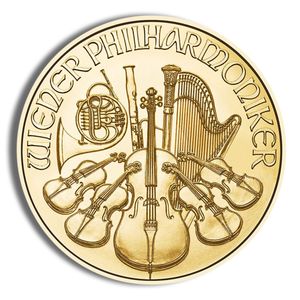
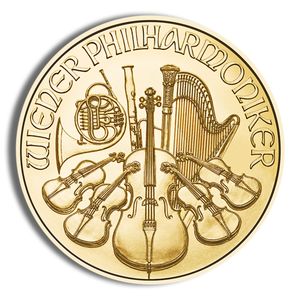
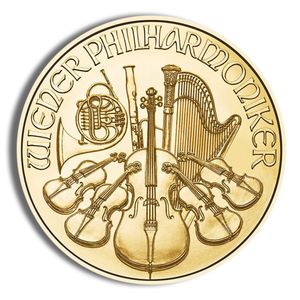
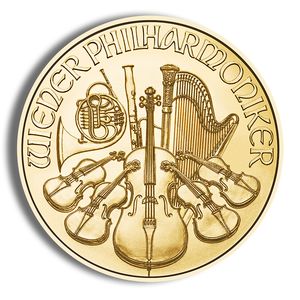
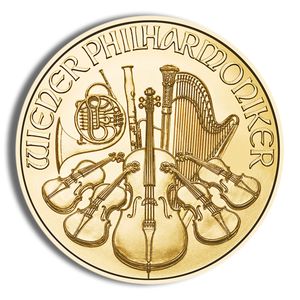
The Philharmonic design is uniform across all sizes and features the pipe organ of the Vienna Musikverein on the obverse and a collection of orchestral instruments, including the Vienna horn, cello, harp, bassoon, and violin, on the reverse. This consistent iconography makes the coins immediately recognizable regardless of size, which contributes to their global trading familiarity.
Fractional sizes serve buyers who want exposure to .9999 fine gold without committing to a full troy ounce at once. The 1/2 oz, 1/4 oz, 1/10 oz, and 1/25 oz denominations all carry the same purity as the 1 oz version, though premiums per troy ounce tend to increase as coin size decreases due to the fixed costs associated with minting smaller pieces. For buyers who prioritize cost efficiency per ounce, the 1 oz remains the most competitively priced option in this series.
History and Background
The Austrian Mint, known in German as the Münze Österreich, has operated in Vienna for over 800 years, making it one of the oldest continuously operating mints in the world. While its history in coinage stretches back centuries, the gold Philharmonic coin program launched in 1989 as part of a broader wave of sovereign gold bullion programs introduced globally during the 1980s, a period that saw governments recognize growing private demand for standardized, government-backed gold products.
The Philharmonic became the first euro-denominated gold coin and quickly established itself as the best-selling gold coin in Europe. Its introduction gave European buyers a domestically issued alternative to coins like the South African Krugerrand and the American Gold Eagle, both of which had dominated the global bullion market throughout the previous decade. The Austrian Mint's commitment to .9999 purity set the Philharmonic apart from many contemporaries, which were struck at .9167 or .9990 fineness.
The program expanded over time to include the fractional denominations now available, accommodating a wider range of buyers. In 2014, the Austrian Mint also introduced a 1/25 oz version, the smallest in the series, which broadened accessibility further. Today the gold Philharmonic is distributed through authorized dealers globally and remains one of the most liquid gold coin formats in the international bullion market.
Purity, Weight, and Specifications
All Austrian gold Philharmonic coins, regardless of denomination, are struck at .9999 fine gold, equivalent to 24 karat gold. This places them alongside other high-purity coins like the Canadian Gold Maple Leaf and the Chinese Gold Panda in terms of fineness, and above the .9167 purity standard used for coins like the American Gold Eagle and South African Krugerrand.
The coin weights in our catalog follow the troy ounce standard used throughout the global precious metals market. The 1 oz coin contains exactly one troy ounce of gold, or approximately 31.1 grams. The 1/2 oz contains 0.5 troy oz, the 1/4 oz contains 0.25 troy oz, the 1/10 oz contains 0.1 troy oz, and the 1/25 oz contains 0.04 troy oz of .9999 fine gold. The face values are denominated in euros, with the 1 oz coin carrying a face value of 100 euros, though the actual market value of each coin is determined by gold spot prices and applicable premiums rather than the nominal face value.
Each coin features the denomination, gold content, and purity clearly marked within the design, which contributes to straightforward verification. The Austrian Mint does not include assay cards or individual certificates with standard bullion-grade Philharmonic coins, but the consistent specifications across decades of production make these coins widely recognizable to dealers and buyers throughout the global market.
Available Brands, Mints, and Product Variations
Every Austrian gold Philharmonic coin in our catalog is produced exclusively by the Austrian Mint in Vienna. Unlike some bullion products that are available from multiple refineries or mints under different brand names, the Philharmonic is a proprietary program, and the Austrian Mint is the sole authorized producer. This exclusivity is part of what gives the coin its consistent quality profile and global recognition.
The five sizes currently available include the 1 oz, 1/2 oz, 1/4 oz, 1/10 oz, and 1/25 oz, all graded Brilliant Uncirculated and offered in random year format. Random year means you'll receive a coin from the Austrian Mint's production run within the years we have in inventory, which may vary. The condition is consistent across the selection, and random year products are a standard format in the bullion market for buyers prioritizing metal content and cost efficiency over a specific issue year.
BU, or Brilliant Uncirculated, indicates the coin has not been placed into circulation and retains its original mint luster. These are not proof coins, which are struck using polished dies for a collector-grade mirror finish and typically carry significantly higher premiums. The BU format is the standard for bullion-grade Philharmonics and is the format most commonly traded in the wholesale and retail gold markets.
Pricing, Premiums, and Market Factors
The price of any gold Philharmonic coin is determined by two components: the current spot price of gold and the premium above spot charged by the dealer. Spot price moves continuously during market hours based on global trading activity across futures exchanges, over-the-counter markets, and wholesale bullion networks. The premium reflects the costs associated with minting, distribution, and dealer operations, and it varies across coin sizes.
Premiums on the 1 oz Philharmonic are generally among the tightest available for any government-issued gold coin, reflecting the high production volume of this program and the deep global market for the coin. Fractional sizes carry higher premiums per troy ounce because the fixed cost of manufacturing is distributed across a smaller gold content. The 1/25 oz coin, for example, carries a noticeably higher premium per ounce than the 1 oz version, which is consistent with fractional pricing across the broader bullion market.
Bullion Standard's pricing updates in real time to reflect current market conditions. Each product page also displays the bid/ask spread, which gives buyers a transparent view of both the purchase price and the expected buyback value at current market levels. Understanding both sides of the transaction, not just the ask price, is central to how we believe gold should be bought and evaluated.
Condition, Packaging, and What to Expect
Austrian gold Philharmonic coins in Brilliant Uncirculated condition arrive with their original mint luster intact. Because these are bullion-grade coins rather than proof issues, they are not individually encapsulated in presentation boxes. Standard bullion Philharmonics are typically shipped in tubes, with the 1 oz coins packaged 10 per tube, though individual coins may be shipped in protective coin flips or sleeves depending on the order quantity and fulfillment format.
Because these are random year products, buyers should expect any year within the available inventory range. The year of issue does not affect the gold content or purity in any way, and random year bullion is a widely accepted and standard format for buyers focused on metal content rather than year-specific collecting. The Austrian Mint's quality control is consistent across all annual productions.
Minor surface marks, handling lines, or bag marks may be present on BU coins, particularly those that have been stored in tubes or handled during packaging. This is normal for bullion-grade coinage and does not indicate a defect or a reduction in gold content. Buyers seeking coins with pristine surfaces and no visible contact marks should consider proof-grade issues, which are produced and packaged specifically for that purpose and are available separately.
Authenticity and Verification
The Austrian Mint employs several production-level features that make genuine gold Philharmonic coins difficult to replicate accurately. The coin's fine detail work, including the intricate rendering of orchestral instruments on the reverse and the pipe organ on the obverse, requires precision die work that is not easily reproduced at the quality level of the original. Edge reeding patterns, coin diameter, thickness, and weight are all tightly controlled to mint specification.
Counterfeiting gold coins at full weight with genuine .9999 fine gold content is economically impractical, though lower-quality counterfeits using base metals exist in the market. Common verification methods include precise weight measurement using a calibrated scale, diameter and thickness checks with a caliper, and magnetic testing, since gold is not magnetic. More advanced methods such as ultrasonic thickness testing and X-ray fluorescence analysis are used by professional dealers and grading services for high-value transactions.
Every product sold through Bullion Standard is sourced from reputable mints, authorized distributors, and established wholesale networks, and is verified for authenticity, weight, and purity before fulfillment. Bullion Standard is an authorized dealer for both PCGS and NGC, holds an A rating with the Better Business Bureau, and is a member of the American Numismatic Association and the National Coin and Bullion Association. These affiliations reflect our commitment to operating within the highest professional standards of the industry.
Liquidity and Resale Considerations
The Austrian gold Philharmonic is one of the most actively traded gold coins in the world, which translates directly into broad dealer recognition and straightforward resale. Any established precious metals dealer, coin shop, or bullion exchange is familiar with the coin's specifications, making it relatively simple to obtain competitive offers when it's time to sell. This recognition is a practical advantage over lesser-known private mint products, which may require more effort to find a buyer willing to pay close to melt value.
Liquidity tends to be strongest for the 1 oz size because it represents the largest single unit of gold content and sees the highest trading volume. Fractional sizes are also widely recognized and traded, though the market for them can be slightly thinner at any given moment. Coins in original condition and original packaging, where applicable, generally receive better offers than coins that show significant wear or have been separated from their tubes or capsules.
Bullion Standard operates as a two-way market, meaning customers can both purchase and sell within the same platform. Buyback pricing is competitive and tied to live market conditions. We believe liquidity is a factor that should be understood before a purchase is made, not only when it's time to exit a position.
Storage and Security
Gold Philharmonic coins, like all physical gold, require secure and environmentally stable storage. Gold itself is chemically inert and resistant to tarnish, but the coins can develop surface marks from handling or contact with other metals and materials. Storing coins individually in protective capsules or in their original tubes helps preserve their condition over time.
For home storage, a quality fireproof safe that is bolted to a structural surface provides a reasonable baseline of security. The weight and cost of a full ounce gold coin collection makes secure storage a practical priority, not just a preference. For larger holdings, third-party vault services and bank safe deposit boxes offer additional layers of security and may provide insurance coverage that home safes do not.
Fractional coins, including the 1/10 oz and 1/25 oz Philharmonics, are small enough that they can be easy to misplace if not stored carefully. Keeping fractionals in labeled tubes, capsules, or a dedicated coin storage box reduces the risk of loss and makes inventory management more straightforward over time. Avoid storing gold coins in environments with high humidity, direct sunlight, or temperature fluctuations, as these conditions can affect packaging and long-term coin presentation.
Selling and Buyback Options
Selling Austrian gold Philharmonic coins back into the market is generally a straightforward process given the coin's global recognition. Buyback pricing from any dealer, including Bullion Standard, is based on current gold spot prices adjusted for applicable dealer margins and current market demand. The bid price displayed on each Bullion Standard product page reflects what we are actively paying for that coin at current market conditions.
Factors that influence the buyback price include the gold content of the specific coin being sold, its condition, whether original packaging is present, and current market liquidity. Coins in BU condition that retain their original packaging and show no significant damage will typically receive the most competitive pricing. Coins that have been cleaned, polished, or show substantial wear may be evaluated differently, though for standard bullion transactions the primary driver remains gold content and spot price.
Bullion Standard's purchasing team handles buyback transactions with the same transparency applied to purchases. Our two-way market structure means customers can obtain a buyback quote within the same platform they used to buy, without needing to seek out a separate dealer or navigate an unfamiliar process. Detailed information on initiating a sale is available through our customer service team and website resources.
Why Buy Austrian Gold Philharmonic Coins?
The gold Philharmonic's primary appeal in the bullion market comes from its combination of government backing, high purity, and global recognizability. As a legal tender coin issued under Austrian law, it carries the credibility of a sovereign issuer alongside the Austrian Mint's long-standing reputation for precision manufacturing. The .9999 fineness is a meaningful differentiator for buyers who prioritize maximum gold purity in the coins they hold.
The range of available sizes adds practical flexibility. A buyer who wants the most cost-efficient form of gold content per dollar spent will generally find the 1 oz coin to be the best option within this series. Buyers who prefer to acquire gold in smaller increments, whether for gifting, portfolio segmentation, or simply managing purchase size, can do so through the 1/2 oz, 1/4 oz, 1/10 oz, or 1/25 oz options without sacrificing purity or recognizability.
The Philharmonic's consistent design across decades of production also means buyers and dealers around the world know what to expect when they see one, which supports straightforward transactions on both the buy and sell side. For buyers who want a standardized, high-purity gold coin from a respected sovereign mint with a long production history, the Philharmonic is one of the most established options in the global bullion market.
Why Buy from Bullion Standard?
Bullion Standard was founded in 2010 and has grown into a nationally recognized online precious metals marketplace built around transparency, honest pricing, and long-term customer relationships. We operate on the principle that trust in this industry is earned through consistent, straightforward conduct, not marketing language. That philosophy shapes how we price products, source inventory, and interact with customers before and after a transaction.
Every Austrian gold Philharmonic coin sold through our platform has been verified for authenticity, weight, and purity before reaching our fulfillment process. We source from reputable mints, authorized distributors, and established wholesale channels, and our A Better Business Bureau rating, ANA membership, and NCBA membership reflect the professional standards we hold ourselves to. Our status as an authorized dealer for both PCGS and NGC further reinforces our commitment to product authenticity and industry accountability.
Our checkout process supports a wide range of payment methods, including Visa, Mastercard, American Express, Discover, PayPal, bank-connected payments through Plaid, wire transfer, paper check, and cryptocurrency through BitPay. Fulfillment is handled with care and reliability, and our customer service team is accessible for pre-purchase questions, order support, and post-purchase assistance. Our goal is to make the experience of buying physical gold feel more like a transparent marketplace and less like a high-pressure sales environment.
Get Near-Spot Pricing with Bullion Standard Pro
Bullion Standard Pro is designed for buyers who want direct access to wholesale-level pricing without the markups typically built into the traditional retail dealer model. Members gain access to live, executable bid and ask pricing that reflects real-time conditions in the wholesale precious metals market. For products like the 1 oz gold Philharmonic, where tight spreads are particularly meaningful at scale, this can represent a measurable difference in acquisition cost compared to standard retail pricing structures.
The platform does not apply additional dealer markups or fixed retail spreads to member pricing. Instead, premiums and bid/ask spreads fluctuate naturally based on real-time supply and demand in the wholesale market, giving members a more accurate view of how products are actually priced and traded at the institutional level. Portfolio holdings are valued using live executable wholesale bid pricing, which provides a more realistic picture of current liquidation value than estimated retail valuations.
Beyond pricing efficiency, Bullion Standard Pro provides members with access to proprietary analytics including historical premium analysis, spread tightness metrics, liquidity indicators, premium percentile rankings, and market sentiment tools. These resources are designed to help buyers evaluate products like Austrian gold Philharmonic coins using objective market data rather than assumptions or marketing claims. For buyers who transact frequently or hold meaningful positions in physical gold, the combination of near-spot pricing and institutional-grade market intelligence represents a meaningful advantage within the physical precious metals market.

 (833) 278-4653