American Gold Eagles | Bullion Standard
Buy American Gold Eagles Online
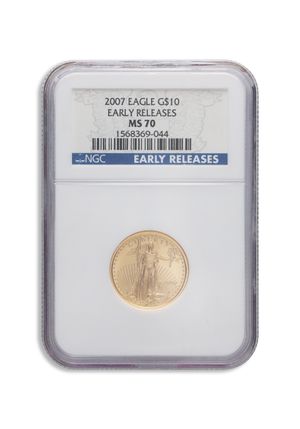
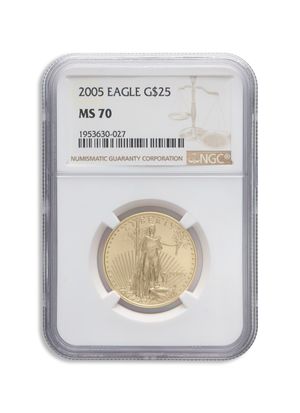
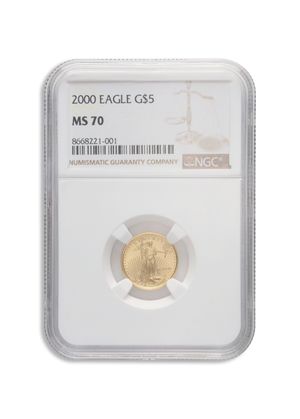
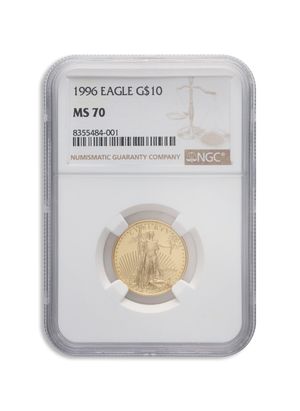
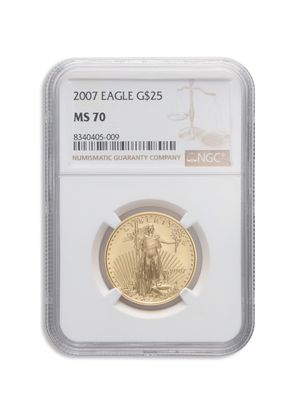
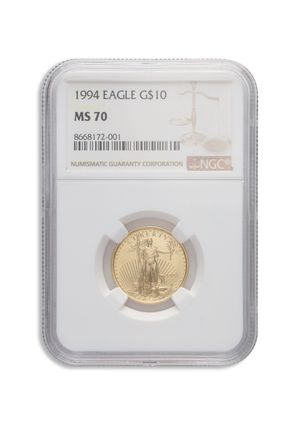
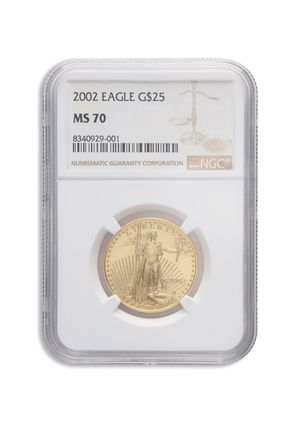
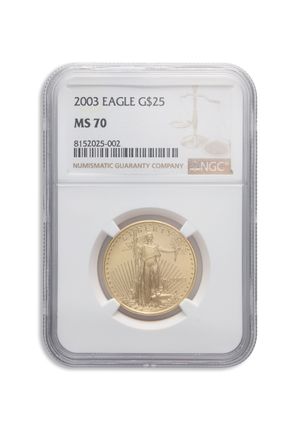
Our catalog of American gold eagles spans the full range of weights, grades, finishes, and years that collectors and bullion buyers actively seek. You'll find the classic 1 oz bullion coin in brilliant uncirculated condition alongside fractional denominations in 1/2 oz, 1/4 oz, and 1/10 oz sizes, giving you flexibility across budget levels and accumulation strategies. Proof issues with original U.S. Mint packaging and certificates of authenticity are also represented, as are professionally graded examples certified by NGC and PCGS in grades ranging from MS69 to MS70 and PF70.
The catalog also includes random year options for buyers who prioritize gold content over specific date selection, as well as circulated or impaired-condition coins for those focused purely on melt value. Year-specific coins stretch back to the inaugural 1986 issue, with strong representation through the early years of the series. At Bullion Standard, every listing reflects current market conditions and is priced with the transparency that defines how we operate across the entire platform.
What Are American Gold Eagles?
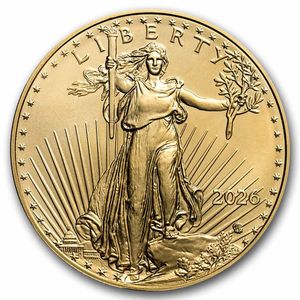
American gold eagles are official legal tender gold coins produced by the United States Mint, authorized under the Gold Bullion Coin Act of 1985. Each coin contains 22-karat gold alloyed with copper and silver to improve durability, giving the coin its characteristic warm tone. The alloy composition results in a coin that contains exactly the stated weight of fine gold, with total coin weight slightly higher to account for the alloying metals. The $50 face value on the 1 oz coin, $25 on the half-ounce, $10 on the quarter-ounce, and $5 on the tenth-ounce reflect their legal tender status, though their actual transaction value tracks closely with the gold spot price.
The series is produced in two primary finish types. Bullion strikes are intended for the general market and are distributed through authorized purchasers rather than sold directly by the Mint. Proof versions are minted with polished dies and are sold directly by the U.S. Mint, typically with original packaging and a certificate of authenticity. The distinction matters when comparing premiums, as proof coins typically carry a higher premium reflecting their specialized production process and collector presentation.
Buyers choose american gold eagles for reasons that range from ease of resale to familiarity within the domestic market. They're among the most widely recognized gold coins in the world, which translates to practical liquidity advantages. Fractional sizes make the series accessible at lower per-transaction price points while maintaining the same purity and government-backed origin as the full-ounce version.
History and Background
The american gold eagle program launched in 1986, the same year the Gold Bullion Coin Act came into effect. The legislation was partly a response to demand from American investors who lacked a domestically produced gold bullion coin to compete with internationally popular issues like the South African Krugerrand and the Canadian Maple Leaf. From the outset, the program was designed to use gold mined in the United States, a requirement that has remained part of the program's identity since its inception.
The coin's design draws from American numismatic tradition. The obverse features a full-length depiction of Liberty adapted from Augustus Saint-Gaudens' iconic design originally used on the $20 Double Eagle gold coin from 1907 to 1933, while the reverse carries a family of eagles image created by sculptor Miley Busiek. These design choices connected the new bullion program to a longer history of American gold coinage rather than presenting it as a purely modern product. In 2021, the U.S. Mint introduced a redesigned reverse featuring a close-up portrait of an eagle, which now appears on current-year bullion and proof issues.
Proof versions have been produced since 1986, with early proof coins struck at the Philadelphia Mint and later production shifting entirely to West Point. The series has expanded and contracted over the decades based on market demand and Mint production priorities. Certain years carry lower mintage figures that make them more notable to date collectors, while high-demand years like the early 1990s and post-2008 period saw elevated production volumes that reflect broader market interest in gold at those times.
Purity, Weight, and Specifications
American gold eagles are produced in a 22-karat gold alloy with a fineness of 0.9167, meaning each coin contains 91.67% pure gold by weight. The remaining alloy consists of copper and a small amount of silver, which gives the coin its distinctive color and makes it more resistant to surface abrasion than pure gold coins. The fine gold content in each coin matches the denomination exactly: 1 troy ounce of gold in the $50 coin, 0.5 troy oz in the $25 coin, 0.25 troy oz in the $10 coin, and 0.1 troy oz in the $5 coin.
Physical dimensions vary by denomination. The 1 oz coin measures 32.7 mm in diameter and 2.87 mm in thickness. The half-ounce coin has a 27 mm diameter, the quarter-ounce measures 22 mm, and the tenth-ounce is the smallest at 16.5 mm in diameter. These dimensions are consistent across most years of production, though minor variations in thickness appear in some early-year coins, as reflected in catalog data for certain 1986 and 1987 issues. Mint packaging for bullion strikes comes in tubes of 20 coins for the 1 oz size, with outer monster box quantities of 500 coins per standard order for wholesale-level purchasing.
Available Brands, Mints, and Product Variations
All american gold eagle coins in our catalog are produced by the United States Mint, with striking locations at West Point (carrying the "W" mint mark) and Philadelphia (carrying the "P" mint mark, primarily on proof issues). Early bullion strikes from 1986 and 1987 were struck at West Point without a mint mark, while proof coins from the late 1980s carry the "P" mark from Philadelphia. Most bullion issues from 1992 onward carry the "W" mint mark from West Point. Random year products are designated with "Various" as the mint mark, reflecting the possibility of receiving coins from different striking years and facilities.
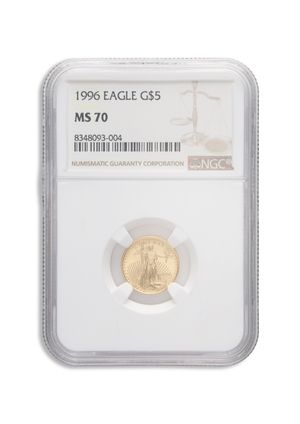
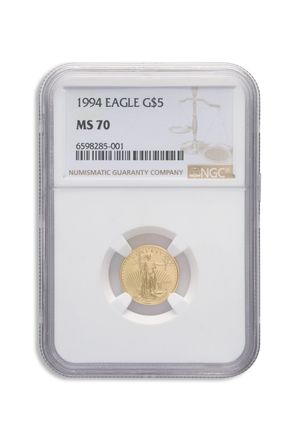
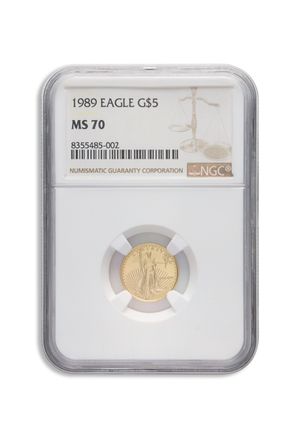
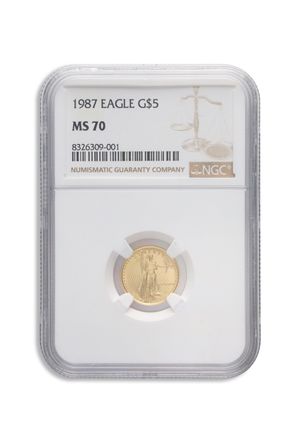
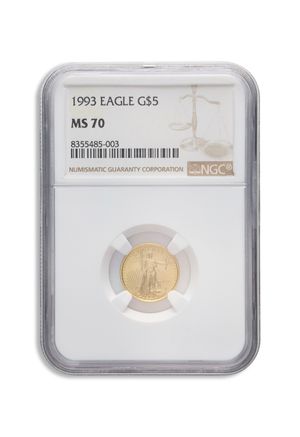
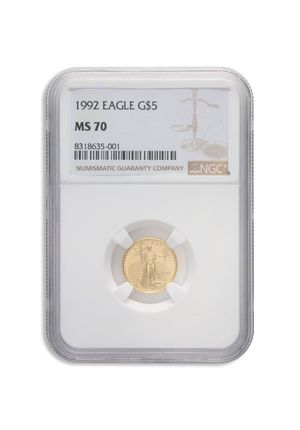
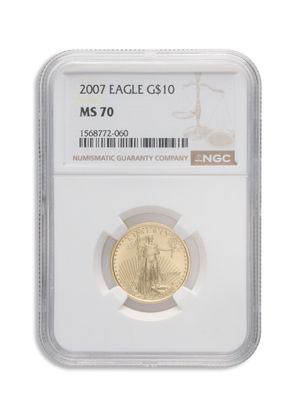
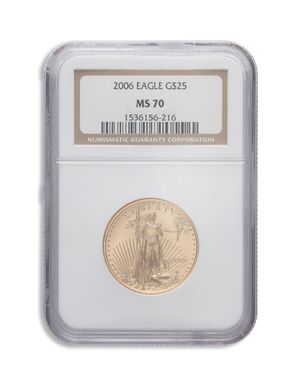
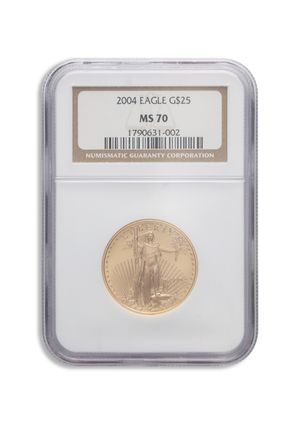
Professionally graded examples in the catalog include coins certified by both NGC (Numismatic Guaranty Company) and PCGS (Professional Coin Grading Service), two of the most respected third-party grading services in the industry. Bullion Standard is an authorized dealer for both services. Graded coins in our catalog span MS69 and MS70 for business strikes and PF70 for proof issues, representing the top end of the grading scale. Special designation labels such as the WTC Ground Zero label on certain PCGS-certified 1986 examples add historical context that some collectors specifically seek.
Set offerings also appear in the catalog, including the 1987 Two-Coin Proof Set containing the 1 oz and 1/2 oz proof coins, four-coin proof sets from 1988, 1989, and 1990 containing all four denominations, and NGC and PCGS certified versions of these sets graded PF70 or PR70. Impaired condition and circulated coins are listed separately and are clearly identified, providing options for buyers who prioritize metal content over cosmetic presentation.
Pricing, Premiums, and Market Factors
The price of any american gold eagle is determined by two components: the current spot price of gold and the premium over that spot price. Spot prices fluctuate continuously based on global trading activity across futures markets, currency movements, and macroeconomic data. Premiums layer on top of spot and are influenced by a range of factors including production costs, distribution margins, dealer inventory positions, and overall market demand at any given time.
Within the series itself, premium levels vary meaningfully by product type. Raw bullion strikes in brilliant uncirculated condition from random years tend to carry the tightest premiums in the series, as they trade as near-interchangeable gold content with minimal collector consideration. Proof coins carry higher premiums reflecting their specialized minting process and original U.S. Mint packaging. Certified coins graded MS70, PF70, or similar top-pop designations carry the highest premiums, which are driven more by collector demand and population scarcity than by gold content alone. Fractional coins generally carry higher per-ounce premiums than the full-ounce coin due to their higher per-unit production and packaging costs relative to gold content.
At Bullion Standard, pricing reflects real-time market conditions and is structured for clarity. Each product page displays both the ask price and the bid price, giving buyers a complete picture of the current bid/ask spread before committing to a purchase. This transparency is central to how we operate and allows buyers to evaluate the true cost of ownership rather than focusing on the purchase price alone. For buyers placing larger orders or those enrolled in Bullion Standard Pro, pricing efficiency improves further as access to wholesale-level market pricing becomes available.
Condition, Packaging, and What to Expect
Bullion strike american gold eagles in brilliant uncirculated condition are typically shipped in tubes of 20 coins or as individual coins, depending on the quantity ordered. Coins purchased as random year may come from any production year and may arrive in varying states of original packaging. Minor contact marks and bag marks are normal for coins that have been handled in bulk mint packaging and do not constitute damage or a reduction in the coin's bullion value. Buyers who require a specific year should select date-specific listings rather than random year products.
Proof versions with box and certificate of authenticity (COA) are packaged as originally issued by the U.S. Mint in a velvet-lined presentation case accompanied by a numbered certificate. These products are expected to arrive in complete, original presentation condition. Graded coins arrive sealed in tamper-evident plastic slabs issued by either NGC or PCGS, which serve as both the authentication and grading record for the coin. Impaired or circulated coins listed in the catalog are clearly identified as such and are sold based on gold content rather than visual presentation.
Authenticity and Verification
Authenticity is non-negotiable when dealing with government-issued gold coins. Every american gold eagle in our catalog is sourced from authorized channels including the U.S. Mint's official distribution network, reputable wholesalers, and established industry distributors. Products are verified for weight, purity, and authenticity as part of our intake and sourcing process before they become available for purchase. Bullion Standard maintains membership with the American Numismatic Association (ANA) and the National Coin and Bullion Association (NCBA), and operates as an authorized dealer for both PCGS and NGC.
Graded coins carry the additional authentication layer provided by the slab itself. PCGS and NGC use proprietary authentication processes that include physical inspection, machine verification, and population tracking. Coins sealed in tamper-evident slabs from either service have been independently verified, which provides buyers with a documented record of the coin's authenticity and grade. For ungraded bullion coins, the U.S. Mint's consistent specifications, including precise diameter, thickness, and edge reeding, provide reliable physical verification benchmarks for experienced handlers.
Counterfeiting is a real concern in any high-value commodity market, which is why sourcing from established, accountable dealers matters. Our sourcing standards prioritize documented provenance and established supplier relationships over pricing convenience. Buyers who are uncertain about coins acquired outside of a trusted dealer network should consider submitting those coins to NGC or PCGS for independent authentication before making purchasing decisions based on them.
Liquidity and Resale Considerations
American gold eagles are among the most liquid gold coins in the global bullion market. Their U.S. government origin, consistent specification, and decades-long production history make them immediately recognizable to dealers, wholesalers, auction houses, and private buyers around the world. This recognition translates into practical resale advantages when compared to lesser-known private mint products or regional issues with limited distribution histories.
The 1 oz bullion strike consistently offers the tightest bid/ask spreads within the series, as it trades closest to a commodity-like format. Fractional coins tend to carry slightly wider spreads due to their higher per-ounce premium cost basis. Proof coins and graded examples occupy a more specialized segment where resale value is influenced more by collector demand and population data than by gold spot price alone. Understanding these distinctions before purchase helps set realistic expectations about what the resale process will look like for each product type.
Bullion Standard's two-way market model is designed to make the resale process more transparent. Rather than treating buyback as an afterthought, we provide live bid pricing on product pages so buyers can see the current spread before making a purchase. This gives buyers a more complete picture of the market from both sides of the transaction before they commit.
Storage and Security
Proper storage protects both the physical condition and the long-term marketability of gold coins. For buyers holding smaller quantities, a quality home safe with fire resistance and bolt-down capability provides a reasonable starting point. Coins in mint tubes or original packaging should be kept in their original containers, as removing coins from sealed tubes or proof boxes can affect their resale presentation and, in the case of proof coins, significantly reduce buyer interest in the secondary market.
Larger holdings benefit from professional vault storage or allocated storage programs, which provide insured, segregated storage in a secure facility without the security risks associated with home storage. Bank safe deposit boxes offer an intermediate option but may limit access during banking hours and typically do not provide insurance coverage through the bank itself. For proof sets and graded coins, consistent temperature and humidity control reduces the risk of box deterioration or toning that can affect visual presentation over time. Whatever storage method is chosen, keeping coins away from direct handling, chemical exposure, and abrasive surfaces preserves both their condition and their marketability.
Selling and Buyback Options
Selling american gold eagles back into the market is straightforward compared to many other physical assets, largely because of the coin's strong recognition and standardized specifications. Dealer buyback programs, including ours at Bullion Standard, are the most direct route for most sellers. Pricing is based on the current spot price of gold plus or minus a margin that reflects the product type, condition, and current market demand. Raw bullion strikes in standard condition are typically processed quickly, while proof sets and graded coins may require additional evaluation based on completeness, slab integrity, or specific date desirability.
Condition and packaging matter during the buyback process. Proof coins with their original box and COA command better buyback terms than the same coin without original packaging. Graded coins in intact PCGS or NGC slabs retain their certification value, while cracked slabs or damaged holders may result in the coin being treated as raw bullion for pricing purposes. Impaired or circulated coins are evaluated based on gold content rather than numismatic characteristics.
Bullion Standard's buyback process is designed to be transparent and efficient. Our purchasing team uses live market pricing to calculate buyback offers, and the bid price displayed on each product page reflects current wholesale market conditions. Sellers can initiate a buyback request directly through the platform, and the process is structured to reduce the friction typically associated with liquidating physical gold through traditional dealer channels.
Why Buy American Gold Eagles?
The american gold eagle's combination of U.S. government backing, consistent specifications, and broad international recognition makes it one of the most practical gold coins for buyers who value resale accessibility. The coin's legal tender status and production under the authority of the U.S. Mint provide a level of institutional credibility that private mint products, regardless of quality, cannot replicate. This matters most when it comes time to sell, as the coin's identity is immediately verifiable and its value is not dependent on the buyer's familiarity with a particular brand or refinery.
The availability of four denominations gives buyers meaningful flexibility. The 1/10 oz coin allows entry into physical gold at a lower dollar amount per transaction, which is useful for systematic accumulation over time. The full-ounce coin offers the most efficient premium structure within the series and aligns closely with wholesale market pricing benchmarks. The half-ounce and quarter-ounce denominations fill the middle ground for buyers who want more than a fractional but aren't ready to commit to a full-ounce purchase per transaction.
Collector appeal within the series adds another dimension. The transition from Roman numeral date inscriptions in the early years to Arabic numerals in 1992, the introduction of the redesigned reverse in 2021, and the specialized proof issues produced throughout the series' history give date and variety collectors a structured framework to work within. This dual appeal across both bullion buyers and collectors contributes to the series' broad and consistent secondary market activity.
Why Buy from Bullion Standard?
Bullion Standard has been operating as a precious metals dealer since 2010, built around the principle that transparency should define every part of the transaction, from pricing to sourcing to post-purchase support. Our platform is designed to function as a genuine marketplace rather than a high-pressure sales environment. Pricing reflects real-time market conditions, and each product page displays both the ask and bid price so buyers can evaluate the full spread before making a decision. That level of clarity is not common across the industry, and it's central to how we've built long-term customer relationships.
Every product we sell is sourced from reputable mints, authorized distributors, and established wholesalers, and verified for authenticity, weight, and purity before it reaches our customers. Our A rating with the Better Business Bureau, active membership in the ANA and NCBA, and authorized dealer status with both PCGS and NGC reflect a commitment to operational standards that go beyond what many dealers maintain. Customers can complete purchases using a wide range of payment methods including Visa, Mastercard, American Express, Discover, PayPal, Plaid-connected bank payments, wire transfer, paper check, and cryptocurrency through BitPay.
Our two-way market model means that the relationship doesn't end at the sale. We publish competitive buyback pricing so customers can understand their exit options before they buy. That approach, treating both sides of the transaction with equal seriousness, reflects the broader philosophy that informed buyers make better decisions and that better decisions build lasting trust.
Get Near-Spot Pricing with Bullion Standard Pro
Bullion Standard Pro is built for buyers who want direct access to wholesale market pricing rather than standard retail structures. Members transact at live, executable wholesale bid and ask prices across a broad range of products, including american gold eagles in bullion, proof, and graded formats. Because the platform does not apply additional dealer markups or dealer spreads on top of wholesale pricing, the spreads members see reflect actual market conditions driven by supply, demand, and liquidity rather than fixed retail margins.
Beyond pricing efficiency, Pro members gain access to a suite of proprietary analytics tools that provide deeper visibility into how individual products trade over time. These include historical premium analysis, premium percentile rankings, bid/ask spread tracking, liquidity metrics, market sentiment indicators, and wholesale order-flow data. For a series as actively traded as the american gold eagle, these tools can surface meaningful differences between product types, years, and grades that aren't visible from spot prices alone.
Portfolio valuation within Bullion Standard Pro uses live executable wholesale bid pricing rather than estimated retail values, giving members a more realistic view of what their holdings are worth in current market conditions. For buyers who accumulate gold systematically or who move meaningfully sized positions, the combination of near-spot pricing and real-time market intelligence represents a measurable improvement over the standard retail purchasing experience. The goal is to bring the analytical clarity found in more established financial markets into the physical precious metals space, and american gold eagles are among the most actively traded products within that framework.

 (833) 278-4653