Buy Palladium Bars and Rounds Online
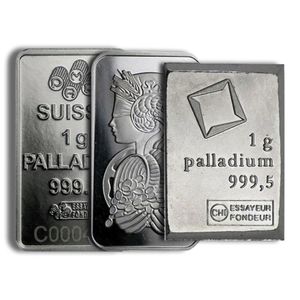
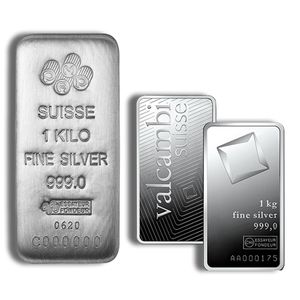
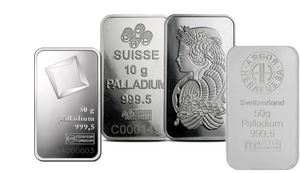
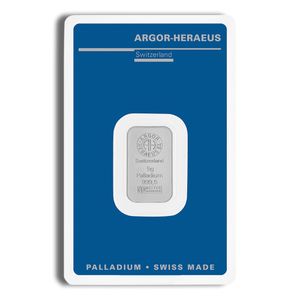
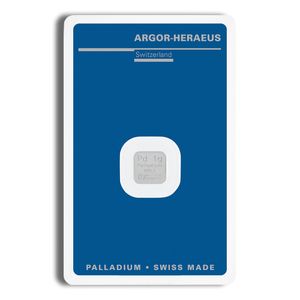
Our palladium bars and rounds catalog covers a range of weights and formats suited to buyers at every level of familiarity with this metal. From the compact 1 gram Argor-Heraeus bar in assay card to the substantial 1 kilo random brand bar, each listing reflects real wholesale sourcing and transparent, real-time pricing. You'll find 1 oz bars from recognized refiners including Credit Suisse, Engelhard, Johnson Matthey, PAMP Suisse, Valcambi, and Argor-Heraeus, alongside random brand options in both assay and loose formats.
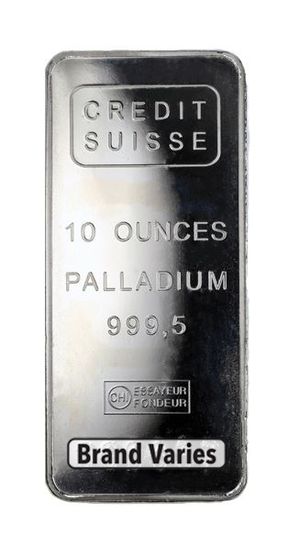
Beyond individual 1 oz bars, the catalog also includes gram-weight bars in 1g, 5g, 10g, and 50g denominations, a 10 oz bar, a 1 kilo bar, and a 1 oz JM Stillwater round in assay card — one of the few palladium rounds available from a major refiner. Whether you're looking for a specific brand or simply want to maximize metal content per dollar spent, the options here reflect the full breadth of what's available in the palladium bar and round market.
Bullion Standard sources from reputable mints, refineries, and authorized distributors. Every product is verified for authenticity, weight, and purity before fulfillment. Our pricing reflects real-time spot market conditions, and each product page displays the bid/ask spread so you can evaluate both acquisition cost and resale value before completing any transaction.
What Are Palladium Bars and Rounds?
Palladium bars are refined bullion products manufactured by private refineries and mints, stamped with weight, purity, and the producing refiner's mark. They differ from government-issued coins in that they carry no face value or legal tender status. Their pricing is driven almost entirely by metal content and the premium associated with the brand, packaging, and weight denomination.
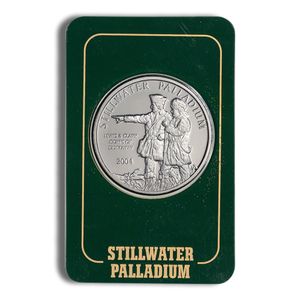
Rounds share the same basic structure as bars but take a disc shape similar to a coin. The 1 oz JM Stillwater palladium round is a well-known example from Johnson Matthey's Stillwater refinery in Montana, one of the few domestic sources of palladium processing. Like bars, rounds carry no legal tender status, but they're often recognized by buyers familiar with the refiner's mark.
Buyers typically choose palladium bars and rounds because they represent the most metal-efficient way to hold physical palladium. There are no premiums associated with government program designs or legal tender designations. The focus is on metal content, purity certification, and refiner credibility — all of which are clearly stated on the bar itself and on the accompanying assay card when one is present.
History and Background
Palladium was discovered in 1803 by British chemist William Hyde Wollaston and named after the asteroid Pallas. For much of the 19th and early 20th centuries, it remained a relatively obscure platinum-group metal with limited industrial use. Its commercial importance grew substantially in the second half of the 20th century as manufacturing demand — particularly from the automotive sector — expanded the market for platinum-group metals.
The modern palladium bar market developed largely through the same network of refineries that established gold and silver bar production. Refiners such as Engelhard, Johnson Matthey, and later PAMP Suisse, Valcambi, and Argor-Heraeus introduced palladium bars as the metal gained traction among industrial buyers and, subsequently, among investors seeking exposure to PGMs in physical form. Johnson Matthey's Stillwater operation became particularly notable as a North American source tied directly to domestic palladium mining in Montana.
Palladium bars have never achieved the same depth of retail market penetration as gold or silver bars, which contributes to tighter supply at the retail level and a more specialized buyer base. The metal experienced significant price volatility in the early 2000s and again in the late 2010s, which drew broader investor attention and expanded the bar market beyond strictly industrial channels. That history has shaped how palladium bars trade today, with recognizable refiner brands commanding better resale recognition than obscure or unbranded products.
Purity, Weight, and Specifications
The standard purity for palladium bars in the investment market is .9995 fine, which is the specification you'll find across nearly all products in this catalog — including bars from Argor-Heraeus, Credit Suisse, Engelhard, Johnson Matthey, PAMP Suisse, Valcambi, and the various random brand options. The Argor-Heraeus 1 oz bar in assay card is produced to a slightly higher .9999 fineness, and the miscellaneous 1 oz palladium listing is certified at .999 fine or better. These differences are minor in terms of metal content but relevant to buyers focused on specification consistency.
Weights in this catalog follow both troy ounce and metric gram standards. Troy ounce offerings range from 1 oz through 10 oz and 1 kilo, while gram denominations include 1g, 5g, 10g, and 50g. All precious metals weights are expressed in troy ounces, where one troy ounce equals 31.1035 grams. This is distinct from the avoirdupois ounce used in everyday commerce, and the distinction matters when calculating metal content by weight.
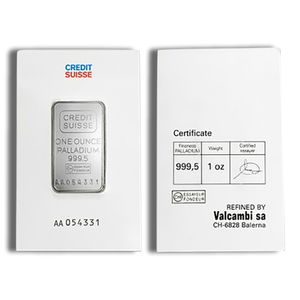
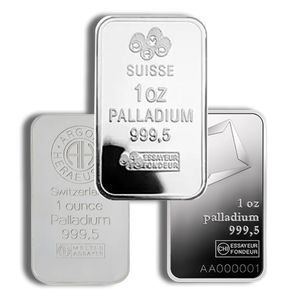
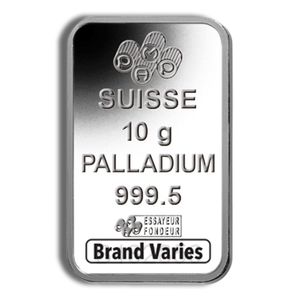
Bars carry stamped markings indicating the refiner's name or logo, the metal content in troy ounces or grams, and the purity designation. Many bars also carry unique serial numbers, particularly those packaged with assay cards. The assay card itself serves as a certificate of authenticity issued by the producing refiner, confirming the bar's specifications and providing an additional layer of verification for the buyer.
Available Brands, Mints, and Product Variations
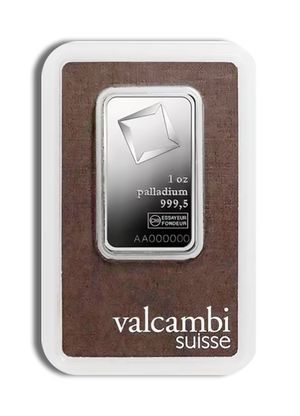
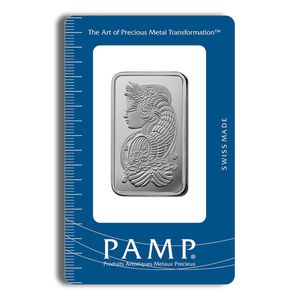
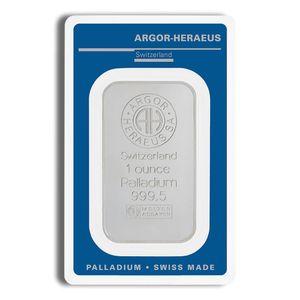
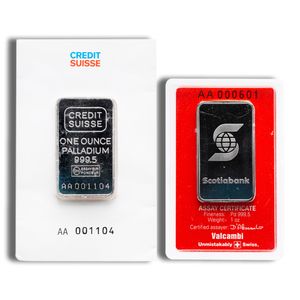
Several well-established refiners are represented in this catalog. Argor-Heraeus, based in Mendrisio, Switzerland, produces both 1g and 5g palladium bars in assay card alongside a .9999 fine 1 oz bar — the highest purity offering in this lineup. PAMP Suisse, also Swiss-based and widely recognized for its Lady Fortuna design, produces a 1 oz palladium bar in assay card. Valcambi, another Swiss refinery with a strong international reputation, offers a 1 oz bar in assay format as well. Credit Suisse's 1 oz palladium bar in assay card is one of the more recognized names in the North American market, even as the bank itself is no longer operating under that name.
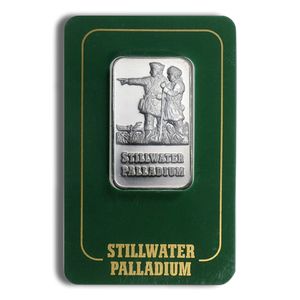
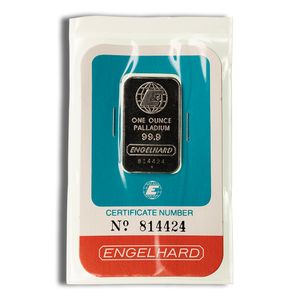
Johnson Matthey's Stillwater-branded products occupy a unique place in the U.S. market. The JM Stillwater 1 oz palladium bar and 1 oz palladium round, both in assay card, were produced at the Stillwater mine complex in Montana — directly connected to one of the few primary palladium-producing operations in North America. Engelhard's 1 oz palladium bar represents a legacy refiner with strong name recognition among experienced bullion buyers, though production has long since ceased, making existing inventory inherently finite.
Random brand and "various" listings provide a more economical entry point for buyers less focused on specific refiner branding. These products come from recognized refiners but are not sorted by brand prior to shipment. Options include bars in assay card, bars without assay card, and the broader "miscellaneous .999 palladium" listing for buyers who simply want certified palladium content at the most competitive available premium. The distinction between assay and non-assay versions of the same nominal bar affects both pricing and resale expectations.
Pricing, Premiums, and Market Factors
Palladium bar prices are anchored to the spot price of palladium, which is quoted in U.S. dollars per troy ounce and moves continuously during trading hours. The premium above spot represents the combined cost of refining, fabrication, packaging, distribution, and dealer margin. Palladium premiums tend to be higher than those on comparable gold or silver bars, reflecting thinner market liquidity, lower production volumes, and a smaller global pool of buyers and sellers at the retail level.
Premium variation within this catalog follows a recognizable pattern. Name-brand bars in assay card — particularly from Swiss refiners like PAMP, Valcambi, and Argor-Heraeus — carry higher premiums than random brand equivalents. Fractional gram bars carry proportionally higher premiums per troy ounce than full ounce or larger bars, which is typical across all precious metals. The 10 oz and 1 kilo bars generally trade closer to spot on a per-ounce basis, rewarding buyers who consolidate into larger denominations when premiums are a primary consideration.
Bullion Standard displays the bid/ask spread on each product page, which reflects both the purchase premium and the current buyback price in real time. Understanding this spread alongside the acquisition cost gives buyers a complete picture of the total cost of ownership, not just the price paid at checkout. Palladium's spot price can shift meaningfully on short notice, so reviewing live pricing before completing a transaction is always advisable.
Condition, Packaging, and What to Expect
Palladium bars shipped in assay cards arrive sealed within the original packaging from the producing refinery. The assay card encases the bar in a tamper-evident holder that includes the refiner's certification details. Buyers should not remove bars from assay packaging, as doing so typically reduces resale value and eliminates the visual verification benefit the packaging provides.
Bars listed as "random brand" or "various" are shipped from available inventory without advance selection of the specific producing refiner. The metal content, purity, and weight will meet the stated specifications, but the brand may vary from one order to the next. This is standard practice in the bullion market and is clearly reflected in the product descriptions. Random brand products listed without assay cards may show minor handling marks, bag marks, or superficial surface variations — this is cosmetically normal and does not affect metal content.
Larger products such as the 10 oz and 1 kilo bars are shipped with appropriate packaging to prevent damage in transit. All products are securely packed for delivery, and orders are fully insured during shipment. Customers should inspect packaging upon arrival and contact our team promptly if any concerns arise.
Authenticity and Verification
Palladium is one of the more technically challenging metals to counterfeit convincingly due to its specific gravity, electrical conductivity, and acoustic characteristics. Standard verification methods include weight checks, dimensional measurements, and non-destructive testing with XRF (X-ray fluorescence) equipment, which can confirm elemental composition without altering the bar. For bars in assay card, the tamper-evident packaging itself provides a first line of verification — any tampering with the card should be treated as a red flag.
Bullion Standard verifies the authenticity, weight, and purity of every product before it reaches our customers. We source exclusively from reputable refineries, authorized distributors, and established wholesale channels. Our team has the expertise and equipment to assess palladium products accurately, and our sourcing practices are designed to eliminate unverified or suspect material from inventory entirely.
Buyers who receive products from outside established channels — secondary market purchases, private sales, or unfamiliar online listings — should seek independent verification before accepting or reselling. Assay cards from known refiners, along with XRF testing at a reputable dealer or testing facility, represent the most reliable verification pathway outside of direct refinery sourcing.
Liquidity and Resale Considerations
Palladium bars are less liquid than gold or silver bars in the retail market, which is a practical reality buyers should account for before purchasing. The global base of retail buyers and dealers who actively trade palladium is smaller, and bid prices can vary more significantly between dealers than they typically would for major gold or silver products. This does not make palladium bars illiquid — they trade actively at the wholesale level and are accepted by most major dealers — but it does mean that brand recognition, packaging integrity, and product format carry more weight in the resale process than they might for gold.
Bars from widely recognized refiners such as PAMP, Valcambi, Argor-Heraeus, Credit Suisse, and Johnson Matthey Stillwater typically resell more smoothly than obscure or unbranded products. Assay-packaged bars in original sealed condition generally receive better pricing than loose bars, all else being equal. The 1 oz format is the most commonly traded size in the retail channel, which contributes to its relative liquidity compared to gram-weight bars or the less commonly held 50g denomination.
Understanding liquidity before purchasing is part of Bullion Standard's core philosophy. Our product pages display the current bid price alongside the ask, so buyers can assess the spread and understand the current resale environment at the time of purchase rather than discovering it only when it's time to sell.
Storage and Security
Palladium bars, particularly those in assay card packaging, should be stored in a stable environment protected from physical damage, extreme humidity, and temperature fluctuation. Unlike silver, palladium does not tarnish under normal conditions, so long-term storage in a well-controlled environment is relatively straightforward. Still, assay cards can crack, warp, or discolor if stored improperly, which can affect perceived condition at resale.
For modest holdings, a quality home safe rated for both fire and theft resistance provides a reasonable baseline. Larger positions, particularly those including 10 oz or 1 kilo bars, are often better suited to a dedicated vault facility or bank safe deposit box, where both environmental controls and security infrastructure are substantially more robust. Third-party vault storage through an IRA custodian or private depository is also a practical option for buyers holding palladium within a self-directed IRA structure.
Gram-weight bars in assay card should be stored carefully to prevent the card from being bent or punctured. Keeping them in a rigid container or binder sleeve within a secure storage unit is a practical approach. Avoid stacking heavy items on top of assay-packaged bars, and keep individual units separated to prevent surface contact between packages over time.
Selling and Buyback Options
Bullion Standard operates as a two-way market, meaning customers can sell palladium bars and rounds back through the same platform used to purchase them. Our buyback pricing reflects real-time wholesale bid conditions, and the current buy price is displayed on each product page. This transparency is intentional — we believe buyers should know what a product is worth on the selling side before they complete a purchase on the buying side.
When selling to Bullion Standard, product condition, packaging integrity, and refiner recognition all influence the buyback price offered. Bars in original sealed assay card from recognized refiners such as PAMP, Argor-Heraeus, Valcambi, and Johnson Matthey Stillwater typically receive the most competitive pricing. Loose bars or products with compromised packaging may be evaluated at a modest discount depending on current market conditions. Our purchasing team assesses products based on verifiable specifications and current wholesale demand, not arbitrary internal grading.
The process is designed to be straightforward. Customers initiate a sell request through their account, lock in a price based on live market conditions, and ship the product to our facility using our insured shipping process. Once received and verified, payment is processed promptly. For larger positions or questions about specific products, our team is available to provide guidance before the process begins.
Why Buy Palladium Bars and Rounds?
Palladium occupies a distinct position among the four primary precious metals. Its supply is geographically concentrated, with the majority of global mine production coming from Russia and South Africa, and meaningful secondary supply from North American sources including the Stillwater and East Boulder mines in Montana. This concentrated supply structure, combined with consistent demand from the automotive catalytic converter industry and growing interest from electronics and chemical manufacturing, gives palladium a market dynamic that differs meaningfully from gold or silver.
Bars and rounds are the most metal-efficient format for holding physical palladium. Without the numismatic premiums or legal tender designations associated with government-issued coins, buyers can access the metal at premiums that reflect primarily refining and fabrication costs. For buyers focused on metal content per dollar spent, particularly in larger denominations like the 10 oz or 1 kilo bar, the cost efficiency relative to coins can be meaningful over time.
The format also offers practical flexibility. Gram-weight bars from Argor-Heraeus allow entry at lower absolute dollar amounts, while larger bars suit buyers consolidating existing positions or managing palladium holdings within a broader physical metals portfolio. The range of formats available in this catalog makes it possible to build a palladium position incrementally or in quantity, depending on preference and budget.
Why Buy from Bullion Standard?
Bullion Standard has operated as a U.S.-based precious metals dealer since 2010, and our reputation is grounded in a straightforward philosophy: transparency in pricing, authenticity in sourcing, and consistency in execution. We source palladium products from reputable refineries and authorized distributors, verify every item before it ships, and price based on real-time market conditions rather than fixed retail markups that obscure the true cost of ownership.
Our platform is built to provide buyers with more than a checkout experience. Each product page includes live pricing, current bid/ask spreads, and the information needed to evaluate a purchase with clarity. We maintain an A rating with the Better Business Bureau, hold active memberships in the American Numismatic Association and the National Coin and Bullion Association, and serve as an authorized dealer for both PCGS and NGC. These affiliations reflect a commitment to professional standards that goes beyond marketing language.
Customers can complete purchases using a wide range of payment methods, including major credit and debit cards, PayPal, bank-connected payments via Plaid, wire transfer, paper check, and cryptocurrency through BitPay. Every order is handled through a secure checkout process and fulfilled with fully insured shipping. Our customer service team is responsive and operationally focused, and our buyback program means that the relationship with Bullion Standard doesn't end at the point of purchase.
Get Near-Spot Pricing with Bullion Standard Pro
Bullion Standard Pro provides members with access to live, executable wholesale bid and ask pricing across the precious metals catalog, including palladium bars and rounds. Rather than applying fixed dealer markups on top of indicative prices, Pro members transact at wholesale market prices that move naturally with supply and demand conditions. For palladium, where retail premiums can be meaningfully higher than those on gold or silver, the pricing efficiency available through Pro can represent a significant difference in the total cost of acquisition.
Pro members also gain access to real-time portfolio valuation based on live wholesale bid pricing — a more accurate representation of current liquidation value than retail-estimate-based portfolio tools. Additional features include historical premium analysis, bid/ask spread tracking, liquidity metrics, and proprietary market intelligence tools designed to help buyers evaluate palladium products using objective data rather than marketing narratives. For buyers making repeat purchases or managing meaningful palladium positions, this level of analytical visibility is difficult to find through conventional retail channels.
The platform is designed to reduce information asymmetry, not to upsell products or generate trading activity. Members gain access to the same category of pricing intelligence that institutional and wholesale buyers use, applied specifically to the physical palladium bar and round market. For price-sensitive buyers or those building positions over time, Bullion Standard Pro offers a more efficient path to market than traditional retail purchasing models.

 (833) 278-4653