Buy Austrian Silver Philharmonics Online
Our catalog of Austrian silver Philharmonics brings together some of the most consistently traded silver coins available in the global bullion market. Each coin is struck by the Austrian Mint in Vienna and contains 1 troy ounce of .999 fine silver, carrying a face value of 1.5 euros. You'll find dated issues for 2023, 2024, and 2025 alongside a random year option for buyers who prioritize silver content over a specific vintage.
The Austrian Mint is one of Europe's oldest and most respected sovereign minting institutions, and the Philharmonic is its flagship bullion coin. These are Brilliant Uncirculated coins packaged in standard mint tubes of 20, with a box quantity of 500 coins. Whether you're adding a single dated coin or purchasing in volume, the structure here is designed to accommodate both retail buyers and those acquiring at a larger scale.
Bullion Standard sources these coins directly through established wholesale channels, and pricing reflects real-time silver spot conditions. The full bid/ask spread is displayed on each individual product page, so you can see both the acquisition cost and the current buyback value before making any decision.
What Are Austrian Silver Philharmonics?
The Austrian silver Philharmonic is a government-issued bullion coin produced annually by the Austrian Mint. It contains exactly 1 troy ounce of .999 fine silver, carries a legal tender denomination of 1.5 euros, and is struck to Brilliant Uncirculated standards. These are not collectible proof coins with heavy numismatic premiums attached. They are purpose-built bullion coins intended for buyers focused on silver content at efficient pricing.
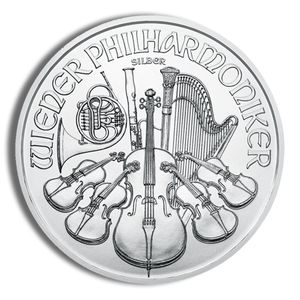
The design is entirely centered on music, which sets the Philharmonic apart from most sovereign bullion coins that tend to feature national symbols or wildlife. The obverse depicts the Great Organ of the Vienna Musikverein concert hall, while the reverse displays a collection of orchestral instruments. The coin takes its name from the Vienna Philharmonic Orchestra, one of the most celebrated ensembles in the world.
Compared to fractional silver coins or rounds from private mints, the 1 oz Philharmonic occupies a practical middle ground. It's a standardized, government-backed format with wide market recognition, easy storability, and a size that makes individual handling straightforward. For buyers who want sovereign-issued silver without the higher premiums often associated with coins like the American Silver Eagle, the Philharmonic is a frequently considered alternative.
History and Background
The Austrian Mint introduced the Philharmonic series in 1989, initially striking the coins in gold. The silver version followed in 2008, entering the market at a time when demand for government-issued silver bullion was expanding globally. Within its first decade, the silver Philharmonic had established itself as one of the top-selling silver bullion coins in Europe and earned significant distribution reach across North American and Asian markets as well.
Austria's minting tradition stretches back centuries, with the Austrian Mint tracing its origins to 1194. The institution has operated continuously through significant political and economic changes across European history, and that institutional depth carries through into the manufacturing precision and quality consistency seen in modern Philharmonic coins. The Vienna Musikverein connection is not incidental branding. The partnership between the Austrian Mint and the Vienna Philharmonic Orchestra reflects a deliberate effort to tie the coin to a cultural institution with genuine international recognition.
Since the silver Philharmonic's introduction, the Austrian Mint has maintained annual production, with mintage volumes varying based on global silver demand. The coin's design has remained largely consistent over the years, which contributes to its straightforward resale profile. Buyers and dealers worldwide recognize the format immediately, which is a practical advantage when it comes time to liquidate.
Purity, Weight, and Specifications
Each Austrian silver Philharmonic in our catalog contains 1 troy ounce of silver at .999 fineness, which meets the standard threshold for silver bullion coins in most markets. The coins measure 37 millimeters in diameter and 3.2 millimeters in thickness. These dimensions are consistent across all annual issues and the random year variant, making them compatible with standard coin holders, tubes, and storage capsules designed for 1 oz silver coins.
The face value of 1.5 euros is struck directly onto each coin and represents legal tender status under Austrian law. In practice, the coin's market value is driven entirely by silver spot prices and applicable premiums rather than its nominal denomination. The .999 purity designation appears on the coin itself, as does the weight and the Austrian Mint's identifying marks, giving buyers a clear on-coin reference for the specifications they're purchasing.
The coins are not assigned serial numbers, which is consistent with standard bullion coin production across most sovereign mints. Assay cards are not included with individual raw coins. Authentication relies on the recognizable design, precise dimensions, known weight, and the Austrian Mint's established manufacturing standards rather than individualized documentation.
Available Brands, Mints, and Product Variations
Every coin in this section of our catalog is produced by the Austrian Mint, headquartered in Vienna. The mint operates as a subsidiary of the Austrian National Bank and holds an exclusive mandate to produce euro-denomination coins for Austria. That institutional backing places the Philharmonic in a category of sovereign-issued silver coins with a clearly defined production authority behind each piece.
The dated options currently available are the 2023, 2024, and 2025 issues, each struck to Brilliant Uncirculated standards and packaged in mint tubes of 20. The random year option ships coins from available inventory across multiple production years, with the mint mark listed as "Various." This variant is straightforward for buyers who have no preference for a specific year and are focused purely on silver content and per-ounce cost. Random year coins are the same .999 fine silver, same weight, same diameter, and produced to the same quality standards as any specific dated issue.
There are no proof versions, special finishes, or limited editions within this section of the catalog. The focus here is entirely on standard BU bullion coins, which keeps the premium structure clean and the product profile familiar across all four SKUs. Buyers comparing these options are essentially choosing between dated inventory and random year pricing, with the underlying silver specifications remaining identical.
Pricing, Premiums, and Market Factors
Silver Philharmonic pricing moves with the spot price of silver, quoted in troy ounces and updated continuously throughout the trading day. The premium you pay above spot reflects a combination of factors: the Austrian Mint's production and distribution costs, wholesale market demand, dealer margins across the supply chain, and current inventory conditions. For widely traded sovereign coins like the Philharmonic, premiums tend to be comparatively efficient relative to smaller-mintage or specialty silver products.
The random year option typically carries a slightly tighter premium than a current-year dated coin, reflecting the fact that buyers accept whatever year is in active inventory. Dated coins for the current year can carry a modest premium increase during peak demand periods, particularly at the start of a new calendar year when fresh inventory enters the market. Premiums on Philharmonics can also shift in response to broader silver market activity, changes in mint production schedules, or periods of elevated retail demand across the sovereign coin market generally.
Bullion Standard displays the full bid/ask spread on each product page, giving you visibility into both what you'll pay and what the current buyback price looks like before you commit to a purchase. That structure is designed to reduce the information asymmetry that's common in traditional dealer environments and to help you evaluate the true cost of ownership rather than focusing solely on the acquisition price.
Condition, Packaging, and What to Expect
Austrian silver Philharmonics in our catalog are graded Brilliant Uncirculated, which reflects the condition in which they leave the Austrian Mint. BU coins have not been in circulation and carry their original mint luster, though minor handling marks or light contact marks can occur during the tube-packaging process and are considered normal and acceptable for bullion-grade coins. These are not graded numismatic pieces, and minor surface imperfections within BU standards do not affect the coin's silver content or bullion market value.
Coins are packaged in standard mint tubes containing 20 coins each. The outer pack quantity is 500 coins, which corresponds to a full monster box. Individual coin orders are typically pulled from these tube lots. If you're ordering a full tube of 20 or quantities that align with standard packaging, coins generally ship in the original mint tube packaging. Smaller quantities ship as individual coins removed from tubes and placed in appropriate protective packaging for transit.
Random year coins will arrive as a genuine Austrian Mint Philharmonic, and the specific year may vary based on available inventory. No specific year can be requested or guaranteed with the random year SKU. If the year of issue is important to you, the dated 2023, 2024, or 2025 options are the appropriate selections.
Authenticity and Verification
The Austrian Mint's production standards include dimensional precision and design consistency that serve as the primary authenticity markers for silver Philharmonics. The coin's diameter of 37 millimeters, thickness of 3.2 millimeters, and exact 1 troy ounce weight provide measurable reference points that any calibrated scale or set of calipers can confirm. Counterfeit Philharmonics do circulate in global markets, and physical verification against known specifications remains one of the most reliable authentication methods available for raw bullion coins.
The design elements themselves provide additional authentication context. The reeded edge, the relief depth on both the organ and instrument designs, the font characteristics of the mint markings, and the overall strike quality are details that experienced buyers and dealers use alongside dimensional checks. Electronic verification devices, including XRF analyzers and ultrasonic thickness testers, are also used by professional dealers to confirm metal composition without damaging the coin.
Bullion Standard sources coins through established wholesale and distributor channels with direct ties to authorized Austrian Mint distribution networks. Every product is verified before it reaches our customers, and our sourcing standards are consistent with our A BBB rating and our memberships in the American Numismatic Association and the National Coin and Bullion Association. We also hold authorized dealer status with PCGS and NGC, though standard BU bullion Philharmonics are typically sold raw rather than in third-party graded holders.
Liquidity and Resale Considerations
The Austrian silver Philharmonic is one of the most widely recognized silver bullion coins in the world, which directly influences how easily it can be resold. Dealers in North America, Europe, and Asia are generally familiar with the coin, and its standardized specifications make the verification process quick and straightforward at the point of sale. Broad market recognition reduces friction when it comes time to liquidate, regardless of where or how you choose to sell.
Dated coins from well-known sovereign mints like the Austrian Mint generally trade efficiently across multiple resale channels, including dealer buyback programs, peer-to-peer markets, and online bullion platforms. The random year option can carry a marginally narrower resale audience in niche collectible markets, but within the standard bullion dealer network, the year of issue rarely affects the buyback price significantly. The silver content and the mint's reputation are the primary drivers of resale value.
Packaging integrity can be a factor in the resale process. Coins that remain in original sealed mint tubes or in unscratched capsules are often easier to process quickly in volume purchasing scenarios. Individual coins with heavy handling damage or significant surface issues may receive closer scrutiny, though for BU bullion coins, reasonable contact marks fall within expected tolerances and are unlikely to affect standard buyback pricing.
Storage and Security
Standard 1 oz silver coins like the Philharmonic are well-suited to a range of storage approaches depending on the quantity you hold. Individual coins or small quantities fit easily in dedicated coin capsules sized for 37 millimeter diameter pieces. For tube quantities of 20 coins, the original mint tubes provide adequate protection during storage and are stackable in most drawer-style or shelf-based coin storage systems.
Larger accumulations are better served by a home safe with appropriate fire and moisture resistance, a bank safe deposit box, or a third-party precious metals depository. Silver is more reactive to environmental conditions than gold, and long-term exposure to humidity, sulfur compounds, or certain packaging materials can cause toning or surface discoloration. While toning does not affect the coin's silver content or bullion value, keeping coins in a dry, stable environment and avoiding contact with rubber bands, newspaper, or unsealed plastic helps maintain surface appearance over time.
For buyers holding a significant number of coins, allocated storage through a licensed depository is worth considering. These facilities maintain segregated storage environments specifically designed for precious metals, with insurance coverage and third-party verification. The cost of professional storage should be weighed against the carrying cost and security limitations of home storage, particularly as holdings grow.
Selling and Buyback Options
Selling Austrian silver Philharmonics back into the market follows a process that depends largely on the channel you choose. Dealer buyback programs are typically the fastest path for standard bullion coins, and the Philharmonic's wide recognition makes the evaluation process efficient at most reputable dealers. Pricing at the point of sale is driven by current silver spot prices, applicable bid premiums or discounts, and the dealer's current inventory position.
Condition and packaging do play a role. Coins in original mint tubes that are cleanly presented process more quickly than loose coins with heavy handling. Significant surface damage is uncommon on properly stored BU coins, but it can be a factor if coins have been improperly housed or exposed to reactive environments over time. The year of issue is generally not a meaningful price differentiator within dealer buyback programs, though it may matter in collector-focused resale channels.
Bullion Standard operates as a two-way market, meaning you can sell back into our platform using competitive buyback pricing that reflects current wholesale bid conditions. Our product pages display the live bid price alongside the ask, so the relationship between acquisition cost and current resale value is visible throughout the buying process. That transparency is intentional. We believe understanding the full transaction from purchase to potential liquidation leads to better decisions and a more straightforward ownership experience.
Why Buy Austrian Silver Philharmonics?
The appeal of the Austrian silver Philharmonic comes down to a combination of sovereign backing, consistent specifications, and broad global recognition. These are government-issued coins produced by one of Europe's most established minting institutions, which gives them a standing in the bullion market that privately minted rounds simply cannot replicate. The 1 oz format is the most liquid size across the silver coin market, and the Philharmonic's design consistency over the years makes it immediately identifiable to dealers and buyers worldwide.
Silver also carries meaningful industrial demand that underpins the physical market in ways that differ from gold. Photovoltaic solar panels, electronics manufacturing, medical applications, and industrial chemical processing all consume silver in significant quantities. That consistent industrial draw sits alongside the coin's bullion demand and contributes to the overall market for silver at the physical level, without implying any directional price outcome.
For buyers comparing the Philharmonic to other 1 oz sovereign silver coins, the premium efficiency is often a relevant consideration. Philharmonics frequently trade at tighter premiums than coins produced in smaller mintage quantities or from mints with narrower global distribution networks. The availability of a random year option adds further flexibility for buyers who want to optimize for price per ounce rather than dating specifics.
Why Buy from Bullion Standard?
Bullion Standard has operated as a precious metals marketplace since 2010, built around a philosophy of pricing transparency and long-term customer relationships. Our platform is designed to give you the information you need to evaluate a purchase fully rather than presenting a simplified price and leaving you to estimate the rest. The bid/ask spread displayed on every product page reflects that approach directly.
Every coin we sell is sourced through verified wholesale channels and authenticated for weight, purity, and condition before fulfillment. Our A BBB rating, ANA membership, NCBA membership, and authorized PCGS and NGC dealer status reflect an operational standard that goes beyond standard retail dealer commitments. Secure checkout accepts a wide range of payment methods including Visa, Mastercard, American Express, Discover, PayPal, Plaid-connected bank payments, wire transfer, paper check, and cryptocurrency through BitPay.
Our two-way market model means you're not purchasing through a one-direction retail channel with uncertain resale options on the back end. From the moment you view a product, you can see both what we're asking and what we're currently bidding, which is the clearest picture available of the true cost of owning physical silver. That operational transparency is what we mean when we say we're building something closer to a genuine marketplace than a traditional high-pressure dealer environment.
Get Near-Spot Pricing with Bullion Standard Pro
Bullion Standard Pro is designed for buyers who want access to live wholesale market pricing rather than standard retail structures. Members transact at executable wholesale bid and ask prices that reflect real-time supply and demand within the professional bullion market. There are no additional dealer markups or dealer spreads layered on top of wholesale pricing, which means premiums and spreads move naturally based on market conditions rather than fixed retail pricing models.
For a product like the Austrian silver Philharmonic, which trades with meaningful wholesale market volume, the difference between standard retail premiums and near-wholesale pricing can be significant over time, particularly for buyers purchasing in quantity or transacting regularly. Pro members also gain access to live portfolio valuation using executable wholesale bid pricing, which provides a more realistic picture of current liquidation value than estimated retail-based portfolio tools.
The platform includes proprietary market intelligence tools covering historical premium analysis, spread tightness metrics, liquidity indicators, and buy/sell ratio data that aggregate wholesale market activity across the bullion market broadly. For buyers who want to evaluate the Philharmonic against other silver coin options using objective data rather than marketing claims, these tools provide the comparative framework to make that assessment with confidence. The goal is to make pricing dynamics transparent and measurable, not something you have to estimate or take on faith.

 (833) 278-4653