As low as: $587.52
As low as: $592.53
As low as: $599.53
As low as: $610.04
As low as: $580.01
As low as: $577.01
As low as: $577.51
As low as: $577.51
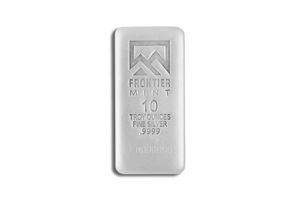
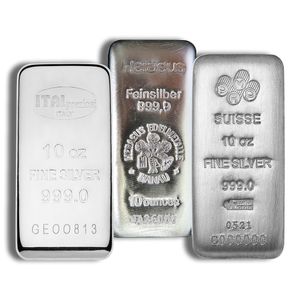
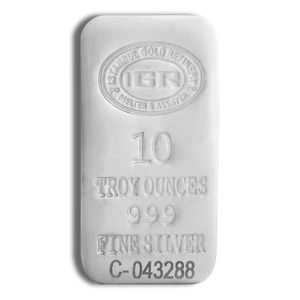
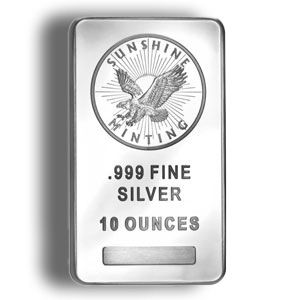
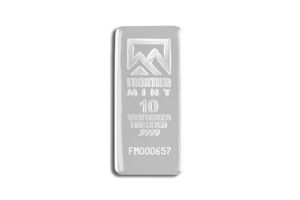
Our catalog of 10 oz silver bars brings together some of the most recognized names in the global bullion market, including Engelhard, Johnson Matthey, PAMP Suisse, the Royal Canadian Mint, The Royal Mint, IGR Metals, Frontier Mint, and Sunshine Mint, along with a selection of random brand options for buyers prioritizing metal content over a specific label. Whether you're looking for a classic cast bar from PAMP, a mirrored or sandblast finish from Frontier Mint, or a sealed Sunshine Mint SMI bar, this is a format that rewards buyers who understand what they're getting.
Bullion Standard operates as a transparent, two-way precious metals marketplace headquartered in San Diego, California. Our pricing reflects real-time market conditions, and every product is verified for authenticity, weight, and purity before it ships. You'll find clear bid and ask pricing on each product page so you can evaluate both sides of the transaction before committing to a purchase.
This is a size that occupies a practical middle ground in the silver bar market. It's substantial enough to reduce per-ounce premiums compared to smaller fractional formats, but far more manageable in terms of price per unit than a 100 oz bar. That balance makes 10 oz silver bars a consistently active segment of the physical silver market.
A 10 oz silver bar is a rectangular silver bullion product weighing exactly ten troy ounces, typically produced by private refineries and mints rather than sovereign government minting programs. The format exists primarily to provide a cost-efficient way to acquire a meaningful quantity of silver in a compact, stackable form that's easy to handle, verify, and store.
Unlike silver coins or rounds, bars in this weight class carry no legal tender designation and are valued almost entirely on their metal content and the reputation of the producing mint or refinery. That simplicity keeps premiums relatively lean compared to government-issued silver products of equivalent weight. Buyers who want pure silver content without paying for the added cost of sovereign coin programs tend to gravitate toward the bar format.
Within the bar format itself, there are meaningful distinctions. Cast bars are produced by pouring molten silver into molds and cooling it, resulting in a rough, organic surface texture that's often associated with older or more industrial producers. Minted bars are cut from rolled silver sheet and struck with precision dies, producing sharper edges, cleaner designs, and a more finished appearance. Both types carry equivalent silver content, but their aesthetics, manufacturing costs, and collector appeal differ.
The 10 oz silver bar format emerged alongside the broader growth of the private refinery industry in the twentieth century. As industrial demand for silver expanded through photography, electronics, and manufacturing, major refineries like Engelhard and Johnson Matthey developed standardized bar formats that served both industrial and investor demand. The 10 oz size became established as a practical retail-facing weight that sat between the heavy industrial 100 oz bar and the smaller 1 oz and 5 oz fractional products.
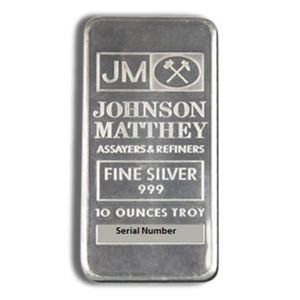
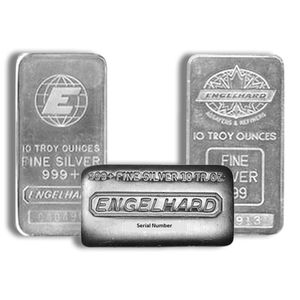
Engelhard and Johnson Matthey played a foundational role in shaping how private silver bars were perceived and traded. Both companies built reputations for consistent purity, clean stamping, and reliable assay practices that gave their bars strong secondary market recognition for decades. Products from these producers, even in used or secondary market condition, continue to trade actively today because of the trust those brands established over many years of refinery operations.
In more recent decades, the market has expanded considerably. Swiss refineries like PAMP entered the retail bullion market with more refined minted bar products featuring detailed design elements and tamper-evident assay packaging. Sovereign mints including the Royal Canadian Mint and The Royal Mint began producing silver bars to complement their coin programs. Regional producers like IGR Metals and domestic operations like Frontier Mint and Sunshine Mint added further variety, giving buyers a broader range of formats, finishes, and security features than the original industrial refinery market ever offered.
Most 10 oz silver bars are produced to a fineness of .999, meaning 99.9% pure silver. Some modern producers, including Frontier Mint's sandblast finish bar listed in our catalog, have moved to .9999 fineness, reflecting improvements in refining technology and growing buyer preference for four-nines purity. Both standards are widely accepted across the wholesale market and recognized by major dealers globally.
The troy ounce is the standard unit of weight for precious metals and differs from the avoirdupois ounce used in everyday commerce. One troy ounce equals approximately 31.1 grams, so a 10 oz silver bar carries approximately 311 grams of silver. Bars are typically stamped with their weight, purity, the producing mint or refinery's name or logo, and in many cases a serial number for tracking and verification purposes.
Assay markings on cast bars are often simpler, reflecting the industrial tradition of those products, while minted bars from producers like PAMP Suisse frequently include assay cards or certificates sealed within tamper-evident packaging. The presence of an assay card provides an additional layer of verification and can influence resale conditions in certain market segments.
The range of 10 oz silver bars in our catalog reflects both the historical depth of the silver bar market and its continued evolution. Engelhard and Johnson Matthey bars represent the legacy refinery tradition, produced in limited quantities during the active years of those refineries and now available primarily through the secondary market. Their recognizable stamps and long-standing reputations keep them actively traded despite no longer being in current production.
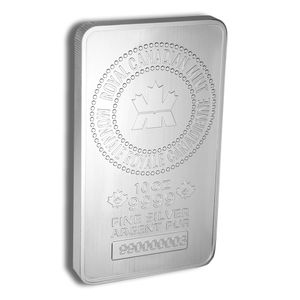
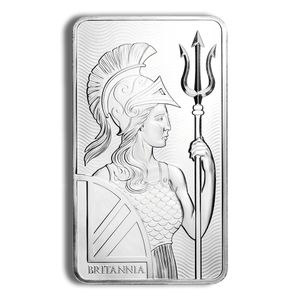
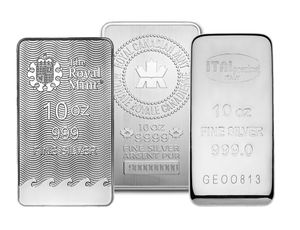
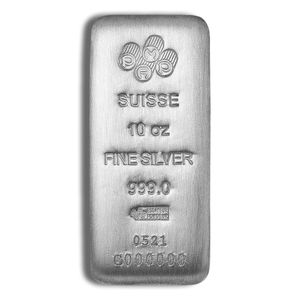
PAMP Suisse's cast bar brings Swiss refinery craftsmanship to the 10 oz format, while The Royal Mint's Britannia bar and the Royal Canadian Mint's silver bar represent the sovereign mint side of the market. These products benefit from the institutional credibility their producing mints have established through decades of government-backed coinage programs. Frontier Mint offers distinct aesthetic choices through its mirrored and sandblast finish options, catering to buyers interested in visual differentiation alongside their silver content. The Sunshine Mint SMI bar in sealed packaging adds another layer of product integrity through its presentation.
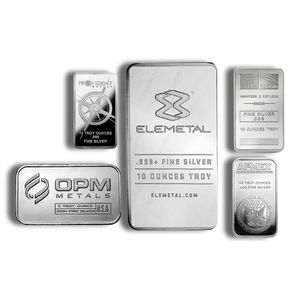
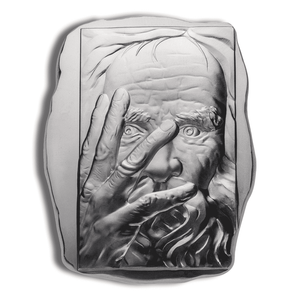
For buyers less focused on a specific brand, the random brand and multi-brand options from NTR, Elemetal, OPM, APMEX, Provident, and others provide a cost-conscious entry point into the 10 oz format. The Argentia Sculpture "Thinking Man" bar rounds out the selection for collectors drawn to artistic design work within the bar format. This breadth means buyers at different price points and with different priorities can find a 10 oz silver bar that fits their approach.
The price of a 10 oz silver bar is always tied to the current spot price of silver, which fluctuates continuously based on global trading activity. On top of the spot price, a premium is applied to cover refining, fabrication, distribution, and dealer operating costs. The 10 oz size is notable for carrying lower per-ounce premiums than smaller bar formats, making it efficient for buyers who want meaningful silver content without the cost structure of fractional products.
Premium levels across 10 oz bars vary depending on the producer, product condition, and current market supply. Legacy bars from Engelhard and Johnson Matthey sometimes command modest premiums above generic alternatives due to their collector following and secondary market recognition. Bars from sovereign or semi-sovereign mints like the Royal Canadian Mint and The Royal Mint tend to carry slightly higher premiums than generic private mint products. Random brand bars typically sit at the lower end of the premium range, which suits buyers focused primarily on silver content.
Bullion Standard's pricing structure is built around transparency. Each product page displays both the ask price and the bid price, which allows buyers to evaluate the full bid/ask spread before purchasing rather than discovering resale conditions only when it's time to sell. Premiums and spreads shift over time as wholesale market conditions, product availability, and demand levels change, so the pricing shown reflects current market reality rather than a fixed markup.
10 oz silver bars arrive in a range of packaging formats depending on the producer and the specific product. Modern minted bars from PAMP and some sovereign mint products come in assay cards or sealed tamper-evident packaging, which preserves the bar's original presentation and provides an additional verification mechanism. The Sunshine Mint SMI bar listed in our catalog is offered in sealed packaging, which similarly preserves condition and provides peace of mind around authenticity.
Legacy bars from Engelhard and Johnson Matthey, sold primarily through secondary market channels, are typically loose without original packaging. Surface marks, light contact scratches, and minor toning are entirely normal for these products and do not affect silver content or weight. Buyers selecting these bars should expect them to show signs of handling consistent with their age and prior circulation through the wholesale market.
Random brand bar listings will ship as available from current inventory, which may include products from any of the listed producers or similar refineries of equivalent purity and weight. Exact designs and brand selections are subject to availability. When ordering products listed as random design or random brand, buyers should base their decision on silver content and specifications rather than visual expectations for a particular label or finish.
Every 10 oz silver bar in Bullion Standard's inventory is verified for authenticity, weight, and purity before it's made available for purchase. Our sourcing comes from reputable mints, refineries, wholesalers, and distributors, and our team applies industry-standard verification practices to confirm product integrity before fulfillment. Bullion Standard holds an A rating with the Better Business Bureau and maintains memberships with both the American Numismatic Association and the National Coin and Bullion Association.
For bars with assay packaging, the sealed card or certificate itself provides a primary layer of verification. Buyers should inspect assay packaging upon receipt and ensure it has not been tampered with. Bars without original packaging can be verified through weight and dimensional testing, as well as through methods such as ultrasonic thickness testing or XRF (X-ray fluorescence) analysis, which confirms elemental composition without damaging the bar.
Established producers like Engelhard, Johnson Matthey, PAMP, the Royal Canadian Mint, and The Royal Mint have well-documented stamp characteristics, dimensional standards, and surface textures that experienced buyers and dealers use to authenticate their products. Familiarity with a producer's genuine characteristics is one of the most practical tools for identifying inconsistencies in the secondary market. Purchasing from a verified dealer with established sourcing relationships is the most straightforward way to reduce authentication risk at the point of acquisition.
The 10 oz silver bar format is broadly recognized across the wholesale precious metals market, making it one of the more liquid bar weights available to individual buyers. Products from well-known producers like Engelhard, Johnson Matthey, PAMP, the Royal Canadian Mint, and Sunshine Mint carry strong market recognition and are accepted by dealers across the country without requiring significant negotiation over product identity or purity.
Random brand bars, while carrying slightly less name recognition than premium-brand alternatives, trade actively because they conform to standard weight and purity specifications that are easily verified. In a market where buyers understand what a .999 fine 10 oz bar represents, the brand on the bar matters less than it might in other product categories. That said, legacy bars from Engelhard and Johnson Matthey often attract a collector following that can support demand beyond their raw silver content.
Packaging condition can influence resale in certain segments of the market. Bars in original assay packaging typically receive cleaner transactions and may command modest premiums in resale channels where condition matters. Loose bars without packaging are still fully tradeable but may face more scrutiny in some resale environments. Understanding these dynamics before purchasing helps buyers select products that align with their intended holding period and exit strategy.
10 oz silver bars are compact enough to store conveniently but substantial enough in aggregate value to warrant thoughtful security planning. For buyers accumulating multiple bars, a quality home safe with fire and theft resistance provides a practical baseline level of protection. Look for safes rated for both fire resistance and physical security rather than relying on lightweight lockboxes that offer minimal deterrent against determined theft.
Bank safe deposit boxes offer an alternative for buyers who prefer institutional storage but should be evaluated with the understanding that access is limited to banking hours and may not be covered by bank insurance. Private vault storage services, offered by independent precious metals custodians and some dealers, provide professionally managed environments with appropriate insurance coverage and documented chain of custody, which can be valuable for larger accumulations.
Silver is susceptible to toning and surface oxidation when exposed to humidity, sulfur compounds, or pollutants over time. Bars in assay packaging are naturally protected by their sealed presentation, while loose bars benefit from individual soft plastic flips or airtight containers that minimize environmental exposure. Avoiding direct contact between bars and materials that off-gas sulfur compounds, such as certain rubbers and cardboards, helps preserve surface appearance without requiring specialized climate control.
Bullion Standard operates as a two-way market, meaning customers can sell silver bars back through our platform using competitive buyback pricing rather than searching for a separate resale outlet. When you're ready to sell, our purchasing team evaluates each product based on current wholesale market conditions, the specific product's mint or refinery, its condition, and whether original packaging is intact. This process is designed to be straightforward and transparent rather than requiring customers to negotiate from a position of incomplete information.
Products from widely recognized producers like Engelhard, Johnson Matthey, PAMP, the Royal Canadian Mint, and The Royal Mint typically move through the buyback process smoothly because our team and the broader wholesale market can evaluate and price them efficiently. Random brand bars and multi-brand lot products are also purchased, with pricing reflecting their silver content and current wholesale demand. The presence of original assay packaging or sealed presentation can streamline the verification step and may support more efficient pricing.
Live bid pricing is displayed on each product page within our platform, which allows sellers to see current buyback rates before initiating a transaction. This transparency is central to how Bullion Standard approaches the sell side of the market. Rather than discovering what a bar is worth only when you contact a dealer, our customers can monitor bid levels over time and make selling decisions based on current, observable market data.
The 10 oz silver bar sits at a point in the weight spectrum where premium efficiency and practical handling align well. Compared to 1 oz bars or silver rounds, the per-ounce premium on a 10 oz bar is typically lower because fabrication and packaging costs are spread across a larger silver content. At the same time, the total dollar outlay per bar remains accessible in a way that 100 oz bars are not for many buyers, which makes it easier to build a position in physical silver without committing to a single large purchase.
Silver's dual role as a precious and industrial metal adds a dimension to this format that doesn't apply to gold bars of equivalent weight. Silver is consumed in solar panels, electronics, medical applications, and industrial manufacturing at a scale that no other precious metal matches, and those physical demand flows are separate from investment-driven buying activity. For buyers who want exposure to silver's material demand profile alongside its role as a physical asset, bars in standard recognized formats like the 10 oz size represent a straightforward way to do that.
From a storage and handling perspective, 10 oz bars are efficient. They stack cleanly, require minimal space relative to their silver content, and are easy to inventory. For buyers building a physical silver position over time, the combination of reasonable premiums, strong market recognition, and practical dimensions makes this a format worth understanding in detail before deciding on a strategy.
Bullion Standard was founded in 2010 and has grown into a nationally recognized precious metals marketplace by prioritizing transparency over traditional high-pressure retail models. Every product we sell is verified for authenticity, weight, and purity before it reaches a customer. Our A BBB rating, ANA membership, and NCBA membership reflect the standards we hold ourselves to operationally, not just the claims we make in marketing.
Our pricing structure is designed to give buyers a complete picture of what they're paying. Each product page displays both the current ask price and the live bid price, so you can evaluate the bid/ask spread and understand the full cost of ownership before clicking purchase. This applies to 10 oz silver bars across every brand in our catalog, from premium minted options to random brand selections. We believe that informed buyers make better decisions, and better decisions lead to longer-term customer relationships.
Secure checkout, reliable fulfillment, and responsive customer service are operational priorities, not afterthoughts. We accept a wide range of payment methods including Visa, Mastercard, American Express, Discover, PayPal, bank-connected payments through Plaid, wire transfer, paper check, and cryptocurrency through BitPay. Post-purchase support is available to address questions about products, shipment status, or the selling process. Our goal is to make the experience feel like a straightforward marketplace where the customer has access to the information needed to make sound decisions at every stage.
Bullion Standard Pro is designed for buyers who want direct access to live wholesale bid and ask pricing across the precious metals market, including the 10 oz silver bar segment. Rather than applying fixed retail markups, Pro members transact at executable wholesale market prices that reflect real-time supply and demand. Premiums and bid/ask spreads fluctuate based on actual market conditions rather than predetermined dealer margins, which creates a more efficient pricing environment for buyers who trade with meaningful frequency or size.
The platform also provides access to historical premium analysis, premium percentile rankings, spread analysis, liquidity metrics, and other proprietary analytics that help members evaluate products using objective data. For buyers comparing multiple 10 oz silver bar options, these tools make it possible to assess whether a current premium is elevated relative to historical norms, how tightly a specific product's spread has been trading, and how wholesale market activity is shifting across the silver bar segment. These are the kinds of signals that are difficult to observe without direct access to wholesale market data.
Portfolio valuation within Bullion Standard Pro reflects live executable wholesale bid pricing rather than estimated retail values, giving members a more realistic picture of what their holdings are worth at current market liquidation levels. For buyers accumulating 10 oz silver bars over time, that difference between retail valuation and real wholesale bid pricing can be material. Bullion Standard Pro is built around the premise that investors deserve access to the same quality of pricing transparency and market intelligence that's available in more established financial markets, applied specifically to the physical precious metals space.