Buy Burnished Silver Eagles Online
Our catalog of burnished silver eagles spans every year of production from 2006 through 2025, covering the full range of packaging formats, certification options, and condition tiers available in today's secondary market. You'll find raw examples with original government packaging, including boxes and Certificates of Authenticity, alongside certified specimens graded MS70 or SP70 by NGC and PCGS. Whether you're searching for a specific date, a particular grading service, or a cap-only example without original government packaging, the selection here reflects the genuine depth of this program.
Bullion Standard sources these coins from reputable wholesalers, distributors, and dealers operating within the established precious metals market. Our pricing reflects real-time silver spot prices, and each product page displays the current bid and ask spread so you can evaluate the full cost of ownership before completing a purchase. The catalog includes both authenticated coins with complete manufacturer attribution to the United States Mint and secondary-market examples listed without manufacturer confirmation, giving buyers full visibility into what they're purchasing.
Notable offerings include the 2008-W Reverse of 2007 burnished silver eagle, a recognized variety with distinct collector interest, as well as the 2021-W Type 2 burnished silver eagle, which marks the redesigned reverse introduced that year. Coins are available in BU condition with original box and COA, cap-only format without original government packaging, and NGC or PCGS certified slabs in the highest achievable grades.
What Are Burnished Silver Eagles?
Burnished silver eagles are a distinct production variant of the American Silver Eagle coin program issued by the United States Mint. Unlike standard bullion silver eagles, which are struck for circulation in the precious metals market, burnished examples are produced using specially burnished planchets that undergo a unique minting process before striking. This results in a coin with a matte or satin-like surface finish that differs visibly from both standard bullion strikes and the frosted devices of proof coins.
The burnished finish creates a surface that collectors and buyers recognize immediately. The coins carry the same specifications as their bullion counterparts, including one troy ounce of .999 fine silver, but are packaged differently by the Mint and carry a "W" mint mark from the West Point Mint, which does not appear on standard bullion issues. This mint mark alone distinguishes every burnished silver eagle from ordinary circulation-quality bullion strikes.
Buyers typically pursue burnished silver eagles for their unique aesthetics, their status as a separate collectible program within the broader American Silver Eagle series, and the fact that they're produced in lower mintages than standard bullion issues. They occupy a space between investment-grade bullion and the higher-cost proof coin segment, making them appealing to collectors who want something more distinctive than a standard bullion coin without committing to full proof pricing.
History and Background
The American Silver Eagle program launched in 1986 under the Liberty Coin Act, establishing one of the most widely recognized government-issued silver coins in the world. For its first two decades, the program consisted of bullion and proof strikes only. The burnished silver eagle was introduced in 2006 as part of a broader expansion that included the 20th anniversary set, offering collectors a new surface finish and format that distinguished itself from both existing product types.
Production of burnished silver eagles continued annually from 2006 through 2008, then paused entirely in 2009 and 2010 due to extremely high bullion demand that required the Mint to redirect production capacity toward standard bullion coins. The program resumed in 2011 and has continued since, though with a notable interruption that makes certain years significantly harder to find than others. The 2008-W Reverse of 2007 variety, which resulted from a die design error during that high-pressure production period, has become one of the more recognized varieties in the entire American Silver Eagle series.
The 2021 program year introduced a redesigned reverse by artist Emily Damstra, replacing the original John Mercanti heraldic eagle reverse that had been in use since 1986. Burnished silver eagles struck after that point are classified as Type 2 coins, and the distinction carries real meaning in the secondary market. Both type classifications remain active within our catalog, spanning the original Type 1 production run and the current Type 2 format.
Purity, Weight, and Specifications
Every burnished silver eagle contains one troy ounce of .999 fine silver, conforming to the same purity standard used across the entire American Silver Eagle program. The legal tender face value is one dollar, though the coin's market value is determined by the silver spot price plus any applicable premium. The coin measures 40.6 millimeters in diameter and weighs 31.103 grams, consistent across all years of production.
The "W" mint mark struck on burnished silver eagles identifies their origin at the West Point Mint in New York, which is responsible for producing all proof and burnished variants within the American Silver Eagle series. This mint mark appears on the obverse and serves as a definitive distinguishing feature from standard bullion issues, which carry no mint mark at all.
Certified examples graded by NGC or PCGS receive encapsulation in tamper-evident plastic holders that display the coin's grade, certification number, and designation. NGC grades burnished silver eagles on the standard Mint State scale, with MS70 representing a coin with no post-production imperfections visible under five-times magnification. PCGS uses the SP designation, for Specimen, to reflect the specialized minting process, with SP70 representing the same standard of perfection within their grading framework.
Available Brands, Mints, and Product Variations
All burnished silver eagles in our catalog originate from the United States Mint, specifically the West Point facility. The program runs uninterrupted in our catalog from 2006 through 2025, with several notable variations that buyers should understand before purchasing. The 2008-W Reverse of 2007 is one of the most significant varieties within the series, produced when dies with the previous year's reverse design were inadvertently used during 2008 production. Two separate SKUs for this variety appear in the catalog, reflecting different sourcing channels for what is otherwise the same coin.
Certified options come from both NGC and PCGS, the two most widely recognized third-party grading services in the numismatic industry. NGC-certified examples are graded MS70, while PCGS-certified examples carry the SP70 designation. Both represent perfect-grade certified coins, but the terminology reflects each service's classification philosophy. Neither grade is inherently superior, and both are broadly recognized in secondary markets. The 2011-W NGC MS70 "Anni Set Designation" is a specialty variant associated with the 25th anniversary set issued that year.
Ungraded examples are available in several formats: with original box and Certificate of Authenticity, in BU condition with the original mint packaging, and as cap-only coins without the outer government packaging. The 2021 Type 2 burnished silver eagle also appears in our catalog with box and COA, reflecting the new reverse design introduced that year. The "Year Varies" SKU represents a secondary-market option for buyers who prefer a burnished silver eagle without a specific date requirement.
Pricing, Premiums, and Market Factors
Burnished silver eagles typically carry higher premiums than standard bullion silver eagles due to their lower mintages, specialized minting process, and status as a separately collectible program. Premium levels vary meaningfully across years and formats. Certified MS70 and SP70 examples command higher premiums than raw BU examples, and certain date-specific coins with low original mintages or recognized varieties can carry premiums well above the typical range for the series.
Packaging condition plays a real role in secondary market pricing. Coins with intact original government packaging, including the original mint box and Certificate of Authenticity, generally retain stronger demand than cap-only examples or coins where original packaging has been damaged or lost. For uncertified buyers focused on silver content rather than collectibility, cap-only examples can offer a more cost-efficient entry point into the series.
Bullion Standard displays the bid and ask spread on each product page, providing buyers with a clear view of both the purchase price and the current buyback value at the time of purchase. Premiums in this category evolve with market conditions, silver spot price movements, and shifting collector demand, so the data on each product page reflects current market conditions rather than static estimates. Understanding the spread before purchasing helps buyers evaluate the true cost of entering and potentially exiting a position in any specific coin.
Condition, Packaging, and What to Expect
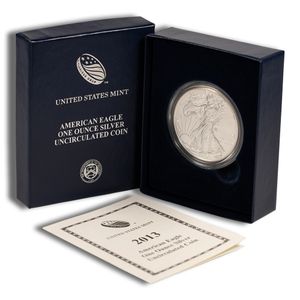
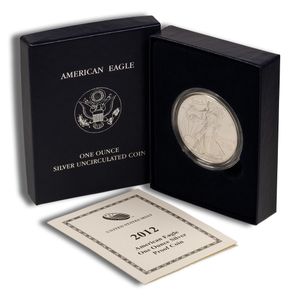
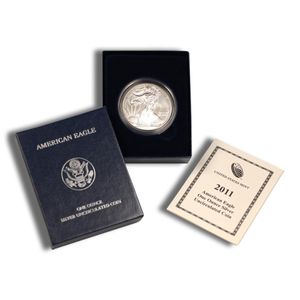
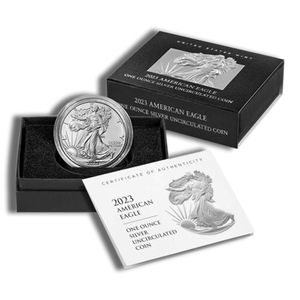
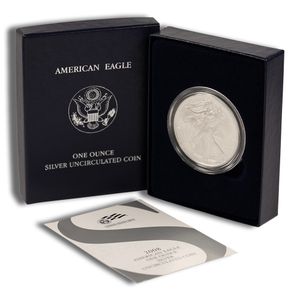
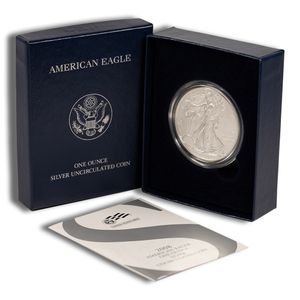
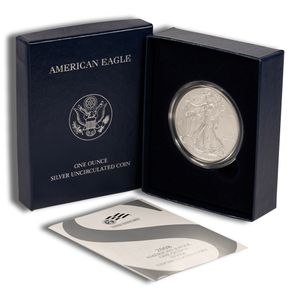
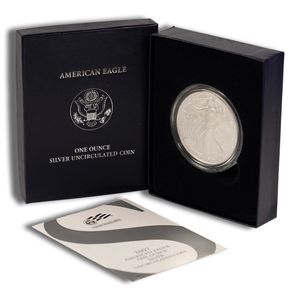
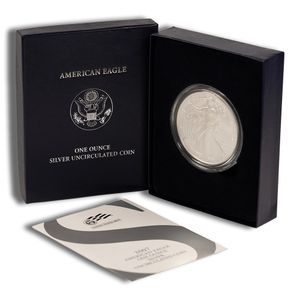
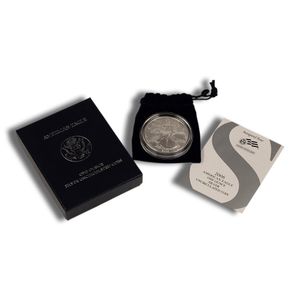
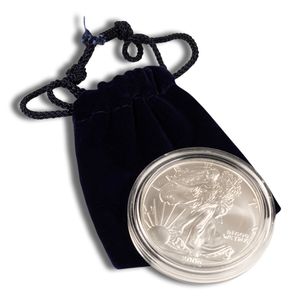
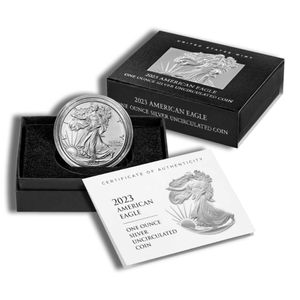
Burnished silver eagles sold as BU with box and COA arrive in the original United States Mint packaging, which includes a protective capsule, a velvet-lined presentation box, and a numbered Certificate of Authenticity. This packaging was specifically designed to preserve the coin's distinctive satin finish, and coins that remain sealed in their original packaging typically show no handling marks or surface disturbances.
Cap-only examples refer to coins that remain in their original mint-issued capsule but without the outer box and certificate. These coins are mechanically identical but are considered incomplete sets from a packaging standpoint. Buyers purchasing for silver content alone will find cap-only coins functionally equivalent, while collectors who value the original presentation should prioritize complete examples with full original government packaging.
Certified coins arrive in rigid NGC or PCGS plastic slabs. These holders are sealed and tamper-evident, and the coin inside should not be removed under any circumstances, as doing so voids the certification and can damage the coin's surfaces. Secondary-market coins sold without manufacturer confirmation reflect sourcing through wholesale and dealer channels rather than directly from the Mint, which is standard practice for a program that has been in production for nearly two decades.
Authenticity and Verification
Burnished silver eagles produced by the United States Mint carry several features that support authentication. The "W" mint mark is a primary distinguishing characteristic that should be present on every genuine example. The coin's unique satin surface finish, which results from the burnished planchet process, is difficult to replicate convincingly and serves as an additional visual reference point for experienced buyers.
Third-party certification from NGC or PCGS provides the most robust layer of authentication available in the numismatic market. Both services employ professional numismatists and use controlled examination environments to verify authenticity before assigning a grade. Certified slabs include a unique certification number that can be verified through each service's online registry, allowing buyers to confirm the coin's authenticity and grade independently after purchase.
Bullion Standard verifies every product's weight and authenticity before it reaches our customers. We source coins from reputable mints, refineries, wholesalers, and distributors and apply consistent intake procedures across our inventory. As an authorized dealer for both NGC and PCGS, we maintain the standards required to handle and resell certified coins within the dealer network, providing an additional layer of accountability behind the products in our catalog.
Liquidity and Resale Considerations
American Silver Eagle coins are among the most widely traded silver products in the world, and the burnished variant benefits from that broad market recognition. Dealers, auction platforms, and individual collectors are generally familiar with the series, and coins with original government packaging or third-party certification tend to attract the widest pool of potential buyers in the secondary market.
Certified MS70 and SP70 examples often trade within specific collector communities that prioritize perfect-grade examples of government-issued coins. These buyers tend to be selective about grading service, date, and any special designations. Raw BU examples, particularly those with full original packaging, are more broadly liquid because they appeal to buyers focused primarily on silver content and official Mint presentation rather than certified perfection.
Certain years within the series are notably more liquid than others. Coins from production gaps, low-mintage years, or recognized varieties like the 2008-W Reverse of 2007 may carry stronger collector demand but can also see more price volatility in the secondary market. Understanding the distinction between broadly liquid coins and specialty collectible variants helps buyers align their purchasing decisions with their actual goals.
Storage and Security
Burnished silver eagles in their original Mint packaging are best stored in their capsules and boxes, which provide both physical protection and humidity buffering. The satin finish on burnished coins is more susceptible to surface disruption from fingerprints and environmental contaminants than proof coins, so handling should be minimal and always done with clean cotton gloves or by touching only the capsule.
For collectors holding multiple examples, a dedicated coin storage box or cabinet with individual slots prevents capsule-to-capsule contact and keeps original packaging intact. Temperature stability and low relative humidity are the key environmental factors for long-term silver preservation. High humidity accelerates toning and surface oxidation, which can affect the appearance of the coin's distinctive satin finish even within a sealed capsule if storage conditions are poor over extended periods.
Certified coins in NGC or PCGS slabs are more resilient due to the sealed holder, but should still be stored in stable conditions and away from direct sunlight. For larger holdings, a home safe rated for both fire and humidity protection or a professional vault service offers the most reliable long-term security. Bank safe deposit boxes provide a cost-effective alternative, though accessibility is limited to bank operating hours.
Selling and Buyback Options
Bullion Standard operates a two-way market structure, meaning customers can both purchase and sell silver eagles within the same platform. When you're ready to sell, our purchasing team evaluates coins based on current silver spot pricing, the coin's format and packaging status, certification tier, year, and overall secondary market demand for the specific variant. Coins with original government packaging and certified examples in MS70 or SP70 typically receive stronger buyback offers than cap-only or unpackaged coins.
The buyback process is designed to be transparent and operationally straightforward. Pricing is tied to live market conditions and reflects the wholesale bid side of the market at the time of sale. The bid price displayed on each product page provides a real-time reference point for what Bullion Standard would pay for eligible examples, eliminating the guesswork that often accompanies dealer buyback negotiations.
Broader resale options include numismatic auction platforms, coin shows, and other online dealers. Burnished silver eagles generally perform well in environments where buyers actively seek specific dates or certified perfect-grade examples, particularly for recognized low-mintage years and varieties. Having original Mint packaging intact and avoiding capsule removal are the two most consistent factors in preserving buyback and resale value regardless of the channel used.
Why Buy Burnished Silver Eagles?
Burnished silver eagles offer a compelling combination of government-issued credibility, a distinctive satin surface finish, and lower mintages compared to standard bullion strikes. For buyers who want something more distinctive than an ordinary bullion coin without the premium associated with full proof production, burnished silver eagles occupy a unique position within the American Silver Eagle program that no other format replicates.
The "W" mint mark, which appears on no standard bullion silver eagle, is a meaningful differentiator for collectors who value complete sets or enjoy the distinction of owning coins that represent the full breadth of the Mint's annual production. The availability of certified MS70 and SP70 examples also allows buyers to acquire perfect-grade specimens with third-party verification, a layer of quality assurance not available with raw bullion coins.
The program's long production history from 2006 through the present, combined with the meaningful interruptions in 2009 and 2010, creates natural scarcity at the date level that standard bullion programs don't produce. Collectors building complete date sets encounter genuine challenges around specific years, and that difficulty contributes to the ongoing collector interest that keeps secondary market demand reasonably active across the series.
Why Buy from Bullion Standard?
Bullion Standard was founded in 2010 and has built its reputation on pricing transparency, product authenticity, and a customer-first marketplace approach. We maintain an A rating with the Better Business Bureau and hold memberships in both the American Numismatic Association and the National Coin and Bullion Association. As an authorized dealer for NGC and PCGS, we carry the credentials required to handle, verify, and resell certified coins within the dealer community's established standards.
Every product in our catalog is verified for authenticity, weight, and purity before it reaches you. Our platform displays both the ask and bid price on each product page, so you know what you're paying and what we'd pay to buy it back before you commit to a purchase. That level of transparency is central to how we operate and reflects a deliberate decision to build long-term customer relationships rather than maximize short-term margins.
Checkout is supported by a wide range of payment methods, including major credit cards, PayPal, bank-connected payments through Plaid, wire transfer, paper check, and cryptocurrency through BitPay. Fulfillment is handled through a secure and reliable process backed by responsive customer service. Whether you're purchasing a single coin or building out a collection over time, the experience is designed to feel straightforward, secure, and supported at every step.
Get Near-Spot Pricing with Bullion Standard Pro
Bullion Standard Pro is designed for buyers who want direct access to executable wholesale bid and ask pricing across a broad range of precious metals products. Rather than purchasing at standard retail prices with fixed dealer markups, Pro members transact at live wholesale market prices that reflect actual supply and demand conditions in real time. For buyers who purchase burnished silver eagles regularly or across multiple date years, the pricing efficiency can be meaningful over time.
Pro members also gain access to proprietary market intelligence tools that go well beyond standard product listings. These include historical premium analysis, premium percentile rankings, bid/ask spread tracking, liquidity metrics, and buy/sell ratio indicators that aggregate data from across the wholesale bullion market. For a series like burnished silver eagles, where premiums can vary significantly by year and certification status, having access to historical premium data and spread tightness analytics allows buyers to make purchasing decisions based on objective market information rather than assumptions.
Portfolio valuation through Bullion Standard Pro uses live executable wholesale bid pricing rather than estimated retail values, giving members a realistic picture of current liquidation value across their holdings at any given moment. For collectors managing a multi-year burnished silver eagle set alongside other precious metals positions, that level of real-time visibility provides a materially more accurate understanding of portfolio composition than static spot-price calculations. Bullion Standard Pro represents the platform's broader mission of bringing the transparency and analytical depth of institutional financial markets to the physical precious metals space.

 (833) 278-4653