The 1964 Kennedy Half Dollar is one of the most recognized 90% silver coins in the American bullion market. Each coin contains 0.3575 troy ounces of silver, and a $1 face value lot includes two coins totaling 0.715 troy ounces of silver at .900 fineness. Struck by the United States Mint at multiple facilities, these coins circulated widely and remain a staple of the junk silver market for buyers seeking silver content tied to a familiar, government-issued piece.
We carry these coins in average circulated condition, making them a practical and cost-effective way to acquire silver by face value rather than by premium-heavy bullion products. For buyers focused on silver content per dollar spent, the $1 face value format is a straightforward and widely understood unit of measure in the secondary market.
The Kennedy Half Dollar was introduced in 1964, just months after the assassination of President John F. Kennedy in November 1963. Congress acted quickly to authorize the new coin as a tribute, and the United States Mint moved to produce it in time for a 1964 release. The coin replaced the Franklin Half Dollar series, whic
…The 1964 Kennedy Half Dollar is one of the most recognized 90% silver coins in the American bullion market. Each coin contains 0.3575 troy ounces of silver, and a $1 face value lot includes two coins totaling 0.715 troy ounces of silver at .900 fineness. Struck by the United States Mint at multiple facilities, these coins circulated widely and remain a staple of the junk silver market for buyers seeking silver content tied to a familiar, government-issued piece.
We carry these coins in average circulated condition, making them a practical and cost-effective way to acquire silver by face value rather than by premium-heavy bullion products. For buyers focused on silver content per dollar spent, the $1 face value format is a straightforward and widely understood unit of measure in the secondary market.
The Kennedy Half Dollar was introduced in 1964, just months after the assassination of President John F. Kennedy in November 1963. Congress acted quickly to authorize the new coin as a tribute, and the United States Mint moved to produce it in time for a 1964 release. The coin replaced the Franklin Half Dollar series, which had run from 1948 through 1963.
The 1964 issue holds a distinct place in American coinage history as the only year the Kennedy Half Dollar was struck in 90% silver. Starting in 1965, the composition changed to a 40% silver clad format, and by 1971 the coin transitioned to a copper-nickel clad composition with no silver content at all. This makes the 1964 date the sole 90% silver year in the entire Kennedy Half Dollar series, which accounts for the consistent demand these coins see in the junk silver market.
Production was heavy across both the Philadelphia and Denver mints, with over 430 million coins struck to meet public demand. Despite that large mintage, circulated examples remain actively traded because of their silver content and historical significance within American numismatic history.
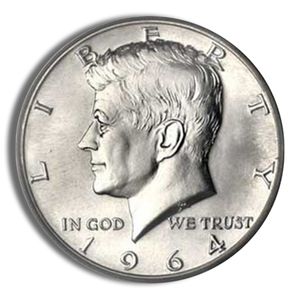
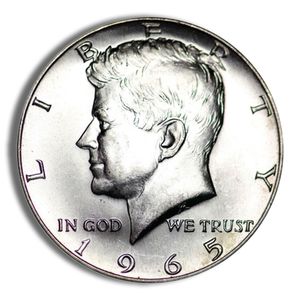
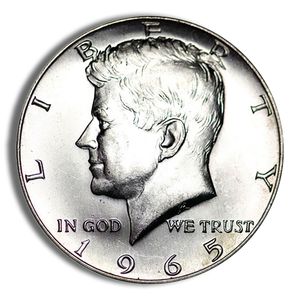
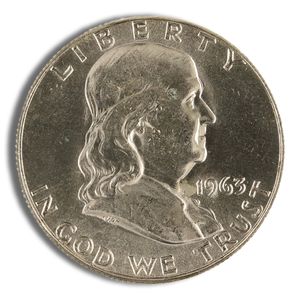
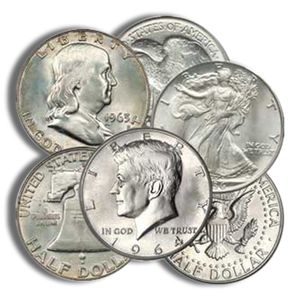
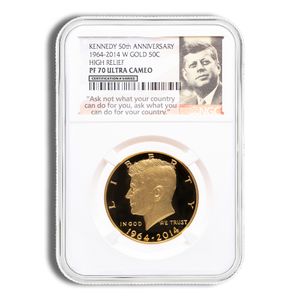
The obverse features a left-facing portrait of President John F. Kennedy, designed by Gilroy Roberts, who was then the United States Mint's Chief Engraver. The inscription "LIBERTY" arcs across the top of the coin, while "IN GOD WE TRUST" appears along the lower left, and the date is positioned at the bottom. The portrait carries a dignified, formal character that reflects the national mood at the time of the coin's creation.
The reverse was designed by Frank Gasparro and features a heraldic eagle centered within a presidential seal motif. The eagle is depicted with wings spread and a shield on its chest, surrounded by a ring of 50 stars representing the states. "UNITED STATES OF AMERICA" and "HALF DOLLAR" are inscribed around the design, completing a reverse composition that carries formal national symbolism without ornamental excess.
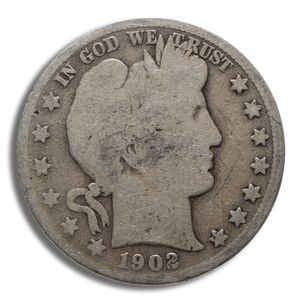
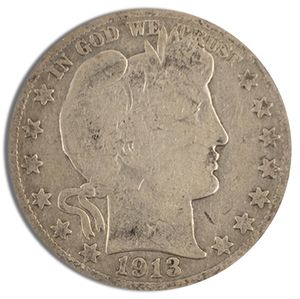
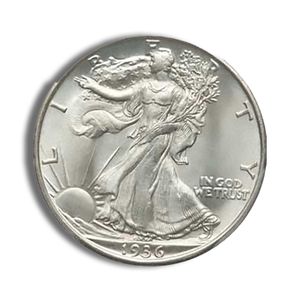
Coins in average circulated condition will show wear to the high points of both designs, with softening of fine detail on Kennedy's hair and the eagle's feathers. The overall design remains identifiable and clear, and the coin's character is not diminished by circulation in the eyes of buyers focused primarily on silver content.
At 0.715 troy ounces of silver per $1 face value, this lot falls below a full troy ounce, making it a flexible entry point for buyers who want to accumulate silver incrementally or diversify across multiple smaller holdings. The half dollar denomination is large enough to handle comfortably and small enough to trade in modest quantities without committing to full-ounce increments.
Junk silver lots denominated by face value are widely understood across the precious metals and coin markets, which makes buying and selling in these units practical. The $1 face value format is one of the most commonly quoted and traded configurations in the secondary market for 90% silver coins.
Kennedy Half Dollars from 1964 are produced to United States Mint standards, with composition, weight, and diameter all governed by federal specifications. The weight of a full 1964 Kennedy Half Dollar is 12.50 grams, and the silver content of 0.3575 troy ounces per coin is consistent and verifiable through standard testing methods. Because these are government-issued coins with known specifications, authentication is straightforward for experienced buyers and dealers alike.
We verify the authenticity and silver content of the coins we carry and source from established channels within the secondary market. Our authorized dealer relationships with PCGS and NGC reflect our commitment to authenticity standards across our broader product catalog, and those same standards inform how we evaluate and handle junk silver lots. Buyers can expect the silver content represented to be accurate to the face value purchased.
These coins are graded average circulated, which is the standard condition descriptor for junk silver coins that have seen genuine use in commerce. Expect honest wear consistent with circulation, including softened detail on the high relief areas of both sides and light surface marks from normal handling. No attempt has been made to clean or artificially improve the appearance of these coins, and individual coin grades within an average circulated lot will vary.
At the $1 face value quantity, coins ship in individual protective plastic flips to keep them secure during transit. Larger face value quantities are typically delivered in coin tubes or sealed bags depending on the amount purchased. Because these are circulated coins sourced from the secondary market, minor contact marks, surface toning, and handling signs are expected and do not affect the silver content or melt value of the coins in any way.
Pricing for 90% silver Kennedy Half Dollars is driven primarily by the spot price of silver, with the silver content per face value dollar serving as the baseline for calculating melt value. A $1 face value in 90% silver coins contains 0.715 troy ounces of silver, which makes it simple to calculate the melt value at any given spot price. Premiums above melt for junk silver are typically modest relative to many modern bullion products, which is part of the format's appeal for buyers prioritizing silver content efficiency.
Premium levels for circulated 90% silver can shift based on overall market demand, secondary market availability, and broader interest in silver at any given time. Our pricing reflects real-time spot conditions and is structured to provide transparency rather than obscure the relationship between spot price and total cost. The bid/ask spread displayed on our product pages gives buyers a clear picture of both acquisition cost and expected resale value before committing to a purchase.
Few silver products trade as readily as 90% silver coinage, and the 1964 Kennedy Half Dollar is among the most recognized examples within that category. The U.S. government origin, standardized silver content, and well-understood face value denomination make these coins easy to trade across coin shops, dealers, and private buyers. Liquidity for junk silver is generally strong because the market for it is deep and the pricing mechanism is transparent.
We operate a two-way market, which means customers can both buy and sell within the same platform. Knowing the buyback pricing before making a purchase gives buyers a clearer picture of the complete transaction, including what the spread looks like from entry to potential exit. For buyers who think beyond acquisition and want to understand the full cost of ownership, our competitive buyback pricing on widely traded silver products like these is a meaningful advantage.
The 1964 Kennedy Half Dollar occupies a unique position in the 90% silver market because it combines genuine historical significance with practical silver content. As the only year in the Kennedy series struck in full 90% silver, the 1964 date carries a distinction that other junk silver coins do not share. That said, buyers primarily drawn to the silver content will find the per-ounce cost of entry through this format competitive relative to many modern bullion alternatives.
The face value denomination system makes it easy to scale purchases up or down based on budget, and the broad familiarity of the Kennedy Half Dollar means most buyers, dealers, and coin shops will recognize and accept these without hesitation. For buyers who want silver in a form that is historically meaningful, practically liquid, and priced close to melt, this is a format that consistently delivers on all three counts.
We have built our business around transparency, and that is especially evident in how we price and present products like junk silver, where the relationship between spot price and melt value should be simple and clear. Our pricing reflects real-time market conditions, and we display the bid/ask spread on every product page so buyers can evaluate the complete transaction before making a decision. There are no hidden markups and no pressure-based sales tactics, just straightforward pricing tied to live market data.
Our A rating with the Better Business Bureau, membership in the American Numismatic Association and the National Coin and Bullion Association, and authorized dealer relationships with both PCGS and NGC reflect a standard of professionalism we hold across every product we carry. Junk silver may not carry a grading label, but it goes through the same scrutiny we apply to the rest of our catalog. Responsive customer service and reliable fulfillment round out an experience designed to prioritize your confidence at every step.
For buyers who regularly work in junk silver and want to transact closer to wholesale market pricing, Bullion Standard Pro provides access to live, executable wholesale bid and ask prices across our catalog. Because junk silver premiums are often tight and sensitive to spot price movement, having real-time pricing visibility rather than relying on delayed or estimated figures can make a meaningful difference in how you evaluate and execute purchases. Pro members also benefit from real-time portfolio valuation using current wholesale bid prices, which gives a more accurate picture of liquidation value than retail-based estimates.
Beyond pricing, Pro includes proprietary market intelligence tools that allow members to evaluate products based on historical premiums, bid/ask spread tightness, and liquidity metrics over time. For a product category like 90% silver where premiums and spreads fluctuate with broader market sentiment and secondary market supply, access to that kind of objective, data-driven context helps you make decisions based on current conditions rather than assumptions.
We support a wide range of payment methods to make the buying process as straightforward as the pricing. Credit card payments are accepted through Visa, Mastercard, American Express, and Discover, and digital options include PayPal, bank-connected payments through Plaid, and cryptocurrency payments via BitPay. Wire transfer and paper check are also available for buyers who prefer traditional bank-based methods.
Every transaction is handled with security and reliability as the baseline expectation. Whether you are making a small purchase or a larger acquisition of junk silver by face value, the same commitment to a secure and frictionless checkout experience applies regardless of payment method chosen.
Volume Discount Pricing Orders paid by debit card, credit card, and PayPal are an item's full list price and receive no discount. Orders paid by cryptocurrency receive a 3% discount from an item's full list price. Orders paid by eCheck (ACH), paper check, and bank wire receive a 4% discount from an item's full list price.
| Quantity | (e)Check/Wire | Crypto | CC/PayPal |
|---|---|---|---|
| 1 - 19 | $43.26 | $44.16 | $45.06 |
| 20 - 99 | $43.05 | $43.95 | $44.84 |
| 100 - 499 | $42.84 | $43.73 | $44.62 |
| 500 - 999 | $42.63 | $43.51 | $44.40 |
| 1000+ | $42.41 | $43.30 | $44.18 |
1+
|
$41.62 | $42.49 | $43.36 |
Product ID: BST-0019862451
| Year | 1964 |
|---|---|
| Precious Metal Type | Silver |
| Bullion Coin Type | Kennedy Half |
| Format | Coin |
| Country of Origin | United States |
| Brand/Mint | U.S. Mint |
| Mint Mark | Various |
| Purity | 0.9 |
| Weight | 0.715 oz |
| Thickness (mm) | 2.15 mm |

| Diameter (mm) | 30.61 mm |
| Grade | Circulated |
The 1964 Kennedy Half Dollar is one of the most recognized 90% silver coins in the American bullion market. Each coin contains 0.3575 troy ounces of silver, and a $1 face value lot includes two coins totaling 0.715 troy ounces of silver at .900 fineness. Struck by the United States Mint at multiple facilities, these coins circulated widely and remain a staple of the junk silver market for buyers seeking silver content tied to a familiar, government-issued piece.
We carry these coins in average circulated condition, making them a practical and cost-effective way to acquire silver by face value rather than by premium-heavy bullion products. For buyers focused on silver content per dollar spent, the $1 face value format is a straightforward and widely understood unit of measure in the secondary market.
The Kennedy Half Dollar was introduced in 1964, just months after the assassination of President John F. Kennedy in November 1963. Congress acted quickly to authorize the new coin as a tribute, and the United States Mint moved to produce it in time for a 1964 release. The coin replaced the Franklin Half Dollar series, whic
…The 1964 Kennedy Half Dollar is one of the most recognized 90% silver coins in the American bullion market. Each coin contains 0.3575 troy ounces of silver, and a $1 face value lot includes two coins totaling 0.715 troy ounces of silver at .900 fineness. Struck by the United States Mint at multiple facilities, these coins circulated widely and remain a staple of the junk silver market for buyers seeking silver content tied to a familiar, government-issued piece.
We carry these coins in average circulated condition, making them a practical and cost-effective way to acquire silver by face value rather than by premium-heavy bullion products. For buyers focused on silver content per dollar spent, the $1 face value format is a straightforward and widely understood unit of measure in the secondary market.
The Kennedy Half Dollar was introduced in 1964, just months after the assassination of President John F. Kennedy in November 1963. Congress acted quickly to authorize the new coin as a tribute, and the United States Mint moved to produce it in time for a 1964 release. The coin replaced the Franklin Half Dollar series, which had run from 1948 through 1963.
The 1964 issue holds a distinct place in American coinage history as the only year the Kennedy Half Dollar was struck in 90% silver. Starting in 1965, the composition changed to a 40% silver clad format, and by 1971 the coin transitioned to a copper-nickel clad composition with no silver content at all. This makes the 1964 date the sole 90% silver year in the entire Kennedy Half Dollar series, which accounts for the consistent demand these coins see in the junk silver market.
Production was heavy across both the Philadelphia and Denver mints, with over 430 million coins struck to meet public demand. Despite that large mintage, circulated examples remain actively traded because of their silver content and historical significance within American numismatic history.
The obverse features a left-facing portrait of President John F. Kennedy, designed by Gilroy Roberts, who was then the United States Mint's Chief Engraver. The inscription "LIBERTY" arcs across the top of the coin, while "IN GOD WE TRUST" appears along the lower left, and the date is positioned at the bottom. The portrait carries a dignified, formal character that reflects the national mood at the time of the coin's creation.
The reverse was designed by Frank Gasparro and features a heraldic eagle centered within a presidential seal motif. The eagle is depicted with wings spread and a shield on its chest, surrounded by a ring of 50 stars representing the states. "UNITED STATES OF AMERICA" and "HALF DOLLAR" are inscribed around the design, completing a reverse composition that carries formal national symbolism without ornamental excess.
Coins in average circulated condition will show wear to the high points of both designs, with softening of fine detail on Kennedy's hair and the eagle's feathers. The overall design remains identifiable and clear, and the coin's character is not diminished by circulation in the eyes of buyers focused primarily on silver content.
At 0.715 troy ounces of silver per $1 face value, this lot falls below a full troy ounce, making it a flexible entry point for buyers who want to accumulate silver incrementally or diversify across multiple smaller holdings. The half dollar denomination is large enough to handle comfortably and small enough to trade in modest quantities without committing to full-ounce increments.
Junk silver lots denominated by face value are widely understood across the precious metals and coin markets, which makes buying and selling in these units practical. The $1 face value format is one of the most commonly quoted and traded configurations in the secondary market for 90% silver coins.
Kennedy Half Dollars from 1964 are produced to United States Mint standards, with composition, weight, and diameter all governed by federal specifications. The weight of a full 1964 Kennedy Half Dollar is 12.50 grams, and the silver content of 0.3575 troy ounces per coin is consistent and verifiable through standard testing methods. Because these are government-issued coins with known specifications, authentication is straightforward for experienced buyers and dealers alike.
We verify the authenticity and silver content of the coins we carry and source from established channels within the secondary market. Our authorized dealer relationships with PCGS and NGC reflect our commitment to authenticity standards across our broader product catalog, and those same standards inform how we evaluate and handle junk silver lots. Buyers can expect the silver content represented to be accurate to the face value purchased.
These coins are graded average circulated, which is the standard condition descriptor for junk silver coins that have seen genuine use in commerce. Expect honest wear consistent with circulation, including softened detail on the high relief areas of both sides and light surface marks from normal handling. No attempt has been made to clean or artificially improve the appearance of these coins, and individual coin grades within an average circulated lot will vary.
At the $1 face value quantity, coins ship in individual protective plastic flips to keep them secure during transit. Larger face value quantities are typically delivered in coin tubes or sealed bags depending on the amount purchased. Because these are circulated coins sourced from the secondary market, minor contact marks, surface toning, and handling signs are expected and do not affect the silver content or melt value of the coins in any way.
Pricing for 90% silver Kennedy Half Dollars is driven primarily by the spot price of silver, with the silver content per face value dollar serving as the baseline for calculating melt value. A $1 face value in 90% silver coins contains 0.715 troy ounces of silver, which makes it simple to calculate the melt value at any given spot price. Premiums above melt for junk silver are typically modest relative to many modern bullion products, which is part of the format's appeal for buyers prioritizing silver content efficiency.
Premium levels for circulated 90% silver can shift based on overall market demand, secondary market availability, and broader interest in silver at any given time. Our pricing reflects real-time spot conditions and is structured to provide transparency rather than obscure the relationship between spot price and total cost. The bid/ask spread displayed on our product pages gives buyers a clear picture of both acquisition cost and expected resale value before committing to a purchase.
Few silver products trade as readily as 90% silver coinage, and the 1964 Kennedy Half Dollar is among the most recognized examples within that category. The U.S. government origin, standardized silver content, and well-understood face value denomination make these coins easy to trade across coin shops, dealers, and private buyers. Liquidity for junk silver is generally strong because the market for it is deep and the pricing mechanism is transparent.
We operate a two-way market, which means customers can both buy and sell within the same platform. Knowing the buyback pricing before making a purchase gives buyers a clearer picture of the complete transaction, including what the spread looks like from entry to potential exit. For buyers who think beyond acquisition and want to understand the full cost of ownership, our competitive buyback pricing on widely traded silver products like these is a meaningful advantage.
The 1964 Kennedy Half Dollar occupies a unique position in the 90% silver market because it combines genuine historical significance with practical silver content. As the only year in the Kennedy series struck in full 90% silver, the 1964 date carries a distinction that other junk silver coins do not share. That said, buyers primarily drawn to the silver content will find the per-ounce cost of entry through this format competitive relative to many modern bullion alternatives.
The face value denomination system makes it easy to scale purchases up or down based on budget, and the broad familiarity of the Kennedy Half Dollar means most buyers, dealers, and coin shops will recognize and accept these without hesitation. For buyers who want silver in a form that is historically meaningful, practically liquid, and priced close to melt, this is a format that consistently delivers on all three counts.
We have built our business around transparency, and that is especially evident in how we price and present products like junk silver, where the relationship between spot price and melt value should be simple and clear. Our pricing reflects real-time market conditions, and we display the bid/ask spread on every product page so buyers can evaluate the complete transaction before making a decision. There are no hidden markups and no pressure-based sales tactics, just straightforward pricing tied to live market data.
Our A rating with the Better Business Bureau, membership in the American Numismatic Association and the National Coin and Bullion Association, and authorized dealer relationships with both PCGS and NGC reflect a standard of professionalism we hold across every product we carry. Junk silver may not carry a grading label, but it goes through the same scrutiny we apply to the rest of our catalog. Responsive customer service and reliable fulfillment round out an experience designed to prioritize your confidence at every step.
For buyers who regularly work in junk silver and want to transact closer to wholesale market pricing, Bullion Standard Pro provides access to live, executable wholesale bid and ask prices across our catalog. Because junk silver premiums are often tight and sensitive to spot price movement, having real-time pricing visibility rather than relying on delayed or estimated figures can make a meaningful difference in how you evaluate and execute purchases. Pro members also benefit from real-time portfolio valuation using current wholesale bid prices, which gives a more accurate picture of liquidation value than retail-based estimates.
Beyond pricing, Pro includes proprietary market intelligence tools that allow members to evaluate products based on historical premiums, bid/ask spread tightness, and liquidity metrics over time. For a product category like 90% silver where premiums and spreads fluctuate with broader market sentiment and secondary market supply, access to that kind of objective, data-driven context helps you make decisions based on current conditions rather than assumptions.
We support a wide range of payment methods to make the buying process as straightforward as the pricing. Credit card payments are accepted through Visa, Mastercard, American Express, and Discover, and digital options include PayPal, bank-connected payments through Plaid, and cryptocurrency payments via BitPay. Wire transfer and paper check are also available for buyers who prefer traditional bank-based methods.
Every transaction is handled with security and reliability as the baseline expectation. Whether you are making a small purchase or a larger acquisition of junk silver by face value, the same commitment to a secure and frictionless checkout experience applies regardless of payment method chosen.