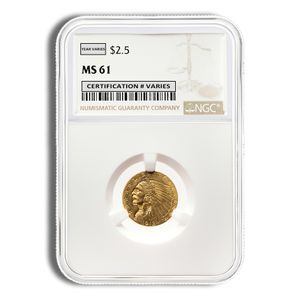
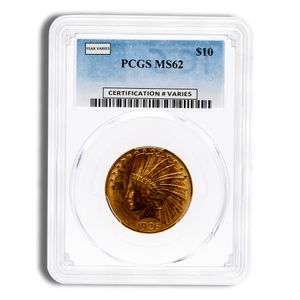
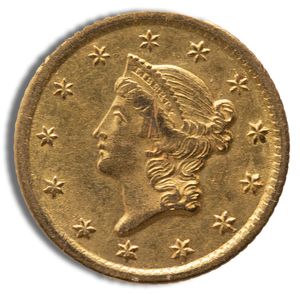
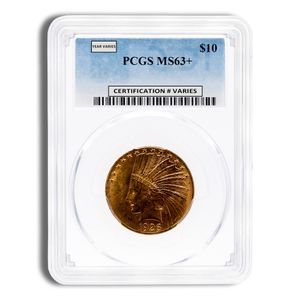
The $1 Gold Indian Type 3 is a nineteenth-century United States coin struck in .900 fine gold, carrying a nominal face value of one dollar. Each coin contains 0.0483 troy ounces of gold and was produced at various mint facilities across the country. The example offered here has been independently graded MS61 by the Numismatic Guaranty Company, placing it in the mint state category and reflecting a coin that has seen minimal wear but may carry light contact marks consistent with that grade tier. We carry these certified pieces for collectors and buyers seeking original American gold coinage with documented authenticity.
The Type 3 designation within the Indian Head gold dollar series distinguishes it from its two predecessors by its enlarged portrait and refined design. As a certified example rather than a generic secondary-market piece, the NGC slab provides a standardized framework for evaluating both the coin's condition and its authenticity. Because the specific year of issue may vary, buyers should expect a coin that falls within the Type 3 production window rather than a fixed date.
History and Background
The gold dollar was authorized und…
Overview of $1 Gold Indian Type 3
The $1 Gold Indian Type 3 is a nineteenth-century United States coin struck in .900 fine gold, carrying a nominal face value of one dollar. Each coin contains 0.0483 troy ounces of gold and was produced at various mint facilities across the country. The example offered here has been independently graded MS61 by the Numismatic Guaranty Company, placing it in the mint state category and reflecting a coin that has seen minimal wear but may carry light contact marks consistent with that grade tier. We carry these certified pieces for collectors and buyers seeking original American gold coinage with documented authenticity.
The Type 3 designation within the Indian Head gold dollar series distinguishes it from its two predecessors by its enlarged portrait and refined design. As a certified example rather than a generic secondary-market piece, the NGC slab provides a standardized framework for evaluating both the coin's condition and its authenticity. Because the specific year of issue may vary, buyers should expect a coin that falls within the Type 3 production window rather than a fixed date.
History and Background
The gold dollar was authorized under the Coinage Act of 1849, introduced partly in response to the influx of gold following the California Gold Rush. The denomination was produced continuously until 1889 and passed through three distinct design types during its lifespan. The Type 1 Liberty Head ran from 1849 to 1854, followed by the small-head Indian Princess Type 2 from 1854 to 1855, and finally the large-head Indian Princess Type 3 from 1856 through the end of production in 1889.
The Type 3 design was a direct response to public and congressional criticism of the Type 2, which suffered from shallow relief and poor strike quality due to the small head relative to the coin's narrow planchet. Chief Engraver James Longacre enlarged the portrait and made adjustments to the reverse to improve strike depth and visual clarity. Type 3 coins were struck at facilities including Philadelphia, San Francisco, Charlotte, Dahlonega, and New Orleans, though production volumes varied considerably by year and mint.
By the time the gold dollar was discontinued in 1889, it had become one of the more artistically distinctive small-denomination coins in American numismatic history. Its long run and variety of issuing mints have made the Type 3 series a consistent focus among collectors of nineteenth-century United States gold coinage.
Design and Aesthetics
The obverse of the Type 3 gold dollar features a large, forward-facing portrait of a Native American princess wearing a feathered headdress, a design element that Longacre revised substantially from the smaller and less defined Type 2 rendering. The date appears below the portrait, and the word LIBERTY is inscribed across the headband of the headdress. The design occupies more of the coin's face than its predecessors, giving the portrait a more commanding and legible presence despite the coin's small diameter.
The reverse carries a wreath composed of corn, wheat, tobacco, and other agricultural motifs encircling the denomination expressed as one dollar, along with the inscription UNITED STATES OF AMERICA. The composition is clean and symmetrical, with the agricultural wreath serving as a visual counterpart to the portrait's cultural imagery. Given the coin's modest diameter of approximately 15 millimeters, the intricacy of both sides reflects careful die work for its era.
At the MS61 grade level, the surfaces will typically show a full mint luster interrupted by scattered contact marks, primarily in the open fields. These marks are characteristic of the grade and do not represent post-mint damage. The overall appearance remains attractive and clearly above circulated condition, making the Type 3 Indian at MS61 a recognizable and presentable certified coin.
Fractional Size and Accessibility
At 0.0483 troy ounces, the $1 Gold Indian Type 3 represents one of the smallest gold coin formats produced by the United States Mint. The coin's diminutive size makes it an accessible entry point for buyers who want certified original American gold without committing to a full ounce or fractional modern bullion coin. Its low gold content by weight also keeps the metal value component relatively contained, meaning the coin's price reflects both its numismatic character and its certified grade in addition to intrinsic metal value.
Because the coin is small enough to handle carefully within its NGC slab, the format naturally lends itself to single-piece collecting rather than bulk accumulation. Buyers interested in nineteenth-century U.S. gold at a more accessible price point often find the Type 3 Indian a practical and historically meaningful choice compared to larger-denomination gold issues of the same era.
Authenticity and Product Integrity
Each coin in this listing has been reviewed, authenticated, and encapsulated by the Numismatic Guaranty Company, one of the two most widely recognized third-party grading services in the numismatic industry. The NGC slab provides tamper-evident encapsulation, an assigned grade, and a certification number that can be verified directly through NGC's online registry. This process removes uncertainty about the coin's authenticity and condition classification, which is particularly important for nineteenth-century gold coins where counterfeits and alterations exist in the broader market.
We are an authorized NGC dealer, which means our relationship with the grading service is formally recognized and that the certified products we carry meet the standards associated with that designation. Our broader sourcing draws from reputable numismatic wholesalers and distributors operating within established market channels. Every certified coin that passes through our inventory is handled with the care expected of slabbed numismatic material, and the NGC encapsulation itself serves as the primary document of record for authenticity and grade.
Condition and Packaging
The MS61 grade assigned by NGC places this coin firmly in the mint state category, meaning no wear is present on the high points from circulation. However, MS61 is the entry-level mint state grade, and coins at this level will exhibit a higher density of contact marks and possible minor blemishes in the fields compared to higher-tier grades within the MS range. The coin retains its original mint luster, though that luster may be interrupted or subdued by the marks noted above. For buyers focused primarily on owning a certified, uncirculated example of this series rather than a premium-grade specimen, MS61 offers an accessible grade tier with full authenticity documentation.
Because this product is NGC-certified and individually slabbed, it ships in its original NGC holder rather than a generic flip or tube. Single purchases ship with the coin secured in its slab, typically within a padded or protective outer container appropriate for numismatic material. The specific year of issue is not predetermined, so the coin you receive will be a genuine Type 3 Indian gold dollar within the applicable production range, certified at MS61, and representative of the grade description above.
Pricing and Market Factors
Pricing for the MS61 Type 3 Gold Indian reflects the current spot price of gold as its baseline, with a premium applied above that figure to account for the coin's certified grade, numismatic status, and the costs associated with third-party authentication. Unlike modern bullion coins where premiums are relatively narrow and driven primarily by supply and demand for metal content, certified nineteenth-century gold carries a numismatic component that can cause premiums to diverge meaningfully from spot. The MS61 grade tier is accessible within the certified range for this series, which tends to keep pricing more moderate compared to higher-grade examples.
Market conditions for Type 3 gold dollars can also be influenced by collector demand specific to the series, year-over-year changes in certified population data from NGC and PCGS, and broader trends in the vintage U.S. gold market. Our pricing reflects real-time gold spot movement alongside the numismatic market context for this coin, giving buyers a transparent view of what drives the number they see at checkout.
Selling and Liquidity
Certified $1 Gold Indians in MS61 occupy a recognized tier within the vintage U.S. gold market and trade regularly through numismatic dealers, auction platforms, and direct buyer channels. The NGC slab adds a layer of standardization that makes the coin easier to transact compared to raw examples, since the grade and authenticity are already established and verifiable. That said, liquidity for certified numismatic coins is generally more dependent on active collector demand than it is for standard bullion products, and pricing can be less immediate to execute depending on market conditions at the time of sale.
We operate within a two-way market model that supports both purchasing and selling, and buyers who acquire this coin through us have a straightforward path to initiating a sale when the time comes. Understanding the distinction between the numismatic premium embedded in a certified coin's price and the underlying metal value is a meaningful part of evaluating any transaction in this category, and we present that information transparently so buyers can assess the full picture before committing.
Why Buy the $1 Gold Indian Type 3 NGC MS61?
The Type 3 Gold Indian occupies a distinct position in American numismatic history as the final and most refined chapter of the gold dollar series. An NGC-graded example at MS61 offers buyers a certified, uncirculated piece from a nineteenth-century U.S. Mint production run without requiring the significant premium associated with higher-grade certified examples. For collectors who prioritize genuine historical material with documented authenticity over gem-quality surfaces, MS61 is a sensible and cost-efficient grade tier.
The random-year format reflects the nature of secondary-market certified coin trading, where specific dates may carry their own collector significance but where the series and grade are often the primary drivers of appeal. Buyers focused on the Type 3 Indian as a category rather than a date-specific rarity will find this listing a practical way to acquire a certified example within a well-defined grade range. The combination of NGC authentication, mint state status, and the historical character of the series makes this a meaningful addition to any collection focused on original American gold coinage.
Why Buy from Bullion Standard?
We have been operating as a precious metals dealer since 2010, and our approach to the business has remained consistent: transparent pricing, honest representation of products, and a buying experience built around the customer rather than the transaction. Our A rating with the Better Business Bureau reflects that consistency, as does our membership in both the American Numismatic Association and the National Coin and Bullion Association. These affiliations are not incidental to how we operate. They reflect a commitment to the standards and ethics those organizations represent.
As an authorized dealer for both NGC and PCGS, we are recognized by the two most respected grading services in the industry, and that relationship extends to how we handle, verify, and present certified products like this one. Our pricing is transparent, our product descriptions are accurate, and our customer service is accessible when questions arise. We do not operate with pressure-based sales tactics or obscure our pricing structures. What you see on the product page is what you pay, and our two-way market means you can return to us when it is time to sell just as easily as when you are ready to buy.
Get Near-Spot Pricing with Bullion Standard Pro
Bullion Standard Pro gives members access to live, executable wholesale bid and ask pricing across our catalog, including certified numismatic products like the Type 3 Gold Indian. For a coin where premiums are shaped by both the underlying gold market and collector-specific demand, having visibility into real-time wholesale pricing provides meaningful context that standard retail listings do not typically offer. Pro members can evaluate what the coin is trading for at the wholesale level and compare that against the retail ask, giving them a more complete picture of the spread they are working within.
Portfolio valuation through Pro uses live wholesale bid pricing rather than estimated retail values, so members can view their holdings based on current liquidation value rather than what a product was purchased for or what it might retail for elsewhere. Combined with our product research tools and historical premium data, Pro provides a framework for understanding certified numismatic coins not just as collectibles, but as instruments with measurable market characteristics that can be tracked and compared over time.
Flexible and Secure Payment Options
We support a broad range of payment methods to make the purchasing process straightforward and secure for every buyer. Credit card payments are accepted through Visa, Mastercard, American Express, and Discover, and PayPal is available for buyers who prefer that platform. Bank-connected payments through Plaid offer a direct and efficient transfer option, while wire transfer and paper check remain available for buyers who prefer traditional banking methods. Cryptocurrency payments are processed through BitPay for those who prefer to transact in digital assets.
Every payment method is integrated with security standards appropriate to precious metals transactions, and our checkout process is designed to minimize friction while protecting buyer information at each step. Whether you are completing a single certified coin purchase or a larger transaction, the same secure and transparent process applies across all payment options.
The $1 Gold Indian Type 3 is a nineteenth-century United States coin struck in .900 fine gold, carrying a nominal face value of one dollar. Each coin contains 0.0483 troy ounces of gold and was produced at various mint facilities across the country. The example offered here has been independently graded MS61 by the Numismatic Guaranty Company, placing it in the mint state category and reflecting a coin that has seen minimal wear but may carry light contact marks consistent with that grade tier. We carry these certified pieces for collectors and buyers seeking original American gold coinage with documented authenticity.
The Type 3 designation within the Indian Head gold dollar series distinguishes it from its two predecessors by its enlarged portrait and refined design. As a certified example rather than a generic secondary-market piece, the NGC slab provides a standardized framework for evaluating both the coin's condition and its authenticity. Because the specific year of issue may vary, buyers should expect a coin that falls within the Type 3 production window rather than a fixed date.
History and Background
The gold dollar was authorized und…
Overview of $1 Gold Indian Type 3
The $1 Gold Indian Type 3 is a nineteenth-century United States coin struck in .900 fine gold, carrying a nominal face value of one dollar. Each coin contains 0.0483 troy ounces of gold and was produced at various mint facilities across the country. The example offered here has been independently graded MS61 by the Numismatic Guaranty Company, placing it in the mint state category and reflecting a coin that has seen minimal wear but may carry light contact marks consistent with that grade tier. We carry these certified pieces for collectors and buyers seeking original American gold coinage with documented authenticity.
The Type 3 designation within the Indian Head gold dollar series distinguishes it from its two predecessors by its enlarged portrait and refined design. As a certified example rather than a generic secondary-market piece, the NGC slab provides a standardized framework for evaluating both the coin's condition and its authenticity. Because the specific year of issue may vary, buyers should expect a coin that falls within the Type 3 production window rather than a fixed date.
History and Background
The gold dollar was authorized under the Coinage Act of 1849, introduced partly in response to the influx of gold following the California Gold Rush. The denomination was produced continuously until 1889 and passed through three distinct design types during its lifespan. The Type 1 Liberty Head ran from 1849 to 1854, followed by the small-head Indian Princess Type 2 from 1854 to 1855, and finally the large-head Indian Princess Type 3 from 1856 through the end of production in 1889.
The Type 3 design was a direct response to public and congressional criticism of the Type 2, which suffered from shallow relief and poor strike quality due to the small head relative to the coin's narrow planchet. Chief Engraver James Longacre enlarged the portrait and made adjustments to the reverse to improve strike depth and visual clarity. Type 3 coins were struck at facilities including Philadelphia, San Francisco, Charlotte, Dahlonega, and New Orleans, though production volumes varied considerably by year and mint.
By the time the gold dollar was discontinued in 1889, it had become one of the more artistically distinctive small-denomination coins in American numismatic history. Its long run and variety of issuing mints have made the Type 3 series a consistent focus among collectors of nineteenth-century United States gold coinage.
Design and Aesthetics
The obverse of the Type 3 gold dollar features a large, forward-facing portrait of a Native American princess wearing a feathered headdress, a design element that Longacre revised substantially from the smaller and less defined Type 2 rendering. The date appears below the portrait, and the word LIBERTY is inscribed across the headband of the headdress. The design occupies more of the coin's face than its predecessors, giving the portrait a more commanding and legible presence despite the coin's small diameter.
The reverse carries a wreath composed of corn, wheat, tobacco, and other agricultural motifs encircling the denomination expressed as one dollar, along with the inscription UNITED STATES OF AMERICA. The composition is clean and symmetrical, with the agricultural wreath serving as a visual counterpart to the portrait's cultural imagery. Given the coin's modest diameter of approximately 15 millimeters, the intricacy of both sides reflects careful die work for its era.
At the MS61 grade level, the surfaces will typically show a full mint luster interrupted by scattered contact marks, primarily in the open fields. These marks are characteristic of the grade and do not represent post-mint damage. The overall appearance remains attractive and clearly above circulated condition, making the Type 3 Indian at MS61 a recognizable and presentable certified coin.
Fractional Size and Accessibility
At 0.0483 troy ounces, the $1 Gold Indian Type 3 represents one of the smallest gold coin formats produced by the United States Mint. The coin's diminutive size makes it an accessible entry point for buyers who want certified original American gold without committing to a full ounce or fractional modern bullion coin. Its low gold content by weight also keeps the metal value component relatively contained, meaning the coin's price reflects both its numismatic character and its certified grade in addition to intrinsic metal value.
Because the coin is small enough to handle carefully within its NGC slab, the format naturally lends itself to single-piece collecting rather than bulk accumulation. Buyers interested in nineteenth-century U.S. gold at a more accessible price point often find the Type 3 Indian a practical and historically meaningful choice compared to larger-denomination gold issues of the same era.
Authenticity and Product Integrity
Each coin in this listing has been reviewed, authenticated, and encapsulated by the Numismatic Guaranty Company, one of the two most widely recognized third-party grading services in the numismatic industry. The NGC slab provides tamper-evident encapsulation, an assigned grade, and a certification number that can be verified directly through NGC's online registry. This process removes uncertainty about the coin's authenticity and condition classification, which is particularly important for nineteenth-century gold coins where counterfeits and alterations exist in the broader market.
We are an authorized NGC dealer, which means our relationship with the grading service is formally recognized and that the certified products we carry meet the standards associated with that designation. Our broader sourcing draws from reputable numismatic wholesalers and distributors operating within established market channels. Every certified coin that passes through our inventory is handled with the care expected of slabbed numismatic material, and the NGC encapsulation itself serves as the primary document of record for authenticity and grade.
Condition and Packaging
The MS61 grade assigned by NGC places this coin firmly in the mint state category, meaning no wear is present on the high points from circulation. However, MS61 is the entry-level mint state grade, and coins at this level will exhibit a higher density of contact marks and possible minor blemishes in the fields compared to higher-tier grades within the MS range. The coin retains its original mint luster, though that luster may be interrupted or subdued by the marks noted above. For buyers focused primarily on owning a certified, uncirculated example of this series rather than a premium-grade specimen, MS61 offers an accessible grade tier with full authenticity documentation.
Because this product is NGC-certified and individually slabbed, it ships in its original NGC holder rather than a generic flip or tube. Single purchases ship with the coin secured in its slab, typically within a padded or protective outer container appropriate for numismatic material. The specific year of issue is not predetermined, so the coin you receive will be a genuine Type 3 Indian gold dollar within the applicable production range, certified at MS61, and representative of the grade description above.
Pricing and Market Factors
Pricing for the MS61 Type 3 Gold Indian reflects the current spot price of gold as its baseline, with a premium applied above that figure to account for the coin's certified grade, numismatic status, and the costs associated with third-party authentication. Unlike modern bullion coins where premiums are relatively narrow and driven primarily by supply and demand for metal content, certified nineteenth-century gold carries a numismatic component that can cause premiums to diverge meaningfully from spot. The MS61 grade tier is accessible within the certified range for this series, which tends to keep pricing more moderate compared to higher-grade examples.
Market conditions for Type 3 gold dollars can also be influenced by collector demand specific to the series, year-over-year changes in certified population data from NGC and PCGS, and broader trends in the vintage U.S. gold market. Our pricing reflects real-time gold spot movement alongside the numismatic market context for this coin, giving buyers a transparent view of what drives the number they see at checkout.
Selling and Liquidity
Certified $1 Gold Indians in MS61 occupy a recognized tier within the vintage U.S. gold market and trade regularly through numismatic dealers, auction platforms, and direct buyer channels. The NGC slab adds a layer of standardization that makes the coin easier to transact compared to raw examples, since the grade and authenticity are already established and verifiable. That said, liquidity for certified numismatic coins is generally more dependent on active collector demand than it is for standard bullion products, and pricing can be less immediate to execute depending on market conditions at the time of sale.
We operate within a two-way market model that supports both purchasing and selling, and buyers who acquire this coin through us have a straightforward path to initiating a sale when the time comes. Understanding the distinction between the numismatic premium embedded in a certified coin's price and the underlying metal value is a meaningful part of evaluating any transaction in this category, and we present that information transparently so buyers can assess the full picture before committing.
Why Buy the $1 Gold Indian Type 3 NGC MS61?
The Type 3 Gold Indian occupies a distinct position in American numismatic history as the final and most refined chapter of the gold dollar series. An NGC-graded example at MS61 offers buyers a certified, uncirculated piece from a nineteenth-century U.S. Mint production run without requiring the significant premium associated with higher-grade certified examples. For collectors who prioritize genuine historical material with documented authenticity over gem-quality surfaces, MS61 is a sensible and cost-efficient grade tier.
The random-year format reflects the nature of secondary-market certified coin trading, where specific dates may carry their own collector significance but where the series and grade are often the primary drivers of appeal. Buyers focused on the Type 3 Indian as a category rather than a date-specific rarity will find this listing a practical way to acquire a certified example within a well-defined grade range. The combination of NGC authentication, mint state status, and the historical character of the series makes this a meaningful addition to any collection focused on original American gold coinage.
Why Buy from Bullion Standard?
We have been operating as a precious metals dealer since 2010, and our approach to the business has remained consistent: transparent pricing, honest representation of products, and a buying experience built around the customer rather than the transaction. Our A rating with the Better Business Bureau reflects that consistency, as does our membership in both the American Numismatic Association and the National Coin and Bullion Association. These affiliations are not incidental to how we operate. They reflect a commitment to the standards and ethics those organizations represent.
As an authorized dealer for both NGC and PCGS, we are recognized by the two most respected grading services in the industry, and that relationship extends to how we handle, verify, and present certified products like this one. Our pricing is transparent, our product descriptions are accurate, and our customer service is accessible when questions arise. We do not operate with pressure-based sales tactics or obscure our pricing structures. What you see on the product page is what you pay, and our two-way market means you can return to us when it is time to sell just as easily as when you are ready to buy.
Get Near-Spot Pricing with Bullion Standard Pro
Bullion Standard Pro gives members access to live, executable wholesale bid and ask pricing across our catalog, including certified numismatic products like the Type 3 Gold Indian. For a coin where premiums are shaped by both the underlying gold market and collector-specific demand, having visibility into real-time wholesale pricing provides meaningful context that standard retail listings do not typically offer. Pro members can evaluate what the coin is trading for at the wholesale level and compare that against the retail ask, giving them a more complete picture of the spread they are working within.
Portfolio valuation through Pro uses live wholesale bid pricing rather than estimated retail values, so members can view their holdings based on current liquidation value rather than what a product was purchased for or what it might retail for elsewhere. Combined with our product research tools and historical premium data, Pro provides a framework for understanding certified numismatic coins not just as collectibles, but as instruments with measurable market characteristics that can be tracked and compared over time.
Flexible and Secure Payment Options
We support a broad range of payment methods to make the purchasing process straightforward and secure for every buyer. Credit card payments are accepted through Visa, Mastercard, American Express, and Discover, and PayPal is available for buyers who prefer that platform. Bank-connected payments through Plaid offer a direct and efficient transfer option, while wire transfer and paper check remain available for buyers who prefer traditional banking methods. Cryptocurrency payments are processed through BitPay for those who prefer to transact in digital assets.
Every payment method is integrated with security standards appropriate to precious metals transactions, and our checkout process is designed to minimize friction while protecting buyer information at each step. Whether you are completing a single certified coin purchase or a larger transaction, the same secure and transparent process applies across all payment options.
This website uses cookies for analytics and to deliver personalized content. By continuing to
use our site, you acknowledge that you have read and agree to our Privacy Policy and Cookie
Policy.
Current Quantities Available
Unfortunately, we only have 0
of
this item in
stock.
Please call us at (833) 278-4653
or email us at support@bullionstandard.com
if you wish to purchase a larger quantity than what is available on our website.
We can often locate additional quantities.

 (833) 278-4653


.png)