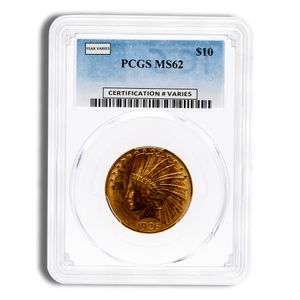
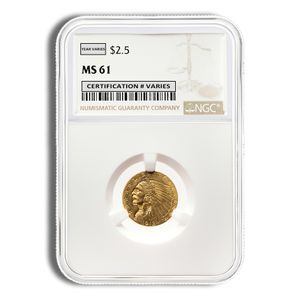
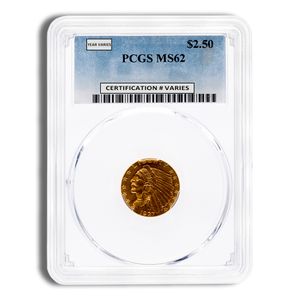
The $10 Gold Indian Eagle is one of the most respected numismatic gold coins ever produced by the United States Mint. Struck in .900 fine gold with a total weight of 0.4837 troy ounces, it carries a face value of ten dollars and stands as one of the defining pieces of early American coinage. Each coin we offer in this listing comes certified MS63 by PCGS, confirming a choice mint state grade with only minor blemishes or contact marks that stop short of a higher designation. Because these are offered as random year, the specific date will vary, but every example meets the same PCGS grade standard regardless of which year you receive.
The MS63 grade places these coins firmly in the collectible tier while still carrying meaningful gold content. For buyers who want a historically significant United States gold coin in a confirmed, third-party-verified state of preservation, this is a strong and accessible entry point.
History and Background
The $10 Gold Indian Eagle was introduced in 1907 as part of President Theodore Roosevelt's ambitious campaign to elevate the artistic quality of American coinage. Roosevelt, dissatisfied with what he viewed as…
Overview of $10 Gold Indian Eagle
The $10 Gold Indian Eagle is one of the most respected numismatic gold coins ever produced by the United States Mint. Struck in .900 fine gold with a total weight of 0.4837 troy ounces, it carries a face value of ten dollars and stands as one of the defining pieces of early American coinage. Each coin we offer in this listing comes certified MS63 by PCGS, confirming a choice mint state grade with only minor blemishes or contact marks that stop short of a higher designation. Because these are offered as random year, the specific date will vary, but every example meets the same PCGS grade standard regardless of which year you receive.
The MS63 grade places these coins firmly in the collectible tier while still carrying meaningful gold content. For buyers who want a historically significant United States gold coin in a confirmed, third-party-verified state of preservation, this is a strong and accessible entry point.
History and Background
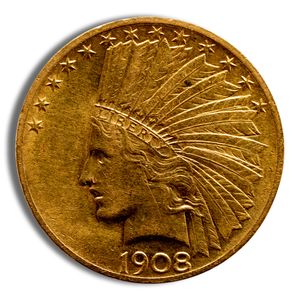
The $10 Gold Indian Eagle was introduced in 1907 as part of President Theodore Roosevelt's ambitious campaign to elevate the artistic quality of American coinage. Roosevelt, dissatisfied with what he viewed as uninspired coin designs, personally enlisted sculptor Augustus Saint-Gaudens to reimagine the nation's gold coinage. While Saint-Gaudens died before the project was completed, his design work informed the finished coins, with Bela Lyon Pratt ultimately executing the Indian Head design on the quarter eagle and half eagle. The $10 Indian was designed by Saint-Gaudens himself, featuring a distinct incuse relief style unlike anything that had appeared on American coinage before.
The incuse design was controversial from the start. Rather than the raised relief found on traditional coins, the imagery was recessed into the coin's surface, a technique borrowed from ancient Egyptian art. Critics argued that the recessed design allowed dirt and bacteria to collect in the grooves, though this concern was largely overstated. Production continued across several years and multiple mint facilities before the series was discontinued in 1933 following the federal suspension of gold coin circulation.
The 1933 cessation makes surviving examples from certain years considerably scarcer than others, and the series as a whole carries strong collector recognition across the numismatic market. These coins were never intended purely as bullion; they were produced as legal tender circulating coinage at a time when gold served as the monetary foundation of the United States economy.
Design and Aesthetics
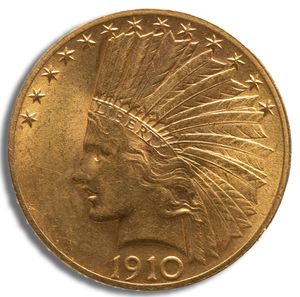
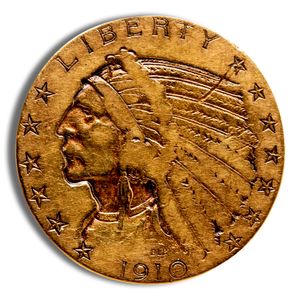
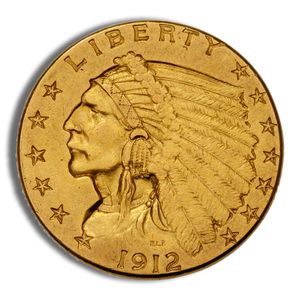
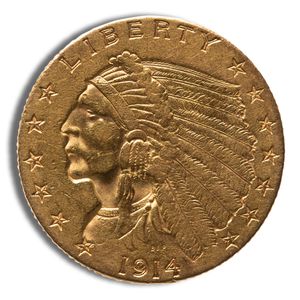
The obverse of the $10 Indian features a left-facing portrait of a Native American chief wearing a full feathered headdress, a design element that gave the coin its popular name. The portrait is rendered in the flat, incuse style that defines the series, with crisp detail pressed into the coin's field rather than rising above it. The word "LIBERTY" arcs across the top, and the date appears below the portrait. Thirteen stars encircle the design, representing the original colonies.
The reverse carries a standing eagle rendered with the same incuse technique, perched with wings partially raised and framed by the inscriptions "UNITED STATES OF AMERICA" and "TEN DOLLARS." The motto "E PLURIBUS UNUM" appears above the eagle, while "IN GOD WE TRUST" is positioned to the side. The overall composition is restrained and architectural, reflecting the classical influence Saint-Gaudens brought to the project. On an MS63-graded example, the original luster is clearly visible across the fields and design elements, with the defining characteristics of a coin that saw minimal wear before being set aside.
Fractional Size and Accessibility
At 0.4837 troy ounces of gold, the $10 Indian Eagle contains slightly under a half ounce of the metal, making it a meaningful fractional option within the pre-1933 United States gold coin category. The size places it between the smaller $5 Half Eagle and the full-ounce-equivalent $20 Double Eagle, offering a natural middle ground for those building a position in American numismatic gold without committing to the higher price point of a Double Eagle.
The coin's combination of gold content and historical significance appeals to buyers who want fractional exposure alongside genuine numismatic character. Because the premium on an MS63-graded example reflects both the gold content and the certified condition, the total cost is naturally higher than a generic fractional gold product, but the distinction in historical pedigree and third-party certification supports that differential.
Authenticity and Product Integrity
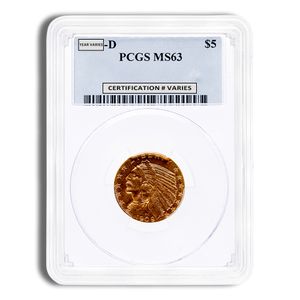
Every coin in this listing is certified by PCGS, one of the two most widely respected grading services in the numismatic industry. PCGS authentication involves physical examination by professional graders who evaluate the coin's genuineness, metal content, and state of preservation before assigning a numeric grade. Each certified coin is then sealed in a tamper-evident PCGS holder with a unique barcode that can be verified directly through the PCGS registry. This process eliminates uncertainty about the coin's identity and condition in a way that raw, uncertified coins cannot offer.
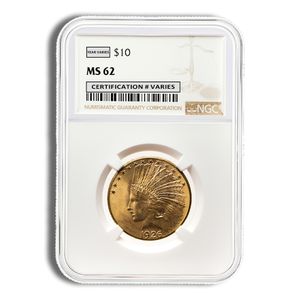
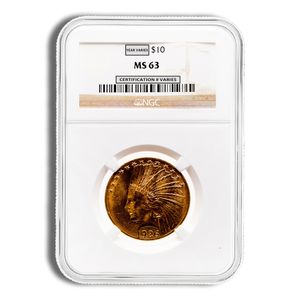
We maintain authorized dealer relationships with both PCGS and NGC, which gives us direct access to certified inventory and supports the consistency of what we list and sell. Because these are pre-1933 United States gold coins struck to the .900 fine gold standard that was federal law at the time, the metal composition has been established for over a century. The certification process confirms that the specific coin in hand matches that standard and has not been altered, cleaned, or otherwise compromised.
Condition and Packaging
MS63 represents a choice mint state grade within the PCGS numerical scale. A coin graded MS63 retains full original mint luster with no signs of circulation, but may exhibit a modest number of contact marks, small abrasions, or minor distractions that prevent a higher grade. On a $10 Indian, where the incuse fields are inherently prone to showing contact, an MS63 example still presents very well and clearly reads as an uncirculated coin. The incuse design is fully sharp, the luster is intact, and any marks present are minor in the context of the series.
Each coin arrives sealed in its original PCGS slab, which serves as both the holder and the certificate of grade. Individual purchases ship with the coin in its PCGS holder protected within appropriate secure packaging. Because these are graded numismatic coins rather than raw bullion, each piece is handled and shipped as an individual certified item regardless of order quantity.
Pricing and Market Factors
Pricing on the $10 Gold Indian Eagle MS63 reflects both the current spot price of gold and the premium associated with certified, numismatic pre-1933 American gold coinage. Because the coin contains 0.4837 troy ounces of gold, the spot component moves directly with the live gold market. The premium above spot accounts for the PCGS certification, the coin's numismatic desirability, the incuse design's collector appeal, and the overall scarcity of surviving MS63 examples across the various production years represented in the random year format.
Pre-1933 gold coins carry premiums that respond to numismatic demand as well as gold price movement, which means these coins can trade differently than standard modern bullion. The MS63 grade tier is a particularly active segment within the Indian Eagle series, as it sits above the more common lower grades while remaining more broadly available than MS64 and MS65 examples. Our pricing reflects real-time market conditions, and the bid/ask spread displayed on the product page provides a clear picture of both the acquisition cost and the current resale context.
Selling and Liquidity
The $10 Gold Indian Eagle is one of the most recognized pre-1933 United States gold coin series in the numismatic market. PCGS-certified MS63 examples trade actively among dealers, collectors, and auction platforms, and the standardized grading removes a significant portion of the uncertainty that complicates the resale of raw coins. Buyers and sellers can reference the PCGS population report and published price guides to understand where a specific example fits within the broader market for the series.
We operate a two-way market, which means customers can sell as well as buy within the same platform. Our buyback pricing on certified pre-1933 gold coins is competitive and reflects current wholesale market conditions rather than arbitrary dealer markups. For buyers who want to understand the full picture before committing, the bid/ask spread on our product page reflects the real relationship between what you pay and what you can expect to receive when it is time to sell.
Why Buy the $10 Gold Indian Eagle PCGS MS63?
The $10 Indian Eagle in MS63 offers something that modern bullion cannot: a direct connection to American monetary history combined with confirmed, certified condition. These coins circulated as legal tender during a period when gold was the functional currency of the United States, and surviving uncirculated examples in MS63 represent the coin as its original recipients would have known it. For buyers who want gold content alongside genuine historical character, this is a meaningfully different product than a modern coin or bar.
The PCGS certification removes the ambiguity that makes raw pre-1933 gold difficult to buy and sell with confidence. Every coin in this listing has been graded, authenticated, and sealed by PCGS, and the grade is verifiable through their online registry. The random year format provides flexibility for buyers focused on grade and gold content rather than a specific date, and it often allows access to a broader range of certified inventory at consistent pricing.
Why Buy from Bullion Standard?
We are an authorized PCGS dealer, which means our access to certified numismatic inventory is direct and our familiarity with grading standards and market pricing is built into how we source and price what we sell. Our A rating with the Better Business Bureau reflects a long record of straightforward transactions and responsive customer support. We are also members of both the American Numismatic Association and the National Coin and Bullion Association, which reflects a commitment to professional standards within the numismatic community.
Transparent pricing is central to how we operate. The bid/ask spread is displayed directly on each product page so buyers can evaluate both the cost of acquisition and the current resale picture before making a decision. We do not rely on high-pressure sales tactics or obscure pricing structures. Our goal is to give you the information you need to make a confident, informed purchase, and to make the selling process equally straightforward when the time comes.
Get Near-Spot Pricing with Bullion Standard Pro
Bullion Standard Pro gives members access to live, executable wholesale bid and ask pricing across a broad range of precious metals products, including certified numismatic gold like the $10 Indian Eagle. For a coin that carries premiums influenced by both gold market conditions and numismatic demand, having visibility into real-time wholesale pricing provides a clearer picture of where the market actually is rather than where retail pricing suggests it might be. Pro members can track how premiums on this series evolve over time and assess bid/ask spreads as market conditions shift.
Portfolio valuation through Pro uses live executable wholesale bid pricing rather than estimated retail values, which provides a more accurate view of what holdings are worth at the wholesale liquidation level. Proprietary analytics and product research tools allow members to compare the $10 Indian Eagle against other pre-1933 gold coins and modern alternatives using objective metrics such as premium history, spread tightness, and liquidity indicators. For buyers who want to evaluate certified numismatic gold with the same rigor they would apply to any other asset, Pro provides the data infrastructure to do exactly that.
Flexible and Secure Payment Options
We support a wide range of payment methods to make every transaction straightforward and secure. Accepted options include Visa, Mastercard, American Express, and Discover, as well as PayPal, bank-connected payments through Plaid, wire transfer, paper check, and cryptocurrency via BitPay. Whether you prefer a traditional card payment or a digital transaction, the checkout process is designed to accommodate your preference without unnecessary friction.
Every transaction is handled with security and confidentiality as core priorities. The same commitment to transparency that shapes our pricing and sourcing also applies to how we process payments and handle customer information. If you have questions about payment options or transaction details before placing an order, our customer support team is available to assist.
Volume Discount Pricing
Orders paid by debit card, credit card, and PayPal are an item's full
list
price
and receive no discount. Orders paid by cryptocurrency receive a 3%
discount
from an item's full list price. Orders paid by eCheck (ACH), paper
check,
and
bank wire receive a 4% discount from an item's full list price.
Quantity
(e)Check/Wire
Crypto
CC/PayPal
1 - 4
$2,339.41
$2,388.14
$2,436.88
5 - 9
$2,333.59
$2,382.20
$2,430.82
10+
$2,327.77
$2,376.26
$2,424.76
1+
$2,307.03
$2,355.09
$2,403.15
In Stock
Ships within 1 business day of cleared payment
Select Your Quantity
For Non-Members:
Free shipping on orders
$497+
.
PRO
Pro Member Delivery:
$23.97 flat-rate, true
wholesale pricing. Free shipping on orders
$10,000+.
Product ID: BST-00067107D9
Specifications
Random Year Status
Random Year
Precious Metal Type
Gold
Bullion Coin Type
Indian Head Eagle
Format
Coin
Country of Origin
United States
Brand/Mint
U.S. Mint
Mint Mark
Various
Purity
0.9
Weight
0.4837 oz
Thickness (mm)
2.023
mm
Diameter (mm)
26.8
mm
Grade
MS63
Grading Service
PCGS
Product Details
Overview of $10 Gold Indian Eagle
The $10 Gold Indian Eagle is one of the most respected numismatic gold coins ever produced by the United States Mint. Struck in .900 fine gold with a total weight of 0.4837 troy ounces, it carries a face value of ten dollars and stands as one of the defining pieces of early American coinage. Each coin we offer in this listing comes certified MS63 by PCGS, confirming a choice mint state grade with only minor blemishes or contact marks that stop short of a higher designation. Because these are offered as random year, the specific date will vary, but every example meets the same PCGS grade standard regardless of which year you receive.
The MS63 grade places these coins firmly in the collectible tier while still carrying meaningful gold content. For buyers who want a historically significant United States gold coin in a confirmed, third-party-verified state of preservation, this is a strong and accessible entry point.
History and Background
The $10 Gold Indian Eagle was introduced in 1907 as part of President Theodore Roosevelt's ambitious campaign to elevate the artistic quality of American coinage. Roosevelt, dissatisfied with what he viewed as…
Overview of $10 Gold Indian Eagle
The $10 Gold Indian Eagle is one of the most respected numismatic gold coins ever produced by the United States Mint. Struck in .900 fine gold with a total weight of 0.4837 troy ounces, it carries a face value of ten dollars and stands as one of the defining pieces of early American coinage. Each coin we offer in this listing comes certified MS63 by PCGS, confirming a choice mint state grade with only minor blemishes or contact marks that stop short of a higher designation. Because these are offered as random year, the specific date will vary, but every example meets the same PCGS grade standard regardless of which year you receive.
The MS63 grade places these coins firmly in the collectible tier while still carrying meaningful gold content. For buyers who want a historically significant United States gold coin in a confirmed, third-party-verified state of preservation, this is a strong and accessible entry point.
History and Background
The $10 Gold Indian Eagle was introduced in 1907 as part of President Theodore Roosevelt's ambitious campaign to elevate the artistic quality of American coinage. Roosevelt, dissatisfied with what he viewed as uninspired coin designs, personally enlisted sculptor Augustus Saint-Gaudens to reimagine the nation's gold coinage. While Saint-Gaudens died before the project was completed, his design work informed the finished coins, with Bela Lyon Pratt ultimately executing the Indian Head design on the quarter eagle and half eagle. The $10 Indian was designed by Saint-Gaudens himself, featuring a distinct incuse relief style unlike anything that had appeared on American coinage before.
The incuse design was controversial from the start. Rather than the raised relief found on traditional coins, the imagery was recessed into the coin's surface, a technique borrowed from ancient Egyptian art. Critics argued that the recessed design allowed dirt and bacteria to collect in the grooves, though this concern was largely overstated. Production continued across several years and multiple mint facilities before the series was discontinued in 1933 following the federal suspension of gold coin circulation.
The 1933 cessation makes surviving examples from certain years considerably scarcer than others, and the series as a whole carries strong collector recognition across the numismatic market. These coins were never intended purely as bullion; they were produced as legal tender circulating coinage at a time when gold served as the monetary foundation of the United States economy.
Design and Aesthetics
The obverse of the $10 Indian features a left-facing portrait of a Native American chief wearing a full feathered headdress, a design element that gave the coin its popular name. The portrait is rendered in the flat, incuse style that defines the series, with crisp detail pressed into the coin's field rather than rising above it. The word "LIBERTY" arcs across the top, and the date appears below the portrait. Thirteen stars encircle the design, representing the original colonies.
The reverse carries a standing eagle rendered with the same incuse technique, perched with wings partially raised and framed by the inscriptions "UNITED STATES OF AMERICA" and "TEN DOLLARS." The motto "E PLURIBUS UNUM" appears above the eagle, while "IN GOD WE TRUST" is positioned to the side. The overall composition is restrained and architectural, reflecting the classical influence Saint-Gaudens brought to the project. On an MS63-graded example, the original luster is clearly visible across the fields and design elements, with the defining characteristics of a coin that saw minimal wear before being set aside.
Fractional Size and Accessibility
At 0.4837 troy ounces of gold, the $10 Indian Eagle contains slightly under a half ounce of the metal, making it a meaningful fractional option within the pre-1933 United States gold coin category. The size places it between the smaller $5 Half Eagle and the full-ounce-equivalent $20 Double Eagle, offering a natural middle ground for those building a position in American numismatic gold without committing to the higher price point of a Double Eagle.
The coin's combination of gold content and historical significance appeals to buyers who want fractional exposure alongside genuine numismatic character. Because the premium on an MS63-graded example reflects both the gold content and the certified condition, the total cost is naturally higher than a generic fractional gold product, but the distinction in historical pedigree and third-party certification supports that differential.
Authenticity and Product Integrity
Every coin in this listing is certified by PCGS, one of the two most widely respected grading services in the numismatic industry. PCGS authentication involves physical examination by professional graders who evaluate the coin's genuineness, metal content, and state of preservation before assigning a numeric grade. Each certified coin is then sealed in a tamper-evident PCGS holder with a unique barcode that can be verified directly through the PCGS registry. This process eliminates uncertainty about the coin's identity and condition in a way that raw, uncertified coins cannot offer.
We maintain authorized dealer relationships with both PCGS and NGC, which gives us direct access to certified inventory and supports the consistency of what we list and sell. Because these are pre-1933 United States gold coins struck to the .900 fine gold standard that was federal law at the time, the metal composition has been established for over a century. The certification process confirms that the specific coin in hand matches that standard and has not been altered, cleaned, or otherwise compromised.
Condition and Packaging
MS63 represents a choice mint state grade within the PCGS numerical scale. A coin graded MS63 retains full original mint luster with no signs of circulation, but may exhibit a modest number of contact marks, small abrasions, or minor distractions that prevent a higher grade. On a $10 Indian, where the incuse fields are inherently prone to showing contact, an MS63 example still presents very well and clearly reads as an uncirculated coin. The incuse design is fully sharp, the luster is intact, and any marks present are minor in the context of the series.
Each coin arrives sealed in its original PCGS slab, which serves as both the holder and the certificate of grade. Individual purchases ship with the coin in its PCGS holder protected within appropriate secure packaging. Because these are graded numismatic coins rather than raw bullion, each piece is handled and shipped as an individual certified item regardless of order quantity.
Pricing and Market Factors
Pricing on the $10 Gold Indian Eagle MS63 reflects both the current spot price of gold and the premium associated with certified, numismatic pre-1933 American gold coinage. Because the coin contains 0.4837 troy ounces of gold, the spot component moves directly with the live gold market. The premium above spot accounts for the PCGS certification, the coin's numismatic desirability, the incuse design's collector appeal, and the overall scarcity of surviving MS63 examples across the various production years represented in the random year format.
Pre-1933 gold coins carry premiums that respond to numismatic demand as well as gold price movement, which means these coins can trade differently than standard modern bullion. The MS63 grade tier is a particularly active segment within the Indian Eagle series, as it sits above the more common lower grades while remaining more broadly available than MS64 and MS65 examples. Our pricing reflects real-time market conditions, and the bid/ask spread displayed on the product page provides a clear picture of both the acquisition cost and the current resale context.
Selling and Liquidity
The $10 Gold Indian Eagle is one of the most recognized pre-1933 United States gold coin series in the numismatic market. PCGS-certified MS63 examples trade actively among dealers, collectors, and auction platforms, and the standardized grading removes a significant portion of the uncertainty that complicates the resale of raw coins. Buyers and sellers can reference the PCGS population report and published price guides to understand where a specific example fits within the broader market for the series.
We operate a two-way market, which means customers can sell as well as buy within the same platform. Our buyback pricing on certified pre-1933 gold coins is competitive and reflects current wholesale market conditions rather than arbitrary dealer markups. For buyers who want to understand the full picture before committing, the bid/ask spread on our product page reflects the real relationship between what you pay and what you can expect to receive when it is time to sell.
Why Buy the $10 Gold Indian Eagle PCGS MS63?
The $10 Indian Eagle in MS63 offers something that modern bullion cannot: a direct connection to American monetary history combined with confirmed, certified condition. These coins circulated as legal tender during a period when gold was the functional currency of the United States, and surviving uncirculated examples in MS63 represent the coin as its original recipients would have known it. For buyers who want gold content alongside genuine historical character, this is a meaningfully different product than a modern coin or bar.
The PCGS certification removes the ambiguity that makes raw pre-1933 gold difficult to buy and sell with confidence. Every coin in this listing has been graded, authenticated, and sealed by PCGS, and the grade is verifiable through their online registry. The random year format provides flexibility for buyers focused on grade and gold content rather than a specific date, and it often allows access to a broader range of certified inventory at consistent pricing.
Why Buy from Bullion Standard?
We are an authorized PCGS dealer, which means our access to certified numismatic inventory is direct and our familiarity with grading standards and market pricing is built into how we source and price what we sell. Our A rating with the Better Business Bureau reflects a long record of straightforward transactions and responsive customer support. We are also members of both the American Numismatic Association and the National Coin and Bullion Association, which reflects a commitment to professional standards within the numismatic community.
Transparent pricing is central to how we operate. The bid/ask spread is displayed directly on each product page so buyers can evaluate both the cost of acquisition and the current resale picture before making a decision. We do not rely on high-pressure sales tactics or obscure pricing structures. Our goal is to give you the information you need to make a confident, informed purchase, and to make the selling process equally straightforward when the time comes.
Get Near-Spot Pricing with Bullion Standard Pro
Bullion Standard Pro gives members access to live, executable wholesale bid and ask pricing across a broad range of precious metals products, including certified numismatic gold like the $10 Indian Eagle. For a coin that carries premiums influenced by both gold market conditions and numismatic demand, having visibility into real-time wholesale pricing provides a clearer picture of where the market actually is rather than where retail pricing suggests it might be. Pro members can track how premiums on this series evolve over time and assess bid/ask spreads as market conditions shift.
Portfolio valuation through Pro uses live executable wholesale bid pricing rather than estimated retail values, which provides a more accurate view of what holdings are worth at the wholesale liquidation level. Proprietary analytics and product research tools allow members to compare the $10 Indian Eagle against other pre-1933 gold coins and modern alternatives using objective metrics such as premium history, spread tightness, and liquidity indicators. For buyers who want to evaluate certified numismatic gold with the same rigor they would apply to any other asset, Pro provides the data infrastructure to do exactly that.
Flexible and Secure Payment Options
We support a wide range of payment methods to make every transaction straightforward and secure. Accepted options include Visa, Mastercard, American Express, and Discover, as well as PayPal, bank-connected payments through Plaid, wire transfer, paper check, and cryptocurrency via BitPay. Whether you prefer a traditional card payment or a digital transaction, the checkout process is designed to accommodate your preference without unnecessary friction.
Every transaction is handled with security and confidentiality as core priorities. The same commitment to transparency that shapes our pricing and sourcing also applies to how we process payments and handle customer information. If you have questions about payment options or transaction details before placing an order, our customer support team is available to assist.
This website uses cookies for analytics and to deliver personalized content. By continuing to
use our site, you acknowledge that you have read and agree to our Privacy Policy and Cookie
Policy.
Current Quantities Available
Unfortunately, we only have 0
of
this item in
stock.
Please call us at (833) 278-4653
or email us at support@bullionstandard.com
if you wish to purchase a larger quantity than what is available on our website.
We can often locate additional quantities.

 (833) 278-4653


.png)