The France Gold 40 Francs struck during the reign of Louis XVIII represents one of the more substantial gold coins produced by the Monnaie de Paris during the Restoration period. Struck in .900 fine gold and weighing 0.3734 troy ounces, the 40 Francs denomination occupied the top tier of French gold coinage during its era. It circulated as legal tender under the authority of the French monarchy between 1816 and 1824, making it both a historically grounded piece and a recognized collector item in the European gold coin market.
The XF (Extremely Fine) grade indicates a piece that retains strong detail across all major design elements, with only light wear from limited circulation. We carry these coins as part of our numismatic gold offering, which spans a broad range of historical European issues alongside modern bullion coinage.
Louis XVIII returned to the French throne in 1814 following the abdication of Napoleon Bonaparte, marking the beginning of the Bourbon Restoration. After a brief interruption during Napoleon's Hundred Days in 1815, Louis XVIII reestablished his reign and held power until his death in
…The France Gold 40 Francs struck during the reign of Louis XVIII represents one of the more substantial gold coins produced by the Monnaie de Paris during the Restoration period. Struck in .900 fine gold and weighing 0.3734 troy ounces, the 40 Francs denomination occupied the top tier of French gold coinage during its era. It circulated as legal tender under the authority of the French monarchy between 1816 and 1824, making it both a historically grounded piece and a recognized collector item in the European gold coin market.
The XF (Extremely Fine) grade indicates a piece that retains strong detail across all major design elements, with only light wear from limited circulation. We carry these coins as part of our numismatic gold offering, which spans a broad range of historical European issues alongside modern bullion coinage.
Louis XVIII returned to the French throne in 1814 following the abdication of Napoleon Bonaparte, marking the beginning of the Bourbon Restoration. After a brief interruption during Napoleon's Hundred Days in 1815, Louis XVIII reestablished his reign and held power until his death in 1824. The coinage struck during this period reflects both the political consolidation of the monarchy and France's effort to restore institutional order after years of revolutionary and Napoleonic upheaval.
The Monnaie de Paris, one of the oldest continuously operating mints in the world, was responsible for producing the 40 Francs series across multiple mint facilities. Each coin carries a mint mark corresponding to the facility where it was struck, which accounts for the "Various" mint designation on coins from this period. These mint marks are a key point of reference for specialists and collectors who track production geography across Restoration-era coinage.
The 40 Francs denomination itself traces its roots to the Napoleonic monetary system established under the Germinal franc in 1803. Louis XVIII retained the franc system upon his restoration, and the 40 Francs piece continued to serve as one of the highest-value gold coins in regular circulation. The series is closely tied to a broader tradition of French gold coinage that predates the Third Republic and remained influential in European monetary history well into the nineteenth century.
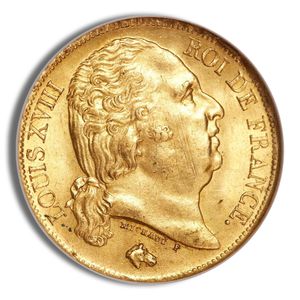
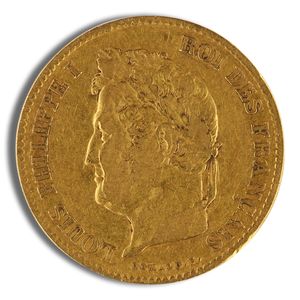
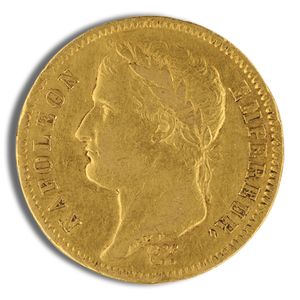
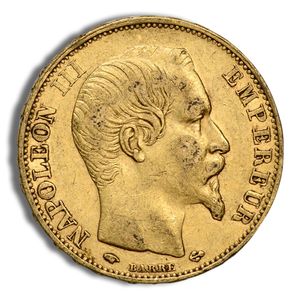
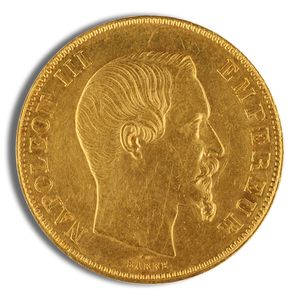
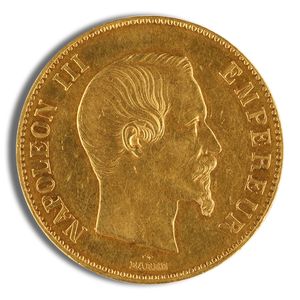
The obverse of the Louis XVIII 40 Francs features a portrait of the king facing to the right, rendered with the level of detail characteristic of early nineteenth-century French portraiture in coinage. The inscription surrounds the effigy and typically includes the king's name and royal title along with the year of issue. The portrait style reflects the neoclassical aesthetic that dominated French official art during the Restoration period.
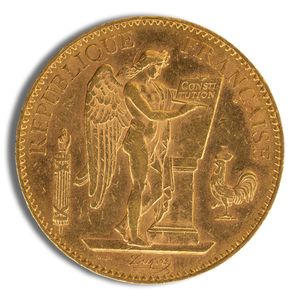
The reverse presents the French royal arms, framed by decorative elements consistent with Bourbon iconography, along with the denomination and the mint mark identifying the facility where the coin was produced. The overall composition is formal and symmetrical, typical of European monarchical coinage of the era. On coins grading XF, the high-relief elements of the portrait and shield retain crisp definition, with only the most elevated points of the design showing any evidence of contact from circulation.
At 0.3734 troy ounces, the Louis XVIII 40 Francs occupies a meaningful position between common fractional sizes and a full troy ounce. It carries more metal content than a quarter-ounce coin while remaining well below the one-ounce threshold, giving buyers a way to acquire historical French gold in a denomination that reflects genuine monetary utility rather than a modern fractional construct. The coin's size is a direct product of the Germinal franc standard rather than a contemporary design choice, which adds to its numismatic character.
For buyers looking to acquire historical European gold without committing to a full-ounce piece, this denomination offers a practical middle ground. The coin's weight and purity are well-documented within the numismatic community, and its established track record in the secondary market provides a reasonable basis for understanding its standing among comparable Restoration-era issues.
French gold coinage of this period is well-catalogued, and the Louis XVIII 40 Francs is among the more thoroughly documented issues in nineteenth-century European numismatics. The Monnaie de Paris maintained consistent alloy standards across the series, with the .900 fine gold composition being both legally mandated and technically enforced through the mint's production controls. Weight and purity on authentic examples are highly consistent, which makes these coins relatively straightforward to authenticate when compared against established references.
Every coin we carry is reviewed for authenticity and verified for metal content prior to being offered through our platform. As authorized dealers for both PCGS and NGC, we operate within the authentication standards upheld by the leading third-party grading services in numismatics, and we apply that same level of scrutiny to the raw coins we handle. Buyers should note that this coin is offered without third-party grading, and the XF grade reflects our in-house assessment.
An XF (Extremely Fine) grade indicates a coin with strong overall detail and minimal wear, typically limited to the highest relief areas of the design. On the Louis XVIII 40 Francs, this means the portrait, lettering, and reverse devices remain well-defined, with luster often still present in the protected fields. The grade is appropriate for a coin that saw some circulation during its time but was not subjected to extended or heavy use.
Individual coins ship in protective plastic flips to preserve their condition during transit. Because this is a numismatic coin with collectible characteristics, it is handled accordingly throughout our fulfillment process. Buyers receiving multiple pieces can expect each to be individually protected, and orders are packaged securely for safe delivery.
Pricing for the Louis XVIII 40 Francs is influenced by both the current spot price of gold and the numismatic premium associated with the specific coin. Because this is a historical issue rather than a modern bullion coin, the premium above spot reflects factors beyond metal content alone, including grade, date, mint mark, eye appeal, and collector demand for Restoration-era French coinage. The interplay between the gold content value and the numismatic component means pricing can shift based on conditions in both the gold market and the collector market simultaneously.
Our pricing is structured around real-time market conditions, and the bid/ask spread displayed on our product page reflects current buying and selling dynamics rather than a fixed retail margin. Understanding both the acquisition price and the expected resale value is the most complete way to evaluate the true cost of ownership for a coin like this one.
The Louis XVIII 40 Francs occupies a recognized category within the European gold coin market, and XF-graded examples are actively traded among both bullion-oriented buyers and numismatic collectors. Its .900 gold composition and documented weight make the metal content straightforward to assess, while the historical significance and grade provide additional support for resale value in collector channels. Liquidity naturally varies more for numismatic coins than for standard modern bullion, and that context is worth keeping in mind.
We operate a two-way market that supports both buying and selling, and customers who have purchased coins through us can access competitive buyback pricing when they decide to sell. Understanding the resale side of a transaction before committing to a purchase is a practice we actively encourage rather than treat as an afterthought.
The appeal of this coin extends well beyond its gold content. It represents a specific and well-documented moment in French political and monetary history, struck under a monarch who presided over one of the more turbulent transitions in modern European governance. For collectors focused on European gold or Restoration-era coinage, the 40 Francs denomination is a cornerstone issue that holds distinct catalogued identity separate from generic bullion coinage.
The XF grade makes it an attractive acquisition for buyers who want a coin with strong visual presence and well-preserved detail without paying the premium associated with Mint State examples. The .900 gold composition is a recognized standard that facilitates straightforward metal value assessment, and the Monnaie de Paris's reputation for consistent production adds to the coin's credibility as both a numismatic and metal-content holding.
We have been operating as a trusted precious metals dealer since 2010, and our approach has remained consistent throughout: transparent pricing, honest product representation, and a buying experience that respects the knowledge of the buyer. Our A rating with the Better Business Bureau reflects a track record built through consistent execution rather than promotional messaging. Membership in the American Numismatic Association and the National Coin and Bullion Association reinforces our commitment to professional standards within the numismatic and bullion communities.
As authorized dealers for PCGS and NGC, we maintain relationships with the most credible grading services in the industry, which informs how we assess and represent raw coins like this one. Every product we offer has been reviewed for authenticity and metal integrity before it reaches a buyer. Our platform is built around clarity on both sides of the transaction, and our two-way market model ensures that the path back out of a purchase is as straightforward as the path in.
Bullion Standard Pro gives members access to live, executable wholesale bid and ask pricing across our catalog, including historical numismatic gold. For buyers evaluating a coin like the Louis XVIII 40 Francs, where pricing reflects both metal content and collector demand, having real-time visibility into wholesale market conditions provides a meaningful informational advantage. Pro members can also access historical premium data and bid/ask spread analysis to better understand how a specific product has been priced over time relative to current market conditions.
Portfolio valuation within Pro is based on live executable wholesale bid pricing rather than estimated retail values, which provides a more accurate picture of current liquidation value. For collectors and buyers who hold multiple numismatic gold positions, this kind of real-time clarity across a broader portfolio is a practical tool for understanding where you stand at any given moment in the market.
We support a wide range of payment methods to make every transaction as straightforward as possible. Buyers can complete purchases using Visa, Mastercard, American Express, Discover, PayPal, bank-connected payments through Plaid, wire transfer, paper check, or cryptocurrency via BitPay. Each payment method is processed through a secure environment designed to protect buyer information throughout the transaction.
The flexibility in payment options reflects our commitment to removing friction from the buying process. Whether you prefer a traditional bank transfer or a digital payment method, we have structured the checkout experience to accommodate a broad range of preferences without compromising on security or reliability.
Product ID: BST-0010533497
| Random Year Status | Random Year |
|---|---|
| Precious Metal Type | Gold |
| Bullion Coin Type | Franc |
| Format | Coin |
| Country of Origin | France |
| Brand/Mint | Monnaie de Paris |
| Mint Mark | Various |
| Purity | 0.9 |
| Weight | 0.3734 oz |
| Thickness (mm) | 1.6 mm |
| Diameter (mm) | 26 mm |
| Grade | XF |
The France Gold 40 Francs struck during the reign of Louis XVIII represents one of the more substantial gold coins produced by the Monnaie de Paris during the Restoration period. Struck in .900 fine gold and weighing 0.3734 troy ounces, the 40 Francs denomination occupied the top tier of French gold coinage during its era. It circulated as legal tender under the authority of the French monarchy between 1816 and 1824, making it both a historically grounded piece and a recognized collector item in the European gold coin market.
The XF (Extremely Fine) grade indicates a piece that retains strong detail across all major design elements, with only light wear from limited circulation. We carry these coins as part of our numismatic gold offering, which spans a broad range of historical European issues alongside modern bullion coinage.
Louis XVIII returned to the French throne in 1814 following the abdication of Napoleon Bonaparte, marking the beginning of the Bourbon Restoration. After a brief interruption during Napoleon's Hundred Days in 1815, Louis XVIII reestablished his reign and held power until his death in
…The France Gold 40 Francs struck during the reign of Louis XVIII represents one of the more substantial gold coins produced by the Monnaie de Paris during the Restoration period. Struck in .900 fine gold and weighing 0.3734 troy ounces, the 40 Francs denomination occupied the top tier of French gold coinage during its era. It circulated as legal tender under the authority of the French monarchy between 1816 and 1824, making it both a historically grounded piece and a recognized collector item in the European gold coin market.
The XF (Extremely Fine) grade indicates a piece that retains strong detail across all major design elements, with only light wear from limited circulation. We carry these coins as part of our numismatic gold offering, which spans a broad range of historical European issues alongside modern bullion coinage.
Louis XVIII returned to the French throne in 1814 following the abdication of Napoleon Bonaparte, marking the beginning of the Bourbon Restoration. After a brief interruption during Napoleon's Hundred Days in 1815, Louis XVIII reestablished his reign and held power until his death in 1824. The coinage struck during this period reflects both the political consolidation of the monarchy and France's effort to restore institutional order after years of revolutionary and Napoleonic upheaval.
The Monnaie de Paris, one of the oldest continuously operating mints in the world, was responsible for producing the 40 Francs series across multiple mint facilities. Each coin carries a mint mark corresponding to the facility where it was struck, which accounts for the "Various" mint designation on coins from this period. These mint marks are a key point of reference for specialists and collectors who track production geography across Restoration-era coinage.
The 40 Francs denomination itself traces its roots to the Napoleonic monetary system established under the Germinal franc in 1803. Louis XVIII retained the franc system upon his restoration, and the 40 Francs piece continued to serve as one of the highest-value gold coins in regular circulation. The series is closely tied to a broader tradition of French gold coinage that predates the Third Republic and remained influential in European monetary history well into the nineteenth century.
The obverse of the Louis XVIII 40 Francs features a portrait of the king facing to the right, rendered with the level of detail characteristic of early nineteenth-century French portraiture in coinage. The inscription surrounds the effigy and typically includes the king's name and royal title along with the year of issue. The portrait style reflects the neoclassical aesthetic that dominated French official art during the Restoration period.
The reverse presents the French royal arms, framed by decorative elements consistent with Bourbon iconography, along with the denomination and the mint mark identifying the facility where the coin was produced. The overall composition is formal and symmetrical, typical of European monarchical coinage of the era. On coins grading XF, the high-relief elements of the portrait and shield retain crisp definition, with only the most elevated points of the design showing any evidence of contact from circulation.
At 0.3734 troy ounces, the Louis XVIII 40 Francs occupies a meaningful position between common fractional sizes and a full troy ounce. It carries more metal content than a quarter-ounce coin while remaining well below the one-ounce threshold, giving buyers a way to acquire historical French gold in a denomination that reflects genuine monetary utility rather than a modern fractional construct. The coin's size is a direct product of the Germinal franc standard rather than a contemporary design choice, which adds to its numismatic character.
For buyers looking to acquire historical European gold without committing to a full-ounce piece, this denomination offers a practical middle ground. The coin's weight and purity are well-documented within the numismatic community, and its established track record in the secondary market provides a reasonable basis for understanding its standing among comparable Restoration-era issues.
French gold coinage of this period is well-catalogued, and the Louis XVIII 40 Francs is among the more thoroughly documented issues in nineteenth-century European numismatics. The Monnaie de Paris maintained consistent alloy standards across the series, with the .900 fine gold composition being both legally mandated and technically enforced through the mint's production controls. Weight and purity on authentic examples are highly consistent, which makes these coins relatively straightforward to authenticate when compared against established references.
Every coin we carry is reviewed for authenticity and verified for metal content prior to being offered through our platform. As authorized dealers for both PCGS and NGC, we operate within the authentication standards upheld by the leading third-party grading services in numismatics, and we apply that same level of scrutiny to the raw coins we handle. Buyers should note that this coin is offered without third-party grading, and the XF grade reflects our in-house assessment.
An XF (Extremely Fine) grade indicates a coin with strong overall detail and minimal wear, typically limited to the highest relief areas of the design. On the Louis XVIII 40 Francs, this means the portrait, lettering, and reverse devices remain well-defined, with luster often still present in the protected fields. The grade is appropriate for a coin that saw some circulation during its time but was not subjected to extended or heavy use.
Individual coins ship in protective plastic flips to preserve their condition during transit. Because this is a numismatic coin with collectible characteristics, it is handled accordingly throughout our fulfillment process. Buyers receiving multiple pieces can expect each to be individually protected, and orders are packaged securely for safe delivery.
Pricing for the Louis XVIII 40 Francs is influenced by both the current spot price of gold and the numismatic premium associated with the specific coin. Because this is a historical issue rather than a modern bullion coin, the premium above spot reflects factors beyond metal content alone, including grade, date, mint mark, eye appeal, and collector demand for Restoration-era French coinage. The interplay between the gold content value and the numismatic component means pricing can shift based on conditions in both the gold market and the collector market simultaneously.
Our pricing is structured around real-time market conditions, and the bid/ask spread displayed on our product page reflects current buying and selling dynamics rather than a fixed retail margin. Understanding both the acquisition price and the expected resale value is the most complete way to evaluate the true cost of ownership for a coin like this one.
The Louis XVIII 40 Francs occupies a recognized category within the European gold coin market, and XF-graded examples are actively traded among both bullion-oriented buyers and numismatic collectors. Its .900 gold composition and documented weight make the metal content straightforward to assess, while the historical significance and grade provide additional support for resale value in collector channels. Liquidity naturally varies more for numismatic coins than for standard modern bullion, and that context is worth keeping in mind.
We operate a two-way market that supports both buying and selling, and customers who have purchased coins through us can access competitive buyback pricing when they decide to sell. Understanding the resale side of a transaction before committing to a purchase is a practice we actively encourage rather than treat as an afterthought.
The appeal of this coin extends well beyond its gold content. It represents a specific and well-documented moment in French political and monetary history, struck under a monarch who presided over one of the more turbulent transitions in modern European governance. For collectors focused on European gold or Restoration-era coinage, the 40 Francs denomination is a cornerstone issue that holds distinct catalogued identity separate from generic bullion coinage.
The XF grade makes it an attractive acquisition for buyers who want a coin with strong visual presence and well-preserved detail without paying the premium associated with Mint State examples. The .900 gold composition is a recognized standard that facilitates straightforward metal value assessment, and the Monnaie de Paris's reputation for consistent production adds to the coin's credibility as both a numismatic and metal-content holding.
We have been operating as a trusted precious metals dealer since 2010, and our approach has remained consistent throughout: transparent pricing, honest product representation, and a buying experience that respects the knowledge of the buyer. Our A rating with the Better Business Bureau reflects a track record built through consistent execution rather than promotional messaging. Membership in the American Numismatic Association and the National Coin and Bullion Association reinforces our commitment to professional standards within the numismatic and bullion communities.
As authorized dealers for PCGS and NGC, we maintain relationships with the most credible grading services in the industry, which informs how we assess and represent raw coins like this one. Every product we offer has been reviewed for authenticity and metal integrity before it reaches a buyer. Our platform is built around clarity on both sides of the transaction, and our two-way market model ensures that the path back out of a purchase is as straightforward as the path in.
Bullion Standard Pro gives members access to live, executable wholesale bid and ask pricing across our catalog, including historical numismatic gold. For buyers evaluating a coin like the Louis XVIII 40 Francs, where pricing reflects both metal content and collector demand, having real-time visibility into wholesale market conditions provides a meaningful informational advantage. Pro members can also access historical premium data and bid/ask spread analysis to better understand how a specific product has been priced over time relative to current market conditions.
Portfolio valuation within Pro is based on live executable wholesale bid pricing rather than estimated retail values, which provides a more accurate picture of current liquidation value. For collectors and buyers who hold multiple numismatic gold positions, this kind of real-time clarity across a broader portfolio is a practical tool for understanding where you stand at any given moment in the market.
We support a wide range of payment methods to make every transaction as straightforward as possible. Buyers can complete purchases using Visa, Mastercard, American Express, Discover, PayPal, bank-connected payments through Plaid, wire transfer, paper check, or cryptocurrency via BitPay. Each payment method is processed through a secure environment designed to protect buyer information throughout the transaction.
The flexibility in payment options reflects our commitment to removing friction from the buying process. Whether you prefer a traditional bank transfer or a digital payment method, we have structured the checkout experience to accommodate a broad range of preferences without compromising on security or reliability.