Buy $3 Gold Coins Online
Our catalog of $3 gold coins focuses exclusively on the $3 Gold Princess, one of the most distinctive denominations ever struck by the United States Mint. Available in a range of grades and grading service certifications, these coins give buyers the flexibility to choose based on condition preference, budget, and collecting goals. Whether you're drawn to circulated examples or professionally certified Mint State pieces, there's a meaningful selection here to explore.
Listings include raw circulated examples graded VF, XF, and AU, as well as Brilliant Uncirculated coins for those who prefer untouched surfaces without third-party certification. For buyers who want the added assurance of professional grading, certified options are available through both NGC and PCGS at MS61 and MS62 grades. All listings are random year, meaning the specific date will vary based on current inventory.
Bullion Standard approaches these coins as a transparent marketplace rather than a traditional high-pressure dealer environment. Premiums, condition expectations, and grading notes are presented clearly so buyers can evaluate each option on its own merits without guesswork.
What Are $3 Gold Coins?
The $3 gold coin is a United States denomination struck in 90% gold with a face value of three dollars. It contains 0.1451 troy ounces of gold, placing it in a relatively unusual weight tier compared to more familiar denominations like the half eagle or quarter eagle. The coin's modest size and face value made it something of a specialty piece during its production years, and that character carries through to the modern collector and bullion market.
Unlike mass-produced American Eagle coins or modern sovereign issues, the $3 gold Princess occupies a space where numismatic interest and gold content both play a meaningful role in pricing. Buyers tend to approach these coins with an eye toward historical significance alongside the underlying metal content. That dual nature distinguishes them from purely weight-driven bullion products like bars or rounds.
Certified examples, particularly those graded by NGC or PCGS, carry additional market structure in the form of a standardized grade that allows buyers and sellers to transact with greater confidence about condition. Raw examples, while more accessible in price, require buyers to assess condition details themselves or rely on the seller's grading description.
History and Background
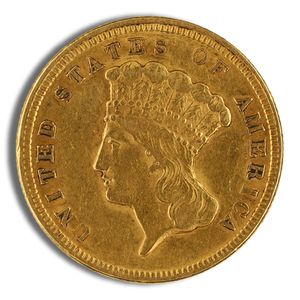
The $3 gold coin was authorized by the U.S. Congress through the Act of February 21, 1853, and production began at the Philadelphia Mint in 1854. The denomination was intended in part to facilitate the purchase of three-cent postage stamps, then the standard letter rate, though it never achieved widespread circulation in that role. James Barton Longacre, the Chief Engraver of the United States Mint at the time, designed the coin's obverse featuring a Native American Princess motif, which became the coin's defining visual identity.
Production continued through 1889 with relatively low mintages in most years, and several dates were struck only as proofs for collectors. The branch mint in Dahlonega, Georgia, and San Francisco also struck limited quantities during certain years, creating a range of mint mark varieties that numismatists pursue today. The coin was never reintroduced after 1889, giving the entire series a closed population that makes certified examples particularly meaningful to specialists.
In the modern market, $3 gold Princess coins trade primarily through numismatic channels and specialty dealers. Their appeal has grown steadily among collectors who value 19th-century U.S. gold coinage, and the certifying services have helped standardize condition assessments across a series that spans decades of variable strike quality and surviving populations.
Purity, Weight, and Specifications
Every $3 gold Princess coin was struck to a purity of .900 fine gold, which was the standard alloy used across all U.S. gold coinage during the 19th century. The remaining 10% of the coin's composition is copper, which gives the coin a slightly warmer color tone compared to modern .9999 fine gold products. Each coin contains 0.1451 troy ounces of pure gold, with a gross weight of approximately 5.015 grams.
The coin's diameter is 20.5 millimeters, making it a compact piece that is noticeably smaller than the more familiar half eagle or eagle denomination. The reeded edge was standard across the series. These dimensional and compositional specifications are consistent across all production years from 1854 through 1889, though minor die variations exist throughout the series.
For buyers sourcing these coins for their gold content, the 0.1451 troy ounce figure is the relevant weight figure, and it applies uniformly to every coin in this catalog regardless of grade or grading service. The purity of .900 is a fixed characteristic of the U.S. Mint's 19th-century gold coinage standard.
Available Brands, Mints, and Product Variations
All coins listed here were produced by the United States Mint, the sole issuing authority for this denomination. Because the series ran for 35 years across multiple mint facilities, random-year listings will draw from a broader pool that may include coins from Philadelphia, San Francisco, or Dahlonega, depending on available inventory. The specific year and mint mark will vary, which is a standard condition for these types of historical U.S. gold coin listings.
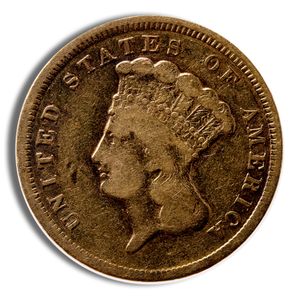
The catalog covers a meaningful spread of grade tiers. Raw circulated coins are available in three conditions: a cleaned or low-premium example for buyers focused purely on gold content at a reduced acquisition cost, a VF (XF45) grade for coins with moderate wear but clear design detail, and an XF (XF40) grade for those seeking well-preserved circulated pieces. The AU58 listing represents the upper end of circulated examples, where only the slightest traces of wear are present on the high points of the design.
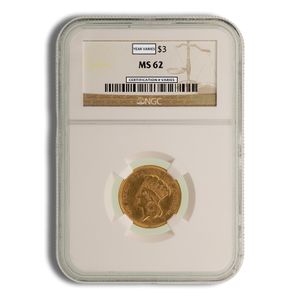
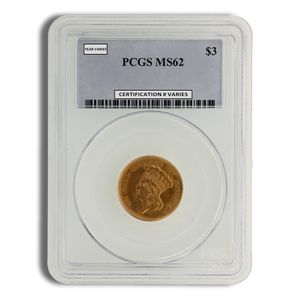
Certified options span both major third-party grading services. NGC-graded coins are available at MS61 and MS62, with PCGS-graded equivalents at the same grade points. The MS61 designation reflects a Mint State coin with some contact marks or minor surface imperfections, while MS62 represents a step up in eye appeal and overall surface quality. Both NGC and PCGS are widely recognized across the numismatic market, and their holders provide a meaningful layer of authenticity verification and grade standardization.
Pricing, Premiums, and Market Factors
Pricing for $3 gold Princess coins is driven by a combination of the underlying gold spot price and the numismatic premium that reflects grade, certification status, eye appeal, and current market demand for 19th-century U.S. gold coinage. Unlike modern bullion coins where premiums are relatively predictable, the numismatic component here can vary considerably depending on the specific grade tier and how active collector demand is at any given time.
Cleaned or problem-coin examples carry the narrowest premiums above gold content, making them the most accessible entry point on a pure metal-value basis. Moving up through VF, XF, and AU grades, premiums increase to reflect better preservation and collector appeal. Certified Mint State coins command a more substantial premium that reflects both the rarity of uncirculated examples within the series and the added confidence that comes from a standardized third-party grade in a tamper-evident holder.
Bullion Standard displays pricing in real time based on current market conditions, and each product page includes bid and ask spread information that reflects both the acquisition cost and the expected resale value. This transparency allows buyers to understand the full cost of ownership rather than focusing solely on the purchase price. For a coin series where numismatic premiums play a significant role, that complete picture matters.
Condition, Packaging, and What to Expect
Raw circulated coins, including the VF, XF, AU, and cleaned/low-premium listings, will arrive loose or in basic protective flips. These are not sealed in assay packaging and will show wear consistent with their assigned grade. Buyers should expect natural toning, minor contact marks, and surface characteristics appropriate to coins that circulated during the 19th century. The specific year and any mint mark present will vary based on available inventory at the time of fulfillment.
Certified coins from NGC or PCGS arrive in the grading service's standard sonically sealed holder, which includes a label identifying the coin's grade, denomination, series, and a certification number that can be verified directly through the respective grading service's online registry. These holders protect the coin from handling and environmental exposure while providing a permanent record of its assessed condition.
The BU listing represents an uncirculated coin that has not been submitted to a third-party grading service. These coins will show no wear on the high points of the design but may exhibit bag marks or minor contact marks typical of coins that were not individually handled during storage. Packaging for BU coins will generally be a protective flip or similar basic presentation.
Authenticity and Verification
Authenticity is a genuine concern in the 19th-century U.S. gold coin market. The $3 denomination's relatively low mintages and collector demand have historically made it a target for counterfeiting and alteration, particularly date alteration on key-date years. Third-party certification through NGC or PCGS provides a meaningful safeguard, as both services employ expert numismatists and advanced detection methods to identify alterations, cleaning, and outright counterfeits before a coin is encapsulated and graded.
For raw coins purchased without certification, Bullion Standard verifies each product for authenticity, weight, and purity before it enters our fulfillment process. Our sourcing relationships with reputable wholesalers and distributors within the numismatic trade provide an additional layer of market-level vetting. Buyers who prefer independent verification after purchase can submit raw coins to NGC or PCGS through standard submission channels.
Certified coins can be cross-referenced using the certification number printed on the NGC or PCGS holder. Both services maintain publicly accessible online registries where buyers can confirm that a holder's label matches the coin inside and that the certification is genuine. This verification step is straightforward and free through each service's website.
Liquidity and Resale Considerations
The $3 gold Princess is a well-recognized series within the U.S. numismatic market, and it trades actively through coin dealers, auction houses, and online numismatic platforms. That said, it occupies a more specialized segment of the market than mainstream bullion coins like American Eagles, which means that resale options and the pace of finding buyers can vary more with market conditions and demand cycles.
Certified examples from NGC and PCGS generally offer more predictable resale dynamics because the standardized grade removes the need for the buyer and seller to negotiate condition. Within certified markets, coins with consistent grades in sealed holders from recognized services tend to find buyers more efficiently than raw examples, particularly at the MS61 and MS62 grade levels where the series is most actively traded.
Raw circulated examples are most liquid when their underlying gold value makes up a larger share of the total acquisition cost, such as with cleaned or lower-grade pieces. As the numismatic premium grows relative to gold content, resale increasingly depends on connecting with a buyer who recognizes and values that premium. Understanding this dynamic before purchasing is part of making an informed decision about which grade tier fits your goals.
Storage and Security
Given the compact size of the $3 gold Princess coin, storage options are flexible. Individual certified coins in NGC or PCGS holders fit easily in standard numismatic storage boxes, slotted coin trays, or binders designed for slabbed coins. These holder formats provide both physical protection and a level of environmental resistance that helps preserve surface quality over time.
Raw coins should be stored in individual protective flips or hard plastic coin capsules to minimize contact with other surfaces. Direct handling of raw gold coins, particularly Mint State examples, should be avoided to prevent fingerprinting or surface abrasion. Cotton gloves or careful edge-only handling is standard practice.
For those building a meaningful quantity of 19th-century U.S. gold coins, a home safe rated for fire and burglary resistance is a practical starting point, while third-party vault storage or bank safe deposit boxes offer a higher security tier for more substantial holdings. Regardless of storage method, keeping coins away from humidity and temperature fluctuations helps preserve their condition over the long term.
Selling and Buyback Options
When you're ready to sell, Bullion Standard operates as a two-way market, meaning we actively purchase the same products we sell. Our buyback pricing is tied to current market conditions and is updated in real time, giving sellers a transparent and current reference point rather than a static offer that may not reflect today's market. The bid price displayed on each product page reflects our current purchasing interest and the broader wholesale market for that specific coin.
Buyback pricing for $3 gold Princess coins is influenced by several factors, including the coin's grade, whether it carries third-party certification, its overall eye appeal and packaging condition, and current demand within the numismatic market. Certified coins in original, unaltered NGC or PCGS holders typically attract the most straightforward pricing because condition is already established. Raw coins are assessed individually and priced based on their observable characteristics.
Initiating a sale through Bullion Standard is designed to be operationally straightforward. Our purchasing team reviews submitted coins against current market pricing, and the process is structured to provide a clear, factual offer rather than a drawn-out negotiation. For repeat sellers or those with larger holdings, Bullion Standard Pro provides access to live wholesale bid pricing that reflects executable market levels rather than estimated retail-based buyback figures.
Why Buy $3 Gold Coins?
The appeal of $3 gold Princess coins is rooted in their combination of 19th-century American numismatic history and tangible gold content. These are not modern bullion coins produced in large quantities for the investment market; they are authentic artifacts of United States Mint production spanning 35 years, with genuine historical character that a newly minted coin simply cannot replicate. For collectors of early American gold coinage, they occupy a distinctive and permanently closed series.
The range of available grade tiers means buyers at different price points can participate in the series in a way that makes sense for them. A cleaned or low-premium example is a cost-conscious way to own an authentic 19th-century U.S. gold coin, while an NGC or PCGS certified MS62 example represents the upper end of what the series typically offers in terms of surface quality and numismatic significance. That grade ladder provides flexibility that many other series don't offer in a single catalog.
For buyers who already own or are building a collection of 19th-century U.S. gold coinage, the $3 Princess is a natural addition that rounds out a broader set alongside the quarter eagle, half eagle, and eagle denominations. Its unusual face value and distinctive Princess motif give it a character that stands apart from every other denomination in American coinage history.
Why Buy from Bullion Standard?
Bullion Standard has operated since 2010 with a consistent focus on pricing transparency, product authenticity, and long-term customer trust. We are headquartered in San Diego, California, and our platform is built around the belief that buyers deserve access to honest, market-based information rather than high-pressure sales tactics or opaque pricing structures. Every product we list reflects that philosophy, from the way premiums are displayed to the buyback pricing shown alongside each listing.
As an authorized dealer for both PCGS and NGC, we have direct relationships with the two most widely recognized third-party grading services in the numismatic market. Our A rating with the Better Business Bureau, along with membership in the American Numismatic Association and the National Coin and Bullion Association, reflects a consistent operational standard across sourcing, verification, fulfillment, and customer service.
Every coin we ship has been verified for authenticity, weight, and purity before it leaves our facility. Customers can complete purchases using a wide range of payment methods, including major credit cards, PayPal, bank-connected payments through Plaid, wire transfer, paper check, and cryptocurrency through BitPay. The goal throughout is a purchasing experience that feels transparent, reliable, and straightforward from first click to delivery.
Get Near-Spot Pricing with Bullion Standard Pro
Bullion Standard Pro is designed for buyers who want direct access to executable wholesale bid and ask pricing rather than standard retail-level quotes. Members transact at live wholesale market prices without additional dealer markups or retail spreads applied on top, which means premiums and spreads reflect actual supply and demand within the wholesale precious metals market rather than fixed retail pricing structures.
For price-sensitive or repeat buyers, the difference between retail and wholesale pricing can be meaningful over time. Pro members can view real-time portfolio valuations based on live wholesale bid pricing, which provides a more realistic picture of current liquidation value than estimates derived from retail price lists. This level of pricing transparency is particularly useful for numismatic products like $3 gold Princess coins, where the relationship between gold content and numismatic premium deserves clear visibility.
Beyond pricing efficiency, Bullion Standard Pro provides access to market intelligence tools, historical premium analytics, spread analysis, and liquidity metrics that help members evaluate products with objective data rather than marketing narratives. For buyers who take a deliberate, research-oriented approach to numismatic and bullion acquisitions, Pro membership brings a level of market access and analytical depth that is difficult to find through traditional dealer channels.

 (833) 278-4653