The $3 Gold Princess is a nineteenth-century United States gold coin struck in .900 fine gold with a weight of 0.1451 troy ounces. Issued by the United States Mint, it carries genuine legal tender status and represents one of the more unusual denominations in American coinage history. The pieces we carry are graded AU58, meaning they grade Choice About Uncirculated and retain nearly all of their original mint detail with only the faintest traces of high-point wear. Because the year is randomly selected, the exact date will vary, though all pieces fall within the series' original production run.
History and Background
The $3 gold coin was authorized by the Coinage Act of 1853 and first struck in 1854 at the Philadelphia Mint, with production later extending to the Charlotte, Dahlonega, New Orleans, and San Francisco facilities. The denomination was created in part to facilitate the purchase of three-cent postage stamps, which had recently been established as the standard letter rate. Despite the practical logic behind its creation, the $3 piece never achieved widespread circulation, and mintage figures remained relatively low throughout the series…
Overview of the $3 Gold Princess
The $3 Gold Princess is a nineteenth-century United States gold coin struck in .900 fine gold with a weight of 0.1451 troy ounces. Issued by the United States Mint, it carries genuine legal tender status and represents one of the more unusual denominations in American coinage history. The pieces we carry are graded AU58, meaning they grade Choice About Uncirculated and retain nearly all of their original mint detail with only the faintest traces of high-point wear. Because the year is randomly selected, the exact date will vary, though all pieces fall within the series' original production run.
History and Background
The $3 gold coin was authorized by the Coinage Act of 1853 and first struck in 1854 at the Philadelphia Mint, with production later extending to the Charlotte, Dahlonega, New Orleans, and San Francisco facilities. The denomination was created in part to facilitate the purchase of three-cent postage stamps, which had recently been established as the standard letter rate. Despite the practical logic behind its creation, the $3 piece never achieved widespread circulation, and mintage figures remained relatively low throughout the series.
The coin was produced continuously through 1889, when production ended permanently. Throughout its run, the design went largely unchanged, making it a remarkably consistent series by American minting standards. Low original mintage combined with limited survival rates in higher grades makes AU examples considerably more scarce than their face value might suggest. The series occupies a respected place in nineteenth-century American numismatics precisely because of its combination of historical context, unusual denomination, and design consistency.
Design and Aesthetics
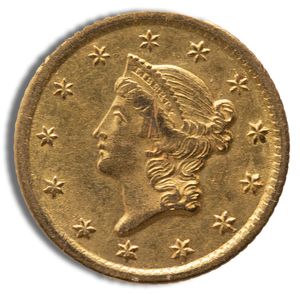
The obverse features a left-facing portrait of a Native American princess wearing a feathered headdress inscribed with the word "PRINCESS." The design was executed by James B. Longacre, the Chief Engraver of the United States Mint, and reflects the artistic conventions of mid-nineteenth-century American coinage. The portrait is surrounded by a ring of stars and the date appears at the bottom of the obverse field.
The reverse displays a wreath of tobacco, wheat, corn, and cotton encircling the denomination "3 DOLLARS" and the date of issue. Above the wreath sits an eagle with a shield, and the inscriptions "UNITED STATES OF AMERICA" and the standard national motto frame the composition. In AU58 condition, the fields retain substantial original luster with only slight wear visible on the highest relief points of the portrait and wreath.
Fractional Size and Accessibility
At 0.1451 troy ounces, the $3 Gold Princess contains less than one-fifth of an ounce of gold, making it one of the smaller gold denominations in American numismatic history. For buyers who want exposure to a genuine nineteenth-century U.S. gold coin without committing to a larger one-ounce or multi-ounce piece, this size offers a practical entry point. The smaller format also makes individual coins more manageable in terms of per-unit cost, which can be useful when building a type set or adding a single piece to an existing collection.
Authenticity and Product Integrity
Every $3 Gold Princess we carry is verified for authenticity, weight, and metal content prior to being made available. The coin's .900 fine gold composition and 0.1451 troy ounce weight are consistent with the original United States Mint specifications for the series, and these parameters can be independently confirmed through standard numismatic testing methods. We are authorized dealers for both PCGS and NGC, giving us direct access to the grading and authentication infrastructure that underpins the certified coin market.
While the pieces offered here are raw and unslabbed, their AU58 grade reflects meaningful detail retention and helps buyers understand what to expect visually. Because these are genuine nineteenth-century U.S. Mint products, their authenticity is rooted in the Mint's own manufacturing standards and the well-documented history of the series itself.
Condition and Packaging
AU58 is the highest designation within the About Uncirculated range on the Sheldon scale. Coins at this grade exhibit light wear confined to the very highest points of the design, with most of the original mint luster still present and visible. On the $3 Princess, this typically means slight friction on the cheek of the portrait and the high points of the reverse wreath, while the fields and lower-relief details remain sharp and largely undisturbed. It is a grade that sits just below Mint State and is considered quite presentable by most standards.
Individual coins ship in protective plastic flips to prevent contact damage during transit. For larger quantity orders, coins are packaged according to standard handling practices appropriate to the lot size. Because these are random-year pieces drawn from our available inventory, the exact date will not be specified in advance, though all examples fall within the $3 Princess production window of 1854 through 1889.
Pricing and Market Factors
Pricing for the $3 Gold Princess is tied to both the spot price of gold and the numismatic premium associated with the series. Because this coin is a genuine nineteenth-century issue with limited original mintage and meaningful collector demand, it typically carries a premium that reflects more than just its gold content. Factors such as grade, date scarcity, and overall market interest in classic American gold coinage all contribute to how this series is priced in the secondary market.
Our pricing reflects real-time gold market conditions alongside the prevailing collector premium for AU-grade examples. Unlike modern bullion coins where premiums are relatively standardized, numismatic pieces like the $3 Princess can see more pronounced premium movement based on shifts in collector demand and available supply. Understanding that relationship helps buyers approach this coin with appropriate context.
Selling and Liquidity
The $3 Gold Princess is a recognized series within the classic American gold coin market, and AU-grade examples attract consistent interest from type collectors, gold enthusiasts, and those building nineteenth-century U.S. coin sets. Its legal tender origins, genuine gold content, and United States Mint provenance support its recognizability in resale environments. Because it occupies a specific and somewhat unusual denomination, it appeals to a distinct segment of the numismatic market rather than competing directly with modern bullion coins.
We operate as a two-way market, meaning we both buy and sell products of this type through the same platform. Buyers who understand the liquidity characteristics of numismatic gold going in are better positioned to make decisions that reflect the full cost of ownership, not just the purchase price.
Why Buy the $3 Gold Princess?
The $3 Gold Princess offers something that modern bullion coins simply cannot replicate: genuine historical provenance combined with intrinsic gold content. Each coin is an original product of the United States Mint, struck in the mid-to-late nineteenth century and carrying a denomination that existed for only a brief window of American monetary history. That combination of rarity, historical significance, and gold content gives this coin a different character than contemporary issues.
For collectors who want to own a piece of classic American gold coinage in a presentable AU grade without pursuing a specific date or full set completion, the random-year format makes this a straightforward option. The .900 fine gold composition and consistent minting standards across the series mean that any date within the run shares the same fundamental specifications, making the random-year offering both practical and accessible.
Why Buy from Bullion Standard?
We have been operating as a precious metals dealer since 2010, and our approach has always prioritized transparency over high-pressure sales tactics. Our A rating with the Better Business Bureau, along with our membership in both the American Numismatic Association and the National Coin and Bullion Association, reflects a consistent commitment to ethical business practices and professional standards. As authorized dealers for PCGS and NGC, we are deeply integrated into the certified coin market and understand how authentication, grading, and market conditions interact for products like the $3 Gold Princess.
Our pricing is structured to reflect actual market conditions rather than manufactured complexity. We display bid/ask spreads openly on product pages so buyers can evaluate the true cost of ownership rather than focusing only on the ask side of the transaction. We accept a broad range of payment methods and support reliable fulfillment backed by responsive customer service. Our goal is a buying experience built on clarity, consistency, and long-term trust.
Get Near-Spot Pricing with Bullion Standard Pro
Bullion Standard Pro gives members access to live, executable wholesale bid and ask pricing across our catalog, including numismatic gold coins like the $3 Princess. Because premiums on nineteenth-century gold can shift meaningfully based on collector demand and wholesale market activity, having visibility into real-time wholesale pricing provides a more complete picture of where a product actually trades relative to its ask price. Pro members can also access historical premium data and spread analysis to better understand how this series has been priced over time.
Portfolio valuation through Pro uses live wholesale bid pricing rather than estimated retail values, which gives members a more accurate view of what their holdings are worth at current market conditions. For buyers who hold multiple numismatic gold pieces alongside modern bullion, this distinction between retail and wholesale valuation can be meaningful when assessing the overall composition of a portfolio.
Flexible and Secure Payment Options
We support a wide range of payment methods to make the purchasing process as straightforward as possible. Customers can pay using Visa, Mastercard, American Express, or Discover, as well as PayPal, bank-connected payments through Plaid, wire transfer, paper check, and cryptocurrency via BitPay. Each method is integrated into a secure transaction environment designed to protect buyers at every step. Whether you prefer the speed of a wire transfer or the convenience of a credit card, we have a payment path that fits how you prefer to transact.
The $3 Gold Princess is a nineteenth-century United States gold coin struck in .900 fine gold with a weight of 0.1451 troy ounces. Issued by the United States Mint, it carries genuine legal tender status and represents one of the more unusual denominations in American coinage history. The pieces we carry are graded AU58, meaning they grade Choice About Uncirculated and retain nearly all of their original mint detail with only the faintest traces of high-point wear. Because the year is randomly selected, the exact date will vary, though all pieces fall within the series' original production run.
History and Background
The $3 gold coin was authorized by the Coinage Act of 1853 and first struck in 1854 at the Philadelphia Mint, with production later extending to the Charlotte, Dahlonega, New Orleans, and San Francisco facilities. The denomination was created in part to facilitate the purchase of three-cent postage stamps, which had recently been established as the standard letter rate. Despite the practical logic behind its creation, the $3 piece never achieved widespread circulation, and mintage figures remained relatively low throughout the series…
Overview of the $3 Gold Princess
The $3 Gold Princess is a nineteenth-century United States gold coin struck in .900 fine gold with a weight of 0.1451 troy ounces. Issued by the United States Mint, it carries genuine legal tender status and represents one of the more unusual denominations in American coinage history. The pieces we carry are graded AU58, meaning they grade Choice About Uncirculated and retain nearly all of their original mint detail with only the faintest traces of high-point wear. Because the year is randomly selected, the exact date will vary, though all pieces fall within the series' original production run.
History and Background
The $3 gold coin was authorized by the Coinage Act of 1853 and first struck in 1854 at the Philadelphia Mint, with production later extending to the Charlotte, Dahlonega, New Orleans, and San Francisco facilities. The denomination was created in part to facilitate the purchase of three-cent postage stamps, which had recently been established as the standard letter rate. Despite the practical logic behind its creation, the $3 piece never achieved widespread circulation, and mintage figures remained relatively low throughout the series.
The coin was produced continuously through 1889, when production ended permanently. Throughout its run, the design went largely unchanged, making it a remarkably consistent series by American minting standards. Low original mintage combined with limited survival rates in higher grades makes AU examples considerably more scarce than their face value might suggest. The series occupies a respected place in nineteenth-century American numismatics precisely because of its combination of historical context, unusual denomination, and design consistency.
Design and Aesthetics
The obverse features a left-facing portrait of a Native American princess wearing a feathered headdress inscribed with the word "PRINCESS." The design was executed by James B. Longacre, the Chief Engraver of the United States Mint, and reflects the artistic conventions of mid-nineteenth-century American coinage. The portrait is surrounded by a ring of stars and the date appears at the bottom of the obverse field.
The reverse displays a wreath of tobacco, wheat, corn, and cotton encircling the denomination "3 DOLLARS" and the date of issue. Above the wreath sits an eagle with a shield, and the inscriptions "UNITED STATES OF AMERICA" and the standard national motto frame the composition. In AU58 condition, the fields retain substantial original luster with only slight wear visible on the highest relief points of the portrait and wreath.
Fractional Size and Accessibility
At 0.1451 troy ounces, the $3 Gold Princess contains less than one-fifth of an ounce of gold, making it one of the smaller gold denominations in American numismatic history. For buyers who want exposure to a genuine nineteenth-century U.S. gold coin without committing to a larger one-ounce or multi-ounce piece, this size offers a practical entry point. The smaller format also makes individual coins more manageable in terms of per-unit cost, which can be useful when building a type set or adding a single piece to an existing collection.
Authenticity and Product Integrity
Every $3 Gold Princess we carry is verified for authenticity, weight, and metal content prior to being made available. The coin's .900 fine gold composition and 0.1451 troy ounce weight are consistent with the original United States Mint specifications for the series, and these parameters can be independently confirmed through standard numismatic testing methods. We are authorized dealers for both PCGS and NGC, giving us direct access to the grading and authentication infrastructure that underpins the certified coin market.
While the pieces offered here are raw and unslabbed, their AU58 grade reflects meaningful detail retention and helps buyers understand what to expect visually. Because these are genuine nineteenth-century U.S. Mint products, their authenticity is rooted in the Mint's own manufacturing standards and the well-documented history of the series itself.
Condition and Packaging
AU58 is the highest designation within the About Uncirculated range on the Sheldon scale. Coins at this grade exhibit light wear confined to the very highest points of the design, with most of the original mint luster still present and visible. On the $3 Princess, this typically means slight friction on the cheek of the portrait and the high points of the reverse wreath, while the fields and lower-relief details remain sharp and largely undisturbed. It is a grade that sits just below Mint State and is considered quite presentable by most standards.
Individual coins ship in protective plastic flips to prevent contact damage during transit. For larger quantity orders, coins are packaged according to standard handling practices appropriate to the lot size. Because these are random-year pieces drawn from our available inventory, the exact date will not be specified in advance, though all examples fall within the $3 Princess production window of 1854 through 1889.
Pricing and Market Factors
Pricing for the $3 Gold Princess is tied to both the spot price of gold and the numismatic premium associated with the series. Because this coin is a genuine nineteenth-century issue with limited original mintage and meaningful collector demand, it typically carries a premium that reflects more than just its gold content. Factors such as grade, date scarcity, and overall market interest in classic American gold coinage all contribute to how this series is priced in the secondary market.
Our pricing reflects real-time gold market conditions alongside the prevailing collector premium for AU-grade examples. Unlike modern bullion coins where premiums are relatively standardized, numismatic pieces like the $3 Princess can see more pronounced premium movement based on shifts in collector demand and available supply. Understanding that relationship helps buyers approach this coin with appropriate context.
Selling and Liquidity
The $3 Gold Princess is a recognized series within the classic American gold coin market, and AU-grade examples attract consistent interest from type collectors, gold enthusiasts, and those building nineteenth-century U.S. coin sets. Its legal tender origins, genuine gold content, and United States Mint provenance support its recognizability in resale environments. Because it occupies a specific and somewhat unusual denomination, it appeals to a distinct segment of the numismatic market rather than competing directly with modern bullion coins.
We operate as a two-way market, meaning we both buy and sell products of this type through the same platform. Buyers who understand the liquidity characteristics of numismatic gold going in are better positioned to make decisions that reflect the full cost of ownership, not just the purchase price.
Why Buy the $3 Gold Princess?
The $3 Gold Princess offers something that modern bullion coins simply cannot replicate: genuine historical provenance combined with intrinsic gold content. Each coin is an original product of the United States Mint, struck in the mid-to-late nineteenth century and carrying a denomination that existed for only a brief window of American monetary history. That combination of rarity, historical significance, and gold content gives this coin a different character than contemporary issues.
For collectors who want to own a piece of classic American gold coinage in a presentable AU grade without pursuing a specific date or full set completion, the random-year format makes this a straightforward option. The .900 fine gold composition and consistent minting standards across the series mean that any date within the run shares the same fundamental specifications, making the random-year offering both practical and accessible.
Why Buy from Bullion Standard?
We have been operating as a precious metals dealer since 2010, and our approach has always prioritized transparency over high-pressure sales tactics. Our A rating with the Better Business Bureau, along with our membership in both the American Numismatic Association and the National Coin and Bullion Association, reflects a consistent commitment to ethical business practices and professional standards. As authorized dealers for PCGS and NGC, we are deeply integrated into the certified coin market and understand how authentication, grading, and market conditions interact for products like the $3 Gold Princess.
Our pricing is structured to reflect actual market conditions rather than manufactured complexity. We display bid/ask spreads openly on product pages so buyers can evaluate the true cost of ownership rather than focusing only on the ask side of the transaction. We accept a broad range of payment methods and support reliable fulfillment backed by responsive customer service. Our goal is a buying experience built on clarity, consistency, and long-term trust.
Get Near-Spot Pricing with Bullion Standard Pro
Bullion Standard Pro gives members access to live, executable wholesale bid and ask pricing across our catalog, including numismatic gold coins like the $3 Princess. Because premiums on nineteenth-century gold can shift meaningfully based on collector demand and wholesale market activity, having visibility into real-time wholesale pricing provides a more complete picture of where a product actually trades relative to its ask price. Pro members can also access historical premium data and spread analysis to better understand how this series has been priced over time.
Portfolio valuation through Pro uses live wholesale bid pricing rather than estimated retail values, which gives members a more accurate view of what their holdings are worth at current market conditions. For buyers who hold multiple numismatic gold pieces alongside modern bullion, this distinction between retail and wholesale valuation can be meaningful when assessing the overall composition of a portfolio.
Flexible and Secure Payment Options
We support a wide range of payment methods to make the purchasing process as straightforward as possible. Customers can pay using Visa, Mastercard, American Express, or Discover, as well as PayPal, bank-connected payments through Plaid, wire transfer, paper check, and cryptocurrency via BitPay. Each method is integrated into a secure transaction environment designed to protect buyers at every step. Whether you prefer the speed of a wire transfer or the convenience of a credit card, we have a payment path that fits how you prefer to transact.
This website uses cookies for analytics and to deliver personalized content. By continuing to
use our site, you acknowledge that you have read and agree to our Privacy Policy and Cookie
Policy.
Current Quantities Available
Unfortunately, we only have 0
of
this item in
stock.
Please call us at (833) 278-4653
or email us at support@bullionstandard.com
if you wish to purchase a larger quantity than what is available on our website.
We can often locate additional quantities.

 (833) 278-4653


.png)