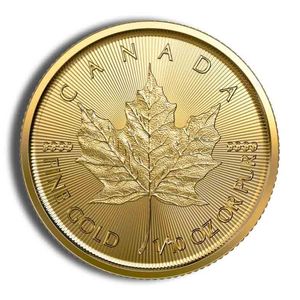
The $1 Gold Liberty Type 1 is a nineteenth-century United States gold coin struck in .900 fine gold and weighing 0.0483 troy ounces. It represents the first design type used for the denomination, issued by the United States Mint beginning in 1849 and produced at various mint facilities throughout its run. These coins are genuine circulated examples graded Very Fine, meaning they exhibit moderate to significant wear consistent with genuine circulation while retaining clear design detail and legibility across the major devices.
We offer these coins at the Very Fine grade level as an accessible entry point into early American gold coinage. Because exact dates and mint marks vary, the specific coin you receive will reflect the broader Type 1 series rather than a single year or facility. What remains consistent across every piece is the grade standard, the metal content, and the historical character that makes this series genuinely distinctive among nineteenth-century U.S. gold issues.
Congress authorized the one-dollar gold denomination through the Coinage Act of 1849, the same legislation that also greenlit the double eagle
…The $1 Gold Liberty Type 1 is a nineteenth-century United States gold coin struck in .900 fine gold and weighing 0.0483 troy ounces. It represents the first design type used for the denomination, issued by the United States Mint beginning in 1849 and produced at various mint facilities throughout its run. These coins are genuine circulated examples graded Very Fine, meaning they exhibit moderate to significant wear consistent with genuine circulation while retaining clear design detail and legibility across the major devices.
We offer these coins at the Very Fine grade level as an accessible entry point into early American gold coinage. Because exact dates and mint marks vary, the specific coin you receive will reflect the broader Type 1 series rather than a single year or facility. What remains consistent across every piece is the grade standard, the metal content, and the historical character that makes this series genuinely distinctive among nineteenth-century U.S. gold issues.
Congress authorized the one-dollar gold denomination through the Coinage Act of 1849, the same legislation that also greenlit the double eagle. The timing was not coincidental. The California Gold Rush had dramatically increased the supply of gold flowing into the United States economy, and a small-denomination gold coin offered a practical way to put that metal into everyday commerce. The first coins of this type entered circulation that same year.
The Type 1 design was produced from 1849 through 1854 and came from the hand of James B. Longacre, the chief engraver of the United States Mint at the time. Coins of this series were struck at several facilities, including Philadelphia, Charlotte, Dahlonega, New Orleans, and San Francisco, which accounts for the variety of mint marks encountered across surviving examples. The Type 1 was eventually replaced due to practical handling concerns related to the coin's small diameter, but it remains the foundational issue in the short-lived series.
The entire $1 gold series had a relatively brief lifespan, with all three types ceasing production in 1889. Type 1 examples, particularly those from branch mints with lower mintages, carry added significance for collectors of nineteenth-century American coinage. The coins that survive today in circulated grades represent authentic artifacts from a transitional period in U.S. monetary history.
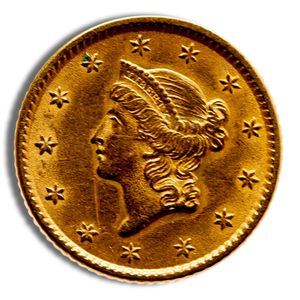
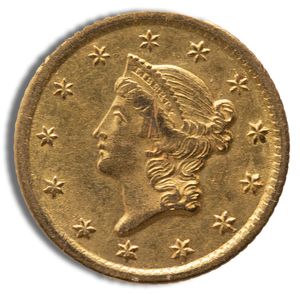
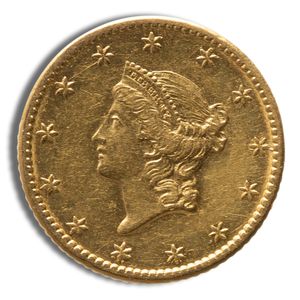
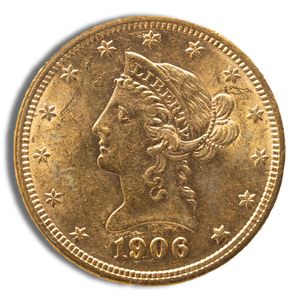
The obverse of the Type 1 features a portrait of Liberty facing left, wearing a coronet inscribed with the word "LIBERTY." Thirteen stars surround the portrait in a tight arc, referencing the original colonies, and the date appears at the base. The design is compact by necessity, as the coin measures just thirteen millimeters in diameter, making it one of the smallest gold coins ever struck for regular U.S. circulation.
The reverse carries an agricultural wreath encircling the denomination "1 DOLLAR," with "UNITED STATES OF AMERICA" inscribed around the periphery. The composition is straightforward and functional, reflecting the utilitarian intent of the denomination. On a Very Fine example, the high points of the obverse portrait and the wreath details will show visible wear, but the core elements of both sides remain identifiable and intact.
At 0.0483 troy ounces, the $1 Gold Liberty Type 1 is one of the smallest gold coin formats in American numismatic history. Its compact size lowers the nominal metal cost per piece relative to larger gold coins, which allows buyers to acquire a genuine piece of nineteenth-century U.S. gold coinage at a comparatively modest price point. The tradeoff is that numismatic and collector premiums make up a larger share of the total cost than they would for a standard one-ounce issue.
For buyers focused primarily on metal content, other formats offer more straightforward value. But for those drawn to historical American coinage, the small size is part of the coin's identity rather than a limitation. These pieces were designed to circulate in everyday commerce, and their diminutive scale is an accurate reflection of how gold was used in mid-nineteenth-century American life.
Every $1 Gold Liberty Type 1 we carry is verified for authenticity, weight, and metal content before it reaches a customer. These coins were struck to the United States Mint's established standards for the denomination, with a fineness of .900 gold and a prescribed weight that has been well-documented for over 170 years. That consistency makes authentication considerably more straightforward than it would be for obscure or lightly traded issues.
As authorized dealers for both PCGS and NGC, we maintain direct relationships with the industry's leading third-party grading and authentication services. While the random-year Very Fine coins we offer are not individually slabbed, our sourcing standards and authentication practices reflect the same level of diligence applied across our broader catalog. Any coin we ship has been handled and reviewed consistent with the grade and type represented.
Very Fine, often abbreviated VF, indicates a coin that has seen genuine circulation but retains clear, identifiable detail across its primary design elements. On the $1 Gold Liberty Type 1, a VF example will show visible wear on Liberty's portrait and the high points of the reverse wreath, but the major features remain sharp enough to be read and appreciated without magnification. These are not slider or lightly circulated coins; they reflect honest wear consistent with everyday use in the mid-to-late nineteenth century.
Individual coins ship in a protective plastic flip to prevent additional handling wear during transit. Because these are circulated examples sourced from the secondary market, minor contact marks, surface toning, or handling signs consistent with their age and grade may be present. This is expected for coins of this type and does not affect the metal content or the authenticity of the piece. The date and mint mark you receive will vary, as the listing covers the full range of Type 1 production years and facilities.
Pricing for the $1 Gold Liberty Type 1 reflects both the spot value of the underlying gold content and a numismatic premium driven by the coin's historical status, collectibility, and relatively limited surviving supply in original circulated grades. Because these are genuine nineteenth-century U.S. Mint issues rather than modern bullion coins, premiums tend to be more influenced by collector demand and grade-specific availability than by spot price movements alone.
Our pricing is structured around real-time market conditions and updated to reflect current spot values alongside the premiums appropriate for this type and grade. The bid/ask spread displayed on our product pages gives buyers a transparent view of both acquisition cost and expected resale value, which is especially relevant for a product category where the numismatic component of pricing can shift based on collector interest and secondary market supply.
The $1 Gold Liberty Type 1 trades within an established market of coin dealers, auction houses, and private collectors who regularly seek circulated examples of early American gold coinage. Very Fine specimens occupy a practical middle ground in the market, carrying genuine collector appeal without the significant premium that near-mint survivors command. This positioning tends to support consistent resale demand across multiple buyer types.
We operate as a two-way market, meaning customers can sell back into the same ecosystem where they made their purchase. Our competitive buyback pricing reflects real-time conditions and is designed to give sellers a clear, efficient exit rather than forcing them to navigate third-party channels when the time comes to liquidate. Understanding liquidity before a purchase matters, and that transparency is built into how we present every product we carry.
The $1 Gold Liberty Type 1 occupies a specific and meaningful place in American numismatic history. It is not a modern bullion product or a commemorative issue; it is an original circulated coin struck by the United States Mint during a formative period in the country's monetary development. For buyers interested in genuine historical American gold, this coin delivers that character at a more accessible price point than many other nineteenth-century U.S. gold types.
The Very Fine grade is well-suited to collectors who want coins with clear design detail and genuine originality rather than cleaned, artificially enhanced, or problem coins. It also represents an honest middle tier within the Type 1 market, sitting above heavily worn examples while remaining approachable relative to high-grade survivors. The random-year format means you may receive a coin from Philadelphia, one of the Southern branch mints, or San Francisco, each carrying its own mint mark and production history.
We have been operating as a nationally recognized precious metals dealer since 2010, building our reputation on transparent pricing, genuine product integrity, and a buying experience that respects the customer's knowledge rather than working around it. Our A rating with the Better Business Bureau, membership in the American Numismatic Association, and membership in the National Coin and Bullion Association reflect a consistent commitment to professionalism across every transaction.
Our authorized dealer relationships with both PCGS and NGC distinguish us from general resellers operating without meaningful accountability to industry authentication standards. Every product we carry is verified before it ships, and our pricing is structured to give customers a clear view of what they are paying and what they can reasonably expect when they decide to sell. We do not operate as a one-way retail channel. Our two-way market model means we stand behind the products we sell by actively providing liquidity on the other side of the transaction as well.
Bullion Standard Pro gives members access to live, executable wholesale bid and ask pricing across our catalog, including numismatic products like the $1 Gold Liberty Type 1. Because pricing for circulated nineteenth-century gold reflects both spot values and collector-driven premiums, having real-time visibility into wholesale market pricing provides a meaningfully clearer picture of true acquisition and liquidation costs than static retail listings can offer. Members can also monitor historical premium trends and bid/ask spread behavior for products in this category to better understand how market demand influences pricing over time.
Portfolio valuation through Pro uses live executable wholesale bid pricing rather than estimated retail values, which gives members a more accurate read on current liquidation value across their holdings. For buyers who treat numismatic gold as a meaningful part of a broader precious metals strategy, the combination of real-time pricing, proprietary market intelligence, and product comparison tools provides a more complete foundation for making and evaluating purchase decisions.
We support a wide range of payment methods to make the purchasing process as convenient and secure as possible. Customers can pay using Visa, Mastercard, American Express, Discover, PayPal, bank-connected payments through Plaid, wire transfer, paper check, or cryptocurrency via BitPay. Each method is integrated into a secure transaction environment built to protect your information and simplify the checkout process from start to finish.
Whether you prefer the immediacy of a card payment, the flexibility of a bank transfer, or the privacy of a cryptocurrency transaction, we have structured our payment options to accommodate a broad range of buyer preferences without creating unnecessary friction. Security and convenience are not tradeoffs in how we process payments; they are both core requirements of how the experience is designed.
Product ID: BST-00050834F9
| Random Year Status | Random Year |
|---|---|
| Precious Metal Type | Gold |
| Bullion Coin Type | Liberty Head Dollar |
| Format | Coin |
| Country of Origin | United States |
| Brand/Mint | U.S. Mint |
| Mint Mark | Various |
| Purity | 0.9 |
| Weight | 0.0483 oz |
| Thickness (mm) | 1 mm |

| Diameter (mm) | 12.7 mm |
| Grade | VF |
The $1 Gold Liberty Type 1 is a nineteenth-century United States gold coin struck in .900 fine gold and weighing 0.0483 troy ounces. It represents the first design type used for the denomination, issued by the United States Mint beginning in 1849 and produced at various mint facilities throughout its run. These coins are genuine circulated examples graded Very Fine, meaning they exhibit moderate to significant wear consistent with genuine circulation while retaining clear design detail and legibility across the major devices.
We offer these coins at the Very Fine grade level as an accessible entry point into early American gold coinage. Because exact dates and mint marks vary, the specific coin you receive will reflect the broader Type 1 series rather than a single year or facility. What remains consistent across every piece is the grade standard, the metal content, and the historical character that makes this series genuinely distinctive among nineteenth-century U.S. gold issues.
Congress authorized the one-dollar gold denomination through the Coinage Act of 1849, the same legislation that also greenlit the double eagle
…The $1 Gold Liberty Type 1 is a nineteenth-century United States gold coin struck in .900 fine gold and weighing 0.0483 troy ounces. It represents the first design type used for the denomination, issued by the United States Mint beginning in 1849 and produced at various mint facilities throughout its run. These coins are genuine circulated examples graded Very Fine, meaning they exhibit moderate to significant wear consistent with genuine circulation while retaining clear design detail and legibility across the major devices.
We offer these coins at the Very Fine grade level as an accessible entry point into early American gold coinage. Because exact dates and mint marks vary, the specific coin you receive will reflect the broader Type 1 series rather than a single year or facility. What remains consistent across every piece is the grade standard, the metal content, and the historical character that makes this series genuinely distinctive among nineteenth-century U.S. gold issues.
Congress authorized the one-dollar gold denomination through the Coinage Act of 1849, the same legislation that also greenlit the double eagle. The timing was not coincidental. The California Gold Rush had dramatically increased the supply of gold flowing into the United States economy, and a small-denomination gold coin offered a practical way to put that metal into everyday commerce. The first coins of this type entered circulation that same year.
The Type 1 design was produced from 1849 through 1854 and came from the hand of James B. Longacre, the chief engraver of the United States Mint at the time. Coins of this series were struck at several facilities, including Philadelphia, Charlotte, Dahlonega, New Orleans, and San Francisco, which accounts for the variety of mint marks encountered across surviving examples. The Type 1 was eventually replaced due to practical handling concerns related to the coin's small diameter, but it remains the foundational issue in the short-lived series.
The entire $1 gold series had a relatively brief lifespan, with all three types ceasing production in 1889. Type 1 examples, particularly those from branch mints with lower mintages, carry added significance for collectors of nineteenth-century American coinage. The coins that survive today in circulated grades represent authentic artifacts from a transitional period in U.S. monetary history.
The obverse of the Type 1 features a portrait of Liberty facing left, wearing a coronet inscribed with the word "LIBERTY." Thirteen stars surround the portrait in a tight arc, referencing the original colonies, and the date appears at the base. The design is compact by necessity, as the coin measures just thirteen millimeters in diameter, making it one of the smallest gold coins ever struck for regular U.S. circulation.
The reverse carries an agricultural wreath encircling the denomination "1 DOLLAR," with "UNITED STATES OF AMERICA" inscribed around the periphery. The composition is straightforward and functional, reflecting the utilitarian intent of the denomination. On a Very Fine example, the high points of the obverse portrait and the wreath details will show visible wear, but the core elements of both sides remain identifiable and intact.
At 0.0483 troy ounces, the $1 Gold Liberty Type 1 is one of the smallest gold coin formats in American numismatic history. Its compact size lowers the nominal metal cost per piece relative to larger gold coins, which allows buyers to acquire a genuine piece of nineteenth-century U.S. gold coinage at a comparatively modest price point. The tradeoff is that numismatic and collector premiums make up a larger share of the total cost than they would for a standard one-ounce issue.
For buyers focused primarily on metal content, other formats offer more straightforward value. But for those drawn to historical American coinage, the small size is part of the coin's identity rather than a limitation. These pieces were designed to circulate in everyday commerce, and their diminutive scale is an accurate reflection of how gold was used in mid-nineteenth-century American life.
Every $1 Gold Liberty Type 1 we carry is verified for authenticity, weight, and metal content before it reaches a customer. These coins were struck to the United States Mint's established standards for the denomination, with a fineness of .900 gold and a prescribed weight that has been well-documented for over 170 years. That consistency makes authentication considerably more straightforward than it would be for obscure or lightly traded issues.
As authorized dealers for both PCGS and NGC, we maintain direct relationships with the industry's leading third-party grading and authentication services. While the random-year Very Fine coins we offer are not individually slabbed, our sourcing standards and authentication practices reflect the same level of diligence applied across our broader catalog. Any coin we ship has been handled and reviewed consistent with the grade and type represented.
Very Fine, often abbreviated VF, indicates a coin that has seen genuine circulation but retains clear, identifiable detail across its primary design elements. On the $1 Gold Liberty Type 1, a VF example will show visible wear on Liberty's portrait and the high points of the reverse wreath, but the major features remain sharp enough to be read and appreciated without magnification. These are not slider or lightly circulated coins; they reflect honest wear consistent with everyday use in the mid-to-late nineteenth century.
Individual coins ship in a protective plastic flip to prevent additional handling wear during transit. Because these are circulated examples sourced from the secondary market, minor contact marks, surface toning, or handling signs consistent with their age and grade may be present. This is expected for coins of this type and does not affect the metal content or the authenticity of the piece. The date and mint mark you receive will vary, as the listing covers the full range of Type 1 production years and facilities.
Pricing for the $1 Gold Liberty Type 1 reflects both the spot value of the underlying gold content and a numismatic premium driven by the coin's historical status, collectibility, and relatively limited surviving supply in original circulated grades. Because these are genuine nineteenth-century U.S. Mint issues rather than modern bullion coins, premiums tend to be more influenced by collector demand and grade-specific availability than by spot price movements alone.
Our pricing is structured around real-time market conditions and updated to reflect current spot values alongside the premiums appropriate for this type and grade. The bid/ask spread displayed on our product pages gives buyers a transparent view of both acquisition cost and expected resale value, which is especially relevant for a product category where the numismatic component of pricing can shift based on collector interest and secondary market supply.
The $1 Gold Liberty Type 1 trades within an established market of coin dealers, auction houses, and private collectors who regularly seek circulated examples of early American gold coinage. Very Fine specimens occupy a practical middle ground in the market, carrying genuine collector appeal without the significant premium that near-mint survivors command. This positioning tends to support consistent resale demand across multiple buyer types.
We operate as a two-way market, meaning customers can sell back into the same ecosystem where they made their purchase. Our competitive buyback pricing reflects real-time conditions and is designed to give sellers a clear, efficient exit rather than forcing them to navigate third-party channels when the time comes to liquidate. Understanding liquidity before a purchase matters, and that transparency is built into how we present every product we carry.
The $1 Gold Liberty Type 1 occupies a specific and meaningful place in American numismatic history. It is not a modern bullion product or a commemorative issue; it is an original circulated coin struck by the United States Mint during a formative period in the country's monetary development. For buyers interested in genuine historical American gold, this coin delivers that character at a more accessible price point than many other nineteenth-century U.S. gold types.
The Very Fine grade is well-suited to collectors who want coins with clear design detail and genuine originality rather than cleaned, artificially enhanced, or problem coins. It also represents an honest middle tier within the Type 1 market, sitting above heavily worn examples while remaining approachable relative to high-grade survivors. The random-year format means you may receive a coin from Philadelphia, one of the Southern branch mints, or San Francisco, each carrying its own mint mark and production history.
We have been operating as a nationally recognized precious metals dealer since 2010, building our reputation on transparent pricing, genuine product integrity, and a buying experience that respects the customer's knowledge rather than working around it. Our A rating with the Better Business Bureau, membership in the American Numismatic Association, and membership in the National Coin and Bullion Association reflect a consistent commitment to professionalism across every transaction.
Our authorized dealer relationships with both PCGS and NGC distinguish us from general resellers operating without meaningful accountability to industry authentication standards. Every product we carry is verified before it ships, and our pricing is structured to give customers a clear view of what they are paying and what they can reasonably expect when they decide to sell. We do not operate as a one-way retail channel. Our two-way market model means we stand behind the products we sell by actively providing liquidity on the other side of the transaction as well.
Bullion Standard Pro gives members access to live, executable wholesale bid and ask pricing across our catalog, including numismatic products like the $1 Gold Liberty Type 1. Because pricing for circulated nineteenth-century gold reflects both spot values and collector-driven premiums, having real-time visibility into wholesale market pricing provides a meaningfully clearer picture of true acquisition and liquidation costs than static retail listings can offer. Members can also monitor historical premium trends and bid/ask spread behavior for products in this category to better understand how market demand influences pricing over time.
Portfolio valuation through Pro uses live executable wholesale bid pricing rather than estimated retail values, which gives members a more accurate read on current liquidation value across their holdings. For buyers who treat numismatic gold as a meaningful part of a broader precious metals strategy, the combination of real-time pricing, proprietary market intelligence, and product comparison tools provides a more complete foundation for making and evaluating purchase decisions.
We support a wide range of payment methods to make the purchasing process as convenient and secure as possible. Customers can pay using Visa, Mastercard, American Express, Discover, PayPal, bank-connected payments through Plaid, wire transfer, paper check, or cryptocurrency via BitPay. Each method is integrated into a secure transaction environment built to protect your information and simplify the checkout process from start to finish.
Whether you prefer the immediacy of a card payment, the flexibility of a bank transfer, or the privacy of a cryptocurrency transaction, we have structured our payment options to accommodate a broad range of buyer preferences without creating unnecessary friction. Security and convenience are not tradeoffs in how we process payments; they are both core requirements of how the experience is designed.