Gold dollar coins from the United States Mint occupy a distinct and well-defined place in American numismatic history, and the Type 3 Indian Head issue is the most refined of the three gold dollar designs produced during the nineteenth century. Weighing 0.0483 troy ounces with a purity of .900 fine gold, each coin contains a small but meaningful quantity of the metal and carries the full weight of United States Mint production behind it. The Type 3 was struck at various mint facilities, and the specific year and mint mark will vary on the coins we offer in this listing. What remains consistent across the series is the design quality, the standardized metal content, and the coin's recognized place in American coinage history.
These coins are listed in AU, or About Uncirculated condition, meaning they saw minimal circulation and retain most of their original mint detail. For buyers who want a circulated-grade example with strong visual appeal and genuine historical character, the Type 3 gold dollar in AU condition represents a practical and approachable entry point into nineteenth century United States gold coinage.
History and Background
The Uni…
Overview of $1 Gold Indian Type 3
Gold dollar coins from the United States Mint occupy a distinct and well-defined place in American numismatic history, and the Type 3 Indian Head issue is the most refined of the three gold dollar designs produced during the nineteenth century. Weighing 0.0483 troy ounces with a purity of .900 fine gold, each coin contains a small but meaningful quantity of the metal and carries the full weight of United States Mint production behind it. The Type 3 was struck at various mint facilities, and the specific year and mint mark will vary on the coins we offer in this listing. What remains consistent across the series is the design quality, the standardized metal content, and the coin's recognized place in American coinage history.
These coins are listed in AU, or About Uncirculated condition, meaning they saw minimal circulation and retain most of their original mint detail. For buyers who want a circulated-grade example with strong visual appeal and genuine historical character, the Type 3 gold dollar in AU condition represents a practical and approachable entry point into nineteenth century United States gold coinage.
History and Background
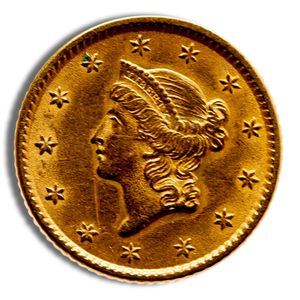
The United States gold dollar was authorized by the Coinage Act of 1849, initially introduced as a response to the influx of gold following the California Gold Rush. The first design, known as Type 1, featured a simple Liberty head and proved problematic in circulation due to its small diameter. The Type 2, introduced in 1854, addressed the size issue by increasing the diameter while reducing the thickness, but its intricate design created minting difficulties.
The Type 3 design debuted in 1856 and remained in production until 1889 when the gold dollar series was officially discontinued. James B. Longacre, the Chief Engraver of the United States Mint, reworked the Type 2 portrait into a larger, more refined version that struck more cleanly and held up better in production. The result was the longest-running of the three gold dollar designs and the most commonly encountered today in circulated and lightly circulated grades. Coins in this series were struck at multiple facilities, including Philadelphia, San Francisco, Dahlonega, Charlotte, and New Orleans, depending on the year of issue.
Design and Aesthetics
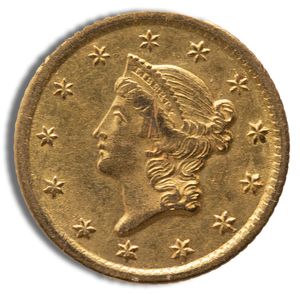
The obverse features a left-facing portrait of a Native American princess wearing a feathered headdress, a design often referred to as the Indian Head despite its stylized and distinctly classical interpretation. The portrait is larger and more defined than the earlier Type 2 version, filling more of the coin's face and allowing for crisper detail when struck properly. The date appears below the portrait, and the word LIBERTY is inscribed across the headband of the headdress.
The reverse carries a wreath of corn, wheat, tobacco, and maple, encircling the denomination expressed as ONE DOLLAR along with UNITED STATES OF AMERICA. The wreath design is detailed and elegant for a coin of this size, reflecting the engraving standards of the mid-to-late nineteenth century United States Mint. Despite the coin's small physical dimensions, the design manages a level of visual complexity that collectors have appreciated for generations.
Fractional Size and Accessibility
At 0.0483 troy ounces, the Type 3 gold dollar is among the smallest gold coins produced by the United States Mint, and that compact size is part of what defines the series. For buyers who want genuine United States gold coinage without committing to a larger format, this denomination offers an accessible price point without sacrificing authenticity or historical significance. The physical size of the coin is notably small, roughly 13 millimeters in diameter, so handling with care is standard practice when evaluating or storing examples.
The fractional nature of the gold dollar also makes it a practical option for buyers building a varied collection of nineteenth century American gold across different denominations. Its low gold weight keeps the spot-related cost manageable while still providing real metal content and a direct connection to American monetary history.
Authenticity and Product Integrity
Every coin in this listing was produced by the United States Mint and carries the full weight of that institution's production standards. The gold content of .900 fine gold per coin was maintained consistently across the Type 3 series, and the 0.0483 troy ounce weight is the established standard for the denomination. These specifications are well-documented and straightforward to verify for any experienced numismatist or precious metals buyer.
We are authorized dealers for both PCGS and NGC, and our sourcing reflects the standards that relationship requires. Each coin we handle is evaluated for authenticity and metal content. For buyers who want independent third-party certification beyond the raw coin format offered here, PCGS and NGC grading services are widely available and we can speak to that process directly if needed.
Condition and Packaging
AU, or About Uncirculated, refers to a coin that spent limited time in circulation and retains most of its original surface detail and luster. On a Type 3 gold dollar graded AU, you can expect light wear on the highest points of the design, particularly on the cheekbone and hair details of the portrait and the high points of the reverse wreath, with significant original luster still visible in the fields and protected areas. These are not problem-free mint state coins, but they are strong examples that retain far more detail than fully circulated grades.
Individual coins ship in protective plastic flips. If you are purchasing a larger quantity, coins will be packaged in a tube or grouped appropriately based on the order size. Because the specific year and mint mark are determined at random from our current inventory, you will receive one or more authentic Type 3 gold dollar coins in AU condition, with the exact date varying from the examples shown. This is a standard practice for random year listings, and it allows us to offer these coins at competitive pricing across the available date range.
Pricing and Market Factors
Pricing for the Type 3 gold dollar in AU condition reflects both the current spot price of gold and a numismatic premium that goes beyond raw metal content. With only 0.0483 troy ounces of gold per coin, the intrinsic metal value is relatively modest, but these coins trade at premiums driven primarily by collector demand, historical significance, and the limited surviving supply of high-grade circulated examples. The premium above spot for nineteenth century United States gold tends to be substantially higher than for modern bullion coins, which is consistent with the numismatic nature of the product.
Year-to-year variations in supply, condition availability, and collector activity also influence pricing within the Type 3 series. Our pricing reflects real-time market conditions and is structured transparently so buyers can evaluate the full cost clearly. The bid and ask spread displayed on our product pages gives buyers a complete picture of both acquisition cost and current resale considerations.
Selling and Liquidity
Type 3 gold dollars are among the more recognizable nineteenth century United States gold coins and are actively traded in the numismatic market. Their standardized specifications, clear series identity, and well-documented mintage history make them straightforward to evaluate for both dealers and collectors. AU examples carry consistent demand from buyers who want circulated-grade American gold with visible detail and historical character.
We operate a two-way market that supports both buying and selling within the same platform, which is particularly relevant for numismatic items where resale timing and pricing can vary. Understanding the current wholesale bid pricing on products like this one before purchasing is part of the informed approach we encourage, and our platform is designed to make that information accessible rather than opaque.
Why Buy the $1 Gold Indian Type 3?
The Type 3 gold dollar stands apart from modern bullion because it combines genuine precious metal content with documented American monetary history. For collectors and buyers of United States gold, the Type 3 is the most achievable entry point into the nineteenth century gold dollar series, with strong strike quality relative to the earlier types and a longer production run that supports a broader range of available dates. In AU condition, these coins retain enough detail to make the design fully readable and visually compelling.
For buyers interested in pre-1933 United States gold, the gold dollar offers a lower-cost entry into the category compared to larger denominations like the $2.50 Quarter Eagle or $5 Half Eagle. The combination of historical significance, United States Mint production, and accessible price point makes the Type 3 gold dollar a practical and well-regarded choice within its category.
Why Buy from Bullion Standard?
We have been operating in the precious metals market since 2010, and the standards we hold ourselves to reflect over a decade of building trust with buyers and sellers across the country. Our A rating with the Better Business Bureau and our memberships in the American Numismatic Association and the National Coin and Bullion Association reflect the professional standards we apply across every transaction. As authorized dealers for both PCGS and NGC, we are held to strict sourcing and authentication requirements that directly benefit the buyers who work with us.
Transparent pricing is a core part of how we operate. The bid and ask spread shown on each product page gives buyers clear visibility into both what they pay and what they can expect to receive when selling, rather than presenting only one side of the transaction. Our two-way market model means liquidity is a consideration we take seriously before a purchase is made, not only when it comes time to sell. Whether you are buying a single coin or building a broader position in United States gold, the experience we provide is designed to be straightforward, well-supported, and free of unnecessary pressure.
Get Near-Spot Pricing with Bullion Standard Pro
Bullion Standard Pro gives members access to live, executable wholesale bid and ask pricing, which is particularly relevant when evaluating numismatic products like the Type 3 gold dollar where premiums above spot can be significant and market-dependent. Rather than relying on static retail pricing, Pro members can see how the product is currently priced at the wholesale level and compare that directly against acquisition cost. For a product category where understanding the spread between buy and sell pricing matters as much as the spot price, that level of transparency is genuinely useful.
Pro members also benefit from real-time portfolio valuation using current wholesale bid prices, providing a more accurate picture of actual liquidation value rather than estimated retail figures. Our proprietary research tools allow members to evaluate premiums, bid/ask spreads, and liquidity across the broader catalog, making it easier to compare numismatic gold products objectively and identify where relative value exists within the market at any given time.
Flexible and Secure Payment Options
We support a wide range of payment methods to make transactions straightforward and secure regardless of how you prefer to pay. Accepted options include Visa, Mastercard, American Express, Discover, PayPal, bank-connected payments through Plaid, wire transfer, paper check, and cryptocurrency payments through BitPay. Each payment method is processed through a secure transaction environment designed to protect your information and provide confidence throughout the purchasing process. If you have questions about a specific payment method or want guidance on which option works best for your order, our support team is available to help.
Gold dollar coins from the United States Mint occupy a distinct and well-defined place in American numismatic history, and the Type 3 Indian Head issue is the most refined of the three gold dollar designs produced during the nineteenth century. Weighing 0.0483 troy ounces with a purity of .900 fine gold, each coin contains a small but meaningful quantity of the metal and carries the full weight of United States Mint production behind it. The Type 3 was struck at various mint facilities, and the specific year and mint mark will vary on the coins we offer in this listing. What remains consistent across the series is the design quality, the standardized metal content, and the coin's recognized place in American coinage history.
These coins are listed in AU, or About Uncirculated condition, meaning they saw minimal circulation and retain most of their original mint detail. For buyers who want a circulated-grade example with strong visual appeal and genuine historical character, the Type 3 gold dollar in AU condition represents a practical and approachable entry point into nineteenth century United States gold coinage.
History and Background
The Uni…
Overview of $1 Gold Indian Type 3
Gold dollar coins from the United States Mint occupy a distinct and well-defined place in American numismatic history, and the Type 3 Indian Head issue is the most refined of the three gold dollar designs produced during the nineteenth century. Weighing 0.0483 troy ounces with a purity of .900 fine gold, each coin contains a small but meaningful quantity of the metal and carries the full weight of United States Mint production behind it. The Type 3 was struck at various mint facilities, and the specific year and mint mark will vary on the coins we offer in this listing. What remains consistent across the series is the design quality, the standardized metal content, and the coin's recognized place in American coinage history.
These coins are listed in AU, or About Uncirculated condition, meaning they saw minimal circulation and retain most of their original mint detail. For buyers who want a circulated-grade example with strong visual appeal and genuine historical character, the Type 3 gold dollar in AU condition represents a practical and approachable entry point into nineteenth century United States gold coinage.
History and Background
The United States gold dollar was authorized by the Coinage Act of 1849, initially introduced as a response to the influx of gold following the California Gold Rush. The first design, known as Type 1, featured a simple Liberty head and proved problematic in circulation due to its small diameter. The Type 2, introduced in 1854, addressed the size issue by increasing the diameter while reducing the thickness, but its intricate design created minting difficulties.
The Type 3 design debuted in 1856 and remained in production until 1889 when the gold dollar series was officially discontinued. James B. Longacre, the Chief Engraver of the United States Mint, reworked the Type 2 portrait into a larger, more refined version that struck more cleanly and held up better in production. The result was the longest-running of the three gold dollar designs and the most commonly encountered today in circulated and lightly circulated grades. Coins in this series were struck at multiple facilities, including Philadelphia, San Francisco, Dahlonega, Charlotte, and New Orleans, depending on the year of issue.
Design and Aesthetics
The obverse features a left-facing portrait of a Native American princess wearing a feathered headdress, a design often referred to as the Indian Head despite its stylized and distinctly classical interpretation. The portrait is larger and more defined than the earlier Type 2 version, filling more of the coin's face and allowing for crisper detail when struck properly. The date appears below the portrait, and the word LIBERTY is inscribed across the headband of the headdress.
The reverse carries a wreath of corn, wheat, tobacco, and maple, encircling the denomination expressed as ONE DOLLAR along with UNITED STATES OF AMERICA. The wreath design is detailed and elegant for a coin of this size, reflecting the engraving standards of the mid-to-late nineteenth century United States Mint. Despite the coin's small physical dimensions, the design manages a level of visual complexity that collectors have appreciated for generations.
Fractional Size and Accessibility
At 0.0483 troy ounces, the Type 3 gold dollar is among the smallest gold coins produced by the United States Mint, and that compact size is part of what defines the series. For buyers who want genuine United States gold coinage without committing to a larger format, this denomination offers an accessible price point without sacrificing authenticity or historical significance. The physical size of the coin is notably small, roughly 13 millimeters in diameter, so handling with care is standard practice when evaluating or storing examples.
The fractional nature of the gold dollar also makes it a practical option for buyers building a varied collection of nineteenth century American gold across different denominations. Its low gold weight keeps the spot-related cost manageable while still providing real metal content and a direct connection to American monetary history.
Authenticity and Product Integrity
Every coin in this listing was produced by the United States Mint and carries the full weight of that institution's production standards. The gold content of .900 fine gold per coin was maintained consistently across the Type 3 series, and the 0.0483 troy ounce weight is the established standard for the denomination. These specifications are well-documented and straightforward to verify for any experienced numismatist or precious metals buyer.
We are authorized dealers for both PCGS and NGC, and our sourcing reflects the standards that relationship requires. Each coin we handle is evaluated for authenticity and metal content. For buyers who want independent third-party certification beyond the raw coin format offered here, PCGS and NGC grading services are widely available and we can speak to that process directly if needed.
Condition and Packaging
AU, or About Uncirculated, refers to a coin that spent limited time in circulation and retains most of its original surface detail and luster. On a Type 3 gold dollar graded AU, you can expect light wear on the highest points of the design, particularly on the cheekbone and hair details of the portrait and the high points of the reverse wreath, with significant original luster still visible in the fields and protected areas. These are not problem-free mint state coins, but they are strong examples that retain far more detail than fully circulated grades.
Individual coins ship in protective plastic flips. If you are purchasing a larger quantity, coins will be packaged in a tube or grouped appropriately based on the order size. Because the specific year and mint mark are determined at random from our current inventory, you will receive one or more authentic Type 3 gold dollar coins in AU condition, with the exact date varying from the examples shown. This is a standard practice for random year listings, and it allows us to offer these coins at competitive pricing across the available date range.
Pricing and Market Factors
Pricing for the Type 3 gold dollar in AU condition reflects both the current spot price of gold and a numismatic premium that goes beyond raw metal content. With only 0.0483 troy ounces of gold per coin, the intrinsic metal value is relatively modest, but these coins trade at premiums driven primarily by collector demand, historical significance, and the limited surviving supply of high-grade circulated examples. The premium above spot for nineteenth century United States gold tends to be substantially higher than for modern bullion coins, which is consistent with the numismatic nature of the product.
Year-to-year variations in supply, condition availability, and collector activity also influence pricing within the Type 3 series. Our pricing reflects real-time market conditions and is structured transparently so buyers can evaluate the full cost clearly. The bid and ask spread displayed on our product pages gives buyers a complete picture of both acquisition cost and current resale considerations.
Selling and Liquidity
Type 3 gold dollars are among the more recognizable nineteenth century United States gold coins and are actively traded in the numismatic market. Their standardized specifications, clear series identity, and well-documented mintage history make them straightforward to evaluate for both dealers and collectors. AU examples carry consistent demand from buyers who want circulated-grade American gold with visible detail and historical character.
We operate a two-way market that supports both buying and selling within the same platform, which is particularly relevant for numismatic items where resale timing and pricing can vary. Understanding the current wholesale bid pricing on products like this one before purchasing is part of the informed approach we encourage, and our platform is designed to make that information accessible rather than opaque.
Why Buy the $1 Gold Indian Type 3?
The Type 3 gold dollar stands apart from modern bullion because it combines genuine precious metal content with documented American monetary history. For collectors and buyers of United States gold, the Type 3 is the most achievable entry point into the nineteenth century gold dollar series, with strong strike quality relative to the earlier types and a longer production run that supports a broader range of available dates. In AU condition, these coins retain enough detail to make the design fully readable and visually compelling.
For buyers interested in pre-1933 United States gold, the gold dollar offers a lower-cost entry into the category compared to larger denominations like the $2.50 Quarter Eagle or $5 Half Eagle. The combination of historical significance, United States Mint production, and accessible price point makes the Type 3 gold dollar a practical and well-regarded choice within its category.
Why Buy from Bullion Standard?
We have been operating in the precious metals market since 2010, and the standards we hold ourselves to reflect over a decade of building trust with buyers and sellers across the country. Our A rating with the Better Business Bureau and our memberships in the American Numismatic Association and the National Coin and Bullion Association reflect the professional standards we apply across every transaction. As authorized dealers for both PCGS and NGC, we are held to strict sourcing and authentication requirements that directly benefit the buyers who work with us.
Transparent pricing is a core part of how we operate. The bid and ask spread shown on each product page gives buyers clear visibility into both what they pay and what they can expect to receive when selling, rather than presenting only one side of the transaction. Our two-way market model means liquidity is a consideration we take seriously before a purchase is made, not only when it comes time to sell. Whether you are buying a single coin or building a broader position in United States gold, the experience we provide is designed to be straightforward, well-supported, and free of unnecessary pressure.
Get Near-Spot Pricing with Bullion Standard Pro
Bullion Standard Pro gives members access to live, executable wholesale bid and ask pricing, which is particularly relevant when evaluating numismatic products like the Type 3 gold dollar where premiums above spot can be significant and market-dependent. Rather than relying on static retail pricing, Pro members can see how the product is currently priced at the wholesale level and compare that directly against acquisition cost. For a product category where understanding the spread between buy and sell pricing matters as much as the spot price, that level of transparency is genuinely useful.
Pro members also benefit from real-time portfolio valuation using current wholesale bid prices, providing a more accurate picture of actual liquidation value rather than estimated retail figures. Our proprietary research tools allow members to evaluate premiums, bid/ask spreads, and liquidity across the broader catalog, making it easier to compare numismatic gold products objectively and identify where relative value exists within the market at any given time.
Flexible and Secure Payment Options
We support a wide range of payment methods to make transactions straightforward and secure regardless of how you prefer to pay. Accepted options include Visa, Mastercard, American Express, Discover, PayPal, bank-connected payments through Plaid, wire transfer, paper check, and cryptocurrency payments through BitPay. Each payment method is processed through a secure transaction environment designed to protect your information and provide confidence throughout the purchasing process. If you have questions about a specific payment method or want guidance on which option works best for your order, our support team is available to help.
This website uses cookies for analytics and to deliver personalized content. By continuing to
use our site, you acknowledge that you have read and agree to our Privacy Policy and Cookie
Policy.
Current Quantities Available
Unfortunately, we only have 0
of
this item in
stock.
Please call us at (833) 278-4653
or email us at support@bullionstandard.com
if you wish to purchase a larger quantity than what is available on our website.
We can often locate additional quantities.

 (833) 278-4653


.png)