Buy $10 Gold Coins Online
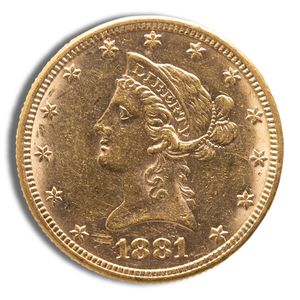
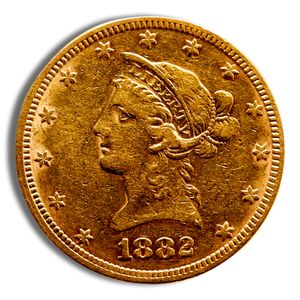
Our catalog of $10 gold coins brings together two of the most historically significant American gold coin types ever struck: the Gold Liberty Eagle and the Gold Indian Eagle. Both series were produced by the United States Mint and carry the same 0.4837 troy ounce gold content at .900 fine purity, making them directly comparable in metal weight while differing considerably in design, era, and collector profile.
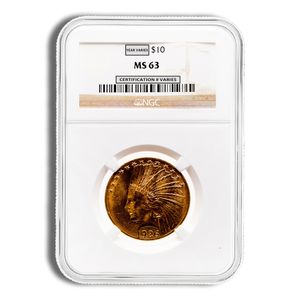
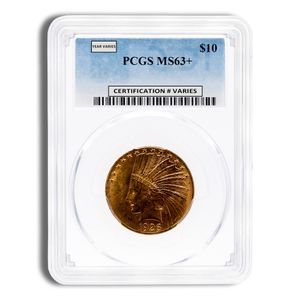
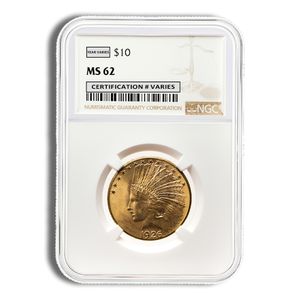
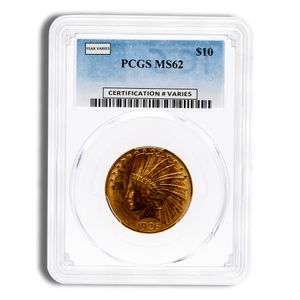
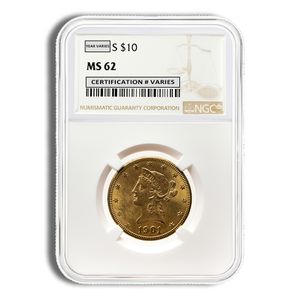
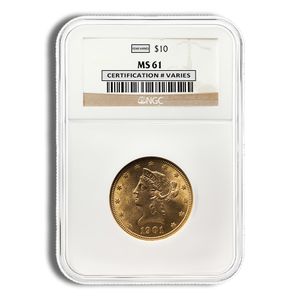
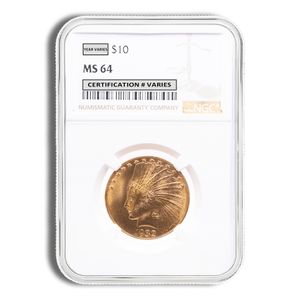
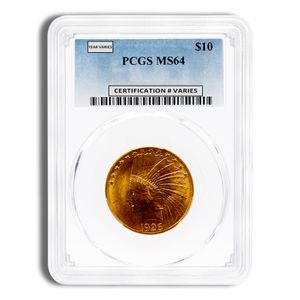
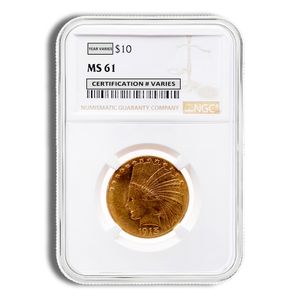
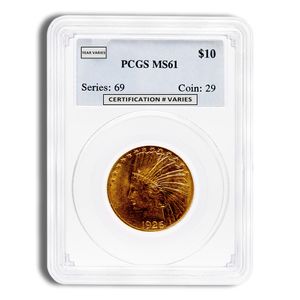
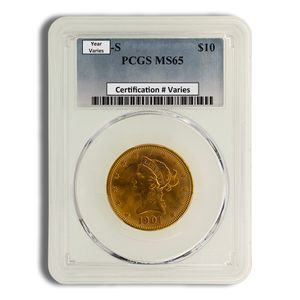
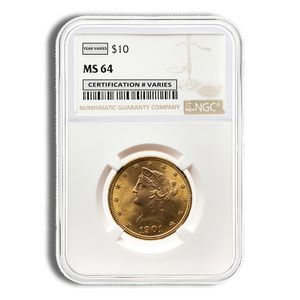
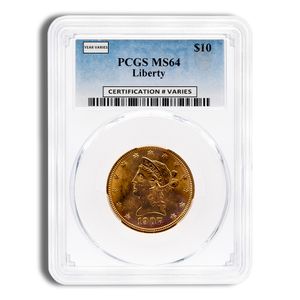
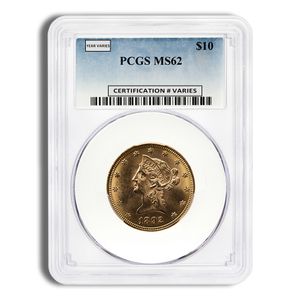
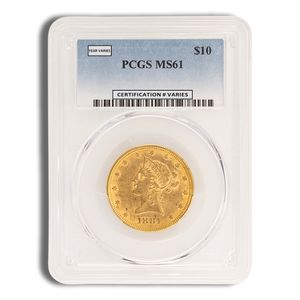
Available grades span the full spectrum from cleaned or low-grade circulated examples all the way through certified Mint State coins graded MS65 by NGC and PCGS. Buyers looking for raw circulated coins can choose from VF, XF, AU, and BU grades. Those seeking third-party certified examples will find professionally slabbed coins at MS61 through MS65 from both NGC and PCGS across both series. Every option visible in the grid above ships from our San Diego headquarters after passing authentication and verification.
Pricing on each listing reflects live market conditions tied directly to the gold spot price, with the premium displayed transparently for every grade and certification level. Whether you're sourcing circulated $10 gold eagles for their metal content or pursuing a specific Sheldon grade for a type set, the selection here is designed to serve both buyers efficiently within the same marketplace.
What Are $10 Gold Coins?
The $10 gold coin is a denomination that dates back to the earliest years of United States coinage and carries an official face value of ten dollars. In collector and dealer terminology, the $10 gold piece is commonly referred to as a gold eagle because of the eagle motif that appears on the reverse of most issues. The denomination represents roughly half the gold content of a standard $20 double eagle, making it a meaningful mid-size holding within the broader spectrum of U.S. gold coinage.
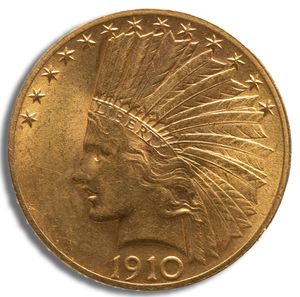
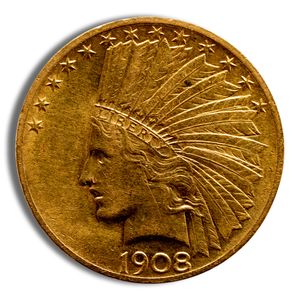
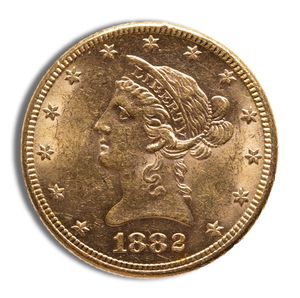
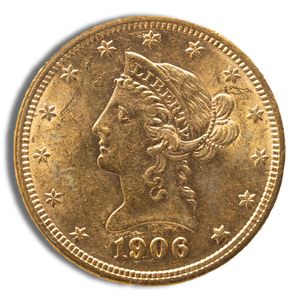
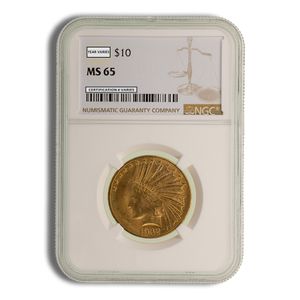
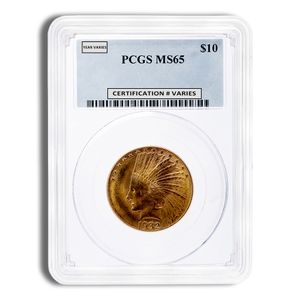
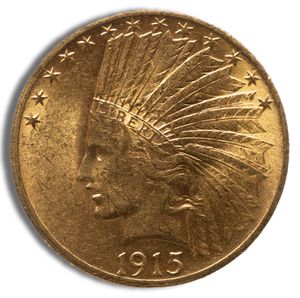
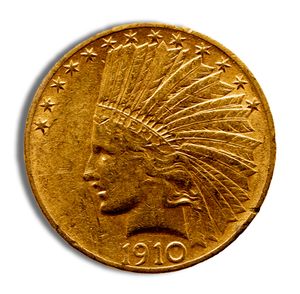
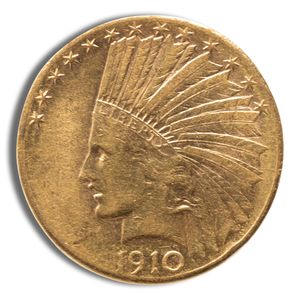
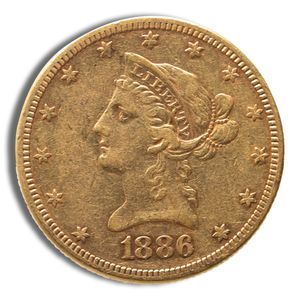
Two distinct design series dominate the $10 gold coin market. The Liberty Eagle, minted from 1838 through 1907, features a Coronet Liberty bust on the obverse. The Indian Eagle, designed by Augustus Saint-Gaudens and minted from 1907 through 1933, replaced the Liberty design with an incuse Indian head portrait that remains one of the more artistically distinctive American coin designs ever produced. Both series were struck in .900 fine gold and share an identical metal weight of 0.4837 troy ounces.
Buyers approach these coins from different angles. Some focus purely on gold content and seek the most competitively priced circulated examples. Others target specific grades for type sets or date-and-mintmark collections. Certified examples graded by NGC or PCGS introduce a third dimension, where the slab, grade, and grading service itself become part of the value equation. Understanding which lens applies to your buying decision is a useful starting point when working through the options in this catalog.
History and Background
The $10 gold denomination was authorized under the Coinage Act of 1792, which established the basic structure of United States currency and defined the gold eagle as a fundamental monetary unit. Early production at the Philadelphia Mint was limited and intermittent, but by the mid-nineteenth century the denomination had settled into regular production across multiple mint facilities including Philadelphia, New Orleans, San Francisco, and Denver. The Carson City Mint also produced $10 Liberty Eagles during its operational period, adding regional mintmark variety to the series.
The Indian Head design introduced in 1907 represented a deliberate artistic departure from earlier American coinage. President Theodore Roosevelt commissioned sculptor Augustus Saint-Gaudens to modernize U.S. coinage, and the resulting Indian Eagle design reflected the influence of ancient Greek coinage with its incuse relief. The design went through early revisions before the series settled into its final form, and production continued under several mint directors until the series was halted in 1933 when Executive Order 6102 effectively ended domestic gold coin circulation.
Following the lifting of private gold ownership restrictions in 1974, pre-1933 U.S. gold coins reentered the marketplace as legal collectibles. The market for $10 Liberty and Indian Eagles developed steadily through dealer networks, auction houses, and eventually online platforms. The introduction of professional third-party grading services by NGC in 1987 and PCGS in 1986 transformed how these coins were bought, sold, and valued by establishing standardized condition grades that reduced subjectivity and improved market transparency. Today both series are actively traded across every major segment of the numismatic and bullion markets.
Purity, Weight, and Specifications
All $10 gold coins in this catalog are struck in .900 fine gold, which is the standard purity applied to U.S. gold coinage produced prior to 1933. The alloy includes 10 percent copper, which contributes to the coin's durability and gives genuine pre-1933 U.S. gold its characteristic warm tone compared to modern 24-karat or .9999 fine gold products. Each coin contains 0.4837 troy ounces of actual gold, a figure that reflects the pure gold content after accounting for the copper alloy component.
The gross weight of a $10 gold eagle is 16.718 grams, with a diameter of 27 millimeters. These specifications remained consistent across both the Liberty and Indian series, allowing buyers to compare gold content directly across grades and series without adjustment. Troy ounce measurement is the standard unit for gold pricing worldwide, and the 0.4837 troy ounce figure is what determines the coin's metal value relative to the spot price of gold at any given moment.
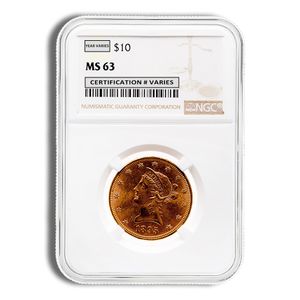
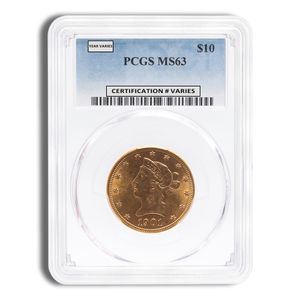
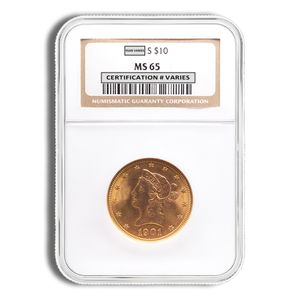
Circulated examples will not display mint-applied markings beyond the date and mintmark, while certified coins carry additional information on the NGC or PCGS holder itself, including the grade, certification number, and series designation. Grading service holders include tamper-evident encapsulation and are registered in the respective grading service's online database, allowing buyers to verify the authenticity and grade of any certified coin independently.
Available Brands, Mints, and Product Variations
Every coin in this catalog was produced by the United States Mint, which operated across several facilities during the production years of both the Liberty and Indian Eagle series. Mintmarks on individual coins identify the specific facility where they were struck, with Philadelphia issues carrying no mintmark and branch mint coins from San Francisco (S), Denver (D), New Orleans (O), and Carson City (CC) designated accordingly. Random year products are assigned based on available inventory, meaning the specific date and mintmark you receive will vary.
Within the Liberty Eagle series, the catalog includes raw circulated grades at VF, XF, and AU, a raw BU example, and certified MS61 through MS65 options from both NGC and PCGS. A cleaned or low-grade option is also available for buyers focused primarily on metal content at the lowest possible premium. The Indian Eagle series mirrors this structure with the same grade range and certification service options, giving buyers a direct side-by-side comparison between the two design types at equivalent condition levels.
The difference between an NGC-graded and PCGS-graded coin of the same type and grade primarily reflects collector and market preference. Both NGC and PCGS are widely recognized throughout the numismatic industry, and both are accepted without question in dealer, auction, and private sale markets. Bullion Standard is an authorized dealer for both grading services, which is relevant when evaluating the authenticity and handling integrity of the certified coins offered here.
Pricing, Premiums, and Market Factors
The base value of any $10 gold coin is anchored to the gold spot price multiplied by its 0.4837 troy ounce gold content. The premium above that melt value reflects factors including grade, certification, series popularity, market demand for specific dates or types, and the overall liquidity of the product. Circulated raw coins in VF or XF condition typically carry modest premiums, while certified MS63 through MS65 examples command significantly higher premiums because their relative scarcity in those grades is well-documented through NGC and PCGS population reports.
The choice of grading service can also influence pricing at higher grade levels. Certain dates and series within pre-1933 U.S. gold coinage show measurable price differences between NGC and PCGS holders of identical numerical grades, a reflection of collector registry set activity and market preference. For random year products at grades MS61 and MS62, this difference tends to be smaller because the collector premium for specific dates is less of a factor.
Bullion Standard displays the bid and ask spread on each product page, giving buyers a transparent view of both the acquisition cost and the current wholesale buyback value before a purchase decision is made. This structure allows buyers to evaluate the full cost of ownership rather than focusing exclusively on the purchase premium. Pricing updates continuously in response to live gold market conditions, so the spreads and premiums shown reflect current market conditions rather than static retail markups.
Condition, Packaging, and What to Expect
Raw circulated coins at VF through AU grades will show wear consistent with their designated grade level. VF examples display moderate wear on the high points with major design details still visible. XF coins show lighter wear with most design elements remaining sharp. AU-graded coins retain significant luster with only slight high-point wear, and BU examples show no wear though they may carry contact marks or minor bag abrasions consistent with their handling history prior to grading.
Certified coins arrive in sealed NGC or PCGS holders with the grade, series, and certification details displayed on the label. These holders should not be cracked out or tampered with, as doing so immediately removes the grading service's guarantee and substantially affects resale value. Raw coins ship in protective coin flips or similar holders appropriate to the product. Cleaned or low-grade examples are marketed explicitly for their gold content and may show cleaning, environmental damage, or grade-below-VF wear that disqualifies them from standard circulated grade designations.
All random year products are sourced from available inventory, and the specific date and mintmark assigned to any order may vary. Buyers specifically seeking a particular date, mintmark, or die variety should note that these listings do not guarantee a specific year of issue. If acquiring a particular date is a priority, that detail should be confirmed through customer service before ordering.
Authenticity and Verification
Pre-1933 U.S. gold coins are subject to counterfeiting given their gold content and numismatic value. Genuine examples carry consistent weight, diameter, and reeding specifications that can be verified using precise measurement tools. The United States Mint's production standards for these series were tightly controlled, and genuine coins exhibit design detail consistency, correct alloy color, and appropriate reeding depth that counterfeit examples frequently fail to replicate convincingly.
For certified coins, authenticity is guaranteed by NGC or PCGS under the terms of their respective holder warranties. Both grading services employ expert numismatists and authentication specialists, and their tamper-evident holders include embedded security features that further reduce the risk of holder fraudulence. Certification numbers printed on each holder can be verified directly through NGC's VerifyNGC tool or PCGS's certification lookup database, confirming that the holder and its contents match the registry record.
Bullion Standard verifies every product it sources prior to listing and fulfillment. Our purchasing team examines incoming inventory for authenticity, weight, and condition before coins are made available for sale. As authorized dealers for both NGC and PCGS, we maintain professional standards consistent with ANA and NCBA membership requirements, and every transaction is backed by our commitment to product accuracy.
Liquidity and Resale Considerations
$10 gold Liberty and Indian Eagles are among the most widely recognized categories of pre-1933 U.S. gold coinage. Both series are actively traded through coin dealers, national auction houses, estate sales, and online platforms, and their gold content is universally understood by professional buyers across the market. This broad recognition translates into practical liquidity, meaning that owners looking to sell into the market typically encounter a functioning buyer pool rather than having to search for a niche audience.
Certified coins in higher Mint State grades carry additional liquidity considerations. NGC and PCGS population data allows buyers and sellers to evaluate relative scarcity at specific grade levels, which affects the pricing behavior of individual coins within those grades. A coin in a high-population grade may trade close to its metal value despite its certified status, while low-population examples in premium grades can command substantial premiums in active collector markets.
Raw circulated examples in VF through AU grades trade primarily on their gold content with a modest premium for condition, and they tend to move efficiently through standard dealer channels. The cleaned or low-grade option trades at the narrowest spreads relative to melt value, which is appropriate for buyers prioritizing metal content over numismatic considerations. Understanding where on this spectrum any particular coin sits is an important part of evaluating resale expectations before purchase.
Storage and Security
Raw $10 gold coins should be stored in a cool, dry environment away from humidity and direct contact with materials that can cause chemical reactions over time. Flips, coin tubes, and two-by-two holders provide basic protection during storage, but long-term storage in quality holders designed specifically for numismatic coins is preferable. Even circulated examples that carry no meaningful numismatic premium benefit from stable storage conditions.
Certified coins in NGC or PCGS holders are already protected by the encapsulation itself, though the holders should still be stored away from prolonged UV light exposure and temperature extremes that can affect the holder material over time. Storing certified coins in individual boxes or foam-lined cases reduces the risk of surface contact between holders, which can cause minor holder scuffs that do not affect the coin but can detract from presentation during resale.
For larger holdings, a home safe bolted to the structure of the building or a private vault service offers more substantial security. Safety deposit boxes at federally insured institutions are widely used for coin storage, though buyers should evaluate insurance coverage separately since standard bank deposit box access does not include coverage for the contents. Regardless of the storage environment chosen, maintaining a current inventory with photographs and certification numbers simplifies both insurance documentation and eventual resale preparation.
Selling and Buyback Options
Bullion Standard operates as a two-way market, meaning our platform is structured to support both buying and selling within the same ecosystem. Customers looking to sell $10 gold coins can request a buyback quote directly through our platform, and pricing is based on the current wholesale bid price rather than a fixed discount schedule. The specific buyback price for any coin will reflect current gold spot prices, the grade and certification status of the coin, product condition, and prevailing market demand at the time of the transaction.
Certified coins in original, unaltered NGC or PCGS holders generally receive the most straightforward buyback process because authentication and condition are already established. Raw coins are evaluated based on visible grade and condition, and coins that have been cleaned, damaged, or altered from their described state at time of sale may receive adjusted pricing. Keeping certified coins in their original holders and maintaining raw coins in protective flips supports the most efficient resale experience.
Our purchasing team reviews incoming sell requests and works to provide competitive buyback pricing consistent with current market conditions. The bid price displayed on each product page reflects the live wholesale market and provides a useful baseline for evaluating what a coin is currently worth on the sell side before making any purchase or sale decision. Buyers who understand both sides of the transaction before they buy are generally better positioned to make decisions that align with their actual goals.
Why Buy $10 Gold Coins?
The $10 gold eagle denomination occupies a practical middle ground in the pre-1933 U.S. gold coin market. Compared to the $20 double eagle, these coins carry roughly half the gold content per unit, which lowers the per-coin cost and makes them more accessible as individual purchases. This fractional quality relative to the double eagle allows buyers to diversify holdings across more individual coins or build type sets without concentrating all gold exposure in larger denomination pieces.
Both the Liberty and Indian series offer meaningful design variety and historical depth, which appeals to buyers who value the numismatic dimension alongside the metal content. The Indian Eagle in particular is considered one of the finer examples of early twentieth century American coin design, and its incuse relief style distinguishes it from every other major U.S. gold coin series. For collectors building type sets of American gold coinage, the $10 denomination provides essential coverage of two distinct design eras.
For buyers focused on gold content rather than numismatics, lower-grade circulated examples offer one of the more cost-effective ways to acquire pre-1933 U.S. gold at or near melt value. The wide availability of raw circulated examples across the grade spectrum gives buyers meaningful flexibility to calibrate premium levels based on their specific priorities. Certified high-grade examples serve a different buyer profile where the scarcity of specific grade populations and the long-term collector market for these coins are the primary considerations.
Why Buy from Bullion Standard?
Bullion Standard has operated as a nationally recognized precious metals marketplace since 2010, and our approach to buying and selling has been shaped by a consistent belief that transparency produces better outcomes for customers. Every product we list is verified for authenticity, weight, and condition before it reaches a buyer, and our pricing is structured to reflect live market conditions rather than fixed retail markups that obscure the relationship between spot price and purchase cost.
As authorized dealers for both NGC and PCGS, we are positioned to source, verify, and represent certified coins accurately. Our membership in the American Numismatic Association and the National Coin and Bullion Association reflects a commitment to professional standards that goes beyond basic compliance. Our A rating with the Better Business Bureau reflects a track record of reliable fulfillment and responsive customer service that matters in an industry where trust is difficult to rebuild once lost.
The checkout process supports a wide range of payment methods including Visa, Mastercard, American Express, Discover, PayPal, Plaid-connected bank payments, wire transfer, paper check, and cryptocurrency through BitPay. Secure fulfillment is standard across every order. Our two-way market structure means that customers can evaluate both the purchase price and the current buyback value before they commit to a transaction, which reflects our broader philosophy that informed buyers make better long-term decisions.
Get Near-Spot Pricing with Bullion Standard Pro
Bullion Standard Pro is designed for buyers who want direct access to live executable wholesale bid and ask pricing across the precious metals market. Rather than transacting at fixed retail prices, Pro members interact with real-time wholesale market pricing that reflects actual supply and demand conditions without additional dealer markups or fixed spreads layered on top. For buyers purchasing $10 gold coins at any grade level, this structure can meaningfully affect the effective cost of acquisition relative to standard retail pricing.
Members also gain access to live portfolio valuation based on current wholesale bid prices, which provides a more realistic picture of liquidation value compared to valuations based on retail or estimated prices. Proprietary tools available through Pro include historical premium analysis, bid/ask spread comparisons, liquidity metrics, and market intelligence across the broader bullion catalog. These tools allow members to evaluate specific coins and grades using objective data rather than relying on marketing descriptions alone.
For buyers who are regularly active in the pre-1933 gold coin market, the pricing efficiency available through Pro represents a structural advantage. The platform is built around the idea that better information and tighter pricing lead to better decisions over time, and the analytics available through Pro are specifically designed to surface the kind of market-level context that helps buyers understand not just what a coin costs today, but how its premium and spread have behaved across changing market conditions. More information about Bullion Standard Pro is available on our platform.

 (833) 278-4653