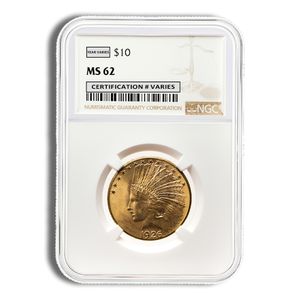
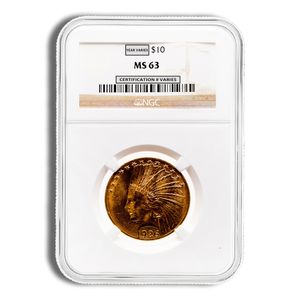
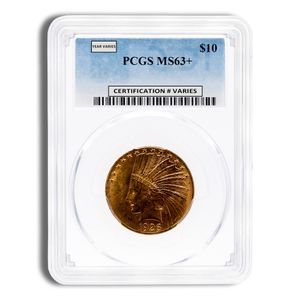
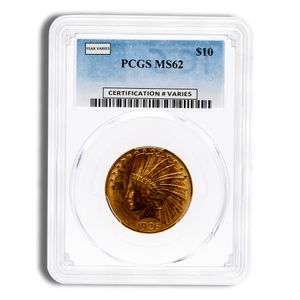
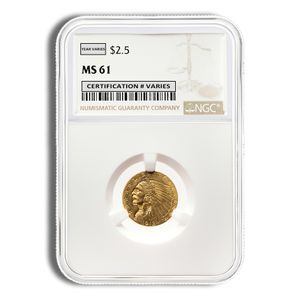
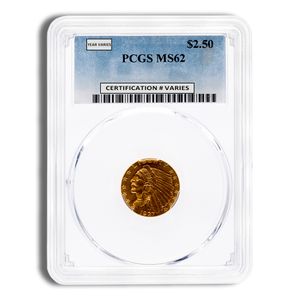
The $10 Gold Indian Eagle is one of the most celebrated coins in American numismatic history, struck in 90% gold with a net weight of 0.4837 troy ounces. Produced at various United States Mint facilities, it carries legal tender status and represents the highest denomination within the classic Indian Head Eagle series. The examples we carry are certified MS65 by NGC, meaning they have been independently evaluated, authenticated, and encapsulated in a tamper-evident holder that confirms both grade and genuineness. Because these are offered as random year, the specific date and mint mark will vary, though all examples meet the same NGC MS65 standard regardless of origin.
History and Background
The Indian Head Eagle was introduced in 1907 following a commission by President Theodore Roosevelt, who sought to elevate American coinage to a standard of artistic excellence comparable to ancient Greek currency. Sculptor Bela Lyon Pratt was tasked with designing the $10 denomination, drawing inspiration from the work of Augustus Saint-Gaudens while developing a distinctly different approach. Pratt employed an incuse relief design, meaning the central imag…
Overview of $10 Gold Indian Eagle
The $10 Gold Indian Eagle is one of the most celebrated coins in American numismatic history, struck in 90% gold with a net weight of 0.4837 troy ounces. Produced at various United States Mint facilities, it carries legal tender status and represents the highest denomination within the classic Indian Head Eagle series. The examples we carry are certified MS65 by NGC, meaning they have been independently evaluated, authenticated, and encapsulated in a tamper-evident holder that confirms both grade and genuineness. Because these are offered as random year, the specific date and mint mark will vary, though all examples meet the same NGC MS65 standard regardless of origin.
History and Background
The Indian Head Eagle was introduced in 1907 following a commission by President Theodore Roosevelt, who sought to elevate American coinage to a standard of artistic excellence comparable to ancient Greek currency. Sculptor Bela Lyon Pratt was tasked with designing the $10 denomination, drawing inspiration from the work of Augustus Saint-Gaudens while developing a distinctly different approach. Pratt employed an incuse relief design, meaning the central imagery sits recessed into the field rather than raised above it, a technique virtually unique in American coinage history.
The series ran from 1907 through 1933, when President Franklin D. Roosevelt suspended gold coin production as part of broader monetary policy changes during the Great Depression. During that span, the coin was struck primarily at the Philadelphia and New Orleans mints, with certain dates and mint marks becoming considerably scarcer than others. The series has attracted serious collector and dealer attention for over a century, with high-grade examples recognized as significant achievements in American numismatics.
Design and Aesthetics
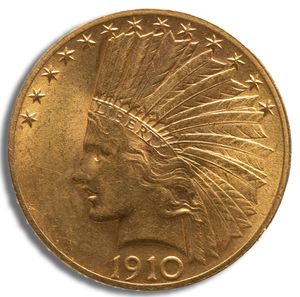
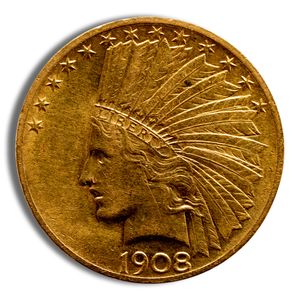
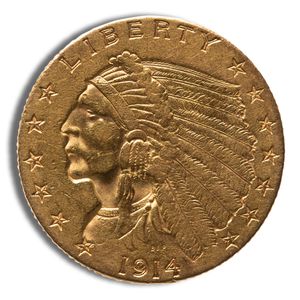
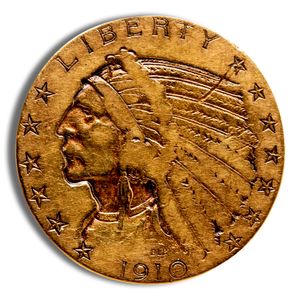
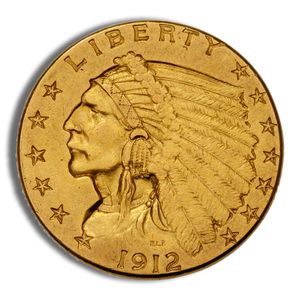
The obverse features a portrait of Liberty wearing a Native American war bonnet, rendered in incuse relief so that the design sits below the coin's flat field rather than projecting above it. The portrait conveys a sense of quiet dignity and is surrounded by thirteen stars representing the original colonies, with the date positioned at the lower rim. This design approach gives the coin a distinctly muted, almost meditative visual quality compared to the bold raised designs common to most American gold coinage of the same era.
The reverse presents a standing eagle perched on a bundle of arrows, rendered with the same incuse technique. The inscriptions "UNITED STATES OF AMERICA," "E PLURIBUS UNUM," and the denomination "TEN DOLLARS" are incorporated into the design with characteristic restraint. At the gem MS65 level, the surfaces retain full original luster with only minimal contact marks visible under magnification, and the incuse details show sharp, clean definition throughout.
Fractional Size and Accessibility
At 0.4837 troy ounces, the $10 Indian Eagle carries meaningful gold content without requiring the full outlay associated with a one-ounce coin. This sub-ounce format makes it practical for buyers seeking to acquire pre-1933 U.S. gold without concentrating the entire position in a single full-ounce piece. The sizing also aligns naturally with the original denomination structure of the U.S. gold coinage system, where the Eagle, Half Eagle, and Quarter Eagle formed a coherent series across the 19th and early 20th centuries.
Authenticity and Product Integrity
NGC certification is the definitive standard for verifying the authenticity and grade of a pre-1933 U.S. gold coin. Each MS65 example has passed NGC's multi-stage grading process, during which trained numismatists assess the coin's strike, luster, surface preservation, and eye appeal before assigning a grade. The coin is then sealed in a sonically bonded plastic holder with a unique certification number that can be verified through NGC's online registry. We are an authorized NGC dealer, which means we transact in certified coins within the official NGC dealer network and stand behind the authenticity of every graded product we carry.
Because these coins are certified and encapsulated, concerns about cleaning, artificial toning, or undisclosed damage have already been addressed through the grading process. The holder itself serves as both a protective enclosure and a transparent record of the coin's certified condition.
Condition and Packaging
MS65 is a gem uncirculated grade within the Sheldon 70-point numismatic scale, indicating a coin that has never been used in commerce and retains strong original luster, sharp design detail, and only the most minimal contact marks allowable for the grade. At this level, eye appeal is genuinely impressive rather than merely acceptable, and the coin will typically display vibrant cartwheel luster across both the incuse design elements and the surrounding fields. This grade represents a meaningful step above the more common MS63 and MS64 examples that tend to dominate the market for pre-1933 U.S. gold.
Each certified coin ships in its NGC plastic holder, which protects the coin without requiring any additional handling on the buyer's part. Because these are individual certified coins rather than bulk bullion, they do not follow the standard tube-and-box format used for modern bullion issues. If you are purchasing multiple examples, each will arrive in its own NGC slab, and we package orders to prevent movement or contact between holders during transit.
Pricing and Market Factors
Pricing for the MS65 $10 Gold Indian Eagle reflects both the current spot price of gold and the numismatic premium associated with the coin's grade, series, and historical significance. Because this is a certified pre-1933 U.S. gold coin rather than a modern bullion product, the premium structure is more complex than that of a standard gold bar or sovereign coin. Grade differentials within the Indian Head Eagle series are meaningful, and the spread between MS64 and MS65 examples can be substantial depending on date, demand, and current wholesale market activity.
Random year pricing allows buyers to acquire a certified MS65 example without paying the additional premium that specific key dates or conditionally rare issues command. Our pricing reflects current market conditions for generic-date MS65 examples within the series, and we display the bid/ask spread on each product page so buyers can evaluate the complete transaction rather than focusing solely on the ask price.
Selling and Liquidity
Pre-1933 U.S. gold certified by NGC trades actively within both the numismatic and bullion markets, and the $10 Indian Eagle is among the more recognizable series within that category. MS65 examples attract both grade-conscious collectors and buyers seeking certified gold with a verifiable condition record, which broadens the pool of potential buyers relative to lower-grade or uncertified material. The NGC certification adds a layer of objectivity that simplifies the resale process, as buyers transacting sight-unseen can rely on the grade rather than conducting independent evaluation.
We operate a two-way market that supports both buying and selling, and our buyback pricing on certified U.S. gold reflects current wholesale market conditions. Understanding what a coin is likely to bring on the bid side before acquiring it is a meaningful part of evaluating any numismatic purchase, and we make that information available rather than leaving it to be discovered at the point of sale.
Why Buy the $10 Gold Indian Eagle NGC MS65?
The MS65 grade occupies a position in the market where the premium over lower grades is justified by a meaningfully improved coin rather than a marginal one. At gem level, the incuse design of the Indian Head Eagle reads with full clarity, and the original luster that defines an uncirculated pre-1933 gold coin is fully intact. Buyers who want a coin that genuinely looks the way Bela Lyon Pratt intended it to look will find MS65 the practical sweet spot between accessibility and presentation quality.
The random year format allows buyers to enter this series at a competitive price point without sacrificing grade, which is the more consequential variable for most buyers in this range. For those building a numismatic gold position or simply seeking a historically significant American coin in confirmed gem condition, the NGC-certified MS65 $10 Indian Eagle offers a well-defined, verifiable product with broad market recognition on both the buy and sell side.
Why Buy from Bullion Standard?
We approach certified numismatic gold the same way we approach modern bullion: with transparent pricing, clear presentation, and a two-way market that treats liquidity as a first-order concern rather than an afterthought. Our authorized dealer status with NGC means we operate within the official NGC network, and every certified coin we carry has been verified before it reaches a customer. Our A rating with the Better Business Bureau and membership in both the American Numismatic Association and the National Coin and Bullion Association reflect a long-term commitment to professional standards across every category we carry.
We display the bid/ask spread on each product page because we believe buyers deserve to understand the full cost of ownership before completing a purchase. That transparency extends to our buyback process, where competitive wholesale pricing means customers who decide to sell are not navigating an opaque or one-sided market. Our platform is designed to make buying and selling physical gold more straightforward, and the certified numismatic market is no exception.
Get Near-Spot Pricing with Bullion Standard Pro
Bullion Standard Pro provides members with access to live, executable wholesale bid and ask pricing across a broad range of products, including certified pre-1933 U.S. gold. For a product like the MS65 $10 Indian Eagle, where the premium structure involves both metal content and numismatic grade, having real-time visibility into wholesale market pricing on both sides of the transaction adds meaningful context to every decision. Members can also access historical premium data and spread analysis that help evaluate where current pricing sits relative to past market conditions.
Portfolio valuation within Pro uses live executable wholesale bid pricing rather than retail estimates, giving members a more accurate picture of what their holdings would actually bring in the current market. This approach reflects our broader goal of reducing the information gap that has traditionally made the certified coin and bullion markets difficult to navigate with confidence.
Flexible and Secure Payment Options
We support a wide range of payment methods to make every transaction straightforward and secure. Buyers can pay using Visa, Mastercard, American Express, or Discover, as well as PayPal for added flexibility. Bank-connected payments are available through Plaid, and customers who prefer traditional methods can use wire transfer or paper check. Cryptocurrency payments are accepted via BitPay for those who prefer a digital payment option. Every payment method is processed with security and reliability in mind, and our checkout process is designed to move quickly from order placement through fulfillment without unnecessary friction.
The $10 Gold Indian Eagle is one of the most celebrated coins in American numismatic history, struck in 90% gold with a net weight of 0.4837 troy ounces. Produced at various United States Mint facilities, it carries legal tender status and represents the highest denomination within the classic Indian Head Eagle series. The examples we carry are certified MS65 by NGC, meaning they have been independently evaluated, authenticated, and encapsulated in a tamper-evident holder that confirms both grade and genuineness. Because these are offered as random year, the specific date and mint mark will vary, though all examples meet the same NGC MS65 standard regardless of origin.
History and Background
The Indian Head Eagle was introduced in 1907 following a commission by President Theodore Roosevelt, who sought to elevate American coinage to a standard of artistic excellence comparable to ancient Greek currency. Sculptor Bela Lyon Pratt was tasked with designing the $10 denomination, drawing inspiration from the work of Augustus Saint-Gaudens while developing a distinctly different approach. Pratt employed an incuse relief design, meaning the central imag…
Overview of $10 Gold Indian Eagle
The $10 Gold Indian Eagle is one of the most celebrated coins in American numismatic history, struck in 90% gold with a net weight of 0.4837 troy ounces. Produced at various United States Mint facilities, it carries legal tender status and represents the highest denomination within the classic Indian Head Eagle series. The examples we carry are certified MS65 by NGC, meaning they have been independently evaluated, authenticated, and encapsulated in a tamper-evident holder that confirms both grade and genuineness. Because these are offered as random year, the specific date and mint mark will vary, though all examples meet the same NGC MS65 standard regardless of origin.
History and Background
The Indian Head Eagle was introduced in 1907 following a commission by President Theodore Roosevelt, who sought to elevate American coinage to a standard of artistic excellence comparable to ancient Greek currency. Sculptor Bela Lyon Pratt was tasked with designing the $10 denomination, drawing inspiration from the work of Augustus Saint-Gaudens while developing a distinctly different approach. Pratt employed an incuse relief design, meaning the central imagery sits recessed into the field rather than raised above it, a technique virtually unique in American coinage history.
The series ran from 1907 through 1933, when President Franklin D. Roosevelt suspended gold coin production as part of broader monetary policy changes during the Great Depression. During that span, the coin was struck primarily at the Philadelphia and New Orleans mints, with certain dates and mint marks becoming considerably scarcer than others. The series has attracted serious collector and dealer attention for over a century, with high-grade examples recognized as significant achievements in American numismatics.
Design and Aesthetics
The obverse features a portrait of Liberty wearing a Native American war bonnet, rendered in incuse relief so that the design sits below the coin's flat field rather than projecting above it. The portrait conveys a sense of quiet dignity and is surrounded by thirteen stars representing the original colonies, with the date positioned at the lower rim. This design approach gives the coin a distinctly muted, almost meditative visual quality compared to the bold raised designs common to most American gold coinage of the same era.
The reverse presents a standing eagle perched on a bundle of arrows, rendered with the same incuse technique. The inscriptions "UNITED STATES OF AMERICA," "E PLURIBUS UNUM," and the denomination "TEN DOLLARS" are incorporated into the design with characteristic restraint. At the gem MS65 level, the surfaces retain full original luster with only minimal contact marks visible under magnification, and the incuse details show sharp, clean definition throughout.
Fractional Size and Accessibility
At 0.4837 troy ounces, the $10 Indian Eagle carries meaningful gold content without requiring the full outlay associated with a one-ounce coin. This sub-ounce format makes it practical for buyers seeking to acquire pre-1933 U.S. gold without concentrating the entire position in a single full-ounce piece. The sizing also aligns naturally with the original denomination structure of the U.S. gold coinage system, where the Eagle, Half Eagle, and Quarter Eagle formed a coherent series across the 19th and early 20th centuries.
Authenticity and Product Integrity
NGC certification is the definitive standard for verifying the authenticity and grade of a pre-1933 U.S. gold coin. Each MS65 example has passed NGC's multi-stage grading process, during which trained numismatists assess the coin's strike, luster, surface preservation, and eye appeal before assigning a grade. The coin is then sealed in a sonically bonded plastic holder with a unique certification number that can be verified through NGC's online registry. We are an authorized NGC dealer, which means we transact in certified coins within the official NGC dealer network and stand behind the authenticity of every graded product we carry.
Because these coins are certified and encapsulated, concerns about cleaning, artificial toning, or undisclosed damage have already been addressed through the grading process. The holder itself serves as both a protective enclosure and a transparent record of the coin's certified condition.
Condition and Packaging
MS65 is a gem uncirculated grade within the Sheldon 70-point numismatic scale, indicating a coin that has never been used in commerce and retains strong original luster, sharp design detail, and only the most minimal contact marks allowable for the grade. At this level, eye appeal is genuinely impressive rather than merely acceptable, and the coin will typically display vibrant cartwheel luster across both the incuse design elements and the surrounding fields. This grade represents a meaningful step above the more common MS63 and MS64 examples that tend to dominate the market for pre-1933 U.S. gold.
Each certified coin ships in its NGC plastic holder, which protects the coin without requiring any additional handling on the buyer's part. Because these are individual certified coins rather than bulk bullion, they do not follow the standard tube-and-box format used for modern bullion issues. If you are purchasing multiple examples, each will arrive in its own NGC slab, and we package orders to prevent movement or contact between holders during transit.
Pricing and Market Factors
Pricing for the MS65 $10 Gold Indian Eagle reflects both the current spot price of gold and the numismatic premium associated with the coin's grade, series, and historical significance. Because this is a certified pre-1933 U.S. gold coin rather than a modern bullion product, the premium structure is more complex than that of a standard gold bar or sovereign coin. Grade differentials within the Indian Head Eagle series are meaningful, and the spread between MS64 and MS65 examples can be substantial depending on date, demand, and current wholesale market activity.
Random year pricing allows buyers to acquire a certified MS65 example without paying the additional premium that specific key dates or conditionally rare issues command. Our pricing reflects current market conditions for generic-date MS65 examples within the series, and we display the bid/ask spread on each product page so buyers can evaluate the complete transaction rather than focusing solely on the ask price.
Selling and Liquidity
Pre-1933 U.S. gold certified by NGC trades actively within both the numismatic and bullion markets, and the $10 Indian Eagle is among the more recognizable series within that category. MS65 examples attract both grade-conscious collectors and buyers seeking certified gold with a verifiable condition record, which broadens the pool of potential buyers relative to lower-grade or uncertified material. The NGC certification adds a layer of objectivity that simplifies the resale process, as buyers transacting sight-unseen can rely on the grade rather than conducting independent evaluation.
We operate a two-way market that supports both buying and selling, and our buyback pricing on certified U.S. gold reflects current wholesale market conditions. Understanding what a coin is likely to bring on the bid side before acquiring it is a meaningful part of evaluating any numismatic purchase, and we make that information available rather than leaving it to be discovered at the point of sale.
Why Buy the $10 Gold Indian Eagle NGC MS65?
The MS65 grade occupies a position in the market where the premium over lower grades is justified by a meaningfully improved coin rather than a marginal one. At gem level, the incuse design of the Indian Head Eagle reads with full clarity, and the original luster that defines an uncirculated pre-1933 gold coin is fully intact. Buyers who want a coin that genuinely looks the way Bela Lyon Pratt intended it to look will find MS65 the practical sweet spot between accessibility and presentation quality.
The random year format allows buyers to enter this series at a competitive price point without sacrificing grade, which is the more consequential variable for most buyers in this range. For those building a numismatic gold position or simply seeking a historically significant American coin in confirmed gem condition, the NGC-certified MS65 $10 Indian Eagle offers a well-defined, verifiable product with broad market recognition on both the buy and sell side.
Why Buy from Bullion Standard?
We approach certified numismatic gold the same way we approach modern bullion: with transparent pricing, clear presentation, and a two-way market that treats liquidity as a first-order concern rather than an afterthought. Our authorized dealer status with NGC means we operate within the official NGC network, and every certified coin we carry has been verified before it reaches a customer. Our A rating with the Better Business Bureau and membership in both the American Numismatic Association and the National Coin and Bullion Association reflect a long-term commitment to professional standards across every category we carry.
We display the bid/ask spread on each product page because we believe buyers deserve to understand the full cost of ownership before completing a purchase. That transparency extends to our buyback process, where competitive wholesale pricing means customers who decide to sell are not navigating an opaque or one-sided market. Our platform is designed to make buying and selling physical gold more straightforward, and the certified numismatic market is no exception.
Get Near-Spot Pricing with Bullion Standard Pro
Bullion Standard Pro provides members with access to live, executable wholesale bid and ask pricing across a broad range of products, including certified pre-1933 U.S. gold. For a product like the MS65 $10 Indian Eagle, where the premium structure involves both metal content and numismatic grade, having real-time visibility into wholesale market pricing on both sides of the transaction adds meaningful context to every decision. Members can also access historical premium data and spread analysis that help evaluate where current pricing sits relative to past market conditions.
Portfolio valuation within Pro uses live executable wholesale bid pricing rather than retail estimates, giving members a more accurate picture of what their holdings would actually bring in the current market. This approach reflects our broader goal of reducing the information gap that has traditionally made the certified coin and bullion markets difficult to navigate with confidence.
Flexible and Secure Payment Options
We support a wide range of payment methods to make every transaction straightforward and secure. Buyers can pay using Visa, Mastercard, American Express, or Discover, as well as PayPal for added flexibility. Bank-connected payments are available through Plaid, and customers who prefer traditional methods can use wire transfer or paper check. Cryptocurrency payments are accepted via BitPay for those who prefer a digital payment option. Every payment method is processed with security and reliability in mind, and our checkout process is designed to move quickly from order placement through fulfillment without unnecessary friction.
This website uses cookies for analytics and to deliver personalized content. By continuing to
use our site, you acknowledge that you have read and agree to our Privacy Policy and Cookie
Policy.
Current Quantities Available
Unfortunately, we only have 0
of
this item in
stock.
Please call us at (833) 278-4653
or email us at support@bullionstandard.com
if you wish to purchase a larger quantity than what is available on our website.
We can often locate additional quantities.

 (833) 278-4653

.png)