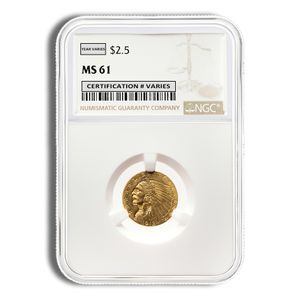
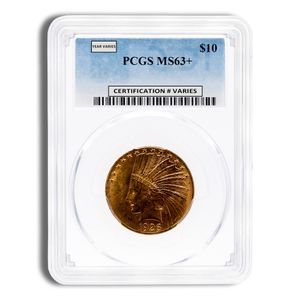
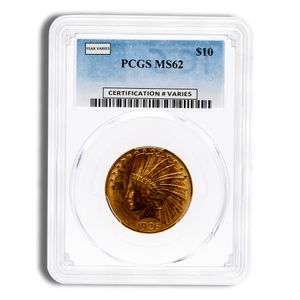
The $10 Gold Indian Eagle is one of the most celebrated coins in American numismatic history, struck in 90% gold with a weight of 0.4837 troy ounces. Produced by the United States Mint and issued as legal tender under the denomination of ten dollars, this coin represents a defining chapter in early twentieth-century American coinage. The example we offer carries an MS64 grade from the Numismatic Guaranty Company, certifying it as a high-quality Mint State specimen with only minor surface imperfections that fall just short of gem status. Because these coins were produced across multiple years at various United States Mint facilities, the specific date and mint mark will vary, making each piece a genuine artifact of its era.
History and Background
The Indian Head Eagle series was designed by sculptor Bela Lyon Pratt and introduced in 1907 under the direction of President Theodore Roosevelt, who sought to elevate the artistic standard of American coinage. Pratt adapted his design from the work of Augustus Saint-Gaudens, giving the coin a distinctive incuse relief style in which the design elements are recessed into the field rather than raised abov…
Overview of $10 Gold Indian Eagle
The $10 Gold Indian Eagle is one of the most celebrated coins in American numismatic history, struck in 90% gold with a weight of 0.4837 troy ounces. Produced by the United States Mint and issued as legal tender under the denomination of ten dollars, this coin represents a defining chapter in early twentieth-century American coinage. The example we offer carries an MS64 grade from the Numismatic Guaranty Company, certifying it as a high-quality Mint State specimen with only minor surface imperfections that fall just short of gem status. Because these coins were produced across multiple years at various United States Mint facilities, the specific date and mint mark will vary, making each piece a genuine artifact of its era.
History and Background
The Indian Head Eagle series was designed by sculptor Bela Lyon Pratt and introduced in 1907 under the direction of President Theodore Roosevelt, who sought to elevate the artistic standard of American coinage. Pratt adapted his design from the work of Augustus Saint-Gaudens, giving the coin a distinctive incuse relief style in which the design elements are recessed into the field rather than raised above it. This was a dramatic departure from conventional minting practice and remains visually distinct from nearly every other American coin series produced before or since.
The series was struck from 1907 through 1916, with a final limited issue in 1926, and production spanned multiple United States Mint facilities including Philadelphia, Denver, New Orleans, and San Francisco. Each facility added its own mint mark, and production numbers varied considerably from year to year, which contributes to the range of relative scarcity collectors encounter across the series. The coin circulated as standard monetary currency during its production run, meaning well-worn examples are far more common than Mint State survivors today.
Design and Aesthetics
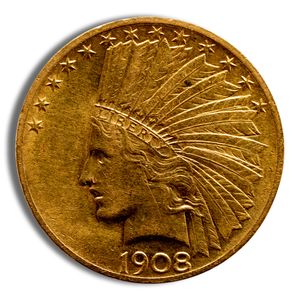
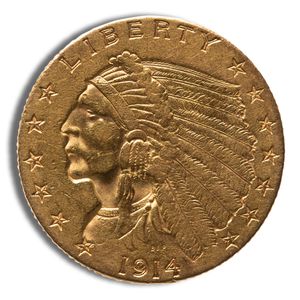
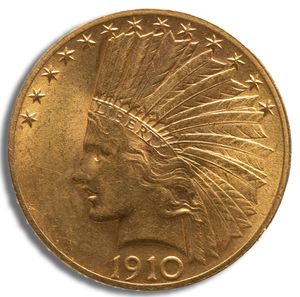
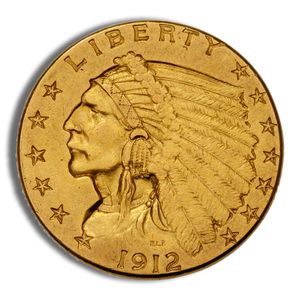
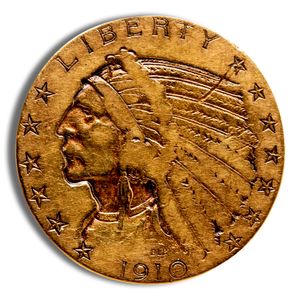
The obverse of the Indian Head Eagle features a portrait of Liberty wearing a Native American war bonnet, an unconventional and culturally complex design choice that set it apart from the classical female portraits common to American coinage of the period. The inscription "LIBERTY" appears above the portrait, the date is positioned below, and stars encircle the rim. The incuse technique gives the portrait an almost sculptural quality, with soft gradations rather than the sharp, raised profiles typically associated with American gold coinage.
The reverse depicts a standing eagle at rest, wings folded, with the inscriptions "UNITED STATES OF AMERICA," "E PLURIBUS UNUM," and the denomination "TEN DOLLARS" arranged around the composition. The motto "IN GOD WE TRUST" appears on issues from 1908 onward after its addition was mandated by Congress. The overall design communicates a restrained, refined aesthetic that diverges sharply from the ornate style of earlier American gold coinage, and it has influenced how collectors and numismatists evaluate American art in coin form ever since.
Fractional Size and Accessibility
At 0.4837 troy ounces, the $10 Indian Eagle contains slightly less than half a troy ounce of gold, which places it in a practical range for buyers who want meaningful gold content without committing to a full-ounce purchase. The coin's denomination and legal tender heritage also give it a distinct identity compared to modern fractional bullion products, combining numismatic significance with tangible metal content in a single piece.
For collectors and buyers who prioritize historical authenticity alongside metal content, this format offers a meaningful way to hold pre-1933 American gold in a graded, authenticated state. The size makes it manageable for handling and storage while still representing a substantial quantity of fine gold relative to smaller fractional alternatives.
Authenticity and Product Integrity
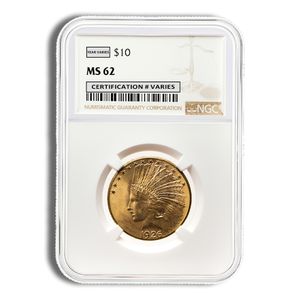
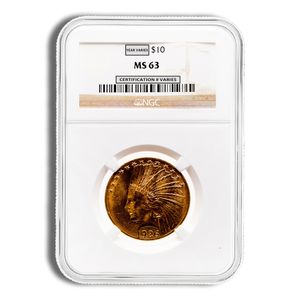
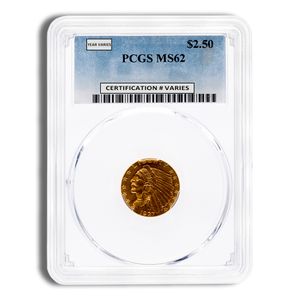
Each coin in this listing is encapsulated and certified by NGC, one of the two most respected independent coin grading services in the industry. NGC authentication confirms the coin's genuine composition, verifies the assigned grade, and seals the piece in a tamper-evident holder that protects its condition and surfaces from the point of grading forward. The MS64 designation reflects a Mint State coin with strong luster and only minor distracting marks or blemishes, placing it well above circulated examples while remaining one grade below the gem threshold.
We are an authorized dealer for both NGC and PCGS, which reflects a formal commitment to grading standards and product integrity that extends throughout our catalog. Pre-1933 American gold carries its own authentication considerations given the age and numismatic value of these pieces, and NGC certification addresses those concerns directly by providing documented, independent verification of authenticity, grade, and originality.
Condition and Packaging
The MS64 grade assigned by NGC indicates a fully Mint State coin with no signs of circulation wear, displaying above-average luster with a small number of contact marks or minor blemishes that prevent it from reaching the gem MS65 tier. At this grade level, the coin presents exceptionally well to the eye, and the vast majority of surface area remains clean and original. The NGC holder preserves that condition by sealing the coin against environmental exposure, handling, and further contact.
Each coin ships in its original NGC slab, which provides both protection and immediate verification of grade and authenticity. Single-coin orders ship with the slab secured in protective packaging appropriate for certified numismatic material. Because this product is listed as a random-year example, the specific date and mint mark will be selected from available inventory at the time of fulfillment, and each coin will carry its own unique NGC certification number.
Pricing and Market Factors
Pricing for the $10 Indian Eagle at the MS64 grade level reflects both the underlying gold content and the numismatic premium associated with its grade, series, and historical significance. The gold content component tracks the spot price of gold in real time, while the numismatic premium reflects collector demand, the relative scarcity of Mint State survivors within the series, and the certification value that NGC grading provides. These two pricing components move somewhat independently, which means market price can be influenced by shifts in either gold spot prices or collector demand for certified pre-1933 American gold.
Our pricing is structured to reflect current market conditions transparently, without unnecessary complexity or hidden markups. The bid/ask spread displayed on our product pages gives buyers a clear picture of both the acquisition cost and the current resale environment, which is particularly relevant for graded numismatic coins where premiums can vary meaningfully from one market cycle to the next.
Selling and Liquidity
The $10 Indian Eagle is one of the most recognized pre-1933 American gold coin types in the secondary market, with an established collector base and consistent dealer demand at the certified level. NGC-graded examples trade across major auction platforms, dealer networks, and coin shows, and the MS64 grade specifically occupies a well-understood position in the market with documented comparable sales that support price discovery. The combination of standardized gold content, a widely known series, and third-party certification makes these coins straightforward to evaluate from a resale standpoint.
We operate a two-way market that supports both buying and selling, so customers who acquired this coin through us have a ready path to liquidation when the time comes. Understanding liquidity before a purchase is as important as the purchase decision itself, and we believe that providing both sides of the transaction within the same platform gives customers a more complete picture of what they own.
Why Buy the $10 Gold Indian Eagle?
The NGC MS64 $10 Indian Eagle occupies a distinct space between pure bullion and high-end numismatic collecting. It offers tangible gold content in a coin that carries genuine historical weight, a legally issued denomination from the United States Mint, and an artistically significant design that continues to draw both collectors and buyers decades after the series was discontinued. The incuse relief style remains one of the most visually striking approaches ever used on American gold coinage, which contributes to sustained demand across collector markets.
At the MS64 grade, the coin represents a certified, high-quality example without the substantial price jump that typically accompanies gem-grade certification. For buyers who want a meaningful Mint State specimen without paying gem premiums, MS64 represents a well-regarded sweet spot within the graded market for this series.
Why Buy from Bullion Standard?
We have built our reputation over more than a decade on transparent pricing, reliable fulfillment, and a customer experience that prioritizes informed decision-making over pressure-based sales. Our authorized dealer status with both NGC and PCGS means we handle certified numismatic products with an understanding of grading standards, holder integrity, and the specific considerations that come with pre-1933 American gold. Every product we offer is verified for authenticity before it reaches a customer.
Our A rating with the Better Business Bureau reflects consistent performance across thousands of transactions, and our memberships in the American Numismatic Association and the National Coin and Bullion Association reflect a commitment to professional standards within the broader numismatic and bullion community. We believe buyers deserve access to clear information, honest pricing, and a straightforward path to both acquiring and eventually selling the products they own.
Get Near-Spot Pricing with Bullion Standard Pro
Bullion Standard Pro gives members access to live, executable wholesale bid and ask pricing that reflects real-time market conditions rather than static retail markups. For a product like the NGC MS64 $10 Indian Eagle, where premiums incorporate both a gold content component and a numismatic layer, understanding how pricing is structured at the wholesale level provides meaningful context for evaluating the true cost of ownership. Members can also access historical premium data and spread analysis tools that help put current market pricing into perspective relative to prior market cycles.
Portfolio valuation within Pro uses live executable wholesale bid pricing, so members see their holdings valued at current market liquidation prices rather than estimated retail figures. This is particularly useful for certified numismatic coins, where the spread between acquisition cost and liquidation value can differ more than it does for standard bullion products. Pro is designed to reduce information asymmetry and give members a clearer, more objective view of the products they own and the market conditions surrounding them.
Flexible and Secure Payment Options
We support a broad range of payment methods to make the buying process straightforward and secure for every customer. Major credit cards including Visa, Mastercard, American Express, and Discover are accepted, along with PayPal, bank-connected payments through Plaid, wire transfer, paper check, and cryptocurrency via BitPay. Each payment channel is integrated with security protocols designed to protect transaction data and customer information throughout the checkout process.
Whether you prefer the convenience of a credit card, the speed of a wire transfer, or the flexibility of cryptocurrency, the checkout experience is built to accommodate your preference without adding unnecessary friction. Our goal is to make every transaction as simple and secure as the products we sell deserve.
The $10 Gold Indian Eagle is one of the most celebrated coins in American numismatic history, struck in 90% gold with a weight of 0.4837 troy ounces. Produced by the United States Mint and issued as legal tender under the denomination of ten dollars, this coin represents a defining chapter in early twentieth-century American coinage. The example we offer carries an MS64 grade from the Numismatic Guaranty Company, certifying it as a high-quality Mint State specimen with only minor surface imperfections that fall just short of gem status. Because these coins were produced across multiple years at various United States Mint facilities, the specific date and mint mark will vary, making each piece a genuine artifact of its era.
History and Background
The Indian Head Eagle series was designed by sculptor Bela Lyon Pratt and introduced in 1907 under the direction of President Theodore Roosevelt, who sought to elevate the artistic standard of American coinage. Pratt adapted his design from the work of Augustus Saint-Gaudens, giving the coin a distinctive incuse relief style in which the design elements are recessed into the field rather than raised abov…
Overview of $10 Gold Indian Eagle
The $10 Gold Indian Eagle is one of the most celebrated coins in American numismatic history, struck in 90% gold with a weight of 0.4837 troy ounces. Produced by the United States Mint and issued as legal tender under the denomination of ten dollars, this coin represents a defining chapter in early twentieth-century American coinage. The example we offer carries an MS64 grade from the Numismatic Guaranty Company, certifying it as a high-quality Mint State specimen with only minor surface imperfections that fall just short of gem status. Because these coins were produced across multiple years at various United States Mint facilities, the specific date and mint mark will vary, making each piece a genuine artifact of its era.
History and Background
The Indian Head Eagle series was designed by sculptor Bela Lyon Pratt and introduced in 1907 under the direction of President Theodore Roosevelt, who sought to elevate the artistic standard of American coinage. Pratt adapted his design from the work of Augustus Saint-Gaudens, giving the coin a distinctive incuse relief style in which the design elements are recessed into the field rather than raised above it. This was a dramatic departure from conventional minting practice and remains visually distinct from nearly every other American coin series produced before or since.
The series was struck from 1907 through 1916, with a final limited issue in 1926, and production spanned multiple United States Mint facilities including Philadelphia, Denver, New Orleans, and San Francisco. Each facility added its own mint mark, and production numbers varied considerably from year to year, which contributes to the range of relative scarcity collectors encounter across the series. The coin circulated as standard monetary currency during its production run, meaning well-worn examples are far more common than Mint State survivors today.
Design and Aesthetics
The obverse of the Indian Head Eagle features a portrait of Liberty wearing a Native American war bonnet, an unconventional and culturally complex design choice that set it apart from the classical female portraits common to American coinage of the period. The inscription "LIBERTY" appears above the portrait, the date is positioned below, and stars encircle the rim. The incuse technique gives the portrait an almost sculptural quality, with soft gradations rather than the sharp, raised profiles typically associated with American gold coinage.
The reverse depicts a standing eagle at rest, wings folded, with the inscriptions "UNITED STATES OF AMERICA," "E PLURIBUS UNUM," and the denomination "TEN DOLLARS" arranged around the composition. The motto "IN GOD WE TRUST" appears on issues from 1908 onward after its addition was mandated by Congress. The overall design communicates a restrained, refined aesthetic that diverges sharply from the ornate style of earlier American gold coinage, and it has influenced how collectors and numismatists evaluate American art in coin form ever since.
Fractional Size and Accessibility
At 0.4837 troy ounces, the $10 Indian Eagle contains slightly less than half a troy ounce of gold, which places it in a practical range for buyers who want meaningful gold content without committing to a full-ounce purchase. The coin's denomination and legal tender heritage also give it a distinct identity compared to modern fractional bullion products, combining numismatic significance with tangible metal content in a single piece.
For collectors and buyers who prioritize historical authenticity alongside metal content, this format offers a meaningful way to hold pre-1933 American gold in a graded, authenticated state. The size makes it manageable for handling and storage while still representing a substantial quantity of fine gold relative to smaller fractional alternatives.
Authenticity and Product Integrity
Each coin in this listing is encapsulated and certified by NGC, one of the two most respected independent coin grading services in the industry. NGC authentication confirms the coin's genuine composition, verifies the assigned grade, and seals the piece in a tamper-evident holder that protects its condition and surfaces from the point of grading forward. The MS64 designation reflects a Mint State coin with strong luster and only minor distracting marks or blemishes, placing it well above circulated examples while remaining one grade below the gem threshold.
We are an authorized dealer for both NGC and PCGS, which reflects a formal commitment to grading standards and product integrity that extends throughout our catalog. Pre-1933 American gold carries its own authentication considerations given the age and numismatic value of these pieces, and NGC certification addresses those concerns directly by providing documented, independent verification of authenticity, grade, and originality.
Condition and Packaging
The MS64 grade assigned by NGC indicates a fully Mint State coin with no signs of circulation wear, displaying above-average luster with a small number of contact marks or minor blemishes that prevent it from reaching the gem MS65 tier. At this grade level, the coin presents exceptionally well to the eye, and the vast majority of surface area remains clean and original. The NGC holder preserves that condition by sealing the coin against environmental exposure, handling, and further contact.
Each coin ships in its original NGC slab, which provides both protection and immediate verification of grade and authenticity. Single-coin orders ship with the slab secured in protective packaging appropriate for certified numismatic material. Because this product is listed as a random-year example, the specific date and mint mark will be selected from available inventory at the time of fulfillment, and each coin will carry its own unique NGC certification number.
Pricing and Market Factors
Pricing for the $10 Indian Eagle at the MS64 grade level reflects both the underlying gold content and the numismatic premium associated with its grade, series, and historical significance. The gold content component tracks the spot price of gold in real time, while the numismatic premium reflects collector demand, the relative scarcity of Mint State survivors within the series, and the certification value that NGC grading provides. These two pricing components move somewhat independently, which means market price can be influenced by shifts in either gold spot prices or collector demand for certified pre-1933 American gold.
Our pricing is structured to reflect current market conditions transparently, without unnecessary complexity or hidden markups. The bid/ask spread displayed on our product pages gives buyers a clear picture of both the acquisition cost and the current resale environment, which is particularly relevant for graded numismatic coins where premiums can vary meaningfully from one market cycle to the next.
Selling and Liquidity
The $10 Indian Eagle is one of the most recognized pre-1933 American gold coin types in the secondary market, with an established collector base and consistent dealer demand at the certified level. NGC-graded examples trade across major auction platforms, dealer networks, and coin shows, and the MS64 grade specifically occupies a well-understood position in the market with documented comparable sales that support price discovery. The combination of standardized gold content, a widely known series, and third-party certification makes these coins straightforward to evaluate from a resale standpoint.
We operate a two-way market that supports both buying and selling, so customers who acquired this coin through us have a ready path to liquidation when the time comes. Understanding liquidity before a purchase is as important as the purchase decision itself, and we believe that providing both sides of the transaction within the same platform gives customers a more complete picture of what they own.
Why Buy the $10 Gold Indian Eagle?
The NGC MS64 $10 Indian Eagle occupies a distinct space between pure bullion and high-end numismatic collecting. It offers tangible gold content in a coin that carries genuine historical weight, a legally issued denomination from the United States Mint, and an artistically significant design that continues to draw both collectors and buyers decades after the series was discontinued. The incuse relief style remains one of the most visually striking approaches ever used on American gold coinage, which contributes to sustained demand across collector markets.
At the MS64 grade, the coin represents a certified, high-quality example without the substantial price jump that typically accompanies gem-grade certification. For buyers who want a meaningful Mint State specimen without paying gem premiums, MS64 represents a well-regarded sweet spot within the graded market for this series.
Why Buy from Bullion Standard?
We have built our reputation over more than a decade on transparent pricing, reliable fulfillment, and a customer experience that prioritizes informed decision-making over pressure-based sales. Our authorized dealer status with both NGC and PCGS means we handle certified numismatic products with an understanding of grading standards, holder integrity, and the specific considerations that come with pre-1933 American gold. Every product we offer is verified for authenticity before it reaches a customer.
Our A rating with the Better Business Bureau reflects consistent performance across thousands of transactions, and our memberships in the American Numismatic Association and the National Coin and Bullion Association reflect a commitment to professional standards within the broader numismatic and bullion community. We believe buyers deserve access to clear information, honest pricing, and a straightforward path to both acquiring and eventually selling the products they own.
Get Near-Spot Pricing with Bullion Standard Pro
Bullion Standard Pro gives members access to live, executable wholesale bid and ask pricing that reflects real-time market conditions rather than static retail markups. For a product like the NGC MS64 $10 Indian Eagle, where premiums incorporate both a gold content component and a numismatic layer, understanding how pricing is structured at the wholesale level provides meaningful context for evaluating the true cost of ownership. Members can also access historical premium data and spread analysis tools that help put current market pricing into perspective relative to prior market cycles.
Portfolio valuation within Pro uses live executable wholesale bid pricing, so members see their holdings valued at current market liquidation prices rather than estimated retail figures. This is particularly useful for certified numismatic coins, where the spread between acquisition cost and liquidation value can differ more than it does for standard bullion products. Pro is designed to reduce information asymmetry and give members a clearer, more objective view of the products they own and the market conditions surrounding them.
Flexible and Secure Payment Options
We support a broad range of payment methods to make the buying process straightforward and secure for every customer. Major credit cards including Visa, Mastercard, American Express, and Discover are accepted, along with PayPal, bank-connected payments through Plaid, wire transfer, paper check, and cryptocurrency via BitPay. Each payment channel is integrated with security protocols designed to protect transaction data and customer information throughout the checkout process.
Whether you prefer the convenience of a credit card, the speed of a wire transfer, or the flexibility of cryptocurrency, the checkout experience is built to accommodate your preference without adding unnecessary friction. Our goal is to make every transaction as simple and secure as the products we sell deserve.
This website uses cookies for analytics and to deliver personalized content. By continuing to
use our site, you acknowledge that you have read and agree to our Privacy Policy and Cookie
Policy.
Current Quantities Available
Unfortunately, we only have 0
of
this item in
stock.
Please call us at (833) 278-4653
or email us at support@bullionstandard.com
if you wish to purchase a larger quantity than what is available on our website.
We can often locate additional quantities.

 (833) 278-4653


.png)