Buy $2.5 Gold Coins Online
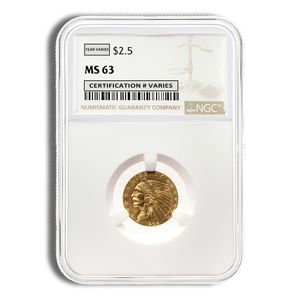
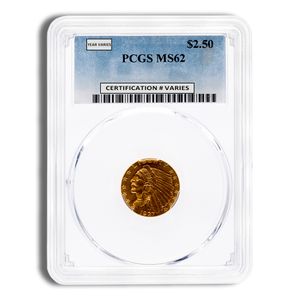
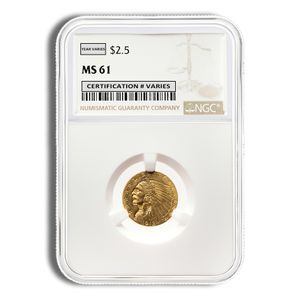
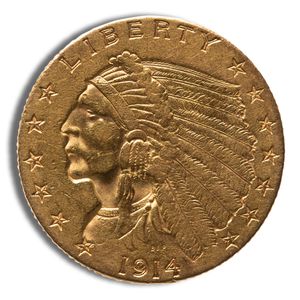
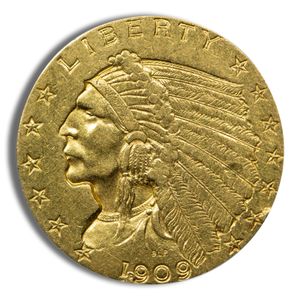
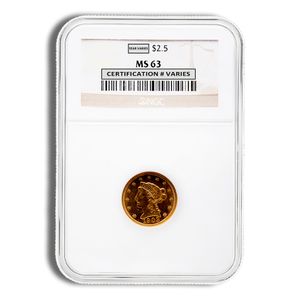
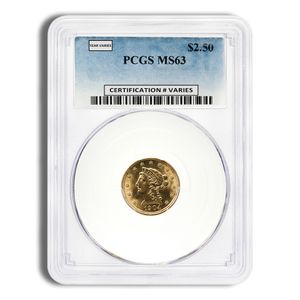
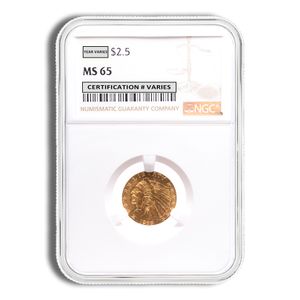
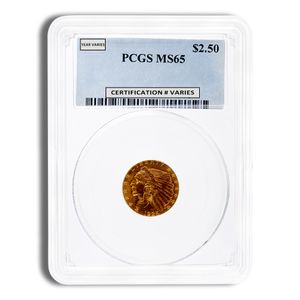
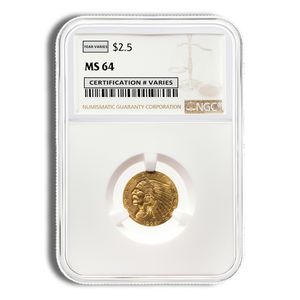
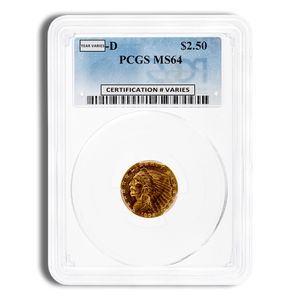
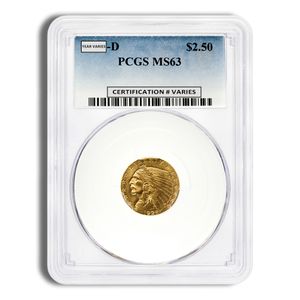
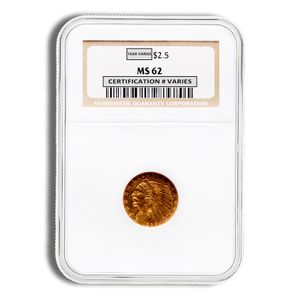
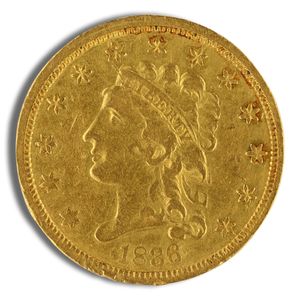
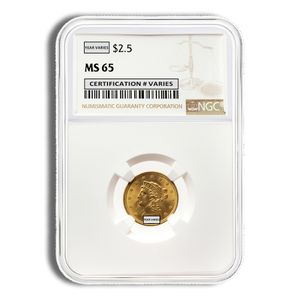
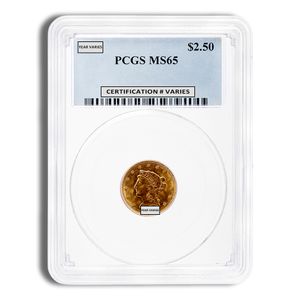
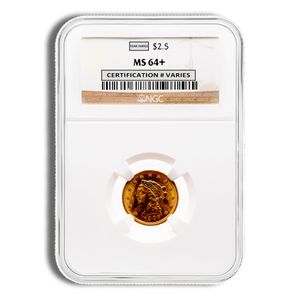
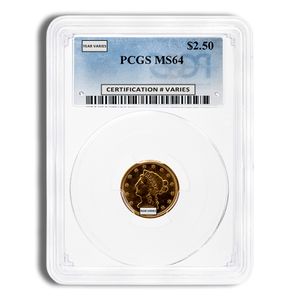
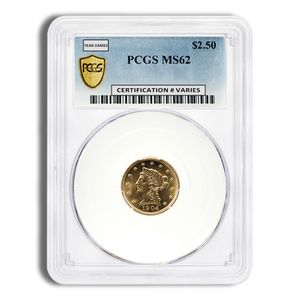
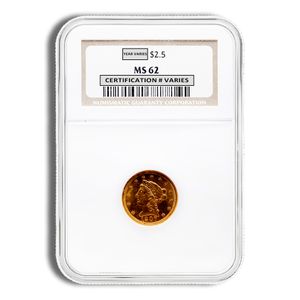
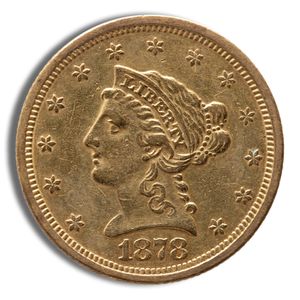
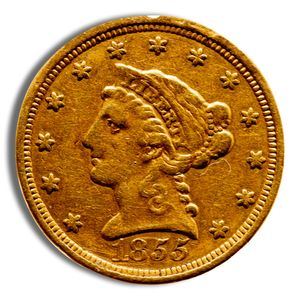
Our catalog of $2.5 gold coins covers three of the most historically significant American gold series ever produced: the Liberty Quarter Eagle, the Classic Head Quarter Eagle, and the Indian Quarter Eagle. Each design series is available across a range of grades and conditions, from circulated examples graded VF, XF, and AU to uncirculated coins certified by NGC and PCGS at grades ranging from MS61 through MS65. Raw BU examples are also available for buyers who prefer unslabbed coins at more accessible price points.
Every coin in this section weighs 0.1209 troy ounces of gold and carries a 90% gold purity, making them consistent in their metallic composition regardless of the design type or grade selected. Whether you're adding a circulated Liberty Quarter Eagle to round out a type set or sourcing a PCGS MS64 Indian Quarter Eagle for a more refined collection, the selection here is built around real market availability and genuine product diversity.
Bullion Standard sources these coins through established wholesale channels and verifies each product for authenticity before fulfillment. Pricing reflects live market conditions and is structured to give buyers a clear picture of what they're paying relative to spot, with bid and ask spreads displayed directly on individual product pages.
What Are $2.5 Gold Coins?
The $2.5 gold coin, officially called the Quarter Eagle, is one of the smallest gold denominations ever issued by the United States government. At 0.1209 troy ounces of gold and a face value of two dollars and fifty cents, it was a legal tender gold coin produced under the authority of the U.S. Mint across several distinct design eras spanning from the late 18th century through the early 20th century. Today these coins are collected and traded both for their gold content and for their historical and numismatic significance.
Buyers typically fall into a few categories. Some pursue Quarter Eagles as type coins, acquiring one example from each major design series to represent a cross-section of American coinage history. Others focus on specific grades or certified examples from NGC or PCGS, where the slab guarantees the coin's authenticity and provides a standardized grade backed by a professional grading service. A third group simply wants fractional U.S. gold at the lowest available premium, making circulated examples in VF or XF condition a practical entry point.
Compared to larger U.S. gold denominations like the Half Eagle or Eagle, the Quarter Eagle carries a lower absolute price, which makes it more accessible. The tradeoff is that premiums as a percentage of spot can be slightly higher on fractional gold, a dynamic common across all sub-one-ounce gold products regardless of issuer.
History and Background
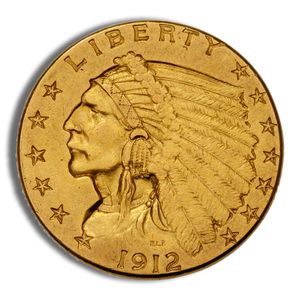
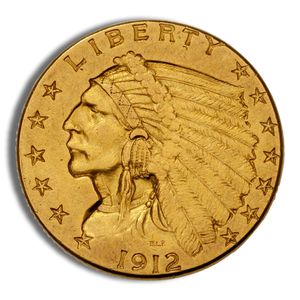
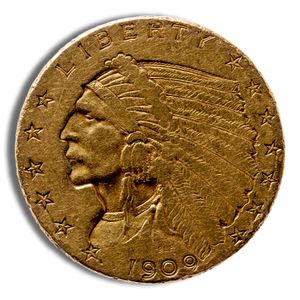
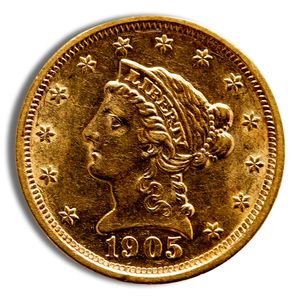
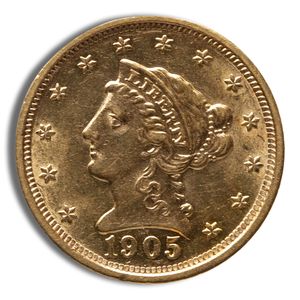
The Quarter Eagle was authorized by the Coinage Act of 1792 and first struck in 1796. Over the following century and a quarter, the series passed through several distinct design phases, each reflecting the artistic and political sensibilities of its era. The Capped Bust and Classic Head designs gave way to the long-running Liberty Head design, which was produced from 1840 through 1907 and became the most commercially familiar version of the denomination. The Indian Head Quarter Eagle, designed by Bela Lyon Pratt, followed from 1908 to 1929 and introduced an unusual incuse relief style unlike anything else in American numismatics.
Production of Quarter Eagles ended in 1929, and along with all other U.S. gold coins, they were effectively removed from circulation when President Roosevelt issued Executive Order 6102 in 1933, requiring private citizens to surrender gold coins to the Federal Reserve. Coins that survived this period in collector or estate holdings represent the overwhelming majority of examples available in today's market, which directly influences their relative scarcity by date, grade, and series.
The modern numismatic market has treated Quarter Eagles with consistent demand, particularly the Indian Head series in higher grades. PCGS and NGC have certified large populations of these coins, providing buyers with standardized grading benchmarks and authentication records that make the modern market for these pieces considerably more transparent than it was a generation ago.
Purity, Weight, and Specifications
All $2.5 gold Quarter Eagles listed here share a uniform metallic composition: 90% gold and 10% copper, expressed as a fineness of .900. This alloy was the standard for U.S. gold coinage throughout the 19th and early 20th centuries, and it gives these coins their characteristic warm yellow color. The actual gold content comes to 0.1209 troy ounces per coin, which is the figure used when calculating gold content value relative to spot price.
Coin diameter and weight also remained consistent within each design series, though minor die variations and the natural wear associated with circulated coins can affect exact measurements on individual examples. For certified coins in NGC or PCGS slabs, the grading holder itself provides a tamper-evident encapsulation that preserves the coin's physical condition and provides a certified grade documented in each service's online registry.
When evaluating these coins purely on metal content, the relevant figures are straightforward: 0.1209 troy oz of gold at .900 purity per coin. For certified coins, the grade assigned by NGC or PCGS becomes an equally important variable, as it significantly influences the premium above melt value.
Available Brands, Mints, and Product Variations
All coins in this section were struck by the United States Mint across various production years, with specific dates assigned randomly unless noted otherwise. The three design series represented are the Classic Head Quarter Eagle (minted 1834 to 1839), the Liberty Head Quarter Eagle (minted 1840 to 1907), and the Indian Head Quarter Eagle (minted 1908 to 1929). Each series has its own collector profile, population data, and market pricing characteristics.
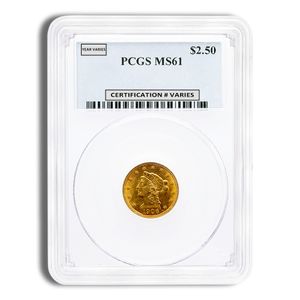
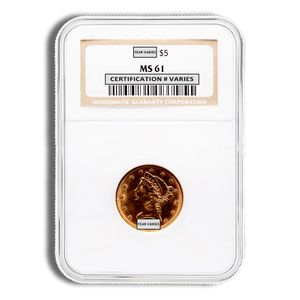
For the Liberty Quarter Eagle series, uncirculated certified options range from NGC MS61 and PCGS MS61 at the entry grade through MS65 at the top of the range, with both grading services represented at every level. The Indian Quarter Eagle follows the same grading structure. Classic Head Quarter Eagles are available in circulated grades only, reflecting the relative scarcity of high-grade survivors from that earlier production era.
Raw BU examples are listed for both the Liberty and Indian series for buyers who prioritize gold content over slab certification. Circulated grades including VF, XF, and AU are offered across all three series, and low-grade or cleaned examples are listed separately with transparent grade designations so buyers understand exactly what they're receiving before purchase.
Pricing, Premiums, and Market Factors
Premiums on U.S. gold type coins like Quarter Eagles are driven by several overlapping factors. The base gold value is calculated from 0.1209 troy ounces multiplied by the current spot price of gold. On top of that, a premium is applied based on the coin's grade, certification status, series, and relative market demand. Circulated examples in VF or XF tend to carry lower absolute premiums than certified MS63 or higher coins, though the percentage relationship can vary meaningfully depending on current collector demand and wholesale supply conditions.
Certified coins from NGC and PCGS command premiums above raw examples because the slab provides third-party authentication and a standardized, documented grade. Within certified coins, premiums escalate sharply at higher grades, particularly MS64 and MS65, where population scarcity drives pricing well beyond the base metal calculation. MS61 and MS62 examples typically sit closer to melt-plus-modest-premium, making them a more accessible entry into the certified U.S. gold coin market.
Bullion Standard displays live bid and ask pricing on each product page so buyers can evaluate the full spread before committing to a purchase. This transparency allows for a more complete picture of the true cost of ownership, including what a coin might realistically be worth at resale relative to its acquisition price under current market conditions.
Condition, Packaging, and What to Expect
Certified coins arrive sealed in original NGC or PCGS plastic holders with the assigned grade printed on the label. These slabs should be considered tamper-evident and should not be cracked open, as doing so voids the certification and significantly reduces resale value. Raw BU and circulated coins are delivered without slabs and may show age-appropriate surfaces consistent with their condition designation.
Coins listed as cleaned or low grade carry a grade of "C" and are priced accordingly. These examples may show evidence of cleaning, polishing, environmental damage, or heavy wear, and they are positioned primarily as a cost-effective way to acquire gold at or near melt value rather than for numismatic purposes. The product listings for these items are clearly labeled so buyers understand what they're purchasing.
Because specific dates are not guaranteed on random-year products, buyers should expect any date within the production range for that series. Date selection is not available for these listings. If a particular date or mint mark is a priority, buyers should contact Bullion Standard directly to inquire about specific availability.
Authenticity and Verification
Certified coins from NGC and PCGS carry the grading service's authentication guarantee. Both services employ expert numismatists who evaluate coins for authenticity, detect cleaning or alteration, and assign grades using standardized 70-point Sheldon scale criteria. The barcode and serial number printed on each slab can be verified directly through the NGC or PCGS online registry, which records the coin's certified weight, diameter, and grade.
Raw and circulated coins sourced by Bullion Standard are evaluated internally for authenticity before shipment. As an authorized dealer for both NGC and PCGS, Bullion Standard has direct access to grading submission services and maintains sourcing relationships with established wholesale networks. Coins that show signs of counterfeiting or improper alteration are not listed for sale.
For buyers who want additional peace of mind on uncertified purchases, submitting raw coins to NGC or PCGS for independent certification is straightforward and relatively affordable at the lower grades. Bullion Standard can facilitate this process for customers interested in having their coins professionally evaluated after purchase.
Liquidity and Resale Considerations
U.S. gold Quarter Eagles are among the most widely recognized pre-1933 American gold coins in the collector and dealer marketplace. Their government origin, consistent metallic composition, and long historical production runs mean they trade actively across coin dealers, numismatic auction houses, and online precious metals platforms. That said, liquidity varies meaningfully by grade and condition.
Circulated examples in VF, XF, and AU are highly liquid because they trade primarily on gold content with a modest numismatic premium. Certified coins in MS61 and MS62 also trade fairly actively, as they represent accessible entry points into the slabbed U.S. gold coin market. Higher-grade examples at MS64 and MS65 are less liquid in terms of transaction frequency but can command significant premiums when the right buyer is present, which is a characteristic of most numismatically scarce items.
Cleaned or low-grade examples are the most straightforwardly liquid, as they tend to trade close to melt and are accepted by most dealers without significant resistance. Buyers should understand that certified coins require a buyer willing to pay for the slab premium at the time of resale, which makes understanding current population data and market demand for specific grades an important part of evaluating these purchases.
Storage and Security
Quarter Eagles are small coins, and their size makes secure storage especially important. Loose coins can be easily misplaced and are more susceptible to incidental contact damage than larger denominations. Storing them in individual coin flips, 2x2 cardboard holders, or in certified slabs reduces the risk of surface wear from handling and makes organized storage easier.
For home storage, a quality fireproof safe bolted to a fixed structure provides a reasonable level of security for smaller quantities. For larger holdings or higher-value certified coins, third-party vault storage through an insured precious metals depository is worth considering. Many institutional vaults offer segregated storage options that keep individual holdings separate from pooled inventory, which is particularly relevant for numismatically significant certified pieces where provenance matters.
Environmental factors including humidity and air quality can affect coin surfaces over time, even for coins in NGC or PCGS slabs. Keeping stored coins away from areas with high humidity or temperature fluctuation helps preserve surface integrity and long-term condition. Silica gel desiccants placed in sealed storage containers offer an inexpensive layer of protection for raw coins stored outside of certified holders.
Selling and Buyback Options
Bullion Standard operates as a two-way market, meaning customers can sell Quarter Eagles back through the same platform where they were purchased. The buyback process begins with a price quote based on current market conditions, the coin's grade and certification status, and the specific series. Certified coins with intact NGC or PCGS slabs are generally quoted at tighter spreads than raw or circulated examples because the grade is already documented and verification is straightforward.
Factors that influence buyback pricing include the grading service certification, the specific grade, current gold spot prices, wholesale demand for that particular product type, and whether the coin's original packaging and certification are intact. Removing a coin from its slab, even if the coin itself is unaltered, typically results in a lower buyback quote because the authentication guarantee is no longer in place.
For circulated and low-grade examples, buyback pricing is primarily driven by gold content relative to spot. These transactions are generally processed quickly because the evaluation is less complex than certified numismatic coins. Customers interested in selling should reach out to Bullion Standard's purchasing team directly to receive a current quote and understand the shipping and payment process before sending coins.
Why Buy $2.5 Gold Coins?
Quarter Eagles appeal to a broad range of buyers for different reasons. For type collectors, they offer one of the most accessible ways to own an original U.S. gold coin from three distinct and historically meaningful design eras without committing to the larger denominations. The Classic Head, Liberty, and Indian designs each carry their own aesthetic and historical identity, and assembling a type set across all three is a straightforward and rewarding collecting goal.
For buyers focused on gold content, circulated Quarter Eagles in VF or XF condition represent a practical way to acquire pre-1933 U.S. gold near melt value, particularly when premiums on modern fractional gold products are elevated. The 90% gold alloy is well-established in the market and widely accepted by dealers and grading services alike.
Certified examples in higher grades appeal to numismatists who want the authentication and grading guarantee that NGC and PCGS provide, along with the documented scarcity that makes MS63 through MS65 Quarter Eagles genuinely difficult to source in quantity. The availability of both PCGS and NGC certification options at each major grade level gives buyers the flexibility to choose based on personal grading service preference.
Why Buy from Bullion Standard?
Bullion Standard has been operating as a transparent precious metals marketplace since 2010, built around the principle that buyers deserve clear pricing, verified products, and straightforward access to both buying and selling. Our catalog of U.S. gold type coins including Quarter Eagles is sourced through established wholesale networks and subject to internal verification before fulfillment. As authorized dealers for both NGC and PCGS, we work directly within the grading service ecosystem rather than around it.
Every product page displays a live bid and ask spread, giving buyers a complete picture of current market pricing rather than a one-sided retail quote. This reflects our broader commitment to transparency, where the goal is informed purchasing rather than pressure-driven sales. Our A rating with the Better Business Bureau and memberships in the American Numismatic Association and the National Coin and Bullion Association reflect the operational standards we hold ourselves to across every transaction.
Payment flexibility is part of the experience as well. Buyers can complete purchases using Visa, Mastercard, American Express, Discover, PayPal, bank-connected payments through Plaid, wire transfer, paper check, or cryptocurrency through BitPay. Fulfillment is handled with care, and our customer service team is accessible for questions both before and after purchase, including for buyers interested in leveraging our buyback program when the time comes to sell.
Get Near-Spot Pricing with Bullion Standard Pro
Bullion Standard Pro is designed for buyers who want direct access to wholesale-level bid and ask pricing across the precious metals market, including U.S. gold type coins. Members transact at executable wholesale market prices rather than traditional retail markups, which means premiums and spreads fluctuate based on actual market supply and demand rather than fixed dealer pricing structures. For buyers making repeated purchases or working with larger quantities, the pricing efficiency can be meaningful.
Beyond pricing, Bullion Standard Pro provides access to real-time portfolio valuation using live wholesale bid pricing, historical premium analysis, spread analytics, and proprietary market intelligence tools. These resources help members evaluate products like Quarter Eagles using objective data, including where current premiums sit relative to historical ranges and how liquidity and spread tightness compare across different grades and certification levels.
The platform is built around the idea that physical precious metals buyers deserve the same quality of market information available in traditional financial markets. By reducing information asymmetry and providing transparent, executable pricing, Bullion Standard Pro aims to create a more efficient buying and selling experience for members who take a data-informed approach to their precious metals decisions.

 (833) 278-4653