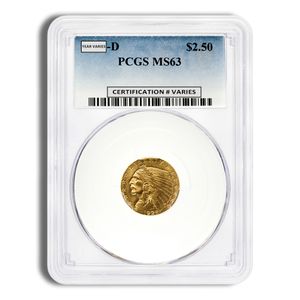
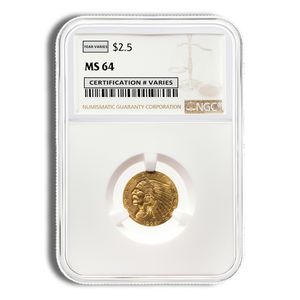
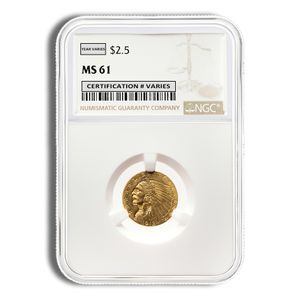
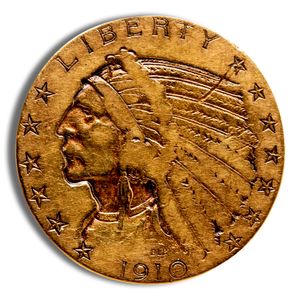
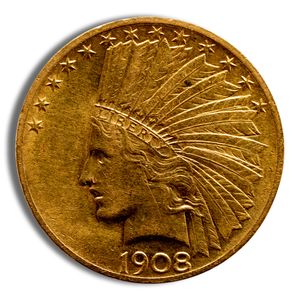
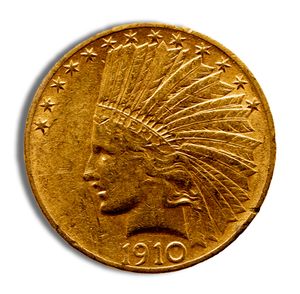
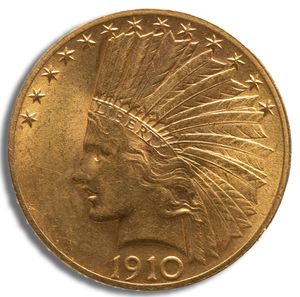
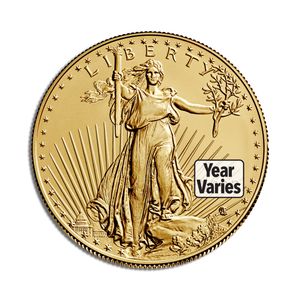
The $2.5 Gold Indian Quarter Eagle is a historic United States gold coin struck in 90% pure gold at a weight of 0.1209 troy ounces. Issued by the United States Mint across various production years from 1908 to 1929, these coins carry legal tender status and represent one of the more distinctive entries in American numismatic history. The pieces we carry are graded Extremely Fine, meaning they exhibit well-preserved detail with only light wear on the highest relief areas. Because production years vary, each coin is representative of the broader Indian Head Quarter Eagle series rather than any single dated issue.
History and Background
The Indian Head Quarter Eagle series was introduced in 1908 as part of a broader artistic reform of American coinage championed during the presidency of Theodore Roosevelt. The design was the work of sculptor Bela Lyon Pratt, who drew on the aesthetic language developed by Augustus Saint-Gaudens to produce a coin unlike anything previously struck by the United States Mint. Rather than the raised relief typical of the era, Pratt employed an incuse or sunken relief design, pressing the imagery into the co…
Overview of the $2.5 Gold Indian Quarter Eagle
The $2.5 Gold Indian Quarter Eagle is a historic United States gold coin struck in 90% pure gold at a weight of 0.1209 troy ounces. Issued by the United States Mint across various production years from 1908 to 1929, these coins carry legal tender status and represent one of the more distinctive entries in American numismatic history. The pieces we carry are graded Extremely Fine, meaning they exhibit well-preserved detail with only light wear on the highest relief areas. Because production years vary, each coin is representative of the broader Indian Head Quarter Eagle series rather than any single dated issue.
History and Background
The Indian Head Quarter Eagle series was introduced in 1908 as part of a broader artistic reform of American coinage championed during the presidency of Theodore Roosevelt. The design was the work of sculptor Bela Lyon Pratt, who drew on the aesthetic language developed by Augustus Saint-Gaudens to produce a coin unlike anything previously struck by the United States Mint. Rather than the raised relief typical of the era, Pratt employed an incuse or sunken relief design, pressing the imagery into the coin's field rather than projecting it outward.
This design choice proved controversial at the time. Critics argued that the recessed design allowed dirt and bacteria to accumulate in the sunken fields, while supporters praised its artistic originality. Despite the debate, the series ran continuously until 1929, with the Philadelphia and Denver mints both contributing to production across different years. Today these coins are recognized as genuinely distinctive artifacts of the American numismatic tradition, produced during a period when the Mint actively pursued artistic excellence over commercial convention.
Design and Aesthetics
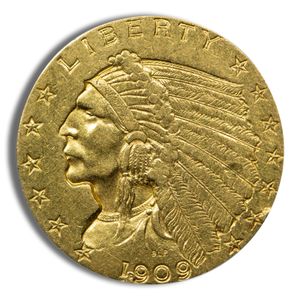
The obverse of the Indian Quarter Eagle features a left-facing Native American figure wearing a traditional feathered headdress, surrounded by thirteen stars representing the original colonies. The word "LIBERTY" appears above, and the date is struck below the portrait. The incuse technique gives the imagery a bas-relief quality that sets it apart from virtually every other American gold coin of the period, producing a distinctive interplay of recessed detail and flat field.
The reverse carries a standing eagle with closed wings resting on a bundle of arrows, with the inscriptions "UNITED STATES OF AMERICA," "E PLURIBUS UNUM," and the denomination "2½ DOLLARS" completing the composition. The "$2.50 IN GOLD" value is noted with 90% gold purity, and the overall design has a restrained elegance that holds up well even at the coin's modest diameter. Because the incuse fields can trap contact residue over time, Extremely Fine examples that retain clear detail across both sides are the more desirable grade within the circulated range.
Fractional Size and Accessibility
At 0.1209 troy ounces of gold, the Quarter Eagle occupies a meaningful position for buyers who want physical gold exposure in a smaller denomination format. The lower per-unit price compared to full-ounce coins makes these pieces accessible to a broader range of buyers and allows for more granular allocation decisions without committing to the full cost of a one-ounce coin.
The fractional format also makes the Indian Quarter Eagle practical for those building a mixed-denomination holding. Its recognized government origin and standardized gold content ensure that smaller purchases still carry the weight of U.S. Mint issuance and the historical significance of one of the more artistically notable coin series in American numismatic production.
Authenticity and Product Integrity
Every $2.5 Gold Indian Quarter Eagle we carry is authenticated for weight, purity, and condition before it is listed or shipped. These coins were originally struck to the exacting standards of the United States Mint, and their 90% gold composition and 0.1209-ounce gold content are well-documented and consistently verifiable. As an authorized dealer for both PCGS and NGC, we maintain the sourcing relationships and authentication standards necessary to handle pre-1933 American gold coinage with confidence.
Because these are raw, ungraded circulated coins rather than slabbed examples, condition assessment is based on industry-standard grading criteria for the Extremely Fine grade. XF coins retain most original design detail with light, even wear across the high points. Any coin falling outside that standard is separated from the inventory before it reaches a customer.
Condition and Packaging
Extremely Fine represents a well-circulated grade in which the coin retains sharp definition across most of the design, with only light wear on the highest relief areas such as the cheekbone of the portrait and the eagle's feathers on the reverse. For an incuse design like the Indian Quarter Eagle, this grade typically means the recessed elements remain clearly defined and legible throughout. These coins show honest circulation history without the heavy smoothing or loss of detail associated with lower grades.
Individual coins ship in protective plastic flips to preserve condition during transit. Orders comprising larger quantities will be packaged appropriately based on volume, with coins secured in a manner consistent with their grade and collectible status. Because these are circulated coins drawn from the secondary market, minor contact marks, surface toning, or light handling signs may be present and are consistent with their grade designation. These characteristics do not affect the gold content or the numismatic integrity of the piece.
Pricing and Market Factors
Pricing for the $2.5 Gold Indian Quarter Eagle is anchored to the spot price of gold, with premiums reflecting several factors specific to pre-1933 U.S. gold coinage. The coin's historical significance, limited surviving supply, and collector demand all contribute to a premium structure that can differ substantially from modern bullion products. Unlike newly produced coins or rounds, pre-1933 issues trade in a market shaped by both the underlying metal value and numismatic considerations.
Because production years vary and specific dates within the series carry different collector valuations, the random-year format of this listing is priced to reflect representative XF examples rather than premium-date issues. Our pricing reflects real-time gold market conditions and is updated to maintain consistency with live spot prices. The bid/ask spread displayed on our product pages gives buyers a transparent view of both acquisition cost and expected resale value before committing to a purchase.
Selling and Liquidity
Pre-1933 U.S. gold coins, including the Indian Quarter Eagle, are recognized across dealer networks, auction markets, and private transactions throughout the country. Their standardized gold content, government origin, and historical pedigree make them broadly familiar to buyers and sellers operating in both the numismatic and bullion markets. XF-grade examples occupy a position that appeals to both general bullion buyers and entry-level coin collectors, which supports consistent demand across multiple buyer categories.
We operate a two-way market that allows customers to both buy and sell within the same platform. When the time comes to liquidate, our competitive buyback pricing reflects current wholesale market conditions rather than arbitrary retail estimates. We believe liquidity is a consideration that belongs at the start of a purchase decision, not at the end of it, and our platform is designed to make that evaluation straightforward.
Why Buy the $2.5 Gold Indian Quarter Eagle?
The Indian Quarter Eagle offers something that most modern bullion products cannot: a distinct artistic identity rooted in a specific and well-documented chapter of American monetary history. The incuse design by Bela Lyon Pratt remains one of the most visually unusual approaches ever applied to a circulating U.S. gold coin, and that distinctiveness has sustained collector and dealer interest well beyond what the gold content alone would support.
For buyers drawn to pre-1933 American gold, the Quarter Eagle provides a lower-cost entry point compared to the $5 Indian or $10 Indian denominations while maintaining the same design language and Mint pedigree. The XF grade ensures meaningful detail retention without the premium associated with Mint State examples, making these coins a practical choice for building a historically grounded gold holding without reaching into the higher end of the grading scale.
Why Buy from Bullion Standard?
We have built our reputation over more than a decade on the principle that buyers deserve clear, accurate information and straightforward pricing without pressure or ambiguity. Our A rating with the Better Business Bureau, membership in both the American Numismatic Association and the National Coin and Bullion Association, and authorized dealer status with PCGS and NGC reflect the professional standards we hold ourselves to across every transaction.
For pre-1933 gold coinage in particular, working with a dealer that understands both the numismatic and bullion dimensions of the market matters. We verify every coin we handle and price transparently based on current market conditions. Our two-way market model means we are committed to the full transaction, not just the sale, and our platform gives buyers the data they need to make confident, well-informed decisions rather than relying solely on a dealer's word.
Get Near-Spot Pricing with Bullion Standard Pro
Bullion Standard Pro gives members access to live, executable wholesale bid and ask pricing across our catalog, including pre-1933 U.S. gold coinage. For a product like the Indian Quarter Eagle, where premiums are influenced by both metal content and numismatic demand, understanding how pricing behaves at the wholesale level provides meaningful context that standard retail listings cannot offer. Pro members can track bid/ask spreads, monitor how premiums shift with market conditions, and value their holdings based on current wholesale liquidation prices rather than estimated retail figures.
The platform also includes proprietary research and comparison tools that allow members to evaluate products across the catalog using objective metrics. Rather than relying on marketing descriptions, Pro members can assess liquidity characteristics, premium history, and market activity to inform their decisions with data. For buyers actively building or managing a gold position, that kind of transparency is a material advantage.
Flexible and Secure Payment Options
We support a broad range of payment methods to make every transaction straightforward and secure. Customers can pay using Visa, Mastercard, American Express, or Discover, and we also accept PayPal, bank-connected payments through Plaid, wire transfer, paper check, and cryptocurrency via BitPay. Whether you prefer a traditional payment method or a digital option, the checkout process is designed to be simple and consistent across all of them. Security and convenience are built into every step of how we process and fulfill orders.
The $2.5 Gold Indian Quarter Eagle is a historic United States gold coin struck in 90% pure gold at a weight of 0.1209 troy ounces. Issued by the United States Mint across various production years from 1908 to 1929, these coins carry legal tender status and represent one of the more distinctive entries in American numismatic history. The pieces we carry are graded Extremely Fine, meaning they exhibit well-preserved detail with only light wear on the highest relief areas. Because production years vary, each coin is representative of the broader Indian Head Quarter Eagle series rather than any single dated issue.
History and Background
The Indian Head Quarter Eagle series was introduced in 1908 as part of a broader artistic reform of American coinage championed during the presidency of Theodore Roosevelt. The design was the work of sculptor Bela Lyon Pratt, who drew on the aesthetic language developed by Augustus Saint-Gaudens to produce a coin unlike anything previously struck by the United States Mint. Rather than the raised relief typical of the era, Pratt employed an incuse or sunken relief design, pressing the imagery into the co…
Overview of the $2.5 Gold Indian Quarter Eagle
The $2.5 Gold Indian Quarter Eagle is a historic United States gold coin struck in 90% pure gold at a weight of 0.1209 troy ounces. Issued by the United States Mint across various production years from 1908 to 1929, these coins carry legal tender status and represent one of the more distinctive entries in American numismatic history. The pieces we carry are graded Extremely Fine, meaning they exhibit well-preserved detail with only light wear on the highest relief areas. Because production years vary, each coin is representative of the broader Indian Head Quarter Eagle series rather than any single dated issue.
History and Background
The Indian Head Quarter Eagle series was introduced in 1908 as part of a broader artistic reform of American coinage championed during the presidency of Theodore Roosevelt. The design was the work of sculptor Bela Lyon Pratt, who drew on the aesthetic language developed by Augustus Saint-Gaudens to produce a coin unlike anything previously struck by the United States Mint. Rather than the raised relief typical of the era, Pratt employed an incuse or sunken relief design, pressing the imagery into the coin's field rather than projecting it outward.
This design choice proved controversial at the time. Critics argued that the recessed design allowed dirt and bacteria to accumulate in the sunken fields, while supporters praised its artistic originality. Despite the debate, the series ran continuously until 1929, with the Philadelphia and Denver mints both contributing to production across different years. Today these coins are recognized as genuinely distinctive artifacts of the American numismatic tradition, produced during a period when the Mint actively pursued artistic excellence over commercial convention.
Design and Aesthetics
The obverse of the Indian Quarter Eagle features a left-facing Native American figure wearing a traditional feathered headdress, surrounded by thirteen stars representing the original colonies. The word "LIBERTY" appears above, and the date is struck below the portrait. The incuse technique gives the imagery a bas-relief quality that sets it apart from virtually every other American gold coin of the period, producing a distinctive interplay of recessed detail and flat field.
The reverse carries a standing eagle with closed wings resting on a bundle of arrows, with the inscriptions "UNITED STATES OF AMERICA," "E PLURIBUS UNUM," and the denomination "2½ DOLLARS" completing the composition. The "$2.50 IN GOLD" value is noted with 90% gold purity, and the overall design has a restrained elegance that holds up well even at the coin's modest diameter. Because the incuse fields can trap contact residue over time, Extremely Fine examples that retain clear detail across both sides are the more desirable grade within the circulated range.
Fractional Size and Accessibility
At 0.1209 troy ounces of gold, the Quarter Eagle occupies a meaningful position for buyers who want physical gold exposure in a smaller denomination format. The lower per-unit price compared to full-ounce coins makes these pieces accessible to a broader range of buyers and allows for more granular allocation decisions without committing to the full cost of a one-ounce coin.
The fractional format also makes the Indian Quarter Eagle practical for those building a mixed-denomination holding. Its recognized government origin and standardized gold content ensure that smaller purchases still carry the weight of U.S. Mint issuance and the historical significance of one of the more artistically notable coin series in American numismatic production.
Authenticity and Product Integrity
Every $2.5 Gold Indian Quarter Eagle we carry is authenticated for weight, purity, and condition before it is listed or shipped. These coins were originally struck to the exacting standards of the United States Mint, and their 90% gold composition and 0.1209-ounce gold content are well-documented and consistently verifiable. As an authorized dealer for both PCGS and NGC, we maintain the sourcing relationships and authentication standards necessary to handle pre-1933 American gold coinage with confidence.
Because these are raw, ungraded circulated coins rather than slabbed examples, condition assessment is based on industry-standard grading criteria for the Extremely Fine grade. XF coins retain most original design detail with light, even wear across the high points. Any coin falling outside that standard is separated from the inventory before it reaches a customer.
Condition and Packaging
Extremely Fine represents a well-circulated grade in which the coin retains sharp definition across most of the design, with only light wear on the highest relief areas such as the cheekbone of the portrait and the eagle's feathers on the reverse. For an incuse design like the Indian Quarter Eagle, this grade typically means the recessed elements remain clearly defined and legible throughout. These coins show honest circulation history without the heavy smoothing or loss of detail associated with lower grades.
Individual coins ship in protective plastic flips to preserve condition during transit. Orders comprising larger quantities will be packaged appropriately based on volume, with coins secured in a manner consistent with their grade and collectible status. Because these are circulated coins drawn from the secondary market, minor contact marks, surface toning, or light handling signs may be present and are consistent with their grade designation. These characteristics do not affect the gold content or the numismatic integrity of the piece.
Pricing and Market Factors
Pricing for the $2.5 Gold Indian Quarter Eagle is anchored to the spot price of gold, with premiums reflecting several factors specific to pre-1933 U.S. gold coinage. The coin's historical significance, limited surviving supply, and collector demand all contribute to a premium structure that can differ substantially from modern bullion products. Unlike newly produced coins or rounds, pre-1933 issues trade in a market shaped by both the underlying metal value and numismatic considerations.
Because production years vary and specific dates within the series carry different collector valuations, the random-year format of this listing is priced to reflect representative XF examples rather than premium-date issues. Our pricing reflects real-time gold market conditions and is updated to maintain consistency with live spot prices. The bid/ask spread displayed on our product pages gives buyers a transparent view of both acquisition cost and expected resale value before committing to a purchase.
Selling and Liquidity
Pre-1933 U.S. gold coins, including the Indian Quarter Eagle, are recognized across dealer networks, auction markets, and private transactions throughout the country. Their standardized gold content, government origin, and historical pedigree make them broadly familiar to buyers and sellers operating in both the numismatic and bullion markets. XF-grade examples occupy a position that appeals to both general bullion buyers and entry-level coin collectors, which supports consistent demand across multiple buyer categories.
We operate a two-way market that allows customers to both buy and sell within the same platform. When the time comes to liquidate, our competitive buyback pricing reflects current wholesale market conditions rather than arbitrary retail estimates. We believe liquidity is a consideration that belongs at the start of a purchase decision, not at the end of it, and our platform is designed to make that evaluation straightforward.
Why Buy the $2.5 Gold Indian Quarter Eagle?
The Indian Quarter Eagle offers something that most modern bullion products cannot: a distinct artistic identity rooted in a specific and well-documented chapter of American monetary history. The incuse design by Bela Lyon Pratt remains one of the most visually unusual approaches ever applied to a circulating U.S. gold coin, and that distinctiveness has sustained collector and dealer interest well beyond what the gold content alone would support.
For buyers drawn to pre-1933 American gold, the Quarter Eagle provides a lower-cost entry point compared to the $5 Indian or $10 Indian denominations while maintaining the same design language and Mint pedigree. The XF grade ensures meaningful detail retention without the premium associated with Mint State examples, making these coins a practical choice for building a historically grounded gold holding without reaching into the higher end of the grading scale.
Why Buy from Bullion Standard?
We have built our reputation over more than a decade on the principle that buyers deserve clear, accurate information and straightforward pricing without pressure or ambiguity. Our A rating with the Better Business Bureau, membership in both the American Numismatic Association and the National Coin and Bullion Association, and authorized dealer status with PCGS and NGC reflect the professional standards we hold ourselves to across every transaction.
For pre-1933 gold coinage in particular, working with a dealer that understands both the numismatic and bullion dimensions of the market matters. We verify every coin we handle and price transparently based on current market conditions. Our two-way market model means we are committed to the full transaction, not just the sale, and our platform gives buyers the data they need to make confident, well-informed decisions rather than relying solely on a dealer's word.
Get Near-Spot Pricing with Bullion Standard Pro
Bullion Standard Pro gives members access to live, executable wholesale bid and ask pricing across our catalog, including pre-1933 U.S. gold coinage. For a product like the Indian Quarter Eagle, where premiums are influenced by both metal content and numismatic demand, understanding how pricing behaves at the wholesale level provides meaningful context that standard retail listings cannot offer. Pro members can track bid/ask spreads, monitor how premiums shift with market conditions, and value their holdings based on current wholesale liquidation prices rather than estimated retail figures.
The platform also includes proprietary research and comparison tools that allow members to evaluate products across the catalog using objective metrics. Rather than relying on marketing descriptions, Pro members can assess liquidity characteristics, premium history, and market activity to inform their decisions with data. For buyers actively building or managing a gold position, that kind of transparency is a material advantage.
Flexible and Secure Payment Options
We support a broad range of payment methods to make every transaction straightforward and secure. Customers can pay using Visa, Mastercard, American Express, or Discover, and we also accept PayPal, bank-connected payments through Plaid, wire transfer, paper check, and cryptocurrency via BitPay. Whether you prefer a traditional payment method or a digital option, the checkout process is designed to be simple and consistent across all of them. Security and convenience are built into every step of how we process and fulfill orders.
This website uses cookies for analytics and to deliver personalized content. By continuing to
use our site, you acknowledge that you have read and agree to our Privacy Policy and Cookie
Policy.
Current Quantities Available
Unfortunately, we only have 0
of
this item in
stock.
Please call us at (833) 278-4653
or email us at support@bullionstandard.com
if you wish to purchase a larger quantity than what is available on our website.
We can often locate additional quantities.

 (833) 278-4653


.png)