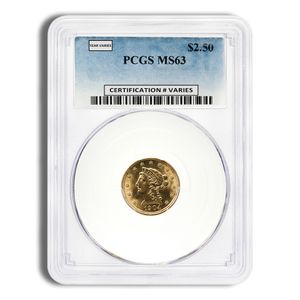
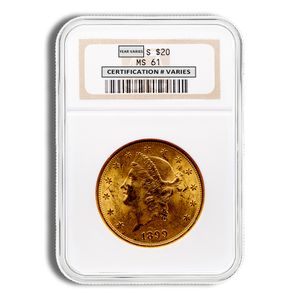
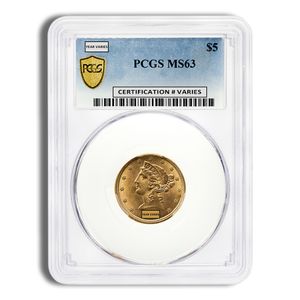
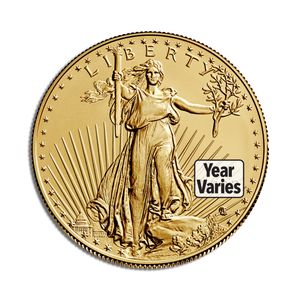
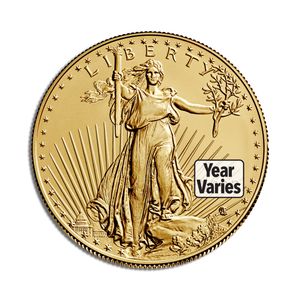
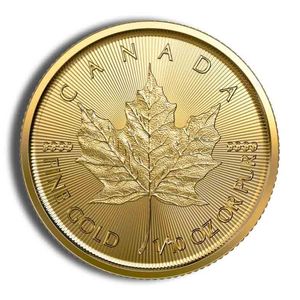
The $2.5 Gold Liberty Quarter Eagle is a classic United States gold coin struck in .900 fine gold with a total weight of 0.1209 troy ounces, equating to a net gold content of approximately 0.1209 oz. Issued by the United States Mint across multiple facilities over a span of more than a century, these coins carry a nominal face value of $2.50 and occupy a distinct place among American gold coinage. The "AU" or About Uncirculated designation indicates that the coin saw minimal circulation, with most of its original mint luster still intact and only light wear visible on the highest points of the design.
We offer these coins as random-year selections, meaning the specific date and mint mark will vary. Each coin will fall within the AU grade range and meet the standards we apply across our inventory of circulated gold.
History and Background
The Quarter Eagle series traces its origins to the Coinage Act of 1792, which formally established the United States monetary system and authorized the production of gold denominations including the $2.50 coin. Early issues began in 1796, and production continued with various design iterations thr…
Overview of the $2.5 Gold Liberty Quarter Eagle
The $2.5 Gold Liberty Quarter Eagle is a classic United States gold coin struck in .900 fine gold with a total weight of 0.1209 troy ounces, equating to a net gold content of approximately 0.1209 oz. Issued by the United States Mint across multiple facilities over a span of more than a century, these coins carry a nominal face value of $2.50 and occupy a distinct place among American gold coinage. The "AU" or About Uncirculated designation indicates that the coin saw minimal circulation, with most of its original mint luster still intact and only light wear visible on the highest points of the design.
We offer these coins as random-year selections, meaning the specific date and mint mark will vary. Each coin will fall within the AU grade range and meet the standards we apply across our inventory of circulated gold.
History and Background
The Quarter Eagle series traces its origins to the Coinage Act of 1792, which formally established the United States monetary system and authorized the production of gold denominations including the $2.50 coin. Early issues began in 1796, and production continued with various design iterations through 1929. The Liberty Head design associated with the later part of this series was introduced in 1840 and was engraved by Christian Gobrecht, with subsequent refinements made over the decades that followed.
The coins were produced at several United States Mint facilities throughout their run, including Philadelphia, New Orleans, San Francisco, and Denver, each of which used its own mint mark. Production volumes varied considerably by year and facility, which is reflected in the wide range of collector premiums that different dates and mint marks carry today. The Quarter Eagle was ultimately discontinued as the United States moved away from circulating gold coinage in the early twentieth century.
Design and Aesthetics
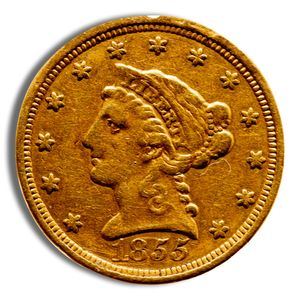
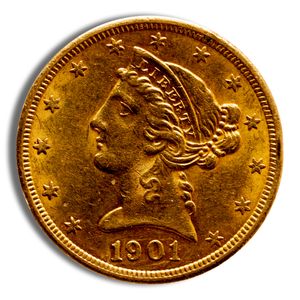
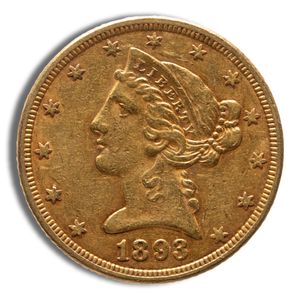
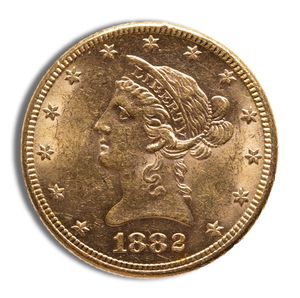
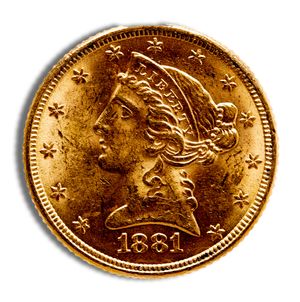
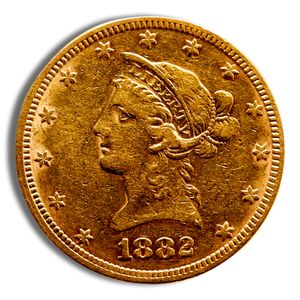
The obverse of the Liberty Head Quarter Eagle features a portrait of Lady Liberty facing left, wearing a coronet inscribed with the word "LIBERTY." Thirteen stars encircle the portrait, representing the original colonies, and the date appears below. The overall composition is clean and formal, characteristic of the mid-to-late nineteenth century numismatic aesthetic favored by the United States Mint during this period.
The reverse displays a heraldic eagle at center, rendered with spread wings, a shield on its breast, and arrows and an olive branch clutched in its talons. The inscriptions "UNITED STATES OF AMERICA" and the denomination "2 1/2 DOLLARS" frame the design. On coins graded About Uncirculated, the fine details of the feathers, shield, and portrait remain largely crisp, though slight friction may be visible on elevated surfaces when examined closely.
Fractional Size and Accessibility
At 0.1209 troy ounces of gold, the Quarter Eagle represents one of the smaller denominations in American gold coinage, which has practical implications for how buyers approach it. The reduced gold content relative to full-ounce coins means a lower per-coin acquisition cost, making it accessible for buyers who want to add physical gold without committing to a larger single purchase.
The fractional format also offers flexibility when building a diversified holding across different sizes and denominations. For buyers interested in historical American gold specifically, the Quarter Eagle offers an entry point into pre-1933 coinage at a price point that reflects both the metal content and the numismatic character of the piece.
Authenticity and Product Integrity
Every Quarter Eagle we carry is authenticated for weight, purity, and condition before being made available. As coins struck by the United States Mint to a standard of .900 fine gold, genuine examples have well-established physical characteristics that experienced professionals can verify. Pre-1933 United States gold coins are among the most widely studied and documented in the numismatic world, and the authentication standards applied to them are correspondingly rigorous.
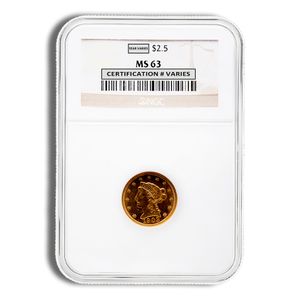
Our authorized dealer relationships with both PCGS and NGC mean we operate within the professional grading and authentication ecosystem that governs serious numismatic transactions. While these particular coins are offered as raw, ungraded examples, the same standards of professional scrutiny apply to all of the pre-1933 gold we carry. Our membership in the American Numismatic Association and the National Coin and Bullion Association further reflects the standards we hold ourselves to in sourcing and handling these coins.
Condition and Packaging
About Uncirculated is a well-defined numismatic grade indicating that a coin has seen only the lightest circulation, if any, with the vast majority of its original surface detail and luster still present. Under the standard Sheldon scale, AU grades typically span from AU-50 through AU-58, with higher numbers reflecting diminishing friction and greater luster retention. Coins in this range are considered highly desirable by buyers who want historical gold with a strong strike and visible detail without paying the premium associated with Mint State examples.
Individual coins ship in protective plastic flips to preserve their condition during transit. Orders for larger quantities will be packaged in tubes or sealed boxes consistent with standard handling for pre-1933 gold coinage. Because these are random-year selections sourced from existing inventory, packaging is determined by available stock at the time of order. As raw coins, minor contact marks, light surface toning, or handling signs consistent with secondary market circulation may be present and do not affect the gold content or the coin's recognized grade.
Pricing and Market Factors
Pricing for the Quarter Eagle is driven by two distinct components: the intrinsic gold value based on the current spot price of gold, and the numismatic or collector premium layered on top. Because these are pre-1933 coins with historical significance, their premiums tend to run higher than those of modern bullion coins, reflecting both their limited and finite supply and the collector demand that accompanies them. Spot price fluctuations affect the floor of the pricing, but the numismatic component can cushion or amplify overall pricing movement depending on collector market conditions.
Our pricing reflects real-time market conditions, and we display the bid/ask spread on each product page so buyers can see the full picture of acquisition cost and current resale value at once. This transparency is particularly meaningful for pre-1933 gold, where the range between buy and sell prices can be wider than it is for standard modern bullion, and where understanding both sides of the transaction matters before committing to a purchase.
Selling and Liquidity
Pre-1933 United States gold coins are well recognized within the precious metals and numismatic markets and trade regularly through dealers, auction houses, and wholesale networks. The Quarter Eagle's status as a government-issued legal tender coin struck to documented specifications supports its recognizability across different resale channels. Buyers and dealers familiar with American gold coinage understand these coins and can assess them efficiently.
We operate a two-way market, which means customers can sell back coins of this type through the same platform used to purchase them. Liquidity for AU-grade pre-1933 gold is generally solid, though it is worth noting that resale premiums and spreads for this category can reflect changing collector demand in addition to underlying metal prices. Understanding both sides of the transaction before buying is something we actively support through the pricing data and market information available on our platform.
Why Buy the $2.5 Gold Liberty Quarter Eagle?
The Quarter Eagle appeals to a specific type of buyer: someone who wants physical gold with historical character rather than a generic modern coin or bar. These are finite pieces of American monetary history, struck by the United States Mint at a time when gold circulated as everyday currency, and the supply will not increase. That combination of fixed supply, documented provenance, and metal content gives the coin a distinct standing relative to modern bullion alternatives.
The AU grade is a practical sweet spot for buyers who want a coin with genuine numismatic integrity without paying the significant premium associated with Mint State examples. High-grade details, substantial luster retention, and a sharp strike are achievable in this grade range at a more efficient cost relative to the coin's overall quality. For buyers building a position in pre-1933 American gold, the Quarter Eagle also provides denominal diversity alongside Half Eagles and Eagles.
Why Buy from Bullion Standard?
We have been operating in the physical precious metals market since 2010, and our approach to pre-1933 gold reflects the same standards we apply across every product category: transparent pricing, authenticated inventory, and a purchasing experience that treats the buyer as an informed participant rather than a passive consumer. Our A rating with the Better Business Bureau and our memberships in the ANA and NCBA reflect the professional standards we hold ourselves to across all transactions.
Our two-way market model means we are not simply a place to buy. We support the selling side with competitive buyback pricing, allowing customers to evaluate liquidity before committing to a purchase rather than discovering it later. For a category like pre-1933 gold where premiums and spreads warrant careful attention, having access to real pricing data on both sides of the transaction is a meaningful advantage we actively provide.
Get Near-Spot Pricing with Bullion Standard Pro
Bullion Standard Pro gives members access to live, executable wholesale bid and ask pricing, which is particularly relevant when evaluating pre-1933 gold where premiums and spreads can fluctuate meaningfully based on collector demand and wholesale market activity. Rather than relying on static listed prices, Pro members can see how the Quarter Eagle is priced and traded at the wholesale level in real time, allowing for more precise decision-making on both the buy and sell side.
Beyond pricing access, Pro members benefit from real-time portfolio valuation using current wholesale bid prices and product research tools that allow direct comparison of premiums, bid/ask spreads, and liquidity across the broader catalog. For buyers actively managing a position in historical American gold, that level of market transparency provides a clearer picture of where a coin like the Quarter Eagle stands relative to other products and how market conditions are evolving.
Flexible and Secure Payment Options
We support a broad range of payment methods to make transactions as convenient and secure as possible. Buyers can complete purchases using Visa, Mastercard, American Express, or Discover, as well as PayPal, bank-connected payments through Plaid, wire transfer, paper check, or cryptocurrency via BitPay. Each payment method is processed through a secure transaction environment designed to protect customer information and ensure reliable fulfillment from start to finish.
$2.5 Gold Liberty Quarter Eagle - AU (Random Year)
The $2.5 Gold Liberty Quarter Eagle is a classic United States gold coin struck in .900 fine gold with a total weight of 0.1209 troy ounces, equating to a net gold content of approximately 0.1209 oz. Issued by the United States Mint across multiple facilities over a span of more than a century, these coins carry a nominal face value of $2.50 and occupy a distinct place among American gold coinage. The "AU" or About Uncirculated designation indicates that the coin saw minimal circulation, with most of its original mint luster still intact and only light wear visible on the highest points of the design.
We offer these coins as random-year selections, meaning the specific date and mint mark will vary. Each coin will fall within the AU grade range and meet the standards we apply across our inventory of circulated gold.
History and Background
The Quarter Eagle series traces its origins to the Coinage Act of 1792, which formally established the United States monetary system and authorized the production of gold denominations including the $2.50 coin. Early issues began in 1796, and production continued with various design iterations thr…
Overview of the $2.5 Gold Liberty Quarter Eagle
The $2.5 Gold Liberty Quarter Eagle is a classic United States gold coin struck in .900 fine gold with a total weight of 0.1209 troy ounces, equating to a net gold content of approximately 0.1209 oz. Issued by the United States Mint across multiple facilities over a span of more than a century, these coins carry a nominal face value of $2.50 and occupy a distinct place among American gold coinage. The "AU" or About Uncirculated designation indicates that the coin saw minimal circulation, with most of its original mint luster still intact and only light wear visible on the highest points of the design.
We offer these coins as random-year selections, meaning the specific date and mint mark will vary. Each coin will fall within the AU grade range and meet the standards we apply across our inventory of circulated gold.
History and Background
The Quarter Eagle series traces its origins to the Coinage Act of 1792, which formally established the United States monetary system and authorized the production of gold denominations including the $2.50 coin. Early issues began in 1796, and production continued with various design iterations through 1929. The Liberty Head design associated with the later part of this series was introduced in 1840 and was engraved by Christian Gobrecht, with subsequent refinements made over the decades that followed.
The coins were produced at several United States Mint facilities throughout their run, including Philadelphia, New Orleans, San Francisco, and Denver, each of which used its own mint mark. Production volumes varied considerably by year and facility, which is reflected in the wide range of collector premiums that different dates and mint marks carry today. The Quarter Eagle was ultimately discontinued as the United States moved away from circulating gold coinage in the early twentieth century.
Design and Aesthetics
The obverse of the Liberty Head Quarter Eagle features a portrait of Lady Liberty facing left, wearing a coronet inscribed with the word "LIBERTY." Thirteen stars encircle the portrait, representing the original colonies, and the date appears below. The overall composition is clean and formal, characteristic of the mid-to-late nineteenth century numismatic aesthetic favored by the United States Mint during this period.
The reverse displays a heraldic eagle at center, rendered with spread wings, a shield on its breast, and arrows and an olive branch clutched in its talons. The inscriptions "UNITED STATES OF AMERICA" and the denomination "2 1/2 DOLLARS" frame the design. On coins graded About Uncirculated, the fine details of the feathers, shield, and portrait remain largely crisp, though slight friction may be visible on elevated surfaces when examined closely.
Fractional Size and Accessibility
At 0.1209 troy ounces of gold, the Quarter Eagle represents one of the smaller denominations in American gold coinage, which has practical implications for how buyers approach it. The reduced gold content relative to full-ounce coins means a lower per-coin acquisition cost, making it accessible for buyers who want to add physical gold without committing to a larger single purchase.
The fractional format also offers flexibility when building a diversified holding across different sizes and denominations. For buyers interested in historical American gold specifically, the Quarter Eagle offers an entry point into pre-1933 coinage at a price point that reflects both the metal content and the numismatic character of the piece.
Authenticity and Product Integrity
Every Quarter Eagle we carry is authenticated for weight, purity, and condition before being made available. As coins struck by the United States Mint to a standard of .900 fine gold, genuine examples have well-established physical characteristics that experienced professionals can verify. Pre-1933 United States gold coins are among the most widely studied and documented in the numismatic world, and the authentication standards applied to them are correspondingly rigorous.
Our authorized dealer relationships with both PCGS and NGC mean we operate within the professional grading and authentication ecosystem that governs serious numismatic transactions. While these particular coins are offered as raw, ungraded examples, the same standards of professional scrutiny apply to all of the pre-1933 gold we carry. Our membership in the American Numismatic Association and the National Coin and Bullion Association further reflects the standards we hold ourselves to in sourcing and handling these coins.
Condition and Packaging
About Uncirculated is a well-defined numismatic grade indicating that a coin has seen only the lightest circulation, if any, with the vast majority of its original surface detail and luster still present. Under the standard Sheldon scale, AU grades typically span from AU-50 through AU-58, with higher numbers reflecting diminishing friction and greater luster retention. Coins in this range are considered highly desirable by buyers who want historical gold with a strong strike and visible detail without paying the premium associated with Mint State examples.
Individual coins ship in protective plastic flips to preserve their condition during transit. Orders for larger quantities will be packaged in tubes or sealed boxes consistent with standard handling for pre-1933 gold coinage. Because these are random-year selections sourced from existing inventory, packaging is determined by available stock at the time of order. As raw coins, minor contact marks, light surface toning, or handling signs consistent with secondary market circulation may be present and do not affect the gold content or the coin's recognized grade.
Pricing and Market Factors
Pricing for the Quarter Eagle is driven by two distinct components: the intrinsic gold value based on the current spot price of gold, and the numismatic or collector premium layered on top. Because these are pre-1933 coins with historical significance, their premiums tend to run higher than those of modern bullion coins, reflecting both their limited and finite supply and the collector demand that accompanies them. Spot price fluctuations affect the floor of the pricing, but the numismatic component can cushion or amplify overall pricing movement depending on collector market conditions.
Our pricing reflects real-time market conditions, and we display the bid/ask spread on each product page so buyers can see the full picture of acquisition cost and current resale value at once. This transparency is particularly meaningful for pre-1933 gold, where the range between buy and sell prices can be wider than it is for standard modern bullion, and where understanding both sides of the transaction matters before committing to a purchase.
Selling and Liquidity
Pre-1933 United States gold coins are well recognized within the precious metals and numismatic markets and trade regularly through dealers, auction houses, and wholesale networks. The Quarter Eagle's status as a government-issued legal tender coin struck to documented specifications supports its recognizability across different resale channels. Buyers and dealers familiar with American gold coinage understand these coins and can assess them efficiently.
We operate a two-way market, which means customers can sell back coins of this type through the same platform used to purchase them. Liquidity for AU-grade pre-1933 gold is generally solid, though it is worth noting that resale premiums and spreads for this category can reflect changing collector demand in addition to underlying metal prices. Understanding both sides of the transaction before buying is something we actively support through the pricing data and market information available on our platform.
Why Buy the $2.5 Gold Liberty Quarter Eagle?
The Quarter Eagle appeals to a specific type of buyer: someone who wants physical gold with historical character rather than a generic modern coin or bar. These are finite pieces of American monetary history, struck by the United States Mint at a time when gold circulated as everyday currency, and the supply will not increase. That combination of fixed supply, documented provenance, and metal content gives the coin a distinct standing relative to modern bullion alternatives.
The AU grade is a practical sweet spot for buyers who want a coin with genuine numismatic integrity without paying the significant premium associated with Mint State examples. High-grade details, substantial luster retention, and a sharp strike are achievable in this grade range at a more efficient cost relative to the coin's overall quality. For buyers building a position in pre-1933 American gold, the Quarter Eagle also provides denominal diversity alongside Half Eagles and Eagles.
Why Buy from Bullion Standard?
We have been operating in the physical precious metals market since 2010, and our approach to pre-1933 gold reflects the same standards we apply across every product category: transparent pricing, authenticated inventory, and a purchasing experience that treats the buyer as an informed participant rather than a passive consumer. Our A rating with the Better Business Bureau and our memberships in the ANA and NCBA reflect the professional standards we hold ourselves to across all transactions.
Our two-way market model means we are not simply a place to buy. We support the selling side with competitive buyback pricing, allowing customers to evaluate liquidity before committing to a purchase rather than discovering it later. For a category like pre-1933 gold where premiums and spreads warrant careful attention, having access to real pricing data on both sides of the transaction is a meaningful advantage we actively provide.
Get Near-Spot Pricing with Bullion Standard Pro
Bullion Standard Pro gives members access to live, executable wholesale bid and ask pricing, which is particularly relevant when evaluating pre-1933 gold where premiums and spreads can fluctuate meaningfully based on collector demand and wholesale market activity. Rather than relying on static listed prices, Pro members can see how the Quarter Eagle is priced and traded at the wholesale level in real time, allowing for more precise decision-making on both the buy and sell side.
Beyond pricing access, Pro members benefit from real-time portfolio valuation using current wholesale bid prices and product research tools that allow direct comparison of premiums, bid/ask spreads, and liquidity across the broader catalog. For buyers actively managing a position in historical American gold, that level of market transparency provides a clearer picture of where a coin like the Quarter Eagle stands relative to other products and how market conditions are evolving.
Flexible and Secure Payment Options
We support a broad range of payment methods to make transactions as convenient and secure as possible. Buyers can complete purchases using Visa, Mastercard, American Express, or Discover, as well as PayPal, bank-connected payments through Plaid, wire transfer, paper check, or cryptocurrency via BitPay. Each payment method is processed through a secure transaction environment designed to protect customer information and ensure reliable fulfillment from start to finish.
This website uses cookies for analytics and to deliver personalized content. By continuing to
use our site, you acknowledge that you have read and agree to our Privacy Policy and Cookie
Policy.
Current Quantities Available
Unfortunately, we only have 0
of
this item in
stock.
Please call us at (833) 278-4653
or email us at support@bullionstandard.com
if you wish to purchase a larger quantity than what is available on our website.
We can often locate additional quantities.

 (833) 278-4653


.png)