Buy $1 Goldback Notes Online
Our catalog of $1 Goldback notes brings together state-specific aurum currency from some of the most recognized regional series in the Goldback program, including Arizona, Nevada, Utah, Wyoming, Idaho, Florida, Oklahoma, South Dakota, and Dallas editions. Each note contains 1/1000 troy ounce of 24-karat gold bonded within a durable, flexible polymer substrate and is manufactured by Valaurum, the creator of the Goldback format. These are tangible gold-bearing currency notes that function as a distinct format within the broader physical gold market.
Bullion Standard offers these notes through a transparent marketplace structure where pricing reflects real-time spot conditions and premiums are clearly displayed. Whether you're adding a single state note or exploring the full range of available designs, you'll find the product details, specifications, and pricing information needed to make a confident purchase decision without navigating a high-pressure sales environment.
What Are $1 Goldback Notes?
Goldback notes are a proprietary currency format created by Valaurum that embeds a precise quantity of pure gold within a layered polymer note using a patented manufacturing process. Unlike traditional bullion coins or bars, these notes are designed to function as spendable local currency while also carrying a defined gold content. The $1 denomination represents the base unit of the Goldback system, containing 0.001 troy ounces of gold per note.
The format is often described using the term "aurum," a Latin word for gold that Valaurum has adopted to describe this class of gold-bearing flexible currency. Each note features intricate, full-color artwork representing historical, cultural, or symbolic imagery associated with its specific state or region. That combination of fractional gold content, artistic design, and currency-like functionality places Goldback notes in a category that sits between traditional bullion and numismatic collectibles.
Buyers are typically drawn to $1 Goldbacks as an accessible entry point into physical gold ownership. At 1/1000 of a troy ounce, these notes allow accumulation of gold in extremely small increments, making them practical for those who want to hold physical gold without committing to larger denominations. They're also popular among collectors who are building complete state series.
History and Background
Valaurum introduced the Goldback format in 2019 with the Utah series, which became the first voluntary local gold currency circulated in the United States in the modern era. The concept built on Utah's earlier legal tender legislation for gold and silver coins and drew from growing interest in state-level monetary alternatives. Utah's series was quickly followed by Nevada, New Hampshire, Wyoming, and South Dakota, with additional states added as the program expanded.
The aurum format itself draws on a much older concept. Valaurum's founder developed the process of depositing ultra-thin layers of gold onto polymer substrates as a way to bring fractional gold ownership into a practical, everyday form. Before Goldbacks, acquiring gold in quantities as small as 1/1000 of an ounce in a portable, physical format was essentially impossible without dealing in dust or grain forms. The Goldback note changed that by creating a standardized, verifiable, and aesthetically refined unit.
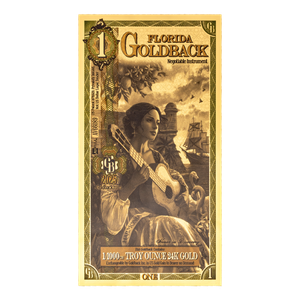
Newer state series, including the Dallas and Florida editions, reflect continued regional expansion of the Goldback concept. Each series features its own artwork commissioned specifically for that region, reinforcing the program's dual identity as both a functional gold-bearing currency and a collectible product line with genuine cultural specificity.
Purity, Weight, and Specifications
The vast majority of $1 Goldback notes carry a gold purity of 0.9999, representing 24-karat fine gold. A small number of notes in the catalog, specifically the South Dakota and Wyoming editions, are listed at 0.999 purity, still well within the accepted standard for investment-grade gold. Each note contains exactly 0.001 troy ounces of gold, equivalent to 1/1000 of a troy ounce, deposited in ultra-thin layers within the note's layered construction.
The physical dimensions of a Goldback note are comparable to conventional paper currency, making them easy to handle and store. Most notes in this series measure approximately 0.1 millimeters in thickness, as noted in the specifications for the Arizona, Nevada, Utah, Wyoming, South Dakota, and Dallas editions. The notes are constructed from a flexible polymer that protects the interior gold layers from oxidation and physical wear under normal handling conditions.
Goldback notes do not carry traditional assay markings or serial numbers in the way that minted bars do. Verification relies on Valaurum's manufacturing process and the visual characteristics of the note itself, including its layered construction and detailed intaglio-style artwork. The polymer casing serves as both a protective layer and a functional verification element, since the bonding process is proprietary and not easily replicated.
Available Brands, Mints, and Product Variations
Every $1 Goldback note in our catalog is produced exclusively by Valaurum, the sole manufacturer of the Goldback format. Valaurum operates as both the patent holder and the production facility for these notes, meaning there are no competing producers of the same format. The brand consistency across all nine state and regional editions ensures that purity standards, manufacturing quality, and dimensional specifications remain uniform across the product line.
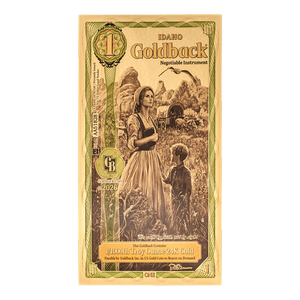
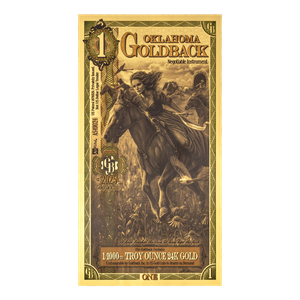
The nine editions currently available include Arizona, Dallas, Florida, Idaho, Nevada, Oklahoma, South Dakota, Utah, and Wyoming. Each features distinct artwork that reflects the identity of its respective state or region, from landscapes and wildlife to historical figures and regional symbols. The Wyoming edition carries an additional classification worth noting: it is listed with a random year status, meaning the specific production year may vary. It is also available in inner packs of 10 and outer packs of 100, making it a practical choice for buyers accumulating in volume.
Across the series, the primary distinction between editions is the design and, in the case of South Dakota and Wyoming, a marginally lower listed purity of 0.999 rather than 0.9999. For buyers focused on building a complete state collection, these differences are part of the appeal. For those primarily focused on gold content, all editions deliver the same 0.001 troy ounce per note regardless of the design.
Pricing, Premiums, and Market Factors
Goldback notes carry premiums above spot gold that are notably higher than those associated with standard bullion bars or coins. This is a direct result of the format's manufacturing complexity. Valaurum's patented deposition process, combined with the cost of full-color printing, polymer substrate materials, and the fractional gold content per unit, makes per-ounce production costs significantly higher than those associated with traditional minted products.
The premium structure also reflects supply and demand dynamics specific to the Goldback market. Because each state series has a dedicated collector base and the format itself serves a niche that no other product occupies, premiums tend to hold at levels that may surprise buyers accustomed to standard bullion pricing. Buyers who are primarily focused on minimizing premium-per-ounce relative to spot would typically find larger denomination Goldback notes or conventional gold bullion formats more cost-efficient. At the $1 note level, the premium reflects the format's collectibility and production cost as much as its gold content.
Bullion Standard displays premiums and bid/ask spreads directly on each product page, so buyers can evaluate the true cost of acquisition relative to current spot pricing. Pricing updates in real time as market conditions shift, and the two-way structure of our marketplace means that buyback pricing is visible alongside purchase pricing, giving buyers a more complete picture of what ownership actually costs from acquisition through eventual resale.
Condition, Packaging, and What to Expect
Goldback notes are sold in new, uncirculated condition. Each note arrives in the condition it left Valaurum's production facility, handled minimally and packaged to protect the polymer surface from unnecessary contact. Individual notes are typically delivered in protective sleeves or small bundled packaging, depending on the quantity ordered and the specific edition.
The Wyoming edition is available in structured pack quantities, with inner packs of 10 and outer packs of 100. For buyers ordering in these increments, notes may arrive factory-bundled rather than individually sleeved. Buyers ordering single notes or small quantities can generally expect individual protective packaging appropriate for the format.
Because these are flexible polymer notes rather than rigid coins or bars, minor variation in surface appearance from note to note is normal and does not affect gold content or authenticity. The polymer construction is designed to be durable under normal conditions, but like any currency-format product, direct contact with abrasive surfaces should be avoided to preserve the note's appearance over time.
Authenticity and Verification
Valaurum's manufacturing process is proprietary and patented, which creates a significant barrier to counterfeiting. The gold deposition process bonds ultra-thin layers of 24-karat gold within a multi-layer polymer construction in a way that is visually and physically distinct from any printed or foil-based imitation. The layered structure, when viewed under proper lighting, produces a characteristic depth and luminosity that is difficult to replicate without the original equipment and process.
Bullion Standard sources Goldback notes directly through authorized distribution channels and verifies product authenticity before fulfillment. Our procurement and verification processes are consistent with the standards we apply across all physical gold products in our catalog. We hold an A rating with the Better Business Bureau and maintain memberships with the American Numismatic Association and the National Coin and Bullion Association, reflecting a broader commitment to product integrity.
For buyers who want to independently verify a Goldback note after purchase, examination of the note's layered construction, artwork detail, and the characteristic behavior of the gold layer under angled light are the most practical tools available. Valaurum also maintains documentation on the physical characteristics of authentic notes, which can serve as a reference for buyers building familiarity with the format.
Liquidity and Resale Considerations
The Goldback format occupies a unique position in the secondary market. While gold bullion coins and bars from major government mints or refineries trade in a broadly liquid global market, Goldback notes trade within a more specialized collector and alternative currency community. Resale demand exists, particularly among collectors who are building state series, local currency enthusiasts, and buyers who value the format's novelty and regional specificity.
Buyers should approach $1 Goldback notes with an understanding that the resale market is narrower than that of standard bullion. Products with wider market recognition, such as American Gold Eagles or standard gold bars from recognized refineries, typically offer faster and more straightforward resale. Goldback notes may take longer to move in the secondary market, and resale premiums can be more variable depending on demand for specific state editions at any given time.
That said, the growing adoption of Goldbacks as a voluntary local currency in certain states has broadened awareness of the format. Complete state sets, low-mintage editions, and notes in pristine condition tend to attract more active buyer interest than worn or loosely stored notes. Mint-condition presentation is a meaningful factor when reselling within this market segment.
Storage and Security
Goldback notes are flexible and thin, which gives them a storage profile unlike traditional coins or bars. Individual notes or small bundles fit easily into protective currency sleeves, rigid card holders, or archival-quality storage pages designed for polymer banknotes. Keeping notes in a dedicated sleeve or holder minimizes surface contact and protects the artwork from scratching or creasing.
For larger quantities, a fireproof home safe offers practical protection against theft and environmental damage. Goldback notes are more susceptible to moisture and temperature extremes than traditional bullion formats, so climate-controlled storage is preferable for long-term holding. Avoiding prolonged exposure to direct sunlight will also help preserve the note's color and surface quality over time.
For buyers accumulating significant quantities of Goldback notes across multiple state editions, a vault storage service may be worth considering, particularly for collections that have grown to a meaningful size. The polymer construction is durable under normal handling, but the notes are not as inherently forgiving of rough treatment as a solid gold coin would be. Storage decisions should reflect the collector-oriented nature of the format.
Selling and Buyback Options
Bullion Standard operates a two-way market that allows customers to both purchase and sell precious metals within the same platform. Buyback pricing for Goldback notes reflects current spot gold prices, the format's premium characteristics, and prevailing demand within the secondary market for the specific state edition being sold. Because Goldback notes trade in a more specialized segment of the bullion market, buyback pricing can vary more noticeably than it would for standard bullion coins or bars.
Condition and packaging play a meaningful role in the buyback process for Goldback notes. Notes that arrive in clean, undamaged condition, ideally in their original protective sleeve or holder, are evaluated more favorably than notes showing visible creasing, surface abrasion, or discoloration. State editions with stronger collector demand may also support tighter bid/ask spreads within our marketplace, though this varies based on market conditions at the time of the transaction.
Our purchasing team handles the buyback process with the same commitment to transparency that defines our acquisition side. Customers can initiate a sell request through our platform, receive a quote based on current wholesale market pricing, and complete the transaction through a straightforward fulfillment process. We believe liquidity should be considered before a purchase is made, which is why bid pricing is displayed alongside ask pricing on our product pages from the moment you begin evaluating a product.
Why Buy $1 Goldback Notes?
The $1 denomination is the most accessible entry point in the Goldback series and allows buyers to acquire physical gold in the smallest standardized increments available in this format. For buyers who want to hold real gold without committing to a full gram or fractional coin, a $1 Goldback note offers a practical option that doesn't require a significant upfront outlay. It's also the natural starting point for anyone building a complete state series.
The state-specific design program gives these notes a layer of cultural and collectible interest that standard bullion products don't offer. Buyers with ties to Arizona, Utah, Wyoming, or any of the other represented states often find additional personal significance in holding a note that reflects their region's identity. That regional specificity is a genuine differentiator in a market where most gold products are geographically interchangeable.
There's also a practical novelty to the format itself. Goldback notes are among the very few physical gold products that are designed to function as actual spendable currency within participating local economies. For buyers interested in the intersection of gold ownership and alternative monetary systems, the $1 Goldback note represents one of the most tangible expressions of that concept available in the current market.
Why Buy from Bullion Standard?
Bullion Standard was founded in San Diego, California in 2010 and has grown into a nationally recognized online precious metals marketplace by prioritizing pricing transparency, product authenticity, and long-term customer relationships over short-term sales pressure. Our platform is structured to function as a genuine marketplace rather than a traditional high-pressure retail environment, with live pricing, visible bid/ask spreads, and clear product specifications on every listing.
Every product we sell, including Goldback notes, is sourced through authorized channels and verified for authenticity before fulfillment. Our A rating with the Better Business Bureau, membership in the American Numismatic Association and the National Coin and Bullion Association, and status as an authorized dealer for PCGS and NGC reflect the standards we hold ourselves to across our entire catalog. These aren't credentials we display for marketing purposes; they represent ongoing commitments to professional conduct and product integrity.
Customers can complete purchases using a wide range of payment methods, including Visa, Mastercard, American Express, Discover, PayPal, bank-connected payments through Plaid, wire transfer, paper check, and cryptocurrency payments through BitPay. Fulfillment is handled with reliable shipping and packaging practices designed to deliver your order in the same condition it left our facility. Our customer service team is accessible and responsive, reflecting the same customer-first philosophy that's guided our operation since we opened.
Get Near-Spot Pricing with Bullion Standard Pro
Bullion Standard Pro is designed for buyers who want direct access to executable wholesale market pricing without the dealer markups that are standard in traditional retail bullion transactions. Members transact at live wholesale bid and ask prices, which means premiums and spreads reflect actual market conditions rather than fixed retail pricing structures. For buyers accumulating Goldback notes in volume, or evaluating their purchase against wholesale benchmarks, that pricing transparency is a meaningful advantage.
Beyond pricing efficiency, Bullion Standard Pro provides access to real-time portfolio valuation based on live wholesale bid pricing, historical premium analytics, spread analysis, and proprietary market intelligence tools that give members a clearer view of how individual products are performing within the broader physical gold market. These tools are particularly useful for buyers who want to understand how Goldback premiums move over time relative to other gold formats.
The platform is built around the principle that better information leads to better decisions. Rather than relying on static product listings or marketing language, Pro members have access to data that reflects real supply and demand conditions within the wholesale market. For anyone who buys precious metals with regularity, that level of transparency changes the character of the purchasing decision from one based on assumption to one grounded in observable market data.


 (833) 278-4653