Buy Austrian Gold Philharmonics Online
Our catalog of Austrian gold Philharmonics spans the full range of sizes produced by the Austrian Mint, from the classic 1 oz coin down to the compact 1/25 oz fractional. Each coin carries 0.9999 fine gold content and is struck at the Vienna Mint, one of the most respected minting institutions in the world. Whether you're adding a full troy ounce or accumulating smaller fractional denominations, you'll find the complete Philharmonic lineup in one place with straightforward, real-time pricing.
The available sizes in our catalog include the 1 oz, 1/2 oz, 1/4 oz, 1/10 oz, and 1/25 oz coins, all in Brilliant Uncirculated condition and designated as random year. A 1 oz impaired condition option is also available for buyers who prioritize gold content over cosmetic presentation. Coins are packaged in standard mint quantities, with the 1 oz coins arriving in tubes of ten and the fractional sizes in rolls of twenty, consistent with how they're distributed at the wholesale level.
Bullion Standard is a San Diego-based precious metals marketplace that has operated since 2010 on a philosophy of pricing transparency and informed buying. Every product you see in this catalog is sourced from reputable distributors, verified for authenticity, and priced to reflect real-time market conditions rather than opaque markups.
What Are Austrian Gold Philharmonics?
The gold Philharmonic is Austria's official bullion coin, issued annually by the Austrian Mint under the authority of the Republic of Austria. It carries a face value denominated in euros, making it legal tender within Austria. For the 1 oz coin, that denomination is 100 euros, with fractional sizes scaled proportionally down to 10 euros for the 1/10 oz and smaller designations for the 1/4 oz and 1/25 oz coins. Legal tender status provides a layer of government backing that distinguishes these coins from privately minted rounds or bars.
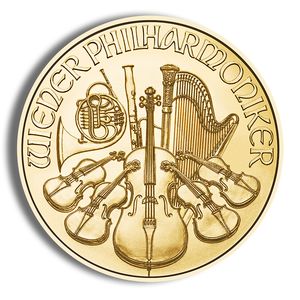
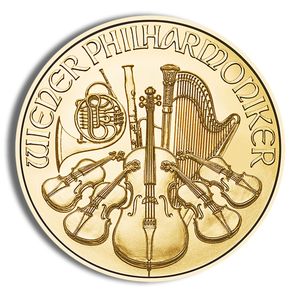
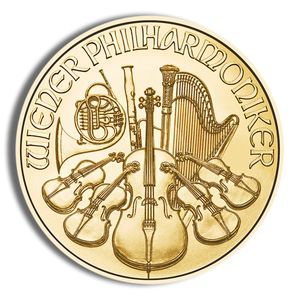
Philharmonics are struck in 24-karat gold at a fineness of 0.9999, placing them among the purest government-issued gold bullion coins in the world. The design is consistent across all sizes and years, featuring the pipe organ of the Golden Hall of the Vienna Musikverein on the reverse and a collection of orchestral instruments on the obverse. The imagery reflects Austria's deep cultural identity tied to classical music, which is part of what makes the coin immediately recognizable to dealers and collectors globally.
Buyers choose Philharmonics for several practical reasons. The coin is among the most widely traded gold bullion coins in the European market and maintains strong recognition across international wholesale and retail channels. It's available in multiple sizes, which gives buyers the flexibility to accumulate gold in the denomination that best suits their position size or storage preferences.
History and Background
The Austrian Mint introduced the gold Philharmonic in 1989, making it one of the first major European gold bullion coin programs to enter the modern market. Prior to its launch, European gold bullion demand was largely satisfied by South African Krugerrands and, to a lesser extent, Canadian Maple Leafs and American Gold Eagles. The Philharmonic entered as a distinctly European alternative, and its 0.9999 fineness set it apart from the Krugerrand's 0.9167 purity standard from the start.
The Austrian Mint itself has operated continuously since 1194, giving it one of the longest institutional histories of any mint still in production. That legacy translates into consistent quality control, precise striking standards, and a reputation that carries weight in both the retail and wholesale precious metals markets. The Vienna Mint's tenure across centuries of minting activity means the institution behind these coins is not a recent entrant but a foundational part of European monetary history.
By the 1990s, the Philharmonic had established itself as the bestselling gold coin in both Europe and the United States for several consecutive years. It has since maintained a prominent position in global gold coin distribution, and the program continues to expand with limited-edition collector variants alongside its standard annual bullion releases. The bullion versions shown in this catalog represent the core product line that has driven the coin's sustained market presence.
Purity, Weight, and Specifications
All Austrian gold Philharmonics in this catalog carry a purity of 0.9999 fine gold, which is the standard four-nines fineness used across the most widely distributed 24-karat bullion coins globally. This purity level is consistent across every size in the series, from the 1 oz down to the 1/25 oz. The absence of alloying metals means the coin's color is a rich, warm yellow characteristic of pure gold.
Weights are expressed in troy ounces, the standard unit of measure for precious metals. The 1 oz coin has a diameter of 37mm and a thickness of 2mm, while the fractional sizes reduce proportionally. The 1/2 oz coin measures 28mm across, the 1/4 oz is 22mm, the 1/10 oz is 16mm, and the 1/25 oz is 13mm with a thickness of 0.8mm. These specifications are consistent across years of production, which simplifies storage, display, and handling for collectors and bulk buyers alike.
The coin carries the denomination, purity, and metal weight as part of its design, which means no separate assay card or certificate is required to confirm those specifications. The markings are struck directly into the coin, providing an inherent authentication layer that's immediately verifiable by any dealer familiar with the series.
Available Brands, Mints, and Product Variations
Every coin in this catalog is produced by the Austrian Mint, the sovereign institution responsible for all official Austrian coinage and the exclusive producer of the Philharmonic series. The mint operates under strict quality standards, and the consistent dimensional and weight tolerances across its bullion output are a direct result of that institutional discipline. There are no third-party refineries or private mints involved in the production of genuine Philharmonics.
The random year designation on all products in this catalog means the specific year of issue is not guaranteed. Coins are drawn from existing inventory and may represent any production year within the modern Philharmonic program. For buyers focused on gold content rather than year-specific collecting, random year coins are typically the more cost-efficient option. The 1 oz impaired condition coin is available for buyers who are exclusively concerned with metal weight and purity and are comfortable accepting coins with light surface wear or contact marks that fall outside Brilliant Uncirculated standards.
The Brilliant Uncirculated coins across the four standard sizes represent the primary market for Philharmonic bullion. These coins have not been circulated as currency and retain the original mint finish, though some contact marks may be present as a result of handling during packaging, which is typical for BU bullion coins. These are not proof coins; the standard bullion strike does not carry the polished die and frosted relief finish associated with numismatic proof versions.
Pricing, Premiums, and Market Factors
Gold Philharmonic pricing is anchored to the live spot price of gold, with a premium added to cover minting, distribution, and dealer costs. The spot price reflects real-time trading activity across global gold markets, and it moves continuously throughout trading hours. The premium above spot represents everything between raw refined gold and the finished coin in your hand, including the Austrian Mint's production cost, distributor margins, and retail handling.
Fractional coins consistently carry higher premiums per troy ounce than the 1 oz coin. This is a structural feature of smaller-format bullion, not a dealer-specific markup. A 1/25 oz coin requires proportionally more minting effort per ounce of gold content than a full-ounce coin, and that cost gets distributed across a smaller amount of metal. Buyers who want to minimize their per-ounce acquisition cost generally focus on the 1 oz size, while those who want smaller denominations accept the premium difference as the cost of flexibility.
Bullion Standard's pricing reflects real-time market conditions and is structured for transparency. Each product page displays both the ask price and the bid price, giving you a clear view of the spread before you make a purchase. This bid/ask structure is central to how we present pricing across the platform, and it allows buyers to evaluate the full cost of ownership rather than focusing exclusively on the purchase price in isolation.
Condition, Packaging, and What to Expect
BU-grade Austrian gold Philharmonics are shipped in standard mint packaging. The 1 oz coins arrive in tubes of ten, and the 1/10 oz and 1/25 oz fractionals come in rolls of twenty, consistent with their standard distribution format. These quantities reflect how the coins leave the Austrian Mint and are maintained through our fulfillment process to preserve their original packaging integrity where possible.
Brilliant Uncirculated does not mean flawless. As bullion coins intended for metal content rather than display-grade numismatic purposes, BU Philharmonics may show minor handling marks, light contact from other coins in the tube, or faint scuffs that result from production and packaging processes. These are cosmetically normal and do not affect the metal content, purity, or weight of the coin. If you're purchasing for display or graded numismatic quality, BU bullion is not the appropriate grade level.
The impaired condition 1 oz coin carries additional cosmetic variation beyond what's expected from BU coins. Impaired coins may show visible wear, deeper contact marks, or surface blemishes consistent with handling over time. They are fully genuine Austrian Mint products with complete gold content, and they're priced to reflect their condition. Buyers who select this option are doing so with a clear understanding that appearance is secondary to gold content.
Authenticity and Verification
Every Austrian gold Philharmonic sold by Bullion Standard is sourced from authorized distributors and verified before shipment. The Austrian Mint maintains strict production standards, and the coin's design, dimensions, and weight tolerances are well documented and widely understood across the dealer community. Counterfeit detection begins with confirming that the coin's weight, diameter, and thickness match published Austrian Mint specifications, which is straightforward using a precision scale and calipers.
The Philharmonic's widespread distribution means it's one of the most frequently handled and most thoroughly understood bullion coins in the global market. Experienced dealers can identify genuine coins by their strike sharpness, edge characteristics, and metal feel. For buyers who want formal third-party verification, PCGS and NGC offer grading and encapsulation services that provide an additional layer of certification. Bullion Standard is an authorized dealer for both PCGS and NGC, which is relevant for customers interested in certified numismatic products.
Sigma Metalytics and XRF analysis devices are common verification tools used at the dealer level to confirm purity without damaging the coin. While these instruments are not required for standard bullion purchases, they represent the kind of verification process that reputable dealers maintain as part of their sourcing and intake procedures. Our sourcing standards include verification at each stage of the supply chain before products reach our fulfillment center.
Liquidity and Resale Considerations
Austrian gold Philharmonics are among the most liquid gold bullion coins in the world. Their recognizability across European, North American, and Asian markets means they're accepted without hesitation by the overwhelming majority of reputable bullion dealers, coin shops, and wholesale buyers. This global recognition is a practical advantage when you eventually decide to sell, because widely known coins face fewer friction points at the point of resale than obscure or privately minted products.
The 1 oz coin carries the strongest resale profile within the series, as it's the standard size most dealers price and handle on a daily basis. Fractional coins remain liquid but may attract slightly different spreads depending on the buyer, given that smaller denominations require more transactions per equivalent ounce of gold. Impaired condition coins are resalable but will typically price at a discount to BU examples in any secondary market environment.
Because Philharmonics are official government-issued coins with consistent specifications, they're generally not subject to the additional scrutiny that privately minted products can encounter during resale. Dealers familiar with the series can verify and price them efficiently, which contributes to faster transaction times and tighter bid/ask spreads relative to less common formats.
Storage and Security
The 1 oz Philharmonic ships in tubes of ten, which makes organized storage straightforward. Standard coin tubes stack neatly in most home safes and fit conveniently in drawer-style safe deposit boxes at financial institutions. For buyers accumulating coins over time, maintaining the original tube packaging is a practical approach that also helps preserve the coin's condition during storage.
Fractional coins, particularly the smaller 1/10 oz and 1/25 oz sizes, require more careful handling given their dimensions. The 1/25 oz coin is just 13mm in diameter and 0.8mm thick, making it among the smallest gold coins in common circulation. Dedicated coin storage albums, capsules, or sealed rolls are worth considering for these sizes to reduce the risk of misplacement or accidental damage during handling.
Environmental factors matter in long-term storage. Gold is chemically inert and resistant to most environmental exposure, but the 0.9999 purity of Philharmonics means there's no alloying metal to add hardness. Pure gold scratches more easily than alloyed gold, so avoiding metal-on-metal contact and minimizing unnecessary handling extends the cosmetic life of these coins. For significant quantities, professional vault storage through third-party custodians is worth evaluating as an alternative to home storage.
Selling and Buyback Options
Bullion Standard operates as a two-way market, meaning we actively purchase precious metals from customers in addition to selling them. Austrian gold Philharmonics are among the products we buy back regularly, given their strong market recognition and consistent demand at the wholesale level. When you're ready to sell, the process begins with a quote based on current wholesale bid pricing, which reflects live market conditions rather than a static buyback schedule.
Buyback pricing for Philharmonics is influenced by several factors including the current gold spot price, the coin's condition, whether original packaging is intact, and the specific size being sold. The 1 oz BU coin will generally receive the most favorable bid pricing given its liquidity profile. Impaired condition coins and fractional denominations are still buyable, but pricing reflects the realities of resale demand and the conditions under which those products trade in the wholesale market.
Understanding the bid/ask spread before you buy is one of the most practical steps you can take as a buyer. Bullion Standard displays both the buy and sell price on each product page, giving you a transparent view of the spread from the moment you start evaluating a purchase. This structure is designed to remove the opacity that has historically made it difficult for buyers to assess the true cost of entering and exiting a position in physical gold.
Why Buy Austrian Gold Philharmonics?
The Philharmonic occupies a distinct position among gold bullion coins because it combines 0.9999 fineness with sovereign government backing and a genuinely iconic design. For buyers who want the purest standard of gold in coin form, few government programs match the four-nines purity specification that the Austrian Mint has maintained across the full run of the series. This fineness also means the coins meet the purity threshold required for inclusion in gold IRA accounts under IRS guidelines.
The size range available in this catalog makes the Philharmonic program adaptable to a wide range of position sizes and accumulation strategies. A buyer working with a smaller budget can enter the market through the 1/10 oz or 1/25 oz coin and benefit from the same Austrian Mint pedigree and global recognition as the full 1 oz coin. This flexibility within a single, coherent product series is one of the practical advantages Philharmonics hold over single-denomination programs.
For buyers who prioritize resale simplicity, the Philharmonic's global footprint is an asset. It's one of the few gold coins that maintains consistent dealer recognition across multiple continents, which expands the pool of potential buyers when the time to sell arrives. That recognition is the result of decades of consistent production, wide distribution, and institutional familiarity that can't be replicated by newer or more obscure mint programs.
Why Buy from Bullion Standard?
Bullion Standard has operated since 2010 from our headquarters in San Diego with a consistent focus on pricing transparency and operational integrity. We maintain an A rating with the Better Business Bureau and hold memberships in the American Numismatic Association and the National Coin and Bullion Association. These affiliations reflect long-term commitments to professional standards within the industry, not recent additions for marketing purposes.
Our pricing is updated in real time to reflect current market conditions, and every product page displays both the ask and bid price so you can evaluate the full spread before committing to a purchase. We believe that kind of transparency should be standard practice in precious metals retail, and it shapes how we structure pricing across the entire catalog. You're never left guessing what your position is worth at the time of purchase.
We accept a wide range of payment methods including Visa, Mastercard, American Express, Discover, PayPal, bank-connected payments through Plaid, wire transfer, paper check, and cryptocurrency through BitPay. Products are sourced from verified distributors, inspected for authenticity, and fulfilled with the same secure processes we've applied since our founding. Our customer service team and two-way market structure are designed around long-term relationships rather than transactional convenience, and that's a distinction that matters when you eventually decide to sell.
Get Near-Spot Pricing with Bullion Standard Pro
Bullion Standard Pro is designed for buyers who want to transact closer to wholesale market pricing rather than standard retail levels. Members gain access to live, executable wholesale bid and ask pricing across the precious metals catalog, including Austrian gold Philharmonics. Unlike the traditional retail model, Pro pricing is not subject to additional dealer markups or fixed retail spreads. Premiums and bid/ask conditions fluctuate naturally based on real-time supply and demand within the wholesale market.
For buyers accumulating Philharmonics across multiple transactions, the pricing efficiency available through Bullion Standard Pro can be meaningful over time. The difference between retail and wholesale pricing per troy ounce may appear modest on any single coin, but it compounds across repeated purchases and becomes more consequential as position sizes grow. Pro membership is structured for buyers who take a longer-term approach to building and managing physical gold holdings.
Beyond pricing, Bullion Standard Pro provides access to portfolio valuation based on live wholesale bid pricing, historical premium analysis, proprietary market intelligence tools, and spread analytics that help members evaluate products using objective data rather than marketing narratives. For buyers who want to understand how Philharmonic pricing has moved relative to spot, how current premiums compare to historical norms, and how bid/ask spreads are evolving across sizes, the Pro platform provides that visibility in a format designed for informed decision-making.


 (833) 278-4653