Buy Palladium Bars Online
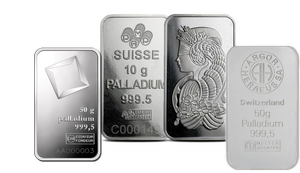
Our palladium bar catalog covers a thoughtful range of weights, formats, and brands suited to buyers at different stages of familiarity with the metal. Options span from 1 gram fractional bars up to 1 kilogram, with 1 oz palladium bars representing the most widely traded size in the catalog. Mints include Argor-Heraeus, PAMP Suisse, Valcambi, Credit Suisse, Johnson Matthey, and Engelhard, alongside a selection of random-brand options for buyers prioritizing metal content over specific branding.
Many of the bars in our catalog are minted format products housed in assay cards, offering tamper-evident packaging that confirms purity and weight at the point of manufacture. Bullion Standard operates as a transparent marketplace where palladium bar pricing reflects live market conditions, and where both the buying and selling sides of the transaction are clearly presented so buyers can evaluate real acquisition costs before committing.
What Are Palladium Bars?
Palladium bars are refined palladium products produced by accredited mints and refineries to precise weight and purity standards, typically .9995 or .9999 fine. They are a direct method of obtaining physical palladium, and their value is anchored to the spot price of palladium on the global commodities markets, with a premium added to account for refining, fabrication, and distribution costs.
Within the bullion bar format, there are two primary production methods: minted and cast. Minted bars are cut or pressed from rolled palladium sheet stock, resulting in a precise, smooth-surfaced product with sharp edges and detailed surface design work. Cast bars are poured from molten metal into molds, producing a rougher finish that is considered entirely acceptable and normal for that format. The majority of palladium bars in our catalog are minted-format products, which tend to feature finer detail, tighter tolerances, and more refined assay packaging.
Buyers generally choose palladium bars for their efficient premium structure relative to palladium coins, their straightforward weight-to-value ratio, and their consistent recognizability among dealers and institutional buyers. The bar format is practical, compact, and easy to verify, making it a common choice among buyers focused on holding physical palladium at a reasonable cost above spot.
History and Background
Palladium was discovered in 1803 by English chemist William Hyde Wollaston, who named the element after the asteroid Pallas. For most of the nineteenth and early twentieth centuries, palladium remained a metallurgical curiosity with limited commercial applications. Its platinum-group classification made it chemically interesting, but industrial deployment was slow to develop compared to platinum or gold.
The modern palladium market began to take shape in the latter half of the twentieth century as automotive catalytic converter technology advanced. Russia and South Africa emerged as the world's dominant palladium-producing nations, with Russia's Norilsk Nickel becoming one of the largest single sources of newly mined palladium supply globally. The volatile pricing environment of the early 2000s, driven partly by Russian government stockpile releases and subsequent supply uncertainty, helped establish palladium as a closely watched commodity among both industrial users and bullion buyers.
The refined palladium bar market grew alongside expanding industrial demand and increasing interest in platinum-group metals as physical holdings. Established Swiss refineries, including PAMP Suisse, Argor-Heraeus, and Valcambi, along with North American refiners like Johnson Matthey and Engelhard, began producing palladium bars in standardized weights and assay-certified formats. These products created a retail and institutional market for physical palladium that runs parallel to the metal's dominant role in manufacturing and industrial processing.
Purity, Weight, and Specifications
The standard purity for palladium bars is .9995 fine, meaning 999.5 parts per thousand are pure palladium. A small number of products reach .9999 fineness, including certain Argor-Heraeus bars in our catalog. Both purity levels are broadly accepted in the bullion market and are considered investment-grade by major exchanges and dealers. Purity is typically stamped directly onto the bar alongside the manufacturer name, weight, and a serial number where applicable.
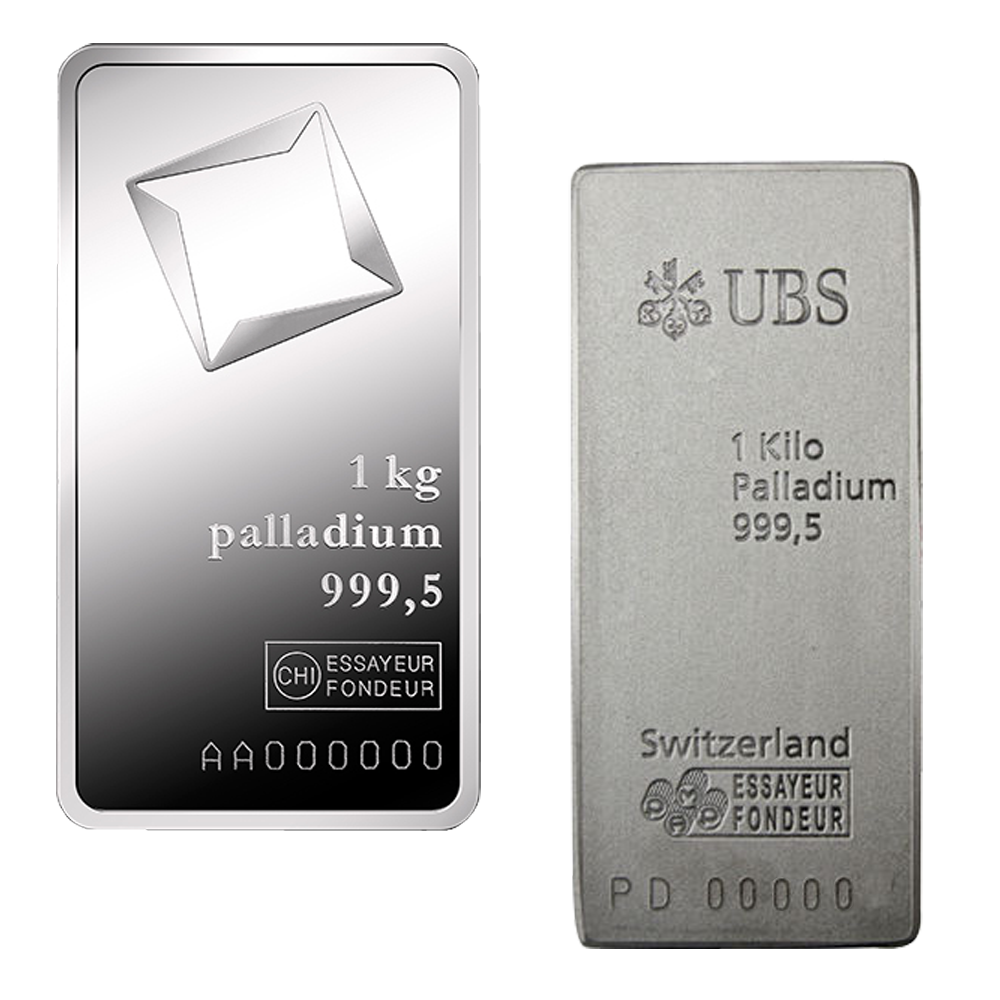
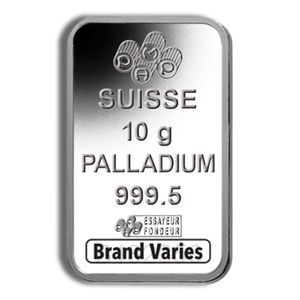
Weight options in our catalog range from 1 gram to 1 kilogram, with the most common retail standard being the 1 troy ounce bar at 31.1035 grams. Gram-denominated options include 1g, 5g, 10g, and 50g bars, all produced to metric weight standards rather than troy ounce conventions. The 1 kilo bar, containing approximately 32.15 troy ounces of palladium, represents the largest format available and is typically suited to buyers seeking maximum metal per transaction.
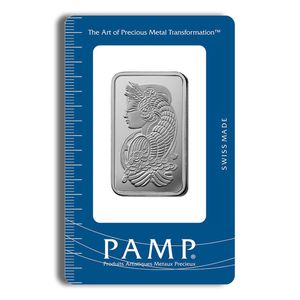
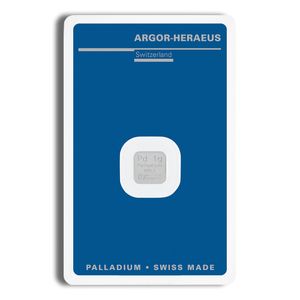
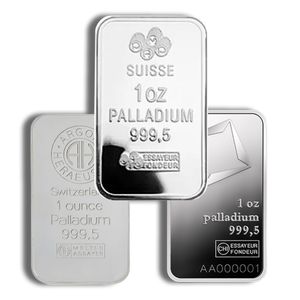
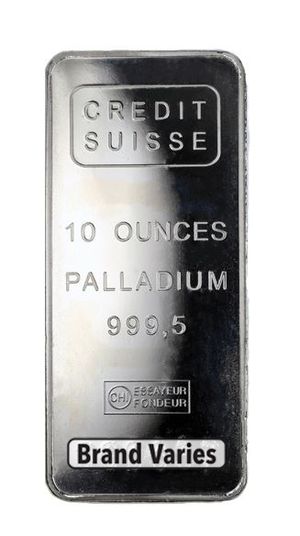
Physical dimensions vary meaningfully between manufacturers and weights. For example, the 1 oz PAMP Suisse Lady Fortuna bar measures approximately 41mm by 24mm with a 2.63mm thickness, while the 1 oz Credit Suisse bar is 40mm by 23mm at 4mm thick, and the Argor-Heraeus 1 oz bar is considerably larger at 85mm by 54mm but thinner at 2mm. These differences reflect distinct refinery fabrication choices and packaging designs rather than any difference in metal content.
Available Brands, Mints, and Product Variations
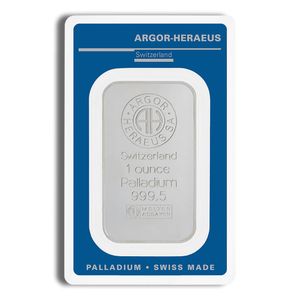
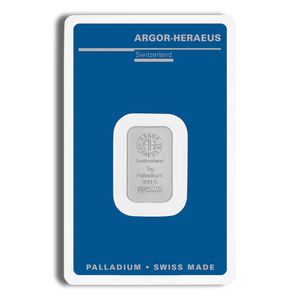
Argor-Heraeus, headquartered in Mendrisio, Switzerland, is one of the world's most respected precious metals refineries. Their palladium bars are known for clean design, consistent quality, and tamper-evident assay card packaging. Our catalog includes Argor-Heraeus palladium bars in 1 gram, 5 gram, and 1 troy ounce sizes, all produced to .9995 or .9999 fine purity standards and presented in sealed assay cards with serialized certificates.
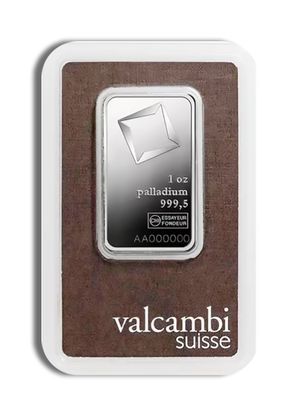
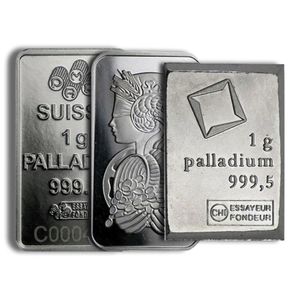
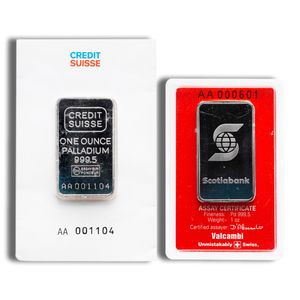
PAMP Suisse, also Swiss-based and part of the MKS group, produces the Lady Fortuna design found on their 1 gram and 1 oz palladium bars. The Fortuna motif, depicting the Roman goddess of fortune in relief, has become one of the most recognizable bar designs in the global bullion market. Valcambi, another leading Swiss refinery, offers a clean minimalist bar design in 1 oz format, also available with assay card packaging. Credit Suisse bars carry the backing of one of Switzerland's most recognized financial institutions and remain broadly familiar among dealers and buyers worldwide.
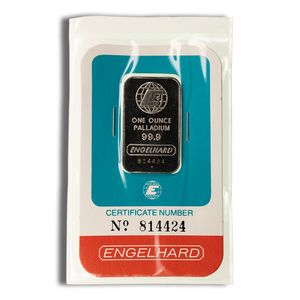
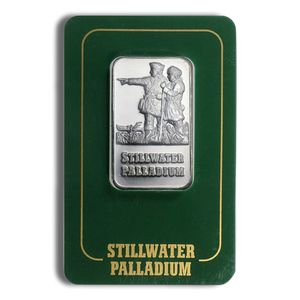
Johnson Matthey's JM Stillwater palladium bars reflect the company's deep roots in platinum-group metal refining, with particular relevance to North American palladium sourcing from the Stillwater mine in Montana. Engelhard, a historically significant American refinery now part of BASF, produced palladium bars that remain recognizable and liquid in the secondary market despite no longer being in active production. For buyers prioritizing metal content over brand, our random-brand options span multiple weights and offer palladium from various accredited sources at competitive premiums.
Pricing, Premiums, and Market Factors
Palladium bar pricing is calculated by adding a per-ounce premium to the current spot price of palladium, which is quoted in US dollars per troy ounce on the global commodities markets using the XPD designation. The premium accounts for refinery fabrication costs, assay packaging, dealer distribution margins, and market supply and demand conditions. Because palladium is a far thinner market than gold or silver, premiums can shift more significantly in response to changes in wholesale availability or broader market volatility.
Several factors influence the premium spread between individual products. Assay-carded minted bars from recognized refineries like PAMP or Argor-Heraeus typically carry higher premiums than random-brand bars of equivalent weight, reflecting the additional production and packaging costs as well as stronger secondary market demand for branded products. Smaller fractional bars such as 1 gram or 5 gram sizes carry proportionally higher premiums per ounce than 1 oz or larger bars, since fabrication costs are spread across less metal content.
Bullion Standard's pricing is structured around real-time market conditions and is presented with clarity rather than layered fees. Our bid/ask spreads are displayed directly on each product page, giving buyers a transparent view of both the acquisition cost and the current wholesale buyback value before a purchase is made. This approach reflects our broader philosophy that understanding the complete transaction, including the resale side, is as important as the purchase price itself.
Condition, Packaging, and What to Expect
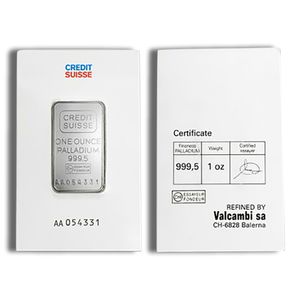
Most palladium bars in our catalog are new, mint-condition products delivered in original assay card packaging where specified. Assay cards are sealed, typically heat-laminated or blister-sealed enclosures that contain the bar alongside a certificate confirming weight, purity, and manufacturer authenticity. These cards should not be opened if maintaining the original presentation is a priority, as opened assay packaging can affect resale value with some buyers.
Random-brand palladium bars are sourced from a range of accredited refineries and may arrive in varying packaging presentations. These products meet the same .9995 fine purity standard as branded alternatives, but the specific manufacturer, country of origin, or exact dimensions may vary from shipment to shipment. Minor surface marks, handling contact, or packaging differences are entirely normal for random-brand bullion and are not considered defects.
Products listed without assay cards, such as the 1 oz random-brand bar with no assay, are genuine palladium bullion delivered loose or in basic protective packaging. These are functionally identical in metal content to assay-carded alternatives and are appropriate for buyers who prioritize the metal itself over packaging presentation.
Authenticity and Verification
Every palladium bar sold through Bullion Standard is sourced from reputable mints, refineries, authorized wholesalers, and established distributors. Each product is verified for authenticity, correct weight, and declared purity before fulfillment. Our sourcing relationships and verification protocols are integral to the trust we've built with customers since our founding in 2010.
Assay cards serve as a first-level authentication layer, providing a tamper-evident seal and manufacturer certificate that travels with the bar. For products from refineries such as Argor-Heraeus and Valcambi, unique serial numbers are often embedded in the card or stamped on the bar itself, allowing for direct traceability back to the producing refinery. This serial-level accountability is particularly relevant for buyers who intend to resell through institutional or dealer channels that require documented provenance.
Palladium is less commonly counterfeited than gold or silver due to its relatively limited retail market, but buyers should still rely on established dealers and verifiable sourcing chains. The density and physical properties of palladium are specific enough that basic density and dimensional testing can confirm authenticity for experienced handlers, and many professional dealers use XRF analyzers for non-destructive composition verification. Purchasing through a verified dealer like Bullion Standard, with documented sourcing and an A BBB rating, is the most straightforward assurance of product legitimacy.
Liquidity and Resale Considerations
Palladium is a recognized exchange-traded commodity with active spot and futures markets, and refined palladium bars from established refineries are accepted by dealers and wholesale buyers globally. Products from PAMP Suisse, Argor-Heraeus, Valcambi, Credit Suisse, and Johnson Matthey carry strong dealer recognition and tend to be easier to resell than obscure or unrecognized bar brands, particularly in the secondary market.
The 1 oz format is the most liquid size for retail palladium bars, with the widest buyer base and the tightest bid/ask spreads relative to other sizes. Larger formats like the 1 kilo bar are typically bought and sold through wholesale and institutional channels rather than retail, which can affect the speed and ease of liquidation depending on where a seller takes the product. Fractional bars in 1 gram or 5 gram sizes are more accessible entry points but may carry wider effective spreads at resale relative to their purchase premium.
Condition and packaging matter in the resale process. Bars held in original, undamaged assay cards are generally more straightforward to sell and may command slight premiums over loose or visibly handled pieces, particularly for branded products from recognized Swiss refineries. Random-brand bars in good condition are resalable at prevailing spot-related prices but may command less flexibility in dealer negotiations than branded alternatives.
Storage and Security
Palladium bars are dense, relatively compact, and do not tarnish or oxidize under normal environmental conditions, making them comparatively straightforward to store. A 1 oz palladium bar is physically small, and even a modest number of bars can be stored in a compact home safe without requiring significant dedicated space. For buyers accumulating larger quantities, professional vault storage is a more practical and insured solution.
Assay-carded bars should be stored flat in a stable environment, away from sharp objects that could pierce or crack the laminated card. Loose bars should be kept in individual protective sleeves or capsules to prevent contact damage and surface scratching. While cosmetic wear does not affect metal content, visible surface damage can complicate resale with condition-conscious buyers.
For significant holdings, a third-party segregated vault service offers insurance coverage, professional-grade security, and documented chain of custody. Bank safe deposit boxes are a lower-cost alternative but typically lack insurance coverage for bullion contents without a separate policy. Regardless of storage method, keeping purchase records, assay documentation, and any serial numbers associated with your bars in a secure separate location is a practical precaution.
Selling and Buyback Options
Palladium bars can be sold back into the market through dealer buyback programs, which are the most direct and commonly used channel for retail bullion holders. Buyback pricing is driven by the current palladium spot price adjusted by a wholesale bid premium or discount, which reflects current market conditions, dealer inventory needs, and the specific product being sold. Products with strong brand recognition and intact assay packaging typically receive the most competitive bids.
Bullion Standard operates a two-way market structure, meaning customers can both purchase and sell palladium bars within the same platform. Our buyback pricing is grounded in live wholesale market conditions and is displayed transparently alongside product pricing, so sellers can evaluate current bids before initiating a transaction. This structure allows customers to assess liquidity and expected net proceeds at any point, not only when they have already decided to sell.
When preparing to sell palladium bars, retaining original packaging and assay cards, along with any purchase receipts or serial number records, supports a cleaner transaction and may influence the buyback offer. Our purchasing team evaluates products based on weight, purity, condition, mint or refinery, and current wholesale market pricing. The process is designed to be operationally straightforward, with clear communication throughout so sellers understand exactly how their pricing was determined.
Why Buy Palladium Bars?
Palladium bars offer a direct, cost-efficient way to hold physical palladium with lower per-ounce premiums than palladium coins, which carry additional fabrication and legal tender costs. The bar format is designed around metal content rather than numismatic presentation, making it the more practical choice for buyers whose primary interest is in the palladium itself rather than collectible design. For those accumulating meaningful quantities of physical palladium, bars in 1 oz or larger sizes are generally the most economically efficient format.
Palladium's deep integration into industrial manufacturing, most notably in automotive catalytic converter systems that process exhaust emissions in gasoline-powered vehicles, means its demand profile is tied to real-world production activity rather than purely to financial market sentiment. South Africa and Russia account for the substantial majority of global palladium mine supply, and supply concentration at that level can contribute to meaningful price sensitivity when production disruptions or export restrictions occur. These supply dynamics make palladium a structurally distinct metal relative to gold or silver.
Physical palladium bars also offer flexibility in terms of scale. The range of available sizes, from 1 gram up to 1 kilogram, allows buyers to calibrate their exposure and spending in ways that align with their specific situation. Fractional sizes like 5 gram or 10 gram bars provide accessible entry points, while 1 oz and larger bars are better suited to buyers focused on premium efficiency and streamlined storage.
Why Buy from Bullion Standard?
Bullion Standard was founded in 2010 in San Diego, California, and has grown into a nationally recognized online precious metals marketplace by consistently prioritizing pricing transparency, authentic sourcing, and a customer-first operational philosophy. Our A rating with the Better Business Bureau, combined with memberships in the American Numismatic Association and the National Coin and Bullion Association, reflects the professional standards we hold ourselves to across every transaction.
Every palladium bar we sell is sourced through reputable refineries, authorized wholesalers, and established distribution channels, and each product is verified for authenticity, weight, and purity before shipping. We're an authorized dealer for both PCGS and NGC, and our sourcing relationships span the leading Swiss refineries and North American producers featured in our palladium bar catalog. Customers can pay using a wide range of methods including Visa, Mastercard, American Express, Discover, PayPal, Plaid bank-connected payments, wire transfer, paper check, and cryptocurrency via BitPay.
What distinguishes Bullion Standard from a traditional dealer model is our emphasis on the complete transaction rather than just the sale. Bid and ask spreads are visible on every product page. Our two-way market structure means liquidity is built into the platform from the start, not something customers have to figure out separately when they decide to sell. Our goal is to create a buying experience that feels transparent and informative rather than transactionally pressured.
Get Near-Spot Pricing with Bullion Standard Pro
Bullion Standard Pro is designed for buyers who want to transact as close to the wholesale market as possible. Members gain access to live, executable wholesale bid and ask pricing across a broad range of precious metals products, including palladium bars, allowing them to see exactly how products are priced at the wholesale level rather than relying on estimated or static retail quotes. Importantly, the platform does not apply additional dealer markups or dealer spreads on top of wholesale pricing, so premiums and spreads fluctuate based on actual market conditions.
The platform also includes real-time portfolio valuation using live executable wholesale bid pricing, giving members a more accurate picture of what their holdings are currently worth in liquidation terms rather than an estimate based on retail spot multiples. Additional tools cover historical premium analysis, premium percentile rankings, spread analysis, liquidity metrics, and proprietary market intelligence that aggregates wholesale market activity to help members identify changes in pricing conditions and buying or selling pressure that may not be visible from spot prices alone.
For buyers who transact in palladium bars with any regularity, the pricing efficiency available through Bullion Standard Pro can represent a meaningful difference in effective cost over time. The combination of tighter spreads, transparent wholesale pricing, and analytical tools creates a more informed purchasing environment that reflects how the professional bullion market actually operates, rather than the opacity that has historically characterized retail precious metals buying.


 (833) 278-4653