Buy 1 Gram Gold Bars Online
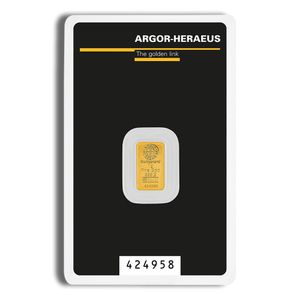
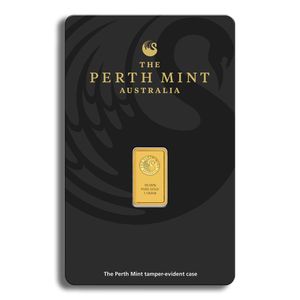
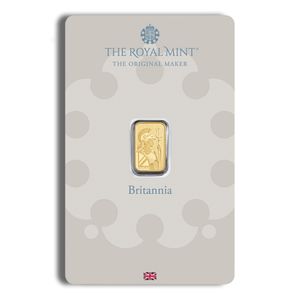
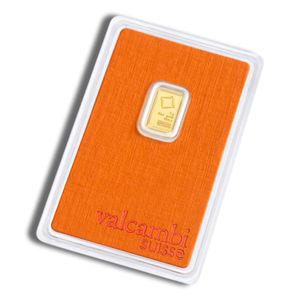
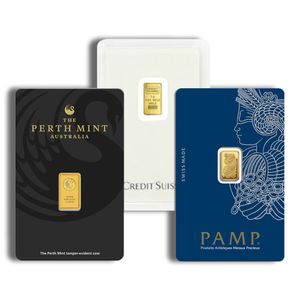
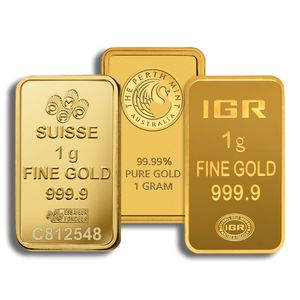
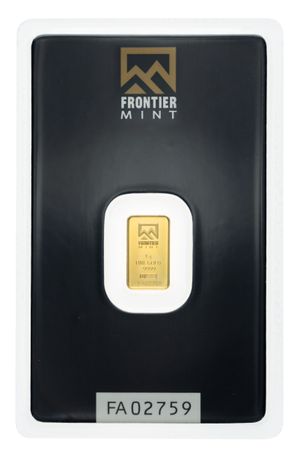
Our catalog of 1 gram gold bars brings together some of the most respected refineries and mints operating in the global bullion market today. You'll find minted bars from Argor-Heraeus, PAMP Suisse, Valcambi, Geiger Edelmetalle, Perth Mint, The Royal Mint, IGR Metals, and Frontier Mint, each sealed in individual assay cards and verified for .9999 fine gold content. Whether you're looking for a specific brand or open to a random assay bar at a lower premium, our selection covers the full range of options buyers typically seek in this weight class.
Every 1 gram gold bar listed here carries 0.03215 troy ounces of gold and meets the standard .9999 fine purity level recognized internationally across wholesale and retail bullion markets. Bullion Standard sources these products directly from reputable mints, refineries, and authorized distributors, and every item is verified for authenticity, weight, and purity before it's made available for purchase. Pricing reflects real-time market conditions and is displayed alongside bid and ask information so you can evaluate the complete transaction, not just the purchase price.
If you're comparing individual assay options across brands, or deciding between a named mint bar and a random brand offering, the product grid above shows current pricing for each item side by side. That transparency is central to how Bullion Standard operates, and it's something you'll notice throughout the buying experience.
What Are 1 Gram Gold Bars?
A 1 gram gold bar is the smallest commercially standardized weight in the minted bar format, containing exactly one metric gram of gold refined to .9999 fineness. At roughly 0.032 troy ounces, it represents a fractional entry point into physical gold ownership that requires a significantly lower initial outlay than full-ounce or multi-ounce bar formats. For buyers who want to accumulate gold incrementally or who prefer acquiring physical metal in smaller, individual units, the 1 gram bar is one of the most practical options available.
Unlike cast bars, which are produced by pouring molten metal into molds and tend to have a more utilitarian appearance, virtually all 1 gram gold bars are minted bars. The minting process involves precision stamping of highly refined blanks, resulting in sharper design detail, cleaner surface finishes, and more consistent dimensional tolerances. Most 1 gram bars measure roughly 15 mm in length, under 10 mm in width, and less than 1 mm thick, making them compact enough to handle individually but substantial enough to carry clear mint markings and purity stamps.
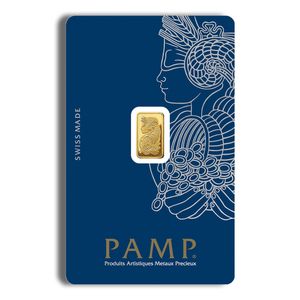
Nearly all 1 gram gold bars sold through reputable dealers come sealed in individual assay cards, also referred to as assay packaging or blister packaging. The assay card encapsulates the bar in a tamper-evident enclosure and includes printed certification of the bar's weight, purity, and refinery of origin. This packaging format is standard across all the named brands in our catalog and is one of the defining characteristics of quality 1 gram gold bars in today's market.
History and Background
The 1 gram gold bar as a commercially standardized product emerged primarily from European refineries in the latter half of the twentieth century. Swiss refineries, particularly PAMP Suisse, Valcambi, and Argor-Heraeus, played a central role in establishing the format as a globally recognized option within the broader minted bar market. These facilities developed the technology and processes necessary to produce fractional gold bars with the dimensional precision and surface quality required for them to be taken seriously as bullion products rather than novelties.
The adoption of assay card packaging was a significant development that helped legitimize the 1 gram format in retail and institutional channels. By sealing each bar in a tamper-evident card with printed certification, refineries were able to address authenticity concerns that had traditionally made small gold products difficult to verify and trade efficiently. Over time, mints and refineries outside Switzerland, including Geiger Edelmetalle in Germany, the Istanbul Gold Refinery in Turkey, and Perth Mint in Australia, expanded their own 1 gram product lines using similar assay packaging standards.
The broader growth of the retail bullion market in the early 2000s and the rising interest in fractional gold products following the financial events of 2008 helped establish 1 gram gold bars as a consistent part of most major bullion dealers' inventories. Today, named-brand assay bars from internationally recognized refineries trade with reasonable liquidity and are broadly recognized across dealer networks globally.
Purity, Weight, and Specifications
All 1 gram gold bars in our catalog are refined to .9999 fineness, which represents 99.99% pure gold. This purity level is the current industry standard for investment-grade minted gold bars and is the fineness level stamped directly onto each bar along with the refinery name, weight, and purity designation. The .9999 standard is recognized globally and is required by major refineries operating under the standards set by the London Bullion Market Association (LBMA).
At one metric gram, these bars contain 0.03215 troy ounces of gold. The troy ounce system, which differs from the avoirdupois ounce used in everyday measurement, is the universal weight standard for precious metals pricing and trading. Each bar's troy ounce equivalent is printed on its assay card and is reflected in the metal content figures displayed on our product listings. Dimensional specifications vary slightly by refinery, with most 1 gram bars falling within a range of roughly 14 to 16 mm in length, 8.5 to 10.6 mm in width, and 0.4 to 1.3 mm in thickness depending on the producing mint.
The assay card itself carries printed information that includes the bar's serial number where applicable, the refinery's logo and certification, the gold purity expressed as both a decimal and a fineness marking, and the weight in grams. Serial numbers are present on some bars and absent on others depending on the refinery's production process. Bars from PAMP Suisse, Valcambi, and Argor-Heraeus typically carry individual serial numbers, while others may not. The presence or absence of a serial number does not affect the bar's purity or authenticity but can be a factor in some buyers' preferences.
Available Brands, Mints, and Product Variations
Our 1 gram gold bar selection includes named bars from seven distinct refineries and mints. Argor-Heraeus is one of Switzerland's most established precious metals refineries, operating since 1951 and recognized as an LBMA-accredited good delivery refiner. Their 1 gram bar features a clean minted finish and is sealed in a standard assay blister card. Valcambi Suisse, another Swiss refinery and one of the world's largest gold processing facilities, produces a similarly styled bar that is widely traded and straightforward to verify. PAMP Suisse offers the iconic Lady Fortuna design, which is one of the most recognizable and collected minted gold bar designs in the global market.
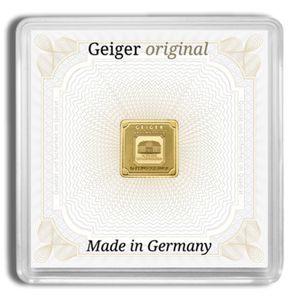
Geiger Edelmetalle, based in Germany, brings a different design tradition to the format. Their 1 gram bar has a notably square profile at roughly 10.6 mm x 10.6 mm, which distinguishes it visually from the more elongated rectangular bars produced by Swiss refineries. IGR Metals, produced by the Istanbul Gold Refinery in Turkey, is an LBMA-accredited refinery offering a compact bar with a straightforward minted finish. Perth Mint, operated by the Government of Western Australia, and The Royal Mint of Great Britain round out the named-brand options, with the Royal Mint's Britannia design adding numismatic interest to the product. Frontier Mint rounds out the named-brand options in our catalog.
For buyers who are less focused on a specific brand and more focused on acquiring gold at a lower premium, we also carry two random brand options: one in assay card and one without an assay card. The random brand assay bar ships with a legitimate assay enclosure from a recognized refinery, chosen based on current inventory availability. The no-assay option is available for buyers who are comfortable with loose bars and primarily interested in the metal content rather than the retail packaging. Both options contain the same .9999 fine gold in the same 1 gram weight.
Pricing, Premiums, and Market Factors
The price of any 1 gram gold bar is determined by two components: the gold spot price and the premium charged above spot. The spot price represents the real-time market value of gold per troy ounce in the global over-the-counter market. Because a 1 gram bar contains only 0.03215 troy ounces, the base metal value of the bar at any given spot price is relatively low in absolute dollar terms, which means the premium as a percentage of total cost tends to be higher for 1 gram products than for larger formats like 1 oz or 10 oz bars.
Premium levels vary across the named brands in our catalog. Bars from PAMP Suisse and Perth Mint, which carry recognized designs and strong secondary market demand, generally command higher premiums than comparable bars from less widely circulated refineries. Random brand bars carry lower premiums because they offer less brand specificity. Packaging also influences premium: bars with assay cards carry a modest premium over equivalent loose product because the packaging provides tamper-evident verification and is often required by buyers in the secondary market. The no-assay random brand option reflects this by being priced slightly below the assay equivalent.
Bullion Standard displays both the ask price and the bid price on each product page, which means you can see not only what you'll pay but also what the bar is currently worth on the wholesale buyback market. The spread between those two numbers reflects the true cost of ownership more accurately than the premium above spot alone. For buyers who are price-sensitive or who trade in physical gold with any regularity, that information is more useful than a headline premium percentage taken in isolation.
Condition, Packaging, and What to Expect
Named-brand 1 gram gold bars in our catalog ship in their original, factory-sealed assay cards. These cards are tamper-evident, meaning any attempt to open or reseal the packaging will be visible on inspection. When you receive a bar in assay packaging, it should arrive with the card intact, the bar clearly visible through the clear plastic window, and all printed certification legible. Minor surface variations on the bar itself, including faint handling marks or slight variations in surface texture, are normal for minted products and do not indicate an authenticity issue.
Random brand bars with assay cards will arrive in a legitimate assay enclosure from a recognized refinery, but the specific brand cannot be guaranteed in advance. If you have a preference for a particular mint, the named-brand options in our catalog are the appropriate choice. The no-assay random brand bar ships as a loose bar without an enclosure, and buyers should expect cosmetic variation consistent with handling and storage. These bars are not accompanied by a certificate of authenticity separate from the bar's own mint markings.
All orders are shipped in discreet, unmarked packaging without any external indication of the contents. Bullion Standard's fulfillment process is designed to protect both your privacy and the physical integrity of your order during transit. Insurance options are available at checkout, and signature confirmation requirements depend on order value thresholds.
Authenticity and Verification
Every product in our catalog is sourced from reputable mints, refineries, wholesalers, and authorized distributors and verified for authenticity, weight, and purity before it's listed or shipped. For named-brand 1 gram bars, the primary verification layer is the assay card itself. A properly sealed, unaltered assay card from an LBMA-accredited refinery such as PAMP Suisse, Valcambi, or Argor-Heraeus is one of the strongest forms of product authentication available in the retail bullion market.
Several refineries incorporate additional anti-counterfeiting features into both the bar and the assay packaging. PAMP Suisse uses a proprietary Veriscan technology that creates a digital fingerprint of each bar's unique surface characteristics, allowing the bar to be verified against a database even after the assay card has been opened. Valcambi and Argor-Heraeus use holographic elements, microprinting, and serial number tracking. Geiger Edelmetalle incorporates UV-reactive inks and other covert security features in their assay packaging. These measures exist because the value of gold at any weight level makes it a target for counterfeiting, and reputable refineries invest accordingly in countermeasure development.
Bullion Standard maintains an A rating with the Better Business Bureau and holds membership in both the American Numismatic Association and the National Coin and Bullion Association. Our sourcing relationships are with established wholesale partners and authorized distributors, and we do not source product through channels that cannot be verified for product integrity.
Liquidity and Resale Considerations
Liquidity in the physical bullion market is closely tied to product recognizability and standardization. A 1 gram gold bar from a well-known refinery like PAMP Suisse, Valcambi, or Argor-Heraeus carries broad recognition across dealer networks, secondary market platforms, and international buyers. That recognition generally translates to faster resale and more competitive buyback offers compared to bars from less established or regional refineries. The assay card plays a meaningful role here as well, since many buyers and dealers require intact packaging as a condition of a competitive offer.
Random brand bars, while containing the same gold content and purity, may attract slightly lower buyback bids in some markets simply because the refinery of origin cannot be confirmed in advance. Bars with intact assay cards are consistently more liquid than equivalent loose product because the packaging simplifies the authentication process for the buyer. If resale flexibility is a priority, selecting a named-brand bar in an intact assay card is generally the more practical approach.
Because the metal value in a 1 gram bar is small relative to the per-unit handling costs in the secondary market, the effective bid/ask spread as a percentage of total value tends to be wider for 1 gram products than for larger formats. This is a structural characteristic of the fractional gold bar market and is worth factoring into your decision when comparing this format to 1 oz or larger alternatives.
Storage and Security
One of the practical advantages of 1 gram gold bars is their small physical footprint. Individual assay cards measuring roughly 60 mm x 90 mm in most cases can be stored efficiently in virtually any secure environment, from a standard home safe to a bank safe deposit box or a third-party vault storage facility. The assay card provides a layer of physical protection for the bar itself, reducing the risk of surface damage from contact with other items during storage.
For buyers accumulating multiple bars over time, a fireproof home safe with a quality lock mechanism provides a reasonable entry-level storage solution. Temperature and humidity are less critical for gold than for other materials, since gold does not oxidize or corrode under normal environmental conditions. That said, avoiding prolonged exposure to moisture, chemicals, or abrasive surfaces will preserve the condition of both the bar and its assay packaging, which is relevant for resale purposes.
For larger accumulations or buyers who prefer not to maintain physical custody, third-party precious metals vault storage through an insured and audited facility is an option worth evaluating. This approach removes the logistical burden of home storage while keeping the metal in a fully allocated, physically segregated account. Shipping allocated gold back to yourself or to a dealer when you're ready to sell is generally straightforward through most vault providers.
Selling and Buyback Options
Bullion Standard operates a two-way market structure, which means you can sell your 1 gram gold bars back to us directly rather than having to locate a third-party buyer or navigate an auction platform. Our purchasing team evaluates buyback offers based on real-time market conditions, current wholesale bid pricing, product type, mint recognition, and the condition and completeness of the packaging. Named-brand bars in intact assay cards from refineries like PAMP Suisse, Valcambi, Argor-Heraeus, and Perth Mint tend to receive the most competitive buyback pricing because they are the most straightforward for us to verify and resell efficiently.
Random brand bars in assay cards are also accepted, though the buyback price may reflect a modest discount relative to named-brand product depending on the refinery of origin and current market demand. Bars without assay packaging are evaluated on a case-by-case basis, and buyers should expect that condition, presentation, and verifiability all influence the offer. While intact packaging is not always required, it consistently supports a more favorable buyback outcome.
Our buyback pricing is visible on each product page through the displayed bid price, so you can see the current wholesale buyback value before you make a purchase. This transparency is part of how we encourage buyers to evaluate the complete transaction rather than focusing exclusively on the acquisition side. Understanding both the cost to buy and the expected return from selling gives a more complete and honest picture of what ownership actually involves.
Why Buy 1 Gram Gold Bars?
The 1 gram gold bar format appeals primarily to buyers who want to acquire physical gold in the smallest commercially standardized increment available. At roughly 0.032 troy ounces per unit, it allows you to own verified, .9999 fine gold without committing to the larger outlay required for a quarter-ounce, half-ounce, or full-ounce product. For buyers who prefer to accumulate gold gradually over time, or who want to distribute physical gold across multiple people or purposes, the 1 gram bar offers a convenient and recognizable unit to work with.
The assay card format adds practical value for buyers who prioritize ease of handling, verification, and eventual resale. Each bar arrives pre-certified and tamper-evidently sealed, which means no additional testing or verification is required at the time of purchase or transfer. This makes 1 gram assay bars one of the more low-friction formats in the physical gold market, even if the per-unit premium is higher relative to larger bar sizes.
Named-brand bars from internationally recognized refineries also carry a degree of design and brand recognition that some buyers value beyond the metal content alone. The PAMP Suisse Lady Fortuna and the Royal Mint Britannia designs, for example, are familiar to collectors and bullion buyers globally, which contributes to their secondary market recognizability. For buyers who place value on that kind of broad market familiarity, the named-brand 1 gram options in our catalog deliver it in a compact and easily stored format.
Why Buy from Bullion Standard?
Bullion Standard has operated in the U.S. precious metals market since 2010, building a reputation grounded in pricing transparency, product authenticity, and straightforward customer service. Every product we sell is sourced through verified channels and authenticated before it reaches our catalog. Our A rating with the Better Business Bureau and memberships in the American Numismatic Association and the National Coin and Bullion Association reflect a long-term commitment to operating with integrity in a market where trust is everything.
Our pricing model is built around real-time market data, not fixed retail markups. Bid and ask prices are displayed on every product page, giving you visibility into both sides of the transaction before you commit. That level of transparency is not universal in the retail bullion industry, and it reflects our core belief that informed buyers make better decisions and that a more transparent market benefits everyone involved. Payment flexibility is equally broad, with options including Visa, Mastercard, American Express, Discover, PayPal, bank-connected payments through Plaid, wire transfer, paper check, and cryptocurrency through BitPay.
Beyond the purchase itself, Bullion Standard is designed around long-term customer relationships rather than one-time transactions. Our two-way market structure means you can buy and sell within the same ecosystem, with consistent pricing standards applied in both directions. Responsive customer support, reliable fulfillment, and a commitment to post-purchase clarity round out an experience that's designed to feel like a transparent marketplace rather than a traditional high-pressure sales environment.
Get Near-Spot Pricing with Bullion Standard Pro
Bullion Standard Pro is designed for buyers who want to transact closer to wholesale market pricing rather than standard retail levels. Members gain access to live, executable wholesale bid and ask pricing across a broad range of products, including 1 gram gold bars from the named refineries in our catalog. Rather than applying fixed dealer markups, Pro pricing reflects real-time supply and demand within the wholesale precious metals market, allowing premiums and spreads to fluctuate naturally based on actual market conditions.
For buyers who accumulate gold incrementally or who purchase 1 gram bars with any regularity, the reduction in per-unit spread that Pro pricing provides can be meaningful over time. Because the bid/ask spread as a percentage of total value is structurally wider for fractional products like 1 gram bars, accessing tighter wholesale pricing is particularly relevant in this weight class. Pro members can also view real-time portfolio valuations based on live wholesale bid pricing rather than estimated retail values, which provides a more accurate picture of current liquidation value at any point in time.
The platform also includes proprietary research and comparison tools that allow members to evaluate products using metrics such as historical premiums, premium percentile rankings, spread analysis, and liquidity indicators. For buyers who want to understand how specific 1 gram bar products are priced relative to historical norms or relative to other options in the catalog, these tools provide objective data rather than marketing claims. The goal is to make the physical gold market more transparent and more navigable for buyers who take their purchasing decisions seriously.


 (833) 278-4653