Walking Liberty Half Dollars | Bullion Standard
Buy Walking Liberty Half Dollars Online
Our catalog of walking liberty half dollars covers a range of grades and conditions, giving buyers the flexibility to choose based on their priorities and budget. The options listed include circulated examples graded at average circulated, XF (Extremely Fine), and AU (About Uncirculated), as well as BU (Brilliant Uncirculated) specimens for those seeking the sharpest examples available. Each listing represents a $1 face value lot, which translates to two 90% silver half dollar coins carrying a combined silver content of 0.715 troy ounces.
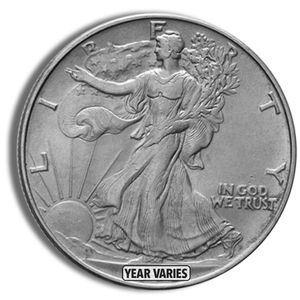
All coins in our catalog are struck by the United States Mint and carry a random year designation, meaning year and mint mark will vary based on available inventory. This is standard practice for 90% silver junk silver offerings, and it reflects how these coins trade in the wholesale market. Bullion Standard sources from reputable distributors and applies transparent pricing that reflects current market conditions rather than inflated retail margins.
Whether you're adding to an existing stack of 90% silver or exploring this format for the first time, the grade-differentiated options here allow for a precise decision based on what condition level matters most for your intended purpose.
What Are Walking Liberty Half Dollars?
Walking liberty half dollars are 90% silver coins struck by the United States Mint from 1916 through 1947. Each coin carries a face value of fifty cents and contains 0.3575 troy ounces of silver in its standard form. Because they're sold in two-coin $1 face value lots, the combined silver content per listing is 0.715 troy ounces. This makes them one of the most straightforward formats in the 90% silver, or "junk silver," market.
The term "junk silver" is a market classification, not a quality judgment. It refers to pre-1965 United States coinage struck in 90% silver that carries no numismatic premium beyond its silver content. Walking liberty half dollars fall squarely in this category, trading primarily on their melt value rather than collector appeal. That said, higher-grade examples such as XF and AU coins do carry a modest premium over standard circulated pieces.
Buyers typically choose this format for its recognizability, government-issued origin, and divisibility. Because the silver content per coin is well established and the coins are widely understood by dealers and individuals alike, they tend to trade efficiently across a broad range of resale environments.
History and Background
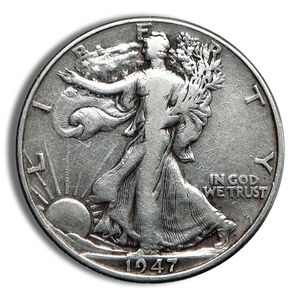
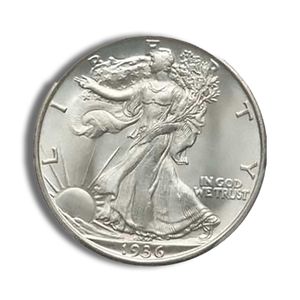
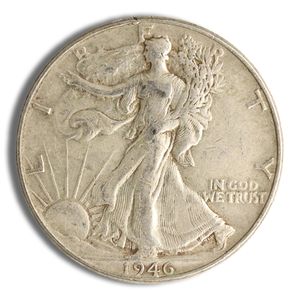
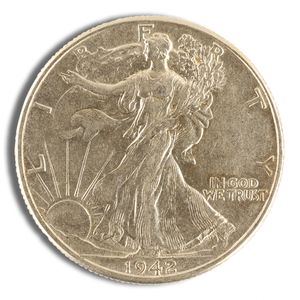
The walking liberty half dollar was introduced in 1916, with designs created by sculptor Adolph A. Weinman. The obverse depicts Lady Liberty in full stride, draped in the American flag and moving toward the sunrise, while the reverse features a bald eagle perched on a mountain crag. Weinman's design is widely regarded as one of the most artistically accomplished in American coinage history, and it was later revived by the United States Mint as the basis for the American Silver Eagle series beginning in 1986.
Production spanned three decades across facilities in Philadelphia, Denver, and San Francisco, with mint marks appearing on the obverse during the early years and later migrating to the reverse. The series saw numerous design refinements and production variations across its 31-year run. Silver content remained consistent at 90% throughout the entire production period, which is why the series is treated uniformly in the bullion market regardless of date or mint mark.
When the Coinage Act of 1965 removed silver from circulating American coinage, pre-1965 90% silver coins like the walking liberty half dollar transitioned into a new role as a recognized silver bullion format. Decades of widespread circulation, strong mint production records, and consistent silver content made these coins a durable and liquid component of the junk silver market, a position they continue to hold today.
Purity, Weight, and Specifications
Each walking liberty half dollar is composed of 90% silver and 10% copper, giving it a purity of 0.900. The gross weight of each coin is 12.5 grams, or approximately 0.4019 troy ounces, with an actual silver content of 0.3575 troy ounces per coin. The standard $1 face value lot consists of two coins, producing a combined silver weight of 0.715 troy ounces. This is the standard silver content calculation used across the junk silver market for walking liberty halves.
Coin diameter is 30.63 millimeters with a reeded edge and a thickness of approximately 1.8 millimeters. These physical specifications are consistent across the entire series, making the coins easy to weigh and verify using standard numismatic and bullion tools. No assay card accompanies these coins, as they are government-issued legal tender whose composition and weight are a matter of public record and long-established market practice.
The 0.715 troy ounce figure is the conventional silver content calculation used for $1 face value in 90% silver half dollars, accounting for average wear across circulated examples. This standard is universally recognized among dealers and is the basis for pricing throughout the wholesale and retail junk silver market.
Available Brands, Mints, and Product Variations
Every walking liberty half dollar in our catalog was struck by the United States Mint, one of the world's oldest and most trusted government minting institutions. Production occurred across three facilities: Philadelphia (no mint mark on many issues), Denver (D), and San Francisco (S). Because all listings are designated as random year with various mint marks, specific dates and facilities are not selected or guaranteed. Coins are drawn from available wholesale inventory and allocated based on grade.
Our catalog offers five distinct product variations differentiated by grade. The average circulated option covers a broad range of circulated examples with visible wear but intact design elements. The XF (Extremely Fine) listings, which are available in two separate SKUs with slightly different condition ranges, represent coins with light to moderate wear and well-defined design details. The AU (About Uncirculated) listing covers coins showing only the slightest friction on the high points, retaining most of their original surface quality. The BU (Brilliant Uncirculated) option represents coins that show no wear and retain their original mint luster, making them the sharpest examples available in the series.
This grade-differentiated structure allows buyers to align their purchase with their specific needs, whether that's maximizing silver content per dollar or acquiring examples with a higher level of visual preservation.
Pricing, Premiums, and Market Factors
Walking liberty half dollars are priced based on their silver content relative to the current spot price of silver, with a premium applied above spot to cover sourcing, handling, and transaction costs. The premium for circulated 90% silver coins is generally among the tightest in the retail silver market, reflecting their status as a commodity-grade product with strong wholesale liquidity. Higher-grade examples such as XF, AU, and BU coins carry incrementally higher premiums that reflect sorting costs and the relative scarcity of well-preserved examples within the available supply.
Several factors influence the premiums on 90% silver coins at any given time. Wholesale supply availability, demand patterns from dealers and collectors, and the current spot price of silver all play a role. During periods of elevated silver demand, premiums on junk silver can widen significantly as available inventory is absorbed by the market. Conversely, when wholesale supply is abundant and demand softens, premiums tend to compress. These dynamics are reflected in real time in Bullion Standard's pricing, which is structured around current market conditions rather than static retail markups.
Bullion Standard's bid/ask spreads are displayed on each product page, giving buyers clear visibility into both acquisition cost and the current buyback price before completing a purchase. This transparency is a core part of how we approach pricing, because understanding both sides of the transaction provides a more complete picture of what ownership actually costs.
Condition, Packaging, and What to Expect
Walking liberty half dollars are shipped as loose coins in protective packaging appropriate to their grade. Average circulated examples will show visible wear consistent with decades of monetary use, including softened high points and reduced surface detail, though major design elements remain clear and identifiable. XF coins display sharper detail with light wear confined to the highest relief areas. AU examples retain nearly full detail with only faint friction visible. BU coins should exhibit no wear and retain original mint luster, though minor contact marks or bag marks common to uncirculated coinage from this era are considered normal and do not affect grade designation.
Because all listings are random year, buyers will not receive coins of a specific date or mint mark unless otherwise noted. This is the standard expectation for junk silver purchases and is consistent with how 90% silver coins are sold throughout the wholesale and retail bullion market. Coins are not individually certified by PCGS or NGC unless specified, and no assay card accompanies the purchase.
Shipment is carefully packaged to protect coins during transit. If you're purchasing for a specific condition threshold, review the grade options closely before selecting a listing, as each grade tier reflects a meaningfully different level of surface preservation.
Authenticity and Verification
Walking liberty half dollars produced by the United States Mint are among the most well-documented and easily verified silver coins in the American numismatic record. Their composition, weight, and dimensions are publicly established and have been consistent across the full production run from 1916 to 1947. Standard verification tools including precision digital scales, calipers, and specific gravity testing are effective for confirming authenticity.
Bullion Standard sources all 90% silver coins from established wholesale distributors and reputable market participants. Each product is reviewed for authenticity and consistency with its assigned grade before reaching customers. We maintain memberships with the American Numismatic Association (ANA) and the National Coin and Bullion Association (NCBA) and are an authorized dealer for both PCGS and NGC, reflecting our commitment to authentication standards across our broader catalog.
While walking liberty half dollars are not individually assay-certified, the well-established production records of the United States Mint and the long market history of 90% silver coinage provide a strong foundation for verification. Buyers who want additional assurance can have individual pieces evaluated by a reputable third-party grading service.
Liquidity and Resale Considerations
Few silver formats are more universally recognized than pre-1965 90% silver coinage from the United States Mint. Walking liberty half dollars are understood by coin dealers, precious metals dealers, pawnshops, and private buyers across the country, which contributes to their broad resale accessibility. This widespread familiarity is one of the reasons junk silver continues to trade as a standard commodity within the bullion market.
Higher-grade examples tend to attract a somewhat broader buyer pool, including collectors who value well-preserved examples of Weinman's design. Circulated examples trade almost entirely on silver content and are priced accordingly in both dealer buyback and secondary market contexts. The divisibility of half dollar coins, each containing 0.3575 troy ounces of silver, also provides flexibility when liquidating portions of a larger holding.
As with any bullion product, resale pricing reflects current spot prices, prevailing premiums in the wholesale market, and the specific grade and condition of the coins being sold. Products with strong market recognition and broad distribution history, like walking liberty half dollars, typically experience more consistent resale pricing than obscure or regionally limited products.
Storage and Security
Walking liberty half dollars are compact, durable, and relatively easy to store compared to larger format bullion products. Because each coin measures 30.63 millimeters in diameter, standard half dollar coin tubes and 2x2 coin flips are widely available and provide practical protection for both individual pieces and bulk quantities. Coins stored in tubes or rolls can be stacked efficiently in a home safe, a bank safe deposit box, or a dedicated vault storage facility.
Silver is susceptible to toning and surface discoloration when exposed to humidity, sulfur compounds, and environmental pollutants over time. Storing coins in airtight containers or coin capsules and keeping humidity levels low will help preserve surface quality, particularly for XF, AU, and BU examples where appearance carries a premium. For average circulated examples purchased primarily for silver content, minor toning or continued oxidation is generally not a concern for resale purposes.
For larger quantities, a professional vault storage solution provides both security and insurance coverage that a home safe typically cannot match. Bullion Standard can provide guidance on storage options as part of our broader customer support resources.
Selling and Buyback Options
Bullion Standard operates a two-way market for precious metals, meaning customers can both purchase and sell coins within the same platform. This approach is central to how we view transparency: liquidity should be understood before a purchase is made, not only when it's time to sell. Our buyback pricing for walking liberty half dollars is updated in real time and reflects current wholesale market conditions, giving sellers a clear and accurate picture of what their coins are worth at any given moment.
Buyback pricing is influenced by several factors including current spot silver prices, prevailing wholesale premiums for 90% silver coinage, the grade and condition of the coins being sold, and overall market demand at the time of the transaction. Higher-grade coins such as AU and BU examples may command modestly better buyback terms than average circulated pieces, though the primary driver for most junk silver transactions remains the spot-based melt value calculation. Coins that deviate significantly from their stated grade or show evidence of damage may be subject to adjusted pricing upon receipt.
The process for selling to Bullion Standard is straightforward. Our purchasing team evaluates submitted coins against current market pricing, and customers receive a clear offer before committing to a transaction. This eliminates the ambiguity common in less transparent dealer environments and reflects our broader commitment to making the sell side of precious metals ownership as clear as the buy side.
Why Buy Walking Liberty Half Dollars?
Walking liberty half dollars occupy a well-defined position in the silver market. They offer a recognizable government-issued format with an established silver content, a broad base of market participants who understand their value, and a grade structure that allows buyers to calibrate their purchase based on condition preferences. For buyers focused on silver content at a tight premium, circulated examples provide one of the more cost-efficient entry points in the retail silver market.
The divisibility of half dollar coins is a practical advantage. Because each coin contains 0.3575 troy ounces of silver, a $1 face value lot of two coins represents a small, manageable unit that can be bought, stored, and resold without the need to break larger formats. This makes the format well suited to buyers who want flexibility in how they accumulate and eventually liquidate their silver holdings.
For collectors and silver buyers alike, the artistic quality of Adolph Weinman's design adds an element of appeal that purely commodity-grade products don't always offer. The walking liberty design is broadly considered one of the finest in United States coinage history, which contributes to the enduring demand for higher-grade examples beyond their silver content alone.
Why Buy from Bullion Standard?
Bullion Standard was founded in 2010 in San Diego, California, and has grown into a nationally recognized precious metals marketplace by centering the customer experience on transparency, authenticity, and reliable fulfillment. Our pricing is structured around real-time market conditions, and our bid/ask spreads are displayed directly on product pages so buyers understand both sides of any transaction before committing.
Every product we carry is sourced from reputable mints, refineries, wholesalers, and distributors, and verified for authenticity and accuracy before reaching customers. We maintain an A rating with the Better Business Bureau and hold memberships with the American Numismatic Association and the National Coin and Bullion Association. These affiliations reflect a commitment to industry standards that goes beyond marketing language.
Our platform supports a wide range of payment methods, including Visa, Mastercard, American Express, Discover, PayPal, bank-connected payments through Plaid, wire transfer, paper check, and cryptocurrency through BitPay. Fulfillment is handled with the same attention to security and accuracy that defines the rest of the purchasing experience. And because we operate a two-way market, customers who sell to us benefit from the same pricing transparency and operational reliability as those who buy.
Get Near-Spot Pricing with Bullion Standard Pro
Bullion Standard Pro is designed for buyers who want direct access to wholesale-level pricing without the markups typical of traditional retail dealer models. Members transact at live, executable wholesale bid and ask prices that reflect real-time supply and demand within the wholesale precious metals market. For products like 90% silver coinage, where premiums are already relatively tight, accessing wholesale pricing can meaningfully reduce the cost of accumulating silver over time.
Beyond pricing efficiency, Bullion Standard Pro provides members with access to real-time portfolio valuation based on live wholesale bid pricing, proprietary market intelligence tools, historical premium analysis, spread tracking, and liquidity metrics. These tools are designed to help members evaluate market conditions and understand how premiums, spreads, and wholesale activity are evolving for specific products, including junk silver coinage.
For buyers who transact regularly or hold significant positions in silver, the combination of near-spot execution pricing and access to transparent market data creates a materially different ownership experience than standard retail purchasing. Bullion Standard Pro is built around the principle that better market information leads to better decisions, and that principle applies as clearly to 90% silver half dollars as to any other product in the precious metals market.


 (833) 278-4653