Buy Credit Suisse Gold Bars Online
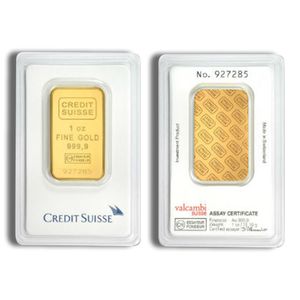
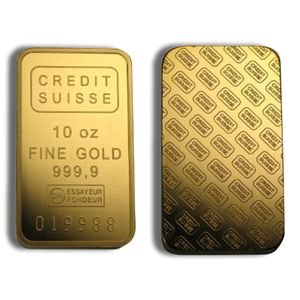
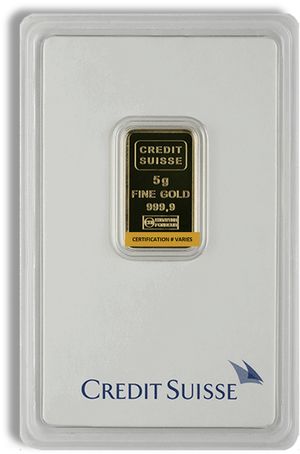
Our catalog features Credit Suisse gold bars across a range of sizes, giving buyers the flexibility to choose the format that best suits their holdings and budget. The selection currently includes a 5 gram bar in assay card, a 1 oz bar in assay card, and a 10 oz bar, each struck to .9999 fine gold and carrying the Credit Suisse name that has long been associated with Swiss precision manufacturing.
These are minted bars, meaning they're produced through a precision stamping process that results in clean, flat surfaces and sharp design detail. Each bar is sourced through reputable wholesale channels and verified before reaching our customers. Bullion Standard's pricing reflects live market conditions, and both the buy and sell sides of each transaction are displayed on individual product pages to give you a complete picture of current market pricing.
Whether you're adding a smaller fractional gram bar or stepping up to a larger 10 oz format, our platform is built around the same commitment to transparent pricing and straightforward execution. No high-pressure sales tactics, no hidden markups buried in the checkout process.
What Are Credit Suisse Gold Bars?
Credit Suisse gold bars are minted gold bars produced under the Credit Suisse brand, historically connected to one of Switzerland's most recognized financial institutions. They are struck from .9999 fine gold and marked with the Credit Suisse name, purity, weight, and in many cases a serial number. The minted format distinguishes them from cast bars, which have a rougher, more industrial appearance. Minted bars have flat, polished surfaces and sharper edges, making them easier to inspect and more visually uniform.
Buyers typically choose Credit Suisse bars because of the brand's global recognition and the standardized specifications that make these bars easy to verify and transact. The assay card packaging found on the 1 oz and 5 gram options provides an added layer of confidence by sealing the bar in a tamper-evident holder alongside authentication documentation. Larger bars like the 10 oz format generally trade at lower premiums relative to their metal content, making them efficient for buyers focused primarily on acquiring gold by weight.
These bars aren't legal tender, which means their value is tied entirely to their gold content and the premium the market assigns to the Credit Suisse name and format. That's an important distinction from government-issued coins, which carry a face value backed by a sovereign authority. For many buyers, the bar format is a deliberate choice that prioritizes metal content and straightforward pricing over collectibility or numismatic premium.
History and Background
Credit Suisse has been associated with Swiss-branded gold products since the mid-twentieth century, a period when Swiss refineries and financial institutions became deeply embedded in the international gold market. Switzerland's role as a neutral financial center made it a natural hub for gold refining, trading, and distribution, and the Credit Suisse name became one of the most recognized in global bullion markets as a result.
The bars themselves have been produced and distributed through partnerships with Swiss refineries, most notably Valcambi Suisse, which is one of the world's largest and most respected precious metals refineries. Valcambi, located in Balerna, Switzerland, is responsible for manufacturing many of the Credit Suisse branded bars that circulate in global wholesale and retail bullion markets today. This is reflected directly in our catalog, where the 10 oz Credit Suisse bar lists Valcambi Suisse as the manufacturer.
Over the decades, Credit Suisse bars became a standard reference product in the North American retail bullion market. Their consistent specifications, widely understood purity markings, and association with Swiss manufacturing helped establish them as a trusted product type among dealers, wholesalers, and individual buyers alike. That recognition continues to support their liquidity across today's secondary market.
Purity, Weight, and Specifications
Every Credit Suisse gold bar in our catalog is struck to .9999 fine gold, which represents a purity of 99.99 percent. This level of fineness exceeds the .999 fine standard found on some other gold bars and is consistent with the higher purity tier used by major Swiss and international refineries. The purity is stamped directly on each bar alongside the Credit Suisse name and the weight designation.
The three weights available here span a practical range. The 5 gram bar contains approximately 0.1607 troy ounces of gold and measures 23.3mm by 14mm with a thickness of 0.83mm, making it one of the more compact fractional formats available. The 1 oz bar is the most widely traded size in this series, measuring 41mm by 24mm with a 1.86mm thickness. The 10 oz bar is considerably larger at 60mm by 35mm and 9mm thick, providing a more substantial format for buyers acquiring gold in larger quantities.
Weights on gold bars are measured in troy ounces, not standard avoirdupois ounces. One troy ounce equals 31.1035 grams, which is why the gram and troy ounce designations on bullion bars are always specified explicitly. Serial numbers are common on larger Credit Suisse bars, providing an additional identification point for individual bars moving through the wholesale and resale markets.
Available Brands, Mints, and Product Variations
The Credit Suisse brand appears on all three bars in our catalog, but the manufacturing source varies. The 5 gram and 1 oz bars are manufactured directly by Credit Suisse, while the 10 oz bar is produced by Valcambi Suisse under the Credit Suisse brand. This is a common arrangement in the bullion industry where a branded product is manufactured by an affiliated or contracted refinery. Valcambi's production standards are well-established, and bars carrying the Credit Suisse name from Valcambi are widely accepted in wholesale and retail bullion markets.
Two of the three bars in our catalog come in assay card packaging. The 5 gram and 1 oz options are each sealed in a tamper-evident assay card that encases the bar in a protective holder with printed authentication details. Assay cards protect the bar from handling damage, preserve the original surface condition, and provide buyers with verifiable documentation at the point of purchase. The 10 oz bar is sold without an assay card, which is standard for larger format bars that are less prone to handling damage and are typically stored rather than passed between hands frequently.
All three bars use the minted format rather than cast production. Minted bars are cut from rolled gold blanks and then struck under precision presses, resulting in uniform dimensions and consistent surface appearance across the product run. This production method is generally associated with higher manufacturing quality and is the standard for most retail-facing bullion bars at these weights.
Pricing, Premiums, and Market Factors
Gold bar pricing is based on the live spot price of gold, with a premium added to cover manufacturing costs, distribution, and dealer margin. Credit Suisse bars generally carry premiums that reflect their strong brand recognition and consistent demand in the North American market. Premiums vary by weight: smaller bars like the 5 gram format typically carry higher premiums as a percentage of metal value because the fixed cost of production and packaging is spread across less metal. The 10 oz bar, by contrast, tends to offer lower per-ounce premiums, making it a more efficient option for buyers prioritizing metal content over convenience or handling flexibility.
Packaging also influences premium levels. Bars sold in assay cards carry a modest additional cost compared to bare bars, but they also tend to retain that premium in the secondary market because of the added verification and condition protection. Market conditions, including overall gold demand, wholesale inventory levels, and buyer activity, can cause premiums to shift over time even when the spot price remains stable.
Bullion Standard displays pricing transparently on each product page, including both the ask price and the current bid price. This gives buyers a clear view of the bid/ask spread before committing to a purchase, which is something many traditional dealers don't make readily visible. Understanding both sides of that spread is central to evaluating the true cost of owning any bullion product, and it's a core part of how our platform is built.
Condition, Packaging, and What to Expect
Credit Suisse gold bars arrive in new, unhandled condition. Bars sealed in assay cards come exactly as received from the mint or refinery, with the tamper-evident card intact. Any bar with a broken or compromised assay seal would be considered a red flag in the secondary market and is not something we would source or fulfill.
For the 10 oz bar, which ships without an assay card, buyers should expect a bar in mint condition with no significant surface damage, though minor handling marks or lint impressions may be present on some bars. This is normal for large minted bars and does not affect the gold content or purity. Gold is a soft metal and can show minor contact marks even through careful handling at the refinery level.
Year of manufacture may vary for some products depending on current inventory. When bars are listed without a specific year designation, they are fulfilled from available stock that meets all purity and specification requirements. All products are verified by our team before shipment, and every bar we sell is confirmed authentic regardless of the production year.
Authenticity and Verification
Every Credit Suisse gold bar we sell is sourced through established wholesale channels and verified for authenticity, weight, and purity before it reaches a customer. Our sourcing relationships include reputable mints, refineries, and distributors, and we do not purchase from unverified or gray-market sources. The assay card packaging on the 1 oz and 5 gram bars provides an additional layer of built-in verification, with the bar's weight, purity, and Credit Suisse branding printed directly on the sealed holder.
For buyers who want to conduct independent verification, gold bars can be tested using a range of methods including ultrasonic thickness testing, X-ray fluorescence analysis, and specific gravity testing. Counterfeit gold bars, while relatively rare in the legitimate dealer market, do exist in the broader marketplace, which makes sourcing from reputable, established dealers an important part of risk management. Bars in intact assay cards are more difficult to counterfeit convincingly because the card itself forms part of the authentication.
Bullion Standard maintains an A rating with the Better Business Bureau and holds memberships with the American Numismatic Association and the National Coin and Bullion Association. We are also an authorized dealer for both PCGS and NGC. These affiliations reflect the standards we hold ourselves to across sourcing, verification, and customer service.
Liquidity and Resale Considerations
Credit Suisse gold bars are among the more liquid branded gold bar products in the North American market. The Credit Suisse name is recognized by dealers, refiners, and private buyers across the United States and internationally, which supports consistent resale demand. Bars that are widely recognized tend to transact more smoothly in the secondary market because buyers and dealers can quickly assess what they're looking at without needing additional verification steps.
The 1 oz format is the most liquid size in this series because it aligns with the most commonly traded weight in the retail bullion market. Larger bars like the 10 oz format are also recognized and traded actively, though the pool of buyers at that size is somewhat narrower simply because the dollar amount involved is larger. Fractional gram bars can be somewhat less liquid on a per-trade basis, though they remain broadly accepted by dealers who are familiar with the Credit Suisse product line.
Bars that remain in their original assay card packaging typically command better resale terms than bars that have been removed, because the intact packaging provides immediate visual confidence during the transaction. Keeping bars sealed and in their original condition is generally the most practical approach to maintaining resale positioning.
Storage and Security
Gold bars should be stored in a controlled environment that protects against physical damage, humidity, and unauthorized access. For the compact 5 gram and 1 oz assay-card bars, a home safe rated for burglary and fire resistance is a practical option that keeps your holdings accessible while providing meaningful security. The assay card packaging for these smaller bars adds a layer of protection against surface scratching during storage.
The 10 oz bar warrants additional consideration given its higher dollar value in a single piece. Allocated vault storage through a recognized precious metals storage facility or a bank safe deposit box are both commonly used options for larger format bars. Vault storage typically provides professional-grade security, insurance coverage, and documented chain of custody, which can matter during a future sale or transfer.
Regardless of the storage method, gold bars should be kept away from corrosive materials and stored in a stable environment. Gold itself is chemically inert and doesn't tarnish or corrode, but mechanical damage from improper storage, such as stacking heavy items on top of unsealed bars, can affect surface condition and resale presentation.
Selling and Buyback Options
Bullion Standard operates a two-way market, meaning customers can sell their Credit Suisse gold bars back through the same platform where they purchased them. Our buyback process is designed to be straightforward: buyers receive a competitive bid based on current wholesale market pricing, the product's condition and packaging, and real-time demand for that specific format. We believe liquidity should be understood before a purchase is made, not treated as an afterthought when it comes time to sell.
Factors that influence the buyback price for any gold bar include the current spot price, the specific product format and weight, whether the original assay card is intact, and general market conditions at the time of the transaction. Credit Suisse bars in assay card packaging typically receive favorable consideration during buyback because the intact packaging reduces verification time and supports faster resale into the wholesale market. Bars that have been removed from their assay cards may still be purchased, though they may receive slightly different terms depending on condition.
Our purchasing team evaluates products using transparent, market-driven pricing rather than arbitrary or static offers. Bid pricing is displayed on product pages in real time, giving sellers a clear view of current buyback levels before initiating a transaction. This eliminates the uncertainty that typically accompanies the resale process at traditional dealers.
Why Buy Credit Suisse Gold Bars?
Credit Suisse gold bars combine recognized branding with standardized specifications, making them a practical choice for buyers who want a bar that's straightforward to own, verify, and eventually sell. The .9999 fine purity is consistent with the highest tier of gold bar manufacturing, and the minted format provides a clean, professional appearance that holds up well in storage and resale contexts.
The range of available weights makes this product type flexible. A buyer adding to an existing position might reach for the 10 oz bar to reduce per-ounce premium costs, while someone making a smaller initial purchase might find the 5 gram or 1 oz assay-card options more practical. Having multiple size options within the same recognized brand allows buyers to scale their holdings incrementally without switching between unfamiliar products.
Swiss-manufactured gold bars carry a specific reputation in global bullion markets that's been built over decades of consistent production standards. That reputation contributes to the ease of resale and dealer acceptance, which matters when you eventually decide to liquidate. For buyers who think practically about both sides of a bullion transaction, the combination of recognized branding, standardized specs, and broad dealer acceptance makes Credit Suisse bars a sensible option to consider.
Why Buy from Bullion Standard?
Bullion Standard was founded in 2010 in San Diego, California, and has grown into a nationally recognized precious metals marketplace built around one core principle: transparency. Our pricing reflects live market conditions, our bid/ask spreads are displayed directly on product pages, and we don't structure our buying experience around high-pressure sales tactics or opaque pricing models. What you see is what you pay.
Every product we sell, including all Credit Suisse gold bars in our catalog, is verified for authenticity, weight, and purity before it ships. We source exclusively from reputable mints, refineries, wholesalers, and distributors, and our team handles every step of the fulfillment process with the same standards. Our A BBB rating, ANA and NCBA memberships, and authorized dealer status with PCGS and NGC reflect the operational standards we maintain across all aspects of the business.
Our platform supports a wide range of payment methods including major credit cards, PayPal, bank-connected payments through Plaid, wire transfer, paper check, and cryptocurrency through BitPay. Secure checkout, reliable fulfillment, and accessible customer support are built into the experience from the start. We exist to help buyers purchase, hold, and sell physical precious metals more intelligently, and that mission shapes everything we do.
Get Near-Spot Pricing with Bullion Standard Pro
Bullion Standard Pro is designed for buyers who want direct access to executable wholesale pricing across gold bars, coins, and other precious metals products. Members transact at live wholesale bid and ask prices without additional dealer markups or retail spread layers applied on top. For buyers purchasing Credit Suisse gold bars with any regularity, the pricing efficiency available through Pro can represent a meaningful difference in acquisition cost over time.
Pro members also gain access to real-time portfolio valuation based on live wholesale bid pricing, which provides a more accurate picture of current liquidation value than retail-estimated figures. Additional tools include historical premium analysis, premium percentile rankings, spread tightness metrics, and order-flow analytics that help members understand how a specific product like a 1 oz or 10 oz Credit Suisse bar is trading relative to its historical pricing range.
The platform is built to reduce the information gap that has traditionally existed in the physical precious metals market. By giving members access to the same pricing data and market intelligence used at the wholesale level, Bullion Standard Pro makes it possible to evaluate any purchase, including Credit Suisse gold bars, using objective, real-time data rather than assumptions. For buyers who take the evaluation process seriously, that access represents a genuine structural advantage.


 (833) 278-4653