Buy 10 oz Silver Bars Online
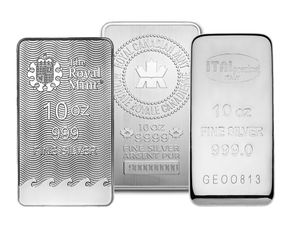
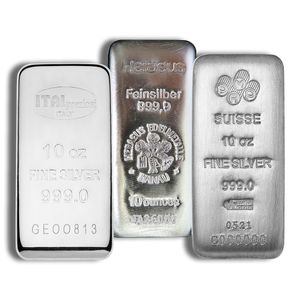
Our catalog of 10 oz silver bars brings together some of the most respected names in the bullion industry, including the Royal Canadian Mint, PAMP Suisse, Asahi Refining, Johnson Matthey, Geiger Edelmetalle, Sunshine Mint, The Royal Mint, Engelhard, Frontier Mint, and Istanbul Gold Refinery. Whether you're drawn to a government-affiliated mint, a well-established private refinery, or a trusted generic brand, you'll find options in both cast and minted formats with purity levels ranging from .999 to .9999 fine silver.
Bullion Standard operates as a transparent precious metals marketplace designed to make the buying process straightforward and informed. Each product listing reflects real-time pricing tied to current spot conditions, and our two-way market structure means we actively purchase back the same products we sell. You won't find inflated markups buried in the fine print here.
This weight class occupies a practical middle ground between smaller fractional bars and large-format commercial silver. It appeals to buyers who want meaningful silver content in a single, manageable unit without stretching into the higher per-ounce premiums that fractional sizes carry. The variety of brands and formats in our lineup reflects the genuine depth of supply available at this weight level in the wholesale silver market.
What Are 10 oz Silver Bars?
A 10 oz silver bar is a refined silver product containing exactly ten troy ounces of silver, struck or poured to standardized purity specifications by a recognized mint or refinery. Troy ounces, the standard unit of measure in the precious metals industry, differ slightly from the standard avoirdupois ounce used in everyday commerce, with one troy ounce equal to approximately 31.1 grams. A 10 oz bar therefore contains roughly 311 grams of silver.
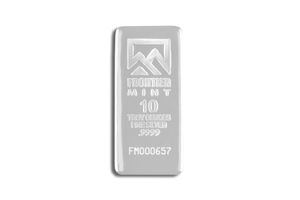
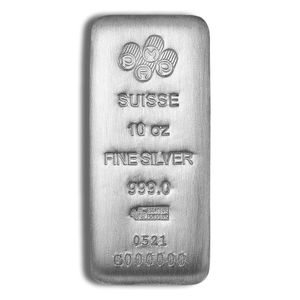
These bars come in two primary production formats. Cast bars are formed by pouring molten silver into a mold and allowing it to solidify, resulting in a raw, textured appearance with natural surface variation. Minted bars are produced by cutting refined silver blanks to precise dimensions and then pressing them under high pressure to create a clean, flat surface with crisp stamped markings. Frontier Mint's cast offerings, PAMP Suisse's cast bar, and IGR's cast bar represent the pour-and-cool format, while the Royal Canadian Mint, Johnson Matthey, Geiger, Sunshine Mint, and The Royal Mint's Britannia bar illustrate the minted approach.
Buyers choose this weight class for several practical reasons. Ten-ounce bars are compact enough to handle comfortably and store efficiently, yet large enough to represent a meaningful amount of silver per unit. Compared to 1 oz bars or fractional rounds, the per-ounce premium on 10 oz bars is typically lower, which makes this format efficient for buyers focused on acquiring silver content at a reasonable cost above spot. They also represent a widely recognized standard in the secondary market, which supports straightforward resale when the time comes.
History and Background
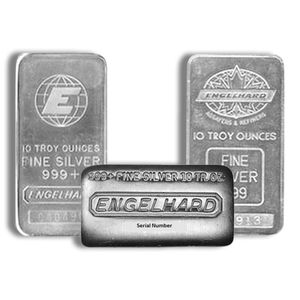
The 10 oz silver bar emerged as a standardized product format as private refineries expanded their production capacity throughout the mid-twentieth century. Companies like Engelhard and Johnson Matthey, both of which appear in our catalog, became defining figures in the North American and global bullion refinery business during that era. Their bars were widely accepted by institutional buyers and private collectors alike, and products bearing those stamps remain highly recognizable in today's secondary market.
The broader silver bar market grew substantially following the deregulation of private gold and silver ownership in the United States in 1974, which opened the door for mass-market bullion products directed at retail buyers. Refineries that had previously served primarily industrial customers began producing consumer-oriented bars in standardized weights, with the 10 oz size quickly establishing itself as a practical option for individual buyers. Internationally, refineries like PAMP Suisse in Switzerland and Geiger Edelmetalle in Germany built reputations for precision and consistency that extended well beyond their domestic markets.
Government mints entered the silver bar market later, with the Royal Canadian Mint and The Royal Mint of Great Britain both developing recognized bar programs alongside their more prominent coin series. The involvement of government-backed institutions brought additional credibility and market acceptance to the silver bar format. Today, the 10 oz bar is produced by dozens of mints and refineries across multiple continents, supported by an active wholesale market that keeps pricing competitive and liquidity relatively consistent.
Purity, Weight, and Specifications
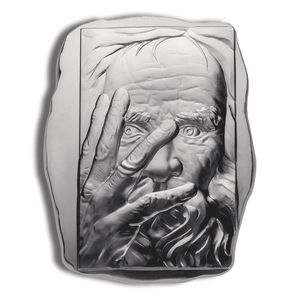
Most 10 oz silver bars carry a purity of .999 fine silver, meaning 99.9% pure silver content. Several products in our catalog are refined to .9999 fine, including the Royal Canadian Mint bar, both Frontier Mint bars, and the Argentia Precision Sculpture bar. The difference between .999 and .9999 reflects an additional step in the refining process that removes trace impurities, though both levels are widely accepted as investment-grade silver in the global bullion market.
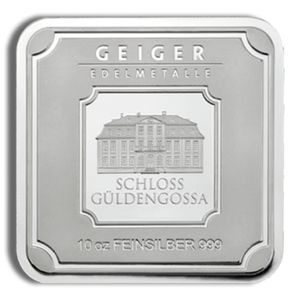
Standard markings on 10 oz silver bars typically include the weight, purity, the mint or refinery name, and in many cases a serial number or assay certification number. Minted bars from producers like the Royal Canadian Mint and Geiger Edelmetalle feature particularly precise dimensions and consistent surface finishes, while cast bars may show natural surface irregularities that result from the pouring process. The Geiger bar, for instance, measures 61.8 mm x 61.8 mm with an 8 mm thickness, giving it a distinctive square profile unlike most rectangular bar formats.
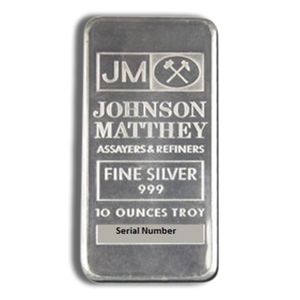
Physical dimensions vary meaningfully across brands at this weight. The Asahi Refining bar measures 90 mm x 46 mm, while the Johnson Matthey bar is 76 mm x 51 mm and 7 mm thick. The PAMP Suisse cast bar comes in at 88.5 mm x 39 mm with a 10.4 mm thickness. These variations reflect different production processes and mold designs rather than differences in silver content, which remains fixed at ten troy ounces regardless of brand.
Available Brands, Mints, and Product Variations
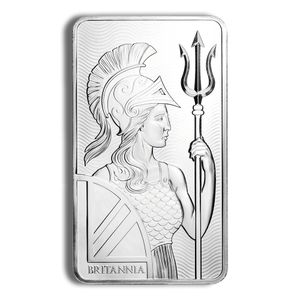
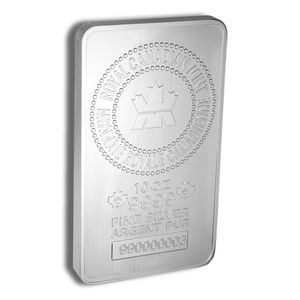
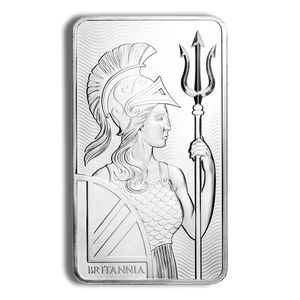
The Royal Canadian Mint bar is among the most precisely manufactured options in our lineup, measuring 90.02 mm x 51.92 mm with a thin 2.04 mm profile that results from its minted production process. It carries a .9999 purity designation and reflects the RCM's reputation for consistent quality across its silver product range. The Royal Mint's Britannia bar shares similar dimensions and carries the recognizable Britannia design, offering .999 fine silver from one of the world's oldest government minting institutions.
Asahi Refining brings a well-regarded American refinery presence to this weight class. Asahi acquired Johnson Matthey's North American refining operations in 2015, and their bars are considered among the most liquid in the secondary market. Speaking of Johnson Matthey, their vintage bars remain highly sought in the secondary market due to their long history in precious metals refining and strong brand recognition among experienced silver buyers. Engelhard bars carry similar historical prestige and are frequently listed in our catalog as random-design products, meaning the specific bar design may vary.
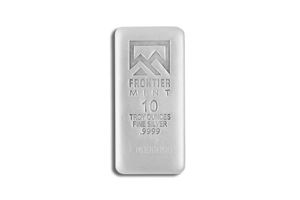
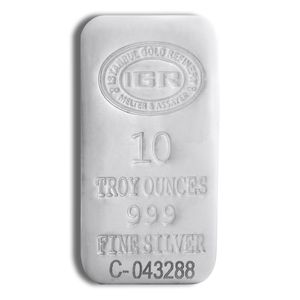
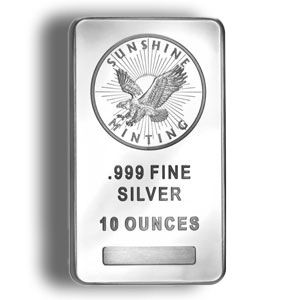
PAMP Suisse's cast bar represents Swiss precision in a pour-format package, while Geiger Edelmetalle's square minted bar offers a distinctive alternative from Germany with sealed packaging. The Istanbul Gold Refinery bar, cast in Turkey and measuring 64.5 mm x 34.85 mm with a substantial 15 mm thickness, provides a compact, chunky profile consistent with its cast production method. Frontier Mint rounds out the domestic American options with two cast bar variants, one with a mirrored finish and one with a sandblast texture, both refined to .9999 purity. Sunshine Mint's sealed-packaging bar and the Argentia Sculpture bar from Canada add further variety, while our random brand and multi-brand listings provide practical options for buyers focused primarily on silver content over brand specificity.
Pricing, Premiums, and Market Factors
The price of a 10 oz silver bar is determined by the current spot price of silver multiplied by ten, plus a premium that reflects production costs, brand recognition, packaging, and market demand. Premiums on 10 oz bars are generally lower on a per-ounce basis than those on 1 oz bars or fractional silver, but higher than what's typically available on 100 oz bars or 1,000 oz commercial bars. This places the 10 oz format in a practical middle zone where per-ounce efficiency and manageable unit size coexist.
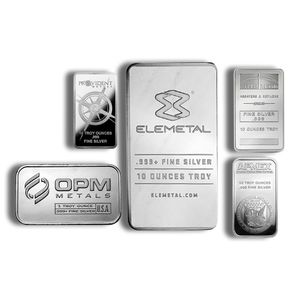
Brand and packaging significantly influence where a specific bar falls within that premium range. A sealed Geiger bar or a Royal Canadian Mint minted bar will typically carry a higher premium than a generic or random-brand cast bar, reflecting the production quality, institutional backing, and secondary market demand associated with those names. Conversely, multi-brand listings like the NTR, Elemetal, OPM, APMEX, or Provident option, or our generic random-brand listings, are priced closer to spot and appeal to buyers prioritizing silver content over brand identity.
Bullion Standard's pricing is tied directly to real-time market conditions, with no hidden fee structures layered into the product price. Our bid/ask spread, displayed on each product page, reflects the true cost of the round-trip transaction and gives buyers a clearer picture of what ownership actually costs relative to spot. This transparency is central to how we operate as a marketplace, and it's particularly useful when comparing bars that carry meaningfully different premiums based on brand or format.
Condition, Packaging, and What to Expect
Most new 10 oz silver bars ship in mint-sealed packaging, individual plastic flips or sleeves, or assay card packaging depending on the producer. The Geiger bar arrives in its signature sealed outer packaging, while the Sunshine Mint bar also comes sealed. Cast bars like the PAMP Suisse, IGR, and Frontier Mint variants may ship in individual protective sleeves without assay cards, which is standard for the cast format. Minted bars from government institutions such as the Royal Canadian Mint and The Royal Mint typically feature more formal packaging consistent with their broader product presentation standards.
Cast bars will naturally show surface variation, minor flow lines, rough edges, and crystalline texture resulting from the cooling process. These characteristics are inherent to the format and are not considered defects. Minted bars present a cleaner, more uniform appearance with clearly stamped text and smooth fields, but minor handling marks or light surface abrasions may be present on bars that were packaged without individual hard plastic protection.
Random-brand and multi-brand listings are supplied from available stock, meaning you may receive a bar from any of the named producers at the time of fulfillment. These products meet the stated purity and weight specifications but may not arrive with original packaging. Buyers selecting these options should expect standard bullion condition, which means the bar may show light signs of handling or storage rather than pristine presentation.
Authenticity and Verification
Every silver bar sold through Bullion Standard is verified for authenticity, weight, and purity before it reaches a customer. Our sourcing network draws exclusively from reputable mints, refineries, wholesalers, and authorized distributors, and our purchasing team applies consistent verification procedures to all incoming inventory. This applies equally to well-known branded bars and generic products.
Established producers take additional steps to protect against counterfeiting. Sunshine Mint incorporates its proprietary Mint Mark SI security feature into its minted bars, which allows authentication using a decoder lens. Geiger Edelmetalle's sealed packaging includes security features that indicate tampering. PAMP Suisse bars produced in the minted Fortuna format include veriscan anti-counterfeiting technology, though the cast bar in our catalog does not. The Royal Canadian Mint uses advanced anti-counterfeiting measures across its silver product range, including laser micro-engraving on select items.
For buyers purchasing vintage or secondary-market bars like Engelhard or Johnson Matthey products, established authentication methods include weight verification, dimensional measurement, ultrasonic thickness testing, and X-ray fluorescence analysis. Bullion Standard applies appropriate verification protocols for all secondary-market inventory before listing. Our A rating with the Better Business Bureau and memberships in the American Numismatic Association and the National Coin and Bullion Association reflect our commitment to product integrity throughout the fulfillment process.
Liquidity and Resale Considerations
Ten-ounce silver bars are among the more liquid bar formats in the physical silver market. The weight class is well understood by dealers, wholesalers, and private buyers, and bars from recognized producers like PAMP Suisse, Asahi Refining, the Royal Canadian Mint, and The Royal Mint tend to be accepted without hesitation in most dealer buyback environments. Vintage Engelhard and Johnson Matthey bars carry strong name recognition and generally attract competitive bids due to their historical standing in the market.
Brand recognition matters in resale. Generic or random-brand bars containing .999 silver are technically interchangeable with branded alternatives from a purity standpoint, but they may receive a slightly lower bid in some dealer contexts because there's less price history attached to a specific product. Assay packaging, when intact, can also support resale value by providing documented proof of origin and purity that simplifies the verification step for the buying dealer.
Standardization is one of the key factors that supports liquidity in this format. Because 10 oz bars conform to a consistent weight standard with broadly recognized purity conventions, they can be evaluated efficiently without extensive testing in most cases. Buyers who prioritize liquidity should lean toward bars from well-capitalized mints with broad dealer acceptance, since those products move most easily through both retail and wholesale channels when resale becomes a priority.
Storage and Security
Ten-ounce silver bars are compact enough to store in a variety of secure environments without requiring specialized infrastructure. A standard home safe rated for both burglary and fire resistance is a practical starting point for moderate holdings. Silver is particularly sensitive to humidity, which can cause tarnishing or oxidation over time, so climate control or the inclusion of desiccant packs in sealed storage environments is worth considering for long-term holds.
For larger quantities, professional vault storage through a third-party depository provides an alternative that keeps silver off-site in a purpose-built, insured facility. Many buyers opt for a combination approach, keeping a portion accessible at home while placing the remainder in allocated vault storage. Allocated storage means your specific bars are held separately under your name, as opposed to pooled or unallocated arrangements where you hold a contractual claim to silver rather than specific physical bars.
Bars with sealed or assay-card packaging should ideally remain in their original packaging throughout the storage period. Removing a bar from its sealed packaging can complicate resale verification and may affect the presentation premium that some buyers associate with factory-sealed products. Cast bars without hard packaging should be stored in individual protective sleeves or capsules to prevent surface contact scratches, which, while largely cosmetic on cast silver, are easier to avoid than to explain at the point of resale.
Selling and Buyback Options
Selling 10 oz silver bars back into the market is generally straightforward given the format's standardization and broad dealer acceptance. Most established bullion dealers, including Bullion Standard, maintain active buyback programs for bars at this weight level, and pricing is tied to current spot values adjusted for product-specific premiums and condition. Bars from well-recognized producers like PAMP Suisse, Asahi, the Royal Canadian Mint, or The Royal Mint typically receive competitive bids because their purity and authenticity can be confirmed quickly.
Condition and packaging affect the buyback process in practical ways. Sealed or assay-packaged bars move through verification faster and may support a marginally better bid than bars with damaged packaging or no documentation. Cast bars are evaluated primarily on weight and purity, since their surface texture makes cosmetic condition a less meaningful factor. Vintage bars from brands like Engelhard and Johnson Matthey are assessed on weight, purity, and brand recognition, with original stamps in legible condition being a positive factor in the evaluation.
Bullion Standard's two-way market structure is built around the principle that liquidity should be considered before a purchase is made, not only at the point of sale. Our purchasing team actively bids on the same products we sell, and our buyback pricing reflects real-time market conditions rather than arbitrary discount schedules. Customers looking to sell can initiate the process through our platform, and the experience is structured to be as transparent as the buying side of the transaction.
Why Buy 10 oz Silver Bars?
The 10 oz silver bar format appeals to buyers who want efficient silver content at a competitive per-ounce premium without committing to the larger capital outlay of a 100 oz bar. At ten troy ounces per unit, these bars are easy to handle, simple to count, and practical to store in stacks or rows within a safe or vault. For buyers accumulating silver incrementally, this size allows meaningful additions to a position without requiring the purchase price of a much larger bar format.
Silver's dual role as both a monetary metal and an industrial material supports consistent wholesale demand that helps maintain market depth for silver bars at this weight class. Industrial applications ranging from electronics and photovoltaics to medical devices and electrical contacts mean silver trades against a backdrop of genuine consumption demand, which is distinct from metals that exist primarily in investment form. That underlying demand contributes to the active secondary market that makes 10 oz silver bars relatively easy to buy and sell through established channels.
The variety of producers available at this weight level is another practical advantage. From government mints like the Royal Canadian Mint and The Royal Mint to iconic private refineries like Engelhard and Johnson Matthey to contemporary producers like Asahi and PAMP Suisse, buyers can select a bar that reflects their preferences around brand recognition, format, finish, or packaging style. That selection depth is relatively unique to this weight class and gives buyers options that simply aren't available at every size point in the silver bar market.
Why Buy from Bullion Standard?
Bullion Standard has been operating as a precious metals dealer since 2010, built around a straightforward principle: trust is earned once and requires consistent effort to maintain. Every aspect of our platform, from how we source and verify products to how we price and fulfill orders, is structured to reflect that commitment. We're headquartered in San Diego, California, hold an A rating with the Better Business Bureau, and maintain active memberships in the American Numismatic Association and the National Coin and Bullion Association.
Our pricing structure is designed for transparency rather than obfuscation. Spot-based pricing is updated in real time, and the bid/ask spread displayed on each product page reflects the actual market cost of a round-trip transaction. Rather than presenting a single retail price divorced from market context, we expose the mechanics of how silver is priced so buyers can make decisions based on complete information. Accepted payment methods include Visa, Mastercard, American Express, Discover, PayPal, bank-connected payments through Plaid, wire transfer, paper check, and cryptocurrency through BitPay.
The two-way market model sets us apart from conventional retail dealerships. We don't just sell silver, we buy it back through the same platform, using competitive pricing that reflects real-time wholesale market conditions. This approach means customers who purchase from us have a clear path to liquidity when their priorities change, and it encourages us to price products honestly from the outset rather than relying on an asymmetric relationship between the buy and sell sides of the transaction. Our goal is to function more like a genuine marketplace than a one-directional retailer.
Get Near-Spot Pricing with Bullion Standard Pro
Bullion Standard Pro is designed for buyers who want direct access to wholesale-level pricing on physical silver. Members transact at live, executable wholesale bid and ask prices rather than fixed retail price points, meaning the premium and spread they see reflect real-time supply and demand in the wholesale market rather than a static markup applied by a dealer. For buyers purchasing 10 oz silver bars with any regularity, the pricing efficiency available through Pro can result in meaningfully tighter acquisition costs over time.
The platform also provides access to proprietary market intelligence tools that go beyond a standard product listing. Members can evaluate silver bars using historical premium data, premium percentile rankings, bid/ask spread analysis, liquidity metrics, and buy/sell ratio indicators drawn from broader wholesale market activity. These tools allow buyers to assess whether current pricing on a specific bar is favorable relative to its own historical range, rather than relying solely on spot price movement as the only reference point.
Portfolio valuation through Bullion Standard Pro uses live executable wholesale bid pricing rather than estimated retail values, giving members a more realistic picture of what their holdings are worth at current market clearing prices. Combined with the absence of additional dealer markups on member transactions, the platform is structured to bring a level of pricing transparency to physical silver ownership that more closely resembles how sophisticated financial market participants evaluate and transact in liquid asset classes. For buyers serious about understanding what they own and what it's actually worth in the market, Bullion Standard Pro provides tools that most retail bullion platforms simply don't offer.


 (833) 278-4653