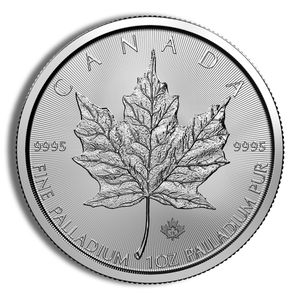
Buy Palladium Maple Leafs Online
Our catalog features the 1 oz palladium Canadian Maple Leaf in brilliant uncirculated condition, struck by the Royal Canadian Mint to a purity of 0.9995 fine palladium. These coins are offered as random year selections, meaning the specific year on the coin varies based on available inventory, but each piece meets the same exacting production standards regardless of date. At 34mm in diameter and 3.2mm thick, the Maple Leaf is one of the most dimensionally consistent palladium coins on the market.
Bullion Standard operates as a transparent precious metals marketplace, and that philosophy extends to how we present palladium products. Pricing reflects live spot conditions, and our product pages display the bid/ask spread so buyers can evaluate the full cost of ownership before committing to a purchase. We believe that kind of clarity matters most when you're buying a metal like palladium, where premiums and liquidity dynamics differ meaningfully from gold or silver.
Whether you're adding a single coin to your holdings or building a position across multiple pieces, the palladium Maple Leaf represents one of the few government-issued palladium coins available from a major sovereign mint. That distinction has real bearing on both acquisition and eventual resale.
What Are Palladium Maple Leafs?
Palladium Maple Leafs are legal tender bullion coins issued by the Royal Canadian Mint and denominated at 50 Canadian dollars. Each coin contains exactly one troy ounce of palladium refined to 0.9995 fineness, placing them among the purest palladium coins produced by any government mint. The obverse carries the traditional effigy of the Canadian monarch, while the reverse features the iconic maple leaf design that defines the entire Maple Leaf bullion series across gold, silver, and platinum.
Unlike palladium rounds or bars produced by private refineries, the Maple Leaf carries sovereign backing and an official face value. That legal tender status doesn't determine the coin's market value, which is driven by the palladium spot price and applicable premiums, but it does reinforce the coin's standing as a government-certified product with consistent specifications. Buyers who prioritize standardization and recognizability tend to gravitate toward sovereign coins precisely for this reason.
Palladium itself occupies a narrow niche within the broader bullion market. The metal doesn't have the same retail depth as gold or silver, which means fewer product formats, fewer mints actively producing coins, and a more concentrated pool of widely recognized products. The Maple Leaf is one of a small number of government-issued palladium coins that trade with meaningful liquidity at the wholesale level.
History and Background
The Royal Canadian Mint introduced the palladium Maple Leaf in 1005, making Canada one of the earliest sovereign mints to issue a palladium bullion coin for the broader market. The series was initially discontinued after modest demand, then reintroduced in 2005 and again in subsequent years as palladium's profile in industrial and investment markets evolved. The modern iteration of the coin reflects both improved minting technology and a palladium market that has grown considerably more active since those early years.
Palladium's rise in prominence as a traded metal is closely tied to its role in automotive catalytic converter manufacturing. As emissions standards tightened in major markets through the 1990s and 2000s, demand from the automotive sector intensified, drawing more attention to palladium as a commodity with meaningful supply constraints. The majority of the world's palladium supply comes from Russia and South Africa, and that geographic concentration has periodically contributed to supply disruptions that influenced wholesale pricing and market premiums.
Against that backdrop, the palladium Maple Leaf became one of the few widely recognized coins that allowed buyers to hold physical palladium in a standardized, government-issued format. The Royal Canadian Mint's reputation for precision manufacturing and consistent quality added credibility to the series, and the coin's design continuity with the broader Maple Leaf program helped establish it within established dealer networks and wholesale markets.
Purity, Weight, and Specifications
Each 1 oz palladium Maple Leaf contains one troy ounce of palladium refined to 0.9995 fineness. That purity level means the coin is 99.95% pure palladium, with trace amounts of other metals to support structural integrity during striking. The 0.9995 standard is consistent across the Maple Leaf series and places these coins among the highest-purity palladium products available from a sovereign mint.
The coin measures 34mm in diameter and 3.2mm in thickness, specifications that have remained consistent across production years and make the Maple Leaf compatible with standard coin holders, capsules, and storage formats designed for 1 oz bullion coins. The face value of 50 Canadian dollars is struck onto the coin as part of its legal tender designation, though the coin's actual transactional value in the market reflects the prevailing palladium spot price plus applicable premiums.
Troy ounce conventions apply to all palladium bullion products, including the Maple Leaf. One troy ounce equals 31.1035 grams, which differs from the standard avoirdupois ounce used in everyday commerce. This distinction matters when comparing weight-based pricing across different product formats or when calculating the total palladium content of a position held across multiple coins.
Available Brands, Mints, and Product Variations
Our current palladium offerings center on the 1 oz palladium Canadian Maple Leaf produced by the Royal Canadian Mint, one of the world's most technically accomplished sovereign mints and the institution responsible for the entire Maple Leaf bullion series. The Royal Canadian Mint operates under federal mandate and maintains strict quality controls across its bullion production lines, which is reflected in the dimensional and compositional consistency of the Maple Leaf across production years.
The random year designation on our listing means the specific date struck on the coin will vary. Coins are sourced from available inventory, and the year of issue is determined by what's currently in circulation through wholesale channels rather than by individual selection. Random year products typically carry narrower premiums than date-specific coins because they're priced for bullion content rather than numismatic preference. For buyers focused on palladium content and product quality rather than a particular year, random year coins represent a practical and cost-efficient format.
Because the palladium coin market is considerably smaller than gold or silver, the range of sovereign producers is limited. The Maple Leaf, alongside the American Palladium Eagle from the United States Mint, represents one of the few government-issued palladium coins with established secondary market recognition. Private mint palladium rounds and bars exist but trade differently in terms of liquidity and dealer recognition. The Maple Leaf's position within that narrow field reinforces its standing as a benchmark product for physical palladium buyers.
Pricing, Premiums, and Market Factors
Palladium is priced in troy ounces and quoted against a spot price that reflects real-time trading in the global commodities market. The premium paid above spot for a palladium Maple Leaf accounts for minting costs, distribution expenses, dealer margins, and supply conditions at any given time. Because the palladium market is less liquid than gold or silver, premiums on palladium coins can be more volatile and may widen or tighten depending on wholesale supply availability and overall market activity.
Palladium's relatively small market means that shifts in industrial demand, particularly from automotive manufacturing, can have a more pronounced effect on spot prices and premiums than similar shifts would in the gold or silver markets. Supply concentration in Russia and South Africa adds another layer of variability, as production disruptions or export constraints have historically moved spot prices significantly. These dynamics don't change the bullion content of the coin, but they do influence the cost of acquiring one and the conditions under which it can be sold.
Bullion Standard's pricing structure reflects real-time market conditions and is presented with transparency on each product page. The bid/ask spread displayed on our listings shows both the acquisition price and the current buyback level, giving buyers a complete view of the transaction before any purchase is made. That kind of pricing clarity is particularly valuable in a market like palladium, where premiums and spreads can differ substantially from those in more actively traded metals.
Condition, Packaging, and What to Expect
Palladium Maple Leafs in our catalog are graded brilliant uncirculated, meaning they're struck for collector and investor quality rather than general circulation. BU coins are produced with dies designed to bring out fine detail and surface quality, and they're handled to avoid contact marks or surface wear from the time they leave the mint. That said, minor variations in surface appearance are normal for bullion-grade coins and don't affect the metal content or the coin's acceptability in the broader market.
These coins are typically packaged in multiples of 10 per inner pack, consistent with standard wholesale distribution for the Maple Leaf series. Individual coins may be delivered in protective coin capsules or as loose coins depending on sourcing. Because these are random year products sourced from existing inventory, the packaging presentation may vary. Buyers should expect the coin itself to meet BU standards regardless of how it's packaged.
Random year selection means you won't know the specific date on the coin at the time of purchase. If a particular year matters for collection purposes, a random year listing is not the appropriate product. For buyers focused on the metal content and the coin's fundamental characteristics, the year of issue has no bearing on palladium content, purity, or the coin's acceptance at the dealer and wholesale level.
Authenticity and Verification
The Royal Canadian Mint employs several manufacturing and security features in its Maple Leaf series to support authenticity verification. Palladium Maple Leafs struck in recent years incorporate a radial line security feature on the coin's field, which creates a micro-engineered pattern that is difficult to replicate and serves as a visual authentication tool. The precise edge reeding and strike quality of genuine Maple Leafs are also consistent indicators that experienced dealers and grading services use during verification.
Bullion Standard verifies the authenticity, weight, and purity of every product before it reaches customers. Our sourcing network includes established mints, authorized distributors, and reputable wholesale counterparties, and our intake process includes physical verification steps appropriate to each product type. Palladium, like platinum, requires specific testing approaches given its density and appearance, and our team is equipped to handle those distinctions.
For buyers who want independent verification, third-party grading services such as PCGS and NGC offer authenticated and encapsulated grading for palladium Maple Leafs. Bullion Standard is an authorized dealer for both services, which means we can facilitate grading requests and help customers understand the process and its implications for resale and storage.
Liquidity and Resale Considerations
Palladium is a less liquid metal than gold or silver, and that reality shapes the resale environment for palladium Maple Leafs. The coin is one of a small number of sovereign palladium products with meaningful recognition among bullion dealers, which helps maintain its resale profile relative to privately minted alternatives. Dealers who actively purchase palladium generally prioritize recognizable products from sovereign mints, and the Maple Leaf qualifies on that basis.
The market for physical palladium is more concentrated, meaning fewer dealers maintain active buyback programs and bid/ask spreads can be wider than those seen in gold or silver. Understanding that spread before buying is an important part of evaluating the full cost of ownership for any palladium product. Bullion Standard's product pages display this spread in real time so buyers can assess the complete transaction picture rather than focusing only on the acquisition premium.
Condition and packaging matter at the point of resale. BU-grade coins in acceptable condition, ideally in their original capsules or protective holders, typically command better pricing than coins showing handling marks or damage. Random year coins are generally valued on metal content and condition rather than date, which means maintaining the coin's physical integrity is the most practical way to preserve its resale position.
Storage and Security
Palladium Maple Leafs are relatively compact coins, and their 34mm diameter makes them compatible with standard 1 oz coin capsules and rigid plastic coin holders. Protecting the coin's surface from scratches and handling marks is worthwhile from a condition standpoint, particularly if resale is part of the long-term plan. Individual capsules or coin tubes designed for 1 oz bullion coins provide adequate protection for home storage scenarios.
For larger holdings, third-party vault storage offers a more secure and insured environment. Several reputable vaulting services operate across the United States, providing allocated or segregated storage options that keep your specific coins separate from other customers' holdings. Vault storage also simplifies the insurance picture, as home insurance policies often have strict limits on coverage for precious metals kept on the premises.
Environmental conditions matter for long-term storage. Palladium is chemically stable and resistant to oxidation under normal conditions, but maintaining a low-humidity storage environment and avoiding contact with chemicals or reactive materials is good practice for any precious metal coin. Keeping coins in their original packaging or in certified coin holders reduces the risk of surface damage from handling or environmental exposure over time.
Selling and Buyback Options
Selling palladium Maple Leafs back into the market follows a straightforward process with any dealer who maintains an active palladium buying program. The buyback price offered by a dealer will reflect the current palladium spot price, the dealer's applicable margin, and an assessment of the coin's condition and packaging. Coins in BU condition with intact protective packaging generally receive stronger bids than coins showing wear or damage.
Bullion Standard operates a two-way market, meaning customers can both purchase and sell precious metals within the same platform. Our purchasing team evaluates palladium Maple Leafs using current wholesale market pricing, and the bid price displayed on our product pages reflects our real-time buyback position. We believe buyers should understand the resale side of the transaction before they commit to a purchase, not after, and our pricing structure is designed to make that evaluation straightforward.
When selling through Bullion Standard, the process involves submitting the coins for evaluation, confirmation of the applicable buyback rate, and settlement through your preferred payment method. Because palladium is a less commonly traded metal, buyers interested in selling should expect that the available pool of active buyers may be narrower than for gold or silver, which is one reason why sticking with sovereign-minted products from recognized programs like the Maple Leaf is worth considering from the outset.
Why Buy Palladium Maple Leafs?
Palladium Maple Leafs occupy a rare position in the precious metals market as one of the few sovereign-issued palladium coins produced by a major government mint. That distinction matters because the dealer and wholesale networks that handle palladium actively tend to recognize and accept coins with sovereign backing more readily than privately produced alternatives. For buyers who want exposure to palladium in a coin format, the Maple Leaf is one of the most practical choices available.
The automotive sector remains the dominant driver of palladium demand globally, with catalytic converters accounting for the majority of annual consumption. That industrial demand profile gives palladium a different fundamental character than gold, and for buyers interested in diversifying their physical metal holdings beyond traditional gold and silver, palladium provides meaningful differentiation. The Maple Leaf packages that exposure in a standardized, government-certified format.
At 0.9995 fineness, the palladium Maple Leaf also meets the purity thresholds required for inclusion in certain retirement account structures that permit physical precious metals, which broadens its potential use cases. Combined with the Royal Canadian Mint's reputation for consistent quality and the Maple Leaf's established recognition in the market, these characteristics make the coin a functional and recognizable format for palladium buyers across a range of objectives.
Why Buy from Bullion Standard?
Bullion Standard was founded in 2010 and operates from San Diego, California, with a business model built on pricing transparency and long-term customer relationships. Our marketplace is designed to function more like an informed trading environment than a traditional dealer setup. That means live pricing, visible bid/ask spreads, and a clear accounting of both acquisition costs and current resale values on every product page.
We source products from reputable mints, authorized distributors, and established wholesale counterparties, and every product goes through a verification process before reaching customers. Our A rating with the Better Business Bureau, membership in the American Numismatic Association and the National Coin and Bullion Association, and authorized dealer status with both PCGS and NGC reflect a commitment to professional standards that spans every part of the operation.
Secure checkout is supported across a wide range of payment methods, including Visa, Mastercard, American Express, Discover, PayPal, bank-connected payments through Plaid, wire transfer, paper check, and cryptocurrency through BitPay. Our customer service team is accessible and responsive, and our fulfillment process is built for reliability. We don't treat the post-purchase experience as an afterthought, because we understand that trust is established across the entire transaction, not just at the point of sale.
Get Near-Spot Pricing with Bullion Standard Pro
Bullion Standard Pro is designed for buyers who want direct access to wholesale market pricing rather than standard retail premiums. Members transact at live, executable wholesale bid and ask prices, meaning the pricing they see reflects actual market conditions rather than fixed retail markups applied on top of those conditions. For palladium, where premiums can be more variable and spreads can be wider than in more liquid metals, the ability to transact closer to wholesale levels carries real practical value.
The platform also provides access to proprietary analytics tools, including historical premium data, spread analysis, liquidity metrics, and market intelligence drawn from wholesale market activity. These tools allow members to evaluate palladium products with the same kind of objective market data that institutional participants use, rather than relying on product descriptions or marketing claims alone. Portfolio valuation through Bullion Standard Pro uses live executable wholesale bid pricing, so members see their holdings valued at current liquidation levels rather than estimated retail prices.
For buyers who purchase palladium with any frequency, or who want a clearer picture of how their holdings relate to current market conditions, Bullion Standard Pro provides a more analytically grounded and pricing-efficient way to participate in the physical palladium market. The membership structure removes the traditional dealer markup layer and places members directly within the wholesale pricing environment, which is a meaningful structural difference from how most retail bullion transactions are executed.


 (833) 278-4653