Buy $10 Goldback Notes Online
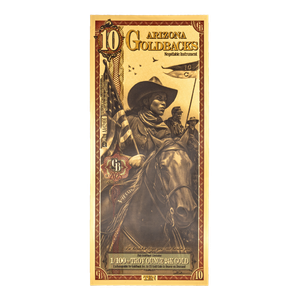
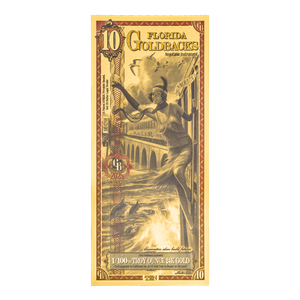
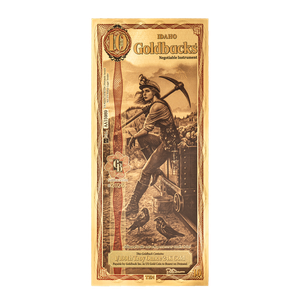
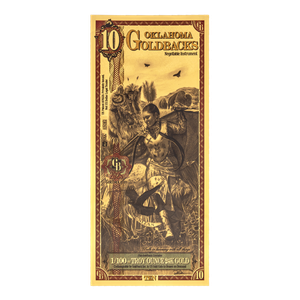
Our catalog of $10 Goldback notes brings together state-specific aurum notes from Arizona, Florida, Idaho, and Oklahoma, each produced by Valaurum and containing 1/100 troy oz of .999 or .9999 fine gold embedded within a flexible, currency-style format. These are among the most distinctive physical gold products available on the market today, combining artisan design with verifiable gold content in a denomination practical enough for everyday handling and gifting.
Each note in this collection is manufactured to Goldback's established aurum standard, making them recognizable across the growing network of merchants and buyers who accept Goldbacks as a voluntary local currency. Bullion Standard sources these directly through reputable distribution channels and presents them with transparent, real-time market pricing so buyers can evaluate cost relative to gold content without ambiguity.
Whether you're exploring Goldbacks for the first time or adding specific state designs to an existing collection, this section of our catalog covers the core $10 denomination across multiple state series, with each product clearly identified by design, purity, and gold weight.
What Are $10 Goldback Notes?
Goldbacks are a form of voluntary complementary currency made from physical gold. Unlike traditional bullion coins or bars, Goldbacks are produced using a proprietary aurum process developed by Valaurum, in which ultra-thin layers of 24-karat gold are laminated between polymer sheets to create a flexible, paper-like note that contains a precise, measurable amount of gold. The $10 denomination contains 1/100 troy oz of fine gold, making it one of the higher-denomination notes in the series.
The format is fundamentally different from coins or rounds. Goldbacks are not struck from a solid blank or poured into a mold. The gold content is distributed evenly across the note's surface through the aurum process, giving each note a translucent, luminous appearance when held up to light. This format makes fractional gold ownership practical at a level that's difficult to achieve with minted coinage without significant per-unit fabrication premiums.
Buyers are drawn to $10 Goldback notes for several reasons: the recognizable state-themed artwork, the novelty of the aurum format, the utility as a voluntary local exchange medium in participating communities, and the appeal of owning a physically small but genuinely gold-containing asset. They occupy a distinct niche that sits between collectible numismatics and conventional bullion.
History and Background
The Goldback concept was developed by Valaurum, a Utah-based company founded with the specific goal of creating spendable gold notes in small enough denominations to be practical for everyday voluntary exchange. The first Goldback series launched in Utah in 2019, and the program has since expanded into multiple states including Nevada, New Hampshire, Wyoming, South Dakota, Arizona, Florida, Idaho, Oklahoma, and others. Each state series features original artwork reflecting local heritage, history, and iconography.
Valaurum's aurum process was developed over several years as a solution to the fundamental problem of fractional gold: the cost of fabricating a coin or round containing only 1/1000 or 1/100 of a troy ounce far exceeds the metal value alone. By embedding gold into a flat, flexible note format through a proprietary lamination process, Valaurum made it possible to produce denominations small enough to function as practical exchange instruments while keeping fabrication costs proportionate to the gold content.
The broader context for Goldbacks sits within a long tradition of complementary and commodity-backed local currencies, but the aurum format represents a genuinely modern approach to that tradition. Since 2019, the program has grown in merchant acceptance and collector interest, and the $10 denomination has become one of the most recognized within each state's series. The expansion into states like Florida, Arizona, Idaho, and Oklahoma reflects sustained demand and production capacity from Valaurum's manufacturing operation.
Purity, Weight, and Specifications
Each $10 Goldback note contains 1/100 troy oz of fine gold, equivalent to approximately 0.3110 grams. The Arizona Goldback is produced to .999 fine gold purity, while the Florida, Idaho, and Oklahoma notes are produced to .9999 fine gold purity. Both purity standards are well within internationally recognized bullion-grade specifications, and the difference between .999 and .9999 is minimal in practical terms for most buyers.
The gold content is embedded within each note using Valaurum's aurum lamination process, which distributes the gold evenly across the note's surface area between polymer protective layers. The result is a note that is visually transparent in areas where the gold layer is thinnest and more opaque gold in color where the layer is concentrated. Each note is sized similarly to a standard U.S. currency note but is noticeably thicker and more rigid due to the lamination construction.
Unlike minted coins, Goldbacks do not carry a face value assigned by a government mint. Their denomination system, expressed in "Goldback" units rather than dollars, is defined by the issuing program and reflects the gold content assigned to each denomination. The $10 designation corresponds to 1/100 troy oz within the series' consistent denomination structure, where a 1 Goldback note contains 1/1000 oz and a 50 Goldback note contains 1/20 oz.
Available Brands, Mints, and Product Variations
All four products in this section of our catalog are produced exclusively by Valaurum, the sole manufacturer of the Goldback aurum note format. Valaurum controls the entire production process, from the proprietary lamination technology to the commissioned artwork developed for each state series. There are no third-party mints or refineries involved in Goldback production, which gives the product line a consistent quality standard across all state editions.
The four state designs currently available at the $10 denomination are Arizona, Florida, Idaho, and Oklahoma. Each carries original artwork specific to that state's series, designed by commissioned artists and reviewed through an approval process that reflects the cultural and historical character of each state. The Arizona series features imagery tied to the state's landscape and heritage; the Florida, Idaho, and Oklahoma series follow a similar design philosophy while representing their own regional identities.
Goldbacks are not produced in varying finish types the way minted coins are. There are no proof, uncirculated, or bullion-strike distinctions within the Goldback format. The aurum process produces a consistent result across the production run, though slight visual variation can exist between individual notes due to the nature of the lamination process. New state series continue to be introduced periodically, and the $10 denomination is one of the most consistently produced across all active state programs.
Pricing, Premiums, and Market Factors
Goldbacks carry a premium above the gold spot price that is meaningfully higher than what you'd pay for equivalent gold weight in bar or coin form. This is expected and intrinsic to the format. The aurum fabrication process is technically complex, and per-unit production costs are significant relative to the small gold content in each note. Buyers evaluating the $10 denomination should approach it with an understanding that the premium reflects manufacturing costs, the voluntary currency utility, and the collectible appeal of the state-specific designs rather than any expectation of premium compression over time.
Pricing for Goldbacks fluctuates with the underlying spot price of gold, since the gold content is real and measurable. However, because the fabrication premium is a substantial portion of the total cost, short-term gold price movements have a less proportional effect on Goldback pricing than they would on a 1 oz gold bar or coin. The spread between buying and selling prices also tends to be wider than for standardized bullion products, which is an important consideration when evaluating total cost of ownership.
Bullion Standard displays real-time pricing across all Goldback listings, with transparent bid and ask values that reflect current market conditions. Our pricing structure is designed to give buyers a clear view of what they're paying relative to the gold content, without obscuring the premium breakdown. Understanding the full cost picture, including both the acquisition price and what you'd receive when selling, is central to how we approach pricing transparency across the platform.
Condition, Packaging, and What to Expect
Goldback notes are typically shipped in individual sleeves or small protective packaging appropriate to their flat, flexible format. Unlike coins, which may arrive in tubes, mint capsules, or assay cards, Goldbacks are not encapsulated in the traditional numismatic sense. The polymer lamination provides its own built-in protection against moisture and light handling, but the notes can develop surface marks or edge wear if handled without care.
New Goldbacks from authorized distribution should arrive in uncirculated condition, free of creases, significant edge wear, or visible surface damage. Minor handling variations may exist from the production and packaging process, but the standard is consistent across Valaurum's output. Buyers should note that the translucent and metallic visual qualities of the notes can make them appear slightly different under different lighting conditions, which is a characteristic of the aurum format rather than a quality issue.
Because Goldbacks are produced in specific state series and denominations rather than by year, there is no random-year component to these products. The Arizona, Florida, Idaho, and Oklahoma $10 notes you see listed are current production editions from Valaurum, and each represents a distinct design that does not change between production runs unless a series update is issued by the program.
Authenticity and Verification
Authenticity verification for Goldback notes relies primarily on the physical characteristics of the aurum format itself. Genuine Valaurum-produced Goldbacks have a distinctive appearance when held up to light: the embedded gold layer creates a consistent luminous quality across the note surface that is difficult to replicate without access to Valaurum's proprietary process. The polymer lamination is uniform, and the artwork reproduction should be sharp and consistent with published design standards for each state series.
Valaurum is the sole authorized producer of Goldback notes, and there is no equivalent alternative manufacturer using the aurum process. This exclusivity provides a degree of built-in authenticity assurance, since there is no ambiguity about what a legitimate Goldback should look and feel like. Buyers familiar with the format can identify the correct weight, flexibility, and visual appearance by comparison with established notes.
Bullion Standard sources Goldbacks through reputable distribution channels and verifies product authenticity before fulfillment. Our sourcing standards apply to every product in our catalog, including aurum-format notes, and every item we ship is confirmed to meet the specifications listed on the product page. We maintain an A rating with the Better Business Bureau and operate as a member of both the American Numismatic Association and the National Coin and Bullion Association, which reflect our ongoing commitment to product integrity and ethical sourcing.
Liquidity and Resale Considerations
Goldbacks occupy a specific and somewhat narrow liquidity profile compared to standard bullion products. Their resale market is growing but remains more limited than the broad secondary market for gold coins or bars from sovereign mints. The most active resale channels for Goldbacks include specialized dealers, online marketplaces with precious metals sections, and the community of merchants and buyers within voluntary Goldback-accepting networks.
The wider bid/ask spread typical of Goldbacks means that resale pricing will generally reflect a meaningful discount from retail acquisition cost. This is a function of the fabrication premium embedded in the product and the relatively specialized buyer pool compared to, say, a 1 oz American Gold Eagle or a standard gold bar. Buyers who understand this dynamic before purchasing are better positioned to make decisions that align with their actual intentions for the product.
State-specific design appeal, collector interest, and the growing merchant acceptance network for Goldbacks in certain regions do contribute to secondary market activity. Notes from well-established series like Utah and Nevada tend to have the most developed resale recognition, while newer state series like Florida and Oklahoma are still building their secondary market presence. Familiarity with the Goldback program and the aurum format is an important factor in resale efficiency.
Storage and Security
Goldback notes are well-suited to flat storage in archival-quality sleeves, binders with non-PVC currency pages, or small secure envelopes. Because the polymer lamination protects against moisture to a reasonable degree, they are less vulnerable than standard paper notes to minor humidity fluctuations, but they should still be stored away from prolonged exposure to heat, direct sunlight, and sharp temperature swings that can affect the lamination over time.
For larger quantities, a home safe or secure lockbox is a practical option that also protects against theft and physical damage. The flat format of Goldbacks makes them space-efficient in storage relative to the equivalent gold content held in coins or rounds, and small quantities can easily fit within a standard currency-storage binder or sealed container. For buyers holding significant gold value across a Goldback collection, a bank safe deposit box or third-party vault service offers additional security.
Handling Goldbacks by the edges reduces the risk of surface contact that might leave fingerprints or light abrasions on the note face. While the polymer lamination is durable relative to raw paper, treating each note with the same care you'd extend to a collectible banknote or uncirculated coin preserves the overall condition and presentation of the piece over time.
Selling and Buyback Options
Selling Goldbacks back into the market requires working with dealers who are familiar with the format and have an active interest in acquiring them. Not all traditional bullion dealers maintain an active Goldback buyback program, so it's worth confirming buyback availability and current pricing before making a purchase if resale is a consideration. Bullion Standard maintains a two-way market model and our purchasing team evaluates Goldback notes based on current market conditions, product condition, and the specific state series being offered.
Buyback pricing for Goldbacks will reflect the current gold spot price applied to the note's gold content, adjusted for the dealer's acquisition requirements and current wholesale market demand for the specific series and denomination. Because the fabrication premium embedded in Goldbacks is a cost of production rather than a recoverable premium at resale, buyers should anticipate that buyback values will typically be closer to the intrinsic gold value than the original retail acquisition price.
Condition and original packaging matter in the Goldback resale process. Notes that show significant creasing, visible surface damage, or edge wear will typically command lower buyback offers than notes in clean, uncirculated condition. Our purchasing team reviews each submission and prices buybacks transparently based on observable condition and current market pricing, without hidden deductions or ambiguous fee structures.
Why Buy $10 Goldback Notes?
The $10 denomination is the practical centerpoint of the Goldback series for many buyers. It contains enough gold to be a meaningful single unit, at 1/100 troy oz, while remaining accessible in price relative to the higher denominations. For buyers exploring the aurum format for the first time, the $10 note offers a balanced entry point that represents the design quality, gold content, and format characteristics of the broader program without the higher outlay of a 25 or 50 Goldback note.
Collectors drawn to state-themed precious metals products will find the variety across Arizona, Florida, Idaho, and Oklahoma appealing as individual additions to a broader Goldback collection. Each state series carries its own commissioned artwork, and for buyers building a complete set across denominations or across states, the $10 note is a consistent and well-produced piece in each series. The aurum format itself is unlike anything else in the bullion market, which contributes to its appeal among buyers looking for something genuinely distinctive.
For buyers participating in communities where Goldbacks are accepted as voluntary exchange, the $10 denomination is one of the most practical for actual use. Its gold content is meaningful enough to represent real value in a transaction, and its recognizability within Goldback-accepting networks makes it a functional exchange instrument in a way that very small gold fractionals in coin form are not. This dual role as both a collectible and a voluntary currency medium is central to the format's appeal and what sets it apart from conventional bullion alternatives.
Why Buy from Bullion Standard?
Bullion Standard was founded in San Diego, California in 2010 with a commitment to operating as a transparent marketplace rather than a high-pressure retail environment. We've built our reputation over more than a decade by prioritizing pricing clarity, product authenticity, and customer trust in an industry where those qualities are not always the default. Our A rating with the Better Business Bureau and active membership in the American Numismatic Association and National Coin and Bullion Association reflect a consistent standard of professional operation.
Every product we list, including Goldback notes, is sourced through verified distribution channels and confirmed for authenticity before it reaches our customers. We display real-time pricing across all listings, including current bid and ask values, so buyers can see both the acquisition cost and the resale context without navigating through ambiguous pricing structures. Our goal is to remove the information asymmetry that has historically made precious metals purchasing more difficult than it needs to be.
Our two-way market model means you can both buy and sell within the same ecosystem, supported by a purchasing team that prices buybacks based on current market conditions rather than arbitrary discount schedules. Payment flexibility extends across credit cards, PayPal, bank-connected payments, wire transfer, check, and cryptocurrency through BitPay. From checkout through fulfillment and into any future resale, the experience is designed around security, clarity, and long-term customer confidence.
Get Near-Spot Pricing with Bullion Standard Pro
Bullion Standard Pro gives members access to live wholesale bid and ask pricing across a wide range of precious metals products, including aurum-format notes. Rather than displaying indicative retail prices with built-in dealer markups, the Pro platform connects members directly to executable wholesale market pricing that reflects real-time supply and demand. For buyers who transact regularly or are price-sensitive to the spread between buying and selling, this structure provides meaningful pricing efficiency.
Goldbacks carry inherently wider spreads than standard bullion products due to their fabrication costs and more specialized market, but Pro members still benefit from the transparency and wholesale pricing access that the platform provides. The ability to view live bid pricing alongside ask pricing gives members a clear picture of the current liquidation value of what they're buying before committing to a purchase, which is a level of market transparency not commonly available through traditional retail dealers.
Beyond pricing, Pro members gain access to proprietary market intelligence tools including historical premium analysis, spread analytics, portfolio valuation based on live wholesale bid pricing, and broader wholesale market activity data. These tools are designed to help members evaluate products using objective, measurable data rather than marketing claims. For buyers building familiarity with the Goldback market or comparing aurum notes against other fractional gold formats, that analytical foundation supports more informed purchasing decisions across the full catalog.


 (833) 278-4653