Buy 5 Gram Platinum Bars Online
Our catalog of 5 gram platinum bars brings together minted products from two of the most respected Swiss refineries in the industry: Argor-Heraeus and Valcambi Suisse. Each bar is presented in an assay card, confirming purity and weight directly from the source. Buyers who prefer flexibility without sacrificing certification can also choose the random brand option, which delivers a 5 gram bar from a reputable mint in assay packaging at a typically accessible price point.
Every bar in this catalog contains 5 grams of platinum at a fineness of 0.9995, equivalent to approximately 0.1607 troy ounces of pure platinum. Whether you have a specific refinery preference or are simply looking for a cost-effective entry point into physical platinum, the options here are straightforward and consistently sourced. Bullion Standard's transparent pricing model ensures that what you see reflects real-time market conditions, not inflated retail markups.
What Are 5 Gram Platinum Bars?
A 5 gram platinum bar is one of the smallest standardized formats available in the platinum bullion market, making it one of the most accessible ways to acquire physical platinum by weight. These bars are minted rather than cast, meaning they're produced by pressing refined platinum blanks through precision dies to achieve a uniform finish, consistent dimensions, and sharp stamped detail. The result is a clean, recognizable product with visible assay markings and refinery branding.
Compared to larger formats like the 1 troy ounce or 10 gram bar, the 5 gram size carries a higher premium per troy ounce due to the proportionally greater fabrication cost relative to metal content. That said, the smaller denomination appeals to buyers who want to accumulate physical platinum in measured increments without committing to a larger upfront purchase. The format is also popular among those who appreciate the tactile presence of a fine platinum bar in a compact, displayable assay card.
History and Background
Platinum's emergence as a refined bullion product is a relatively modern development compared to gold and silver. While the metal was used industrially throughout the twentieth century, the platinum bar market began taking meaningful shape in the 1970s and 1980s as Swiss refineries like Argor-Heraeus and Valcambi established themselves as global leaders in the production of precision minted bars. These refineries helped define the standards that buyers and dealers still rely on today, including the 0.9995 fineness level that has become the benchmark for platinum bars worldwide.
The growth of the assay card as a packaging standard was closely tied to the maturation of the retail bullion market. As demand for smaller fractional bars expanded, refineries developed tamper-evident assay cards to provide buyers with a verifiable chain of custody from production through sale. This packaging format became particularly important for platinum, where verifying purity and authenticity carries considerable weight given the metal's value density relative to its small physical size.
Today, Swiss refineries continue to dominate the 5 gram platinum bar segment due to their long-standing reputation for consistent quality and globally recognized assay certification. The international dealer network has broadly accepted products from Argor-Heraeus and Valcambi as reference-quality bars, which contributes directly to their liquidity in secondary markets.
Purity, Weight, and Specifications
All three bars in this catalog carry a purity of 0.9995, which is the industry standard for refined platinum bullion. This fineness level means the bar is composed of 99.95% pure platinum with trace impurities not exceeding 0.05%. The metal content of each bar is approximately 0.1607 troy ounces, though the precise figure may vary slightly at the decimal level depending on the source documentation and rounding conventions used by individual refineries.
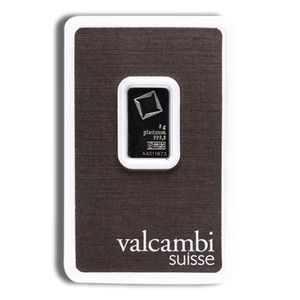
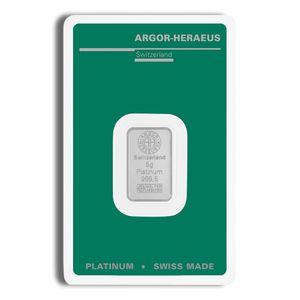
Physical dimensions differ between the Argor-Heraeus and Valcambi bars. The Argor-Heraeus bar measures 23mm in length and 14mm in width at a thickness of 0.9mm, while the Valcambi bar is slightly longer at 33mm with the same 14mm width and 0.9mm thickness. Both are minted format bars, meaning their surfaces are smooth and flat with sharp, defined edges rather than the rougher texture typical of cast bars. Each bar is stamped with the refinery's name, the metal weight, and the purity designation, along with the refinery's logo or assay mark.
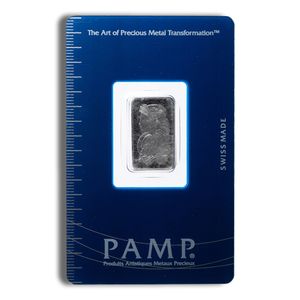
The random brand option shares the same 5 gram weight and 0.9995 purity but does not guarantee a specific refinery, making it ideal for buyers prioritizing metal content and assay certification over brand specificity. This product is always delivered in an assay card, ensuring the bar's authenticity and weight are verified regardless of which refinery produced it.
Available Brands, Mints, and Product Variations
Argor-Heraeus is headquartered in Mendrisio, Switzerland, and operates as one of the world's foremost precious metals refineries. The company produces bars to exacting tolerances and is a recognized good delivery refiner in multiple metals markets. Its 5 gram platinum bar is a clean minted product with a distinctive finish and assay card that includes the refinery's certification. Argor-Heraeus bars are broadly accepted by dealers and institutions worldwide, which supports their secondary market recognition.
Valcambi Suisse, based in Balerna, Switzerland, is another globally recognized refinery with a long history of producing high-precision bullion bars across multiple metals. The Valcambi 5 gram platinum bar is slightly longer than the Argor-Heraeus version and comes in an assay card bearing the Valcambi name, purity stamp, and serial identification. Valcambi is particularly well known for its CombiBars and its consistent quality control across fractional weights, making its platinum bars a reliable choice for buyers who prioritize refinery pedigree.
The random brand option is a practical choice for cost-conscious buyers who want the security of an assay card and confirmed platinum content without a preference for a specific refinery. Products in this category are sourced from reputable mints and refineries and always meet the stated 5 gram, 0.9995 specifications. Because the specific brand is not guaranteed, pricing for this option often reflects a slight efficiency advantage over named-brand products.
Pricing, Premiums, and Market Factors
Like all platinum bullion, 5 gram platinum bars are priced as a function of the current spot price of platinum plus a fabrication and distribution premium. The spot price reflects the live market value of one troy ounce of platinum as traded on international commodities exchanges, and it fluctuates continuously throughout the trading day. Because each bar contains roughly 0.1607 troy ounces, the base metal value is a fraction of the full ounce spot price, and the premium is applied on top of that calculation.
Premiums on 5 gram bars are generally higher on a per-troy-ounce basis than those on larger formats such as 1 ounce or 10 gram platinum bars. This reflects the higher per-unit fabrication cost relative to the amount of metal contained, as well as the assay card packaging, which adds both production cost and a verifiable certification layer. Named refineries like Argor-Heraeus and Valcambi may carry modestly higher premiums than the random brand option due to their brand recognition and broader secondary market acceptance.
Bullion Standard's pricing is structured to reflect real-time market conditions transparently. The bid and ask spread displayed on each product page gives buyers a clear view of both the purchase cost and the current buyback value, providing a complete picture of the total cost of ownership rather than presenting only the purchase price in isolation.
Condition, Packaging, and What to Expect
All 5 gram platinum bars in this catalog are delivered in assay cards, which are sealed, credit-card-sized enclosures that hold the bar in a fixed position behind a clear window. The assay card is heat-sealed at the refinery and includes printed certification details on the reverse, such as the bar's weight, purity, and the refinery's name or logo. Tampering with or opening the assay card is not recommended, as it significantly reduces the bar's secondary market value and removes its provenance documentation.
Because platinum is a dense, hard metal, minted bars typically arrive in pristine condition with clean surfaces and well-defined stamping. Minor handling marks or light contact abrasions on the assay card itself, rather than the bar, are cosmetically possible during shipping and storage and do not affect the bar's metal content or assay certification. Buyers should inspect the seal integrity of the assay card upon receipt and contact Bullion Standard's customer support team if there are any concerns about packaging condition.
Random brand orders are fulfilled based on current inventory and cannot be directed toward a specific refinery. The bar you receive will always carry a recognized brand and assay certification, but the name printed on the card will vary. This variability is reflected in the product listing and should be understood before purchase.
Authenticity and Verification
Every bar sold through Bullion Standard is verified for authenticity, weight, and purity before it reaches our customers. Products are sourced from reputable refineries, wholesalers, and distributors operating within established industry supply chains. Swiss refineries like Argor-Heraeus and Valcambi operate under rigorous internal quality control standards and produce bars that meet internationally accepted purity tolerances, making third-party verification of their assay-sealed products straightforward and reliable.
The assay card itself is a primary anti-counterfeiting measure. Sealed at the point of production, the card is designed to show visible evidence of tampering if someone attempts to open or reseal it. Many assay cards also include holograms, serial numbering, or other embedded security features that further authenticate the bar's origin. These features make the assay card a meaningful line of defense against counterfeit products in the fractional platinum market.
Buyers who purchase outside of established dealer channels should exercise caution. A bar removed from its original assay card is significantly more difficult to verify without specialized testing equipment such as an XRF analyzer or ultrasonic thickness gauge. Purchasing sealed, assay-certified products from a reputable dealer like Bullion Standard provides a clear and documented chain of custody from the refinery to the buyer.
Liquidity and Resale Considerations
Platinum bars from well-recognized Swiss refineries like Argor-Heraeus and Valcambi are broadly accepted in the secondary market, including by bullion dealers, precious metals exchanges, and private buyers. The assay card packaging plays a meaningful role in maintaining liquidity, as it provides immediate verification of the bar's weight and purity without requiring the buyer to independently test the metal. Bars that arrive in broken or opened assay cards will generally be valued differently than sealed examples.
The 5 gram size occupies a niche in the platinum liquidity spectrum. It's recognized enough to trade efficiently through dealer channels, but the smaller weight means individual resale to private buyers may be less practical than selling through a dealer buyback program. Widely recognized refinery brands tend to command tighter spreads in resale scenarios, which is one reason brand selection can matter beyond aesthetics.
Random brand bars are generally liquid as well, particularly when the assay card is intact and the refinery is recognizable, but the absence of a guaranteed brand may result in slightly wider bid/ask spreads depending on current market conditions and the specific brand received.
Storage and Security
Because 5 gram platinum bars are small and relatively easy to misplace, thoughtful storage is worth planning before your first purchase arrives. At home, a quality fireproof safe that is bolted to a structural surface provides a reasonable first line of defense against both theft and environmental damage. Platinum is chemically stable and does not oxidize or corrode under normal conditions, but the assay card packaging can be affected by prolonged exposure to excessive heat, moisture, or direct sunlight.
For buyers accumulating multiple bars over time, a bank safe deposit box is a cost-effective and secure option that removes home storage risk entirely. Institutional vault storage services offered through precious metals custodians are another alternative, particularly for buyers building a more substantial platinum position who want insured, audited storage with a documented chain of custody. Whichever option you choose, keeping bars in their original sealed assay cards is strongly recommended throughout the storage period.
Selling and Buyback Options
Bullion Standard operates as a two-way market, meaning customers can both purchase and sell platinum bars within the same platform. When you're ready to sell, our purchasing team evaluates bars based on current platinum spot prices, the specific product and brand, the condition of the assay packaging, and prevailing market demand. Bars in original sealed assay cards from recognized refineries like Argor-Heraeus and Valcambi generally receive the most competitive buyback pricing due to their verifiable provenance and broad market acceptance.
The buyback process is designed to be straightforward. Customers initiate a sell request, receive a buyback quote based on current market conditions, and ship their bars using insured packaging. Payment is processed after the products are received and verified. Pricing transparency is built into the process: the bid price displayed on each product page reflects our current buyback value, so there are no surprises when it comes time to sell.
Understanding buyback pricing before you purchase is part of making an informed decision. The spread between the purchase price and the current buyback price represents the effective round-trip cost of ownership, and Bullion Standard displays this information openly on every product page. Buyers who want the tightest available spreads and real-time wholesale pricing should explore Bullion Standard Pro, which provides access to executable wholesale bid and ask pricing for qualifying members.
Why Buy 5 Gram Platinum Bars?
Platinum is a functionally distinct metal from gold and silver, and its bullion market reflects that. As one of the densest precious metals, it packs meaningful monetary weight into a very small physical footprint. A 5 gram bar holds roughly 0.1607 troy ounces of platinum in a package not much larger than a thick postage stamp, making it one of the most compact ways to hold refined platinum in physical form.
The fractional format suits buyers who want to establish a position in platinum without acquiring a full troy ounce at once. It also suits those who already hold larger platinum formats and want the flexibility of smaller units for potential resale or allocation purposes. The assay card packaging removes the need for independent verification at the point of sale, streamlining the process of both buying and reselling.
Platinum's industrial demand profile is worth noting in context. The metal is a critical input in catalytic converters, fuel cells, chemical processing equipment, and laboratory applications, among other industrial uses. This demand foundation differs structurally from that of gold, and it's part of what gives platinum its distinct market characteristics relative to other precious metals.
Why Buy from Bullion Standard?
Bullion Standard was founded in San Diego in 2010 and has since grown into a nationally recognized online precious metals marketplace built around a single operating principle: buyers deserve accurate information, transparent pricing, and genuine accountability from their dealer. Our A rating with the Better Business Bureau, membership in the American Numismatic Association and the National Coin and Bullion Association, and authorized dealer status with PCGS and NGC reflect the operational standards we hold ourselves to across every transaction.
Every product sold through our platform is verified for authenticity, weight, and purity before it ships. We source from reputable refineries, wholesalers, and distributors operating within established industry supply chains, and we back that sourcing with documented procedures rather than marketing claims. Our checkout supports a wide range of payment methods, including major credit cards, PayPal, bank-connected payments through Plaid, wire transfer, paper check, and cryptocurrency through BitPay, giving buyers the flexibility to transact in the way that suits them.
Beyond the transaction itself, Bullion Standard is designed to function as a transparent marketplace where buyers can evaluate products using objective data, understand the premiums they're paying, and have a clear path to resale when the time comes. That two-way market structure is central to how we operate and how we earn long-term customer trust.
Get Near-Spot Pricing with Bullion Standard Pro
Bullion Standard Pro is designed for buyers who want direct access to wholesale market pricing rather than standard retail premiums. Members transact at live, executable wholesale bid and ask prices that reflect real-time supply and demand conditions across the wholesale precious metals market. Unlike traditional retail structures, Pro does not apply additional dealer markups or fixed spreads on top of wholesale pricing, allowing premiums and bid/ask spreads to move naturally with the market.
For buyers accumulating platinum in fractional sizes like the 5 gram bar, pricing efficiency matters. Tighter spreads mean a lower effective cost of ownership on each purchase and a closer relationship between your acquisition price and the current market value of what you hold. Pro members can also view live portfolio valuations based on executable wholesale bid prices, giving a more realistic picture of liquidation value than estimated retail figures typically provide.
The platform extends beyond pricing to include proprietary market intelligence tools covering premium history, spread analysis, liquidity metrics, and market sentiment indicators, among others. For buyers who want to evaluate platinum products using objective data rather than dealer recommendations, Bullion Standard Pro provides a more analytically grounded way to participate in the physical precious metals market.


 (833) 278-4653