Buy American Palladium Eagles Online
Our catalog of american palladium eagles spans every major release from the program's 2017 debut through the most recent 2023-W burnished edition, giving buyers access to one of the most complete selections of this coin available from a single dealer. Products include standard bullion strikes, proof and reverse proof finishes, burnished specimens, and professionally graded examples certified by both NGC and PCGS across a range of labels. Each listing reflects the actual inventory sourced directly from the United States Mint and vetted distribution channels.
Buyers will find raw coins in brilliant uncirculated condition alongside certified MS70 and PF70 examples suitable for registry sets or discerning collectors. Several listings include original government packaging with the box and Certificate of Authenticity, preserving the presentation as intended by the U.S. Mint. Pricing at Bullion Standard reflects real-time palladium spot rates, so the premiums you see are transparent and tied directly to current wholesale market conditions rather than arbitrary markup structures.
Whether you're sourcing a raw bullion strike or a mint-sealed proof with full government packaging, our listings are organized to make it straightforward to identify exactly what you're buying before committing to a purchase. Every product in the catalog has been verified for authenticity, weight, and purity prior to fulfillment.
What Are American Palladium Eagles?
American palladium eagles are legal tender coins produced by the United States Mint containing 1 troy ounce of .9995 fine palladium. They carry a face value of $25 and are struck under the authority of the American Eagle Bullion Coin Program, making them among the few palladium bullion coins with official U.S. government backing. The program was authorized by the Palladium American Eagle Bullion Coin Act of 2010, though the first coins were not released until 2017.
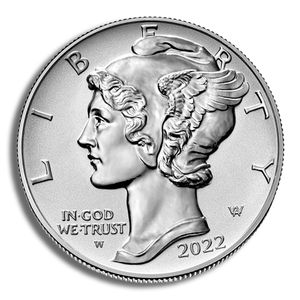
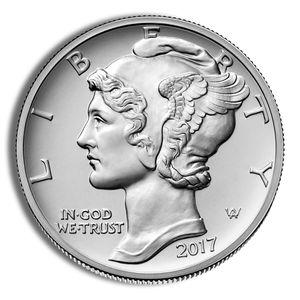
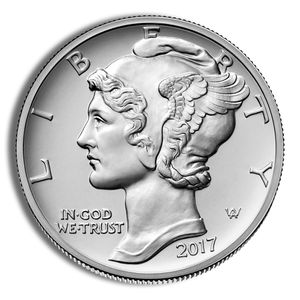
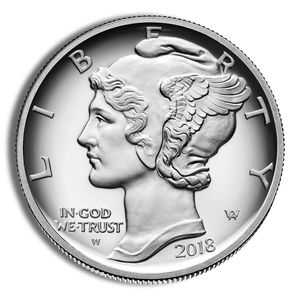
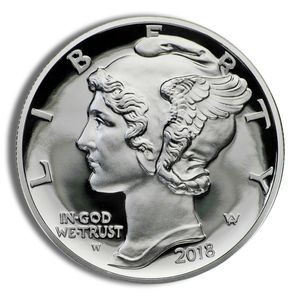
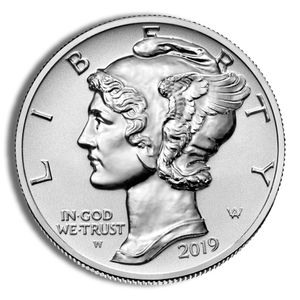
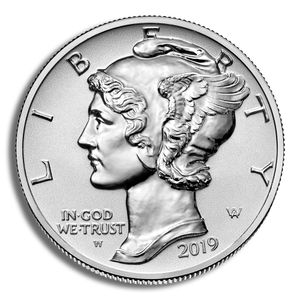
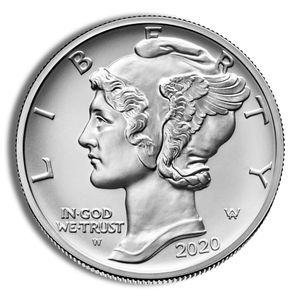
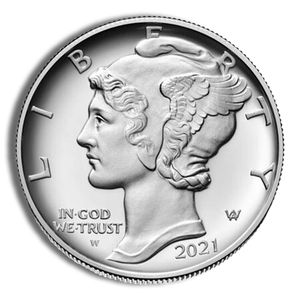
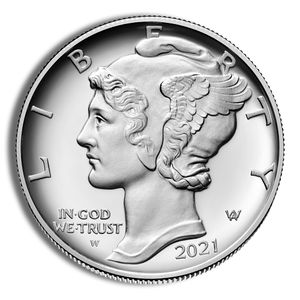
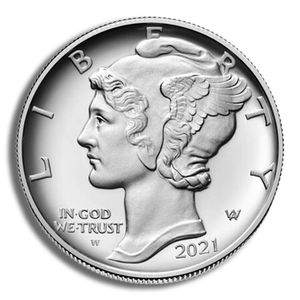
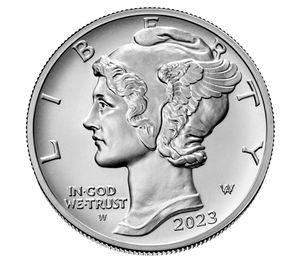
The obverse design is adapted from Adolph Weinman's 1907 Liberty Head design, originally prepared for a proposed half dollar. The reverse features Weinman's eagle in flight from his 1907 American Institute of Architects gold medal. This use of early twentieth-century American numismatic artistry gives the coin a distinctive aesthetic that stands apart from other modern bullion programs. Both proof and reverse proof versions invert the relationship between frosted devices and mirrored fields, creating a markedly different visual presentation from the standard bullion strike.
Unlike gold and silver eagles, which are produced annually in large volumes, palladium eagles are released in more limited quantities and often include special finishes such as proof, reverse proof, and burnished. This production structure means the coins attract both bullion buyers focused on metal content and numismatists interested in the specific finish and certification grade.
History and Background
The American palladium eagle program has its legislative roots in a 2010 act of Congress, but commercial production did not begin until the U.S. Mint launched the first 2017 bullion strike. That inaugural release generated substantial demand relative to mintage, driven in part by the novelty of a government-issued palladium coin from the United States and by palladium's growing prominence in automotive and industrial manufacturing at the time. The 2017 issue remains one of the more recognized releases from the program precisely because of its status as the first.
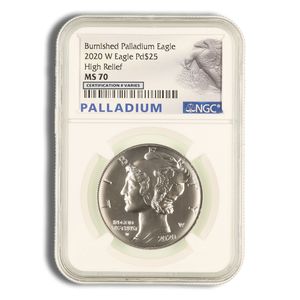
Subsequent years brought significant format diversification. The 2018-W proof was struck at the West Point Mint and released with a box and Certificate of Authenticity, establishing the precedent for the program's collector-oriented releases. The 2019-W introduced the reverse proof finish, while the 2020-W burnished edition offered yet another surface treatment favored by collectors who prefer a non-circulating but matte-like presentation. The 2021-W saw both a standard bullion strike and a proof version released in the same year, a relatively uncommon occurrence within the program's history.
The program's evolution reflects the U.S. Mint's recognition that palladium occupies a distinct position among the four major precious metals. Rather than simply mirroring the format structure of the gold or silver eagle programs, the palladium series has rotated through finishes and formats in a way that creates individual collecting milestones for each year's release. The 2022-W reverse proof and 2023-W burnished editions continue this pattern, keeping the program actively engaged with both bullion buyers and collectors.
Purity, Weight, and Specifications
Every american palladium eagle contains exactly 1 troy ounce of palladium at a fineness of .9995, making it one of the purest palladium coins commercially available. The diameter measures 34.036 mm for most issues, with some years referencing a 34 mm specification depending on the finish and die generation used. Thickness varies slightly by finish, with proof and burnished versions generally measuring 2.5 mm and some bullion issues listed at 3.5 mm.
The $25 face value is a nominal legal tender denomination established by federal statute and does not reflect the coin's market value, which is driven by the current palladium spot price plus any applicable premium. The coin's .9995 purity is consistent across all years and finishes in the program, ensuring that the metal content standard does not vary between a raw 2017 bullion strike and a 2023-W burnished proof-quality example.
Standard bullion issues from 2017 were packaged in tubes of 10 coins, with outer packaging accommodating 100 coins, consistent with U.S. Mint bulk distribution conventions. Later collector-focused releases shifted toward individual presentation cases with accompanying documentation. Understanding these packaging conventions is relevant when comparing listings, since coins removed from original government packaging may carry different secondary market characteristics than sealed examples.
Available Brands, Mints, and Product Variations
All american palladium eagles are struck exclusively by the United States Mint, with collector-finish issues produced specifically at the West Point facility in New York, denoted by the "W" mint mark. The standard 2017 bullion issue did not carry a mint mark, while all subsequent releases from 2018 onward bear the West Point designation. This consistent sourcing from a single government mint reinforces the program's uniformity in terms of metal content and manufacturing standards.
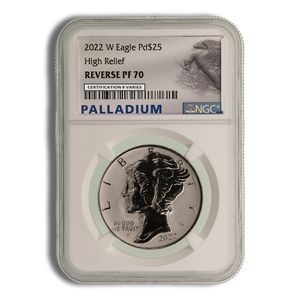
Within our catalog, buyers will find raw coins graded BU alongside professionally certified examples from both NGC and PCGS, the two most widely recognized third-party grading services in the numismatic industry. Certified versions are designated MS70 for burnished or bullion strikes and PF70 for proof and reverse proof examples, representing the highest grade possible on the 70-point Sheldon scale. Label variations exist within certain certified listings, as NGC and PCGS have issued coins under multiple label programs over the years, and these are noted in individual product descriptions.
The 2018-W proof, 2019-W reverse proof, 2020-W burnished, 2021-W proof, 2022-W reverse proof, and 2023-W burnished all represent distinct finish categories, each with its own production characteristics and collector appeal. Raw versions of the proof and reverse proof coins are typically available with the original U.S. Mint box and Certificate of Authenticity, while certified versions are presented in the grading service's standard slab and encapsulation. Buyers interested in a specific year and finish should review individual listings to confirm whether original government packaging is included.
Pricing, Premiums, and Market Factors
The price of any american palladium eagle is directly tied to the current palladium spot price, with a premium applied above that base reflecting production costs, distribution, and market demand. Palladium is one of the more volatile of the four primary precious metals by historical price behavior, and that volatility can influence premiums meaningfully, particularly during periods of constrained supply or elevated industrial demand. Buyers should expect premiums to fluctuate alongside spot price movement, not remain static.
Certified coins, particularly those graded MS70 or PF70, typically carry a higher premium than raw equivalents due to the cost of third-party grading and the incremental collector demand associated with top-pop designations. Proof and reverse proof issues generally command more than standard bullion strikes, and low-mintage years can sustain elevated premiums in the secondary market long after the initial release. The 2017 issue, for example, has maintained a recognized collector following due to its status as the program's inaugural coin.
Bullion Standard displays bid and ask pricing on individual product pages, allowing buyers to evaluate both the acquisition cost and the expected resale value at the time of purchase. This transparency is central to how we operate. Rather than presenting a single retail price in isolation, we believe buyers benefit from understanding the full picture of the transaction, including what the spread looks like relative to current market conditions. Premiums on palladium coins can shift with changes in automotive sector demand, mine supply concentrations in South Africa and Russia, and broader precious metals market sentiment.
Condition, Packaging, and What to Expect
Raw bullion-finish american palladium eagles from 2017 are typically received in the standard U.S. Mint tube packaging, holding 10 coins. These coins are described as brilliant uncirculated but may exhibit minor handling marks or contact lines consistent with bulk mint production, which is standard and expected for non-proof government issues. They are not individually examined for cosmetic perfection unless they have been submitted for third-party grading.
Proof, reverse proof, and burnished issues intended for individual collector release come in original U.S. Mint presentation cases with foam inserts and are accompanied by a Certificate of Authenticity where noted in the listing. These packages are shipped sealed and should arrive in the same condition as received from the Mint's distribution network. Any listing that includes the box and COA will specify this clearly, and buyers should treat that packaging as part of the product's integrity and secondary market presentation.
Certified examples arrive in the tamper-evident plastic slabs issued by NGC or PCGS, which fully encapsulate the coin and display the grade, series label, and certification number on the holder. Slab labels may vary by promotional program or designation, and listings where label assignment is not guaranteed will note "label varies" or "random label" in the product name. Buyers with strong label preferences should contact us prior to purchase to discuss available inventory.
Authenticity and Verification
Every american palladium eagle sold through Bullion Standard is sourced from the United States Mint, authorized distributors, or vetted wholesale channels and verified for authenticity, weight, and metal purity before being made available for sale. The U.S. Mint's production standards for palladium eagles include strict quality control processes at the West Point and Philadelphia facilities, and the .9995 fineness is independently verifiable through professional assay methods.
Certified coins graded by NGC or PCGS have already passed through rigorous third-party authentication and grading procedures before encapsulation. Each slab carries a unique certification number that can be verified directly on the NGC or PCGS online registry, providing an additional layer of confidence in the coin's authenticity and grade. Bullion Standard is an authorized dealer for both NGC and PCGS, which supports our ability to source and represent certified products accurately.
For raw coins, the U.S. Mint's consistent specifications, including the reeded edge, specific diameter and thickness dimensions, and the distinctive Weinman obverse and reverse designs, provide multiple reference points for visual verification. Buyers who intend to hold palladium eagles for extended periods or who are sourcing higher-value certified examples may also consider submitting raw coins to a grading service for independent authentication and encapsulation.
Liquidity and Resale Considerations
American palladium eagles are among the most recognized palladium coins in the U.S. market, and their status as government-issued legal tender with a well-established program history provides a degree of market familiarity that generic palladium products do not always carry. This recognition matters in resale environments, where buyers, dealers, and grading services are more likely to accept coins from known programs with consistent specifications at tighter spreads than less standardized alternatives.
Proof and certified versions, while carrying higher premiums at acquisition, can also command stronger bids in the secondary market, particularly if original government packaging is preserved and the grading service slab is intact. That said, palladium as a metal is traded in a smaller and somewhat more specialized market than gold or silver, which means liquidity can be more sensitive to changes in industrial demand, automotive production cycles, and mine supply dynamics. Buyers should account for this when evaluating the full cost of ownership.
Bullion Standard operates a two-way market, meaning customers can sell palladium eagles back through our buyback program in addition to purchasing them. Evaluating the bid side of the transaction before committing to a purchase gives buyers a clearer understanding of the spread they are accepting, which is among the most honest measures of total acquisition cost available in the physical precious metals market.
Storage and Security
Individual palladium eagles, particularly proof and burnished issues in presentation cases, should be stored in climate-controlled environments that minimize exposure to humidity and temperature fluctuation. The original U.S. Mint packaging provides adequate protection for the coin within, but these boxes are not designed for long-term archival storage in humid or high-temperature conditions. If you plan to hold coins for extended periods, supplemental storage in a sealed container or airtight capsule adds a meaningful layer of protection against environmental degradation.
For raw bullion coins stored in original mint tubes, a quality home safe with fire rating and tamper resistance is the minimum recommended standard for home storage. Bank safe deposit boxes offer an alternative with institutional-level physical security, though access is limited to banking hours. Third-party vault storage through a specialized precious metals custodian provides segregated storage with insurance coverage and is worth considering for larger holdings or for buyers who prefer not to manage security logistics personally.
Certified coins in grading service slabs should be stored upright or in protective slab cases to prevent surface abrasion on the plastic holder over time. Avoid stacking heavy objects on top of slabs, as pressure can stress the seam and compromise encapsulation. Maintaining the slab's integrity is directly relevant to resale value, since damaged holders can raise questions during the buyback or secondary market process.
Selling and Buyback Options
Selling american palladium eagles back into the market involves a similar evaluation process to purchasing them, with key factors including the coin's year, finish, grade, condition, packaging completeness, and the current palladium spot price at the time of the transaction. Proof and certified coins in original packaging typically receive stronger bids than raw coins showing handling wear, and listings where the grading slab remains intact and unaltered are easier to price accurately and transact efficiently.
Bullion Standard's buyback program is structured to provide competitive pricing on the sell side of the transaction. Our purchasing team evaluates products based on current wholesale market conditions, coin-specific liquidity, and the factors listed above rather than applying a one-size-fits-all deduction. Customers considering a sale can request a buyback quote directly through our platform, and the process is designed to be straightforward without requiring customers to navigate a separate or unfamiliar resale environment.
Because palladium trades in a more specialized market than gold or silver, it's worth confirming current buyback terms before making a purchase decision, particularly for higher-premium certified coins where the spread between acquisition cost and resale value warrants careful consideration. Bullion Standard displays bid pricing on product pages precisely to make this evaluation possible at the point of purchase rather than only when a sale becomes necessary.
Why Buy American Palladium Eagles?
American palladium eagles occupy a distinct position in the bullion market as the only U.S. government-issued palladium coin, giving them a level of institutional backing and recognizability that privately minted palladium products cannot replicate. For buyers who prioritize government-sourced metal with legal tender status, the palladium eagle is the only domestic option that meets that standard in a full troy ounce format.
The program's limited annual releases and rotating finishes create a defined collecting structure that appeals to numismatists as well as bullion buyers. Each year's issue, whether a bullion strike, proof, reverse proof, or burnished coin, represents a discrete collectible milestone rather than a generic interchangeable unit. Collectors who are building a complete set by year and finish have a finite and well-defined program to pursue, which is a quality not shared by many other bullion programs of comparable age.
Palladium itself is primarily sourced from mines in South Africa and Russia, with meaningful demand driven by catalytic converter production in the automotive industry. The metal's relatively concentrated supply and ongoing industrial applications give palladium fundamentals that differ meaningfully from gold and silver, providing portfolio diversification across metals with distinct supply and demand characteristics. For buyers interested in holding physical palladium specifically, the american eagle format delivers both metal content and institutional credibility in a single product.
Why Buy from Bullion Standard?
Bullion Standard was founded in San Diego in 2010 with a clear operating principle: transparency first, in pricing, sourcing, and customer communication. That philosophy is reflected across every part of the platform, from the way premiums are displayed to how buyback pricing is communicated before a purchase is made. We don't operate on high-pressure sales tactics, and we don't obscure the spread between what you pay and what you'd receive if you sold the same product back the following day.
Every american palladium eagle in our inventory is sourced from the United States Mint, authorized distributors, or verified wholesale channels. Products are checked for authenticity, weight, and purity as part of our standard fulfillment process. As an authorized dealer for both NGC and PCGS, we are positioned to source and represent certified products with accuracy. Our A rating with the Better Business Bureau and memberships with the American Numismatic Association and the National Coin and Bullion Association reflect our commitment to operating with integrity across all customer interactions.
Our checkout process supports a wide range of payment methods, including Visa, Mastercard, American Express, Discover, PayPal, bank-connected payments through Plaid, wire transfer, paper check, and cryptocurrency payments through BitPay. Fulfillment is handled through a secure and reliable shipping infrastructure, and our customer service team is accessible for questions before and after purchase. We've built this platform to function more like a transparent marketplace than a traditional bullion retailer, because we believe that's what buyers deserve.
Get Near-Spot Pricing with Bullion Standard Pro
Bullion Standard Pro gives members access to live, executable wholesale bid and ask pricing across a broad range of precious metals products, including palladium. Unlike standard retail pricing models that apply fixed dealer markups, Pro pricing reflects real-time supply and demand within the wholesale palladium market. This means premiums and spreads fluctuate naturally based on actual market conditions rather than being held at a static retail level regardless of what's happening in the broader market.
For buyers who transact with any frequency in palladium, the difference between retail and wholesale pricing on a per-ounce basis can be meaningful, particularly given palladium's higher price point relative to silver or platinum. Pro members also benefit from live portfolio valuation using executable wholesale bid pricing rather than estimated retail values, which gives a more accurate picture of what a holding is actually worth in current market conditions. Historical premium data, spread analysis, and liquidity metrics are available to help members evaluate individual palladium eagle listings with the same kind of data-driven context typically reserved for institutional buyers.
The platform is designed to reduce the information asymmetry that has historically characterized the physical precious metals market. By combining transparent executable pricing, product research tools, and proprietary market analytics into a single interface, Bullion Standard Pro gives serious buyers the infrastructure to make more informed decisions on both the buy and sell sides of every transaction. For palladium buyers in particular, where the market is more specialized and liquidity more concentrated, having access to real-time wholesale intelligence is a meaningful operational advantage.


 (833) 278-4653