Buy 5 Gram Gold Bars Online
Our catalog of 5 gram gold bars brings together some of the most respected names in the global bullion market, including Credit Suisse, PAMP Suisse, Valcambi, Perth Mint, Geiger Edelmetalle, and Istanbul Gold Refinery. Every bar in this collection weighs 5 grams and carries a fineness of .9999, representing the standard most associated with modern investment-grade gold. Whether you're drawn to a specific refinery or simply want the most competitively priced option available, the selection here is built to accommodate a range of preferences without unnecessary complexity.
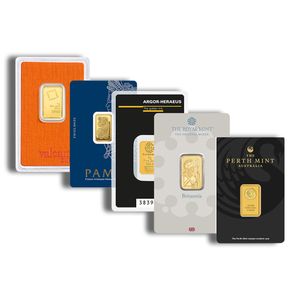
Packaging formats vary across the collection. Most bars are sealed in individual assay cards, which protect the bar, verify its authenticity, and display key specifications such as weight, purity, and the issuing refinery's hallmark. Two products are available as Valcambi CombiBars, which divide a single 5 gram bar into five individually breakable 1 gram segments. A random brand option is also available both with and without an assay card, giving buyers additional flexibility based on their priorities around presentation and price.
Bullion Standard operates as a transparent marketplace built on clear pricing and straightforward sourcing. Rather than layering complexity into the buying experience, our platform is designed to help you evaluate products based on real market data, compare premiums across the catalog, and understand the full picture of what you're buying before placing an order.
What Are 5 Gram Gold Bars?
A 5 gram gold bar sits in the fractional segment of the bar market, positioned above 1 gram and 2.5 gram formats and below the more commonly traded 1 troy ounce standard. At roughly 0.1607 troy ounces, a 5 gram bar represents a meaningful quantity of gold without the capital outlay required by larger formats. This makes it a practical choice for buyers who want physical gold in a compact, precisely weighted unit.
All bars in this range are minted rather than cast, meaning they are stamped or pressed from refined gold blanks to produce a smooth, uniform finish with sharp edges and clearly legible markings. Minted bars generally carry a slightly higher premium than cast bars of the same weight due to the additional production steps involved, but they are also more widely recognized and easier to authenticate by visual inspection. The assay card packaging common across this format reinforces that recognition by providing a tamper-evident enclosure with matching specifications.
Buyers are typically drawn to the 5 gram format for its balance between cost per gram and unit divisibility. It allows for incremental accumulation without committing to larger bar weights, and the standardized sizing is broadly recognized across international bullion markets. The format also stores efficiently and is easy to handle, transport, and resell as a single unit.
History and Background
The modern small-bar market emerged largely in the second half of the twentieth century as refining technology became more sophisticated and demand for accessible gold formats expanded beyond institutional buyers. Swiss refineries played a central role in shaping how small bars are produced and presented today. Credit Suisse and PAMP Suisse, both headquartered in Switzerland, were among the earliest to package fractional bars in assay cards and to treat the bar itself as both a financial instrument and a manufactured product with consistent quality standards. Valcambi, also Swiss, followed a similar trajectory and became one of the largest gold refineries in the world by output.
The German refinery Geiger Edelmetalle brought a distinct square-format design to the market, differentiating its bars visually from the more common rectangular layout used by Swiss producers. Perth Mint, operating under the authority of the Western Australian government, extended the reach of the small-bar market into the Asia-Pacific region and brought government-backed credibility to a format that had historically been dominated by private refineries. Istanbul Gold Refinery, known widely as IGR, expanded the market further into the Middle East and Eastern Europe, where demand for small gold bars has historically been strong.
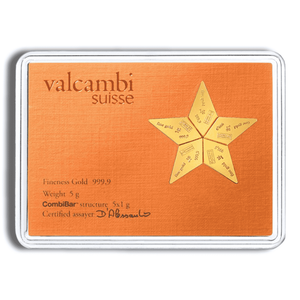
The CombiBar format, introduced by Valcambi, represented a meaningful innovation in how small gold bars are structured. Rather than issuing individual gram bars separately, Valcambi produced perforated sheets that combine multiple segments into a single assay-sealed unit. The 5 x 1 gram Star CombiBar format takes this concept further with a compact, star-shaped configuration of five individually breakable 1 gram segments, each carrying full hallmarking. This format reflects the broader evolution of the small-bar market toward greater divisibility and practical versatility.
Purity, Weight, and Specifications
Every 5 gram gold bar in our catalog carries a gold purity of .9999 fine, also expressed as 24 karat or four nines fine. This is the highest standard purity level in the commercial gold bar market and is maintained consistently across all brands represented here, from Credit Suisse and PAMP Suisse to Geiger, Perth Mint, Valcambi, and IGR. The metal content of 0.1607 troy ounces is consistent across the collection, with minor rounding differences appearing in how individual refineries report their specifications.
Physical dimensions vary by manufacturer. Credit Suisse and PAMP Suisse bars share nearly identical dimensions at approximately 23.3 mm by 14 mm with a thickness around 0.83 mm, reflecting a shared production standard historically associated with their Swiss origins. Geiger bars use a square format at 18.2 mm per side. Perth Mint bars are slightly larger at 23.8 mm by 14.6 mm with a thickness of 1.7 mm. Valcambi bars are marginally narrower than their Credit Suisse counterparts at roughly 23.05 mm by 13.85 mm. The CombiBar format departs entirely from standard rectangular proportions, with the square assay-sealed sheet measuring 34 mm by 34 mm.
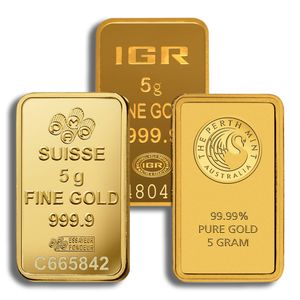
Each bar carries standard assay markings that include the refinery's name or logo, the bar's weight in grams, and its purity level. Many also include a unique serial number or bar number that can be used for authentication and tracking. The assay card enclosure replicates this information externally and is produced by the issuing refinery as an integral part of the bar's certification, not as an aftermarket addition.
Available Brands, Mints, and Product Variations
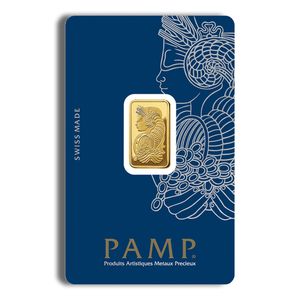
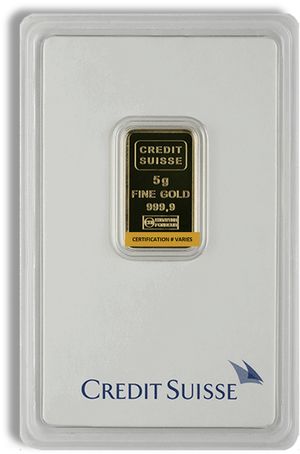
Credit Suisse is one of the most recognized names in the gold bar market, and its 5 gram bar in an assay card remains a benchmark product in the fractional segment. The bank's logo and distinctive card design are broadly familiar to dealers, collectors, and institutional buyers worldwide, which contributes to its recognition at resale. PAMP Suisse, a separate Swiss refinery operating under the MKS Group, offers its 5 gram bar featuring the Lady Fortuna reverse design, one of the most iconic decorative elements in the global bar market. Both bars share the same Swiss manufacturing pedigree and similar physical specifications.
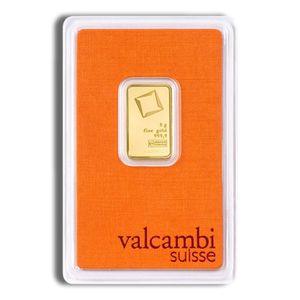
Valcambi is represented in two formats. The standard 5 gram minted bar in an assay card offers a clean, straightforward option with strong refinery recognition. The Valcambi CombiBar Star, available in two versions in our catalog, consists of five 1 gram segments pressed together in a star configuration and individually breakable without tools. Each segment retains its own hallmarking, making separation practical while the unit remains intact for storage and presentation purposes. Perth Mint's 5 gram bar brings Australian government-backed refinery credentials to the format and carries the institution's kangaroo logo along with standard purity and weight markings. Geiger Edelmetalle offers a square-format bar with a distinctive grid-pattern reverse, reflecting the Leipzig-based refinery's signature aesthetic.
For buyers whose priority is price efficiency rather than brand specificity, the random brand options provide access to the same 5 gram .9999 fine gold content from a variety of recognized refineries at potentially lower premiums. The assay-card version includes authentication packaging, while the no-assay version is a loose bar suitable for buyers who prioritize metal content over presentation. The specific brand received with a random selection will vary based on current inventory, but all products sourced this way meet the same weight and purity standards as named brands in the collection.
Pricing, Premiums, and Market Factors
The price of any 5 gram gold bar is composed of two components: the spot price of gold, which reflects real-time trading conditions in the global futures and over-the-counter markets, and the premium above spot charged by the refinery, distributor, and dealer. At the 5 gram size, premiums on a per-gram basis are generally higher than those found on 1 troy ounce bars. This is a consistent characteristic of the fractional bar market across all metals and is driven by the fixed production costs associated with manufacturing, packaging, and distributing smaller units.
Brand recognition directly influences premium levels within the 5 gram segment. Bars from PAMP Suisse, Credit Suisse, and Perth Mint typically carry premiums above the random brand baseline due to their broader international recognition, established distribution networks, and collector familiarity. Geiger and Valcambi occupy a similar tier for buyers familiar with those refineries, while IGR and generic options tend to sit closer to the lower end of the premium range. The CombiBar format commands its own premium structure, reflecting both the design complexity and the added divisibility it provides.
Bullion Standard's pricing is structured around real-time market conditions and updated to reflect current spot prices and wholesale availability. Our platform displays bid and ask pricing on individual product pages, giving buyers direct visibility into the spread between purchase price and buyback value. This transparency is intentional. Understanding the relationship between what you pay and what you'd receive upon resale is a meaningful part of evaluating any precious metals purchase, and we believe that information should be clearly available before the transaction is made rather than discovered afterward.
Condition, Packaging, and What to Expect
Assay-sealed bars are delivered in the original enclosure produced by the refinery. These cards are designed to be tamper-evident, meaning any attempt to open or alter them is visually detectable. The condition of a bar inside an intact assay card is generally considered new, as the enclosure protects against contact, moisture, and handling damage throughout the supply chain. Buyers should not attempt to remove bars from their assay cards, as doing so eliminates the certification and typically reduces resale value.
Loose bars without assay cards, including the no-assay random brand option, may show minor handling marks, surface scratches, or contact wear consistent with storage and transport in bulk. This is standard for unpackaged gold bars and does not affect the metal content, weight, or purity. Buyers who prioritize presentation or plan to resell through channels that value intact packaging should consider the assay-card options instead.
Random brand products will be fulfilled based on current inventory at the time of shipment. The refinery or brand received may differ from any examples shown on the product page. All random brand selections carry the same weight and purity specifications as named products in the collection. Shipment packaging is handled securely and discreetly, consistent with standard precious metals fulfillment practices, and all orders are fully insured in transit.
Authenticity and Verification
Every bar sold through Bullion Standard is sourced from established mints, refineries, authorized distributors, and reputable wholesalers. Before any product enters our inventory, it is verified for authenticity, weight, and purity. This verification process is a baseline operational requirement, not an optional step, and it applies to products from every source in our supply chain. Bullion Standard maintains membership in the American Numismatic Association and the National Coin and Bullion Association, and operates under the professional standards those organizations require of member dealers.
Assay cards provide a primary layer of authentication for bars in this format. Each card is produced by the issuing refinery as part of the bar's original packaging and includes the refinery's name, logo, and specifications alongside the sealed bar itself. Because these cards are tamper-evident, an intact assay card from a recognized refinery is one of the most straightforward authentication signals available to a buyer or dealer evaluating a fractional bar. Additional anti-counterfeiting features are incorporated into some assay card designs, including holographic elements, embossed seals, and microprinting.
Buyers who want independent verification beyond visual inspection can use professional testing methods, including XRF spectrometry, which provides non-destructive elemental analysis of metal composition and purity. This level of testing is available through accredited assayers and is occasionally used for larger purchases or when bars are evaluated outside their original packaging. Bullion Standard is an authorized dealer for both PCGS and NGC, giving customers access to trusted third-party grading and authentication services for products where that layer of verification is relevant.
Liquidity and Resale Considerations
The 5 gram gold bar format is broadly recognized across the international bullion market, though it sits below the 1 troy ounce standard in terms of trading volume and secondary market depth. Bars from globally recognized refineries such as Credit Suisse, PAMP Suisse, Valcambi, and Perth Mint generally carry the strongest secondary market recognition, as dealers and private buyers worldwide are familiar with their hallmarks and authentication characteristics. This familiarity tends to translate into faster transaction times and fewer questions during a resale event.
Intact assay card packaging has a meaningful impact on resale value. Bars presented in their original, tamper-evident enclosures are easier to verify and more acceptable to a wider range of buyers, including dealers, other collectors, and institutional purchasers. Loose bars without assay cards may require additional verification steps at resale, particularly if they originate from refineries whose hallmarks are less universally familiar. The no-assay random brand option reflects this dynamic in its initial premium structure as well.
The CombiBar format introduces a distinct consideration around liquidity. When sold intact as a 5 gram unit, it trades in line with other 5 gram bars from Valcambi. Individual segments separated from the bar trade as standalone 1 gram pieces and are priced accordingly, with the per-gram premium on individual segments typically higher than that of larger integrated units. Buyers considering the CombiBar primarily for its divisibility should understand this dynamic before breaking segments from the whole.
Storage and Security
At 5 grams, these bars are compact and relatively easy to store in a variety of secure environments. A small home safe that meets minimum fire and theft resistance standards is a practical starting point for buyers holding modest quantities. Because the bars are individually sealed in assay cards, they can be stored without additional protective sleeves or holders as long as the enclosures remain intact and undamaged. Assay cards should not be stacked directly under heavy objects or stored in conditions with significant temperature fluctuation or humidity.
For larger holdings or buyers who prefer not to maintain home storage, allocated vault storage through a third-party provider offers a more controlled environment with professional security infrastructure. Many vault providers offer segregated storage options that keep individual bars separate from commingled holdings, which simplifies future retrieval and verification. Bank safe deposit boxes are another option, though accessibility is limited to branch hours and subject to the bank's own policies regarding what may be stored.
Regardless of storage method, maintaining original packaging is advisable from both a preservation and a resale perspective. Loose bars should be stored in protective holders appropriate for their dimensions to minimize surface contact and abrasion. Any storage environment that controls for moisture and avoids direct sunlight will help preserve the bar's appearance over time, which remains relevant even for products whose value is driven primarily by metal content rather than collector condition.
Selling and Buyback Options
Bullion Standard operates a two-way market, meaning customers can both purchase and sell precious metals within the same platform. This structure reflects our belief that liquidity should be factored into a buying decision before a purchase is made, not evaluated separately after the fact. When you're ready to sell, our purchasing team reviews buyback pricing based on current market conditions, the specific product being offered, its mint or refinery of origin, its condition, and whether original packaging is intact.
Products from globally recognized refineries such as Credit Suisse, PAMP Suisse, Valcambi, and Perth Mint are typically accepted without additional authentication steps when presented in their original assay cards, which streamlines the buyback process. Random brand bars and loose bars without assay packaging may require additional review, as they cannot be verified by brand recognition alone. Condition matters throughout this process. A bar in an intact, undamaged assay card from a recognized refinery is the most straightforward product to evaluate and price efficiently.
Our buyback pricing is structured to reflect real-time market conditions rather than fixed schedules, which means the prices we offer move with the market just as our sell-side prices do. This consistency is intentional and part of how we maintain a genuine two-way market rather than simply a retail operation that also accepts sell requests. Customers who want visibility into current buyback pricing for specific products can review bid pricing directly on individual product pages before making any decision to sell.
Why Buy 5 Gram Gold Bars?
The 5 gram format appeals to buyers who want a meaningful quantity of physical gold without the capital commitment required by 1 troy ounce bars. At roughly one-sixth of an ounce, a 5 gram bar represents a natural middle point in the fractional gold bar market, offering more metal than 1 gram or 2.5 gram bars while remaining accessible as a single purchase. The standardized weight and purity across all products in this range make comparison straightforward regardless of which refinery is selected.
The assay card format used across most of this collection adds practical value beyond aesthetics. It protects the bar, confirms its specifications, and simplifies the verification process at resale. For buyers accumulating over time, building a holding of individually certified bars provides a level of documentation that loose bars cannot match. This is particularly relevant for products from prominent refineries whose assay cards are recognized by dealers internationally.
The Valcambi CombiBar format adds a layer of versatility that standard bars do not offer. The ability to break individual 1 gram segments from a single 5 gram unit without tools gives buyers flexibility in how they manage or distribute portions of a holding. For buyers who want the efficiency of purchasing a 5 gram unit combined with the option to handle smaller increments later, the CombiBar represents a distinct format that the standard bar market doesn't replicate.
Why Buy from Bullion Standard?
Bullion Standard was founded in 2010 and has grown from a San Diego-based local operation into a nationally recognized online precious metals marketplace by staying focused on a straightforward principle: transparency above everything else. That philosophy shapes how we price products, how we source inventory, and how we handle every part of the customer experience from first inquiry through post-purchase support. Our A rating with the Better Business Bureau and our membership in the American Numismatic Association and the National Coin and Bullion Association reflect the standards we hold ourselves to operationally.
Every product we sell is verified for authenticity, weight, and purity before it enters our inventory. We source from reputable mints, refineries, and authorized distributors, and we do not list products whose provenance we cannot verify. Checkout is secured and supported by a wide range of payment options including Visa, Mastercard, American Express, Discover, PayPal, bank-connected payments through Plaid, wire transfer, paper check, and cryptocurrency through BitPay. Fulfillment is handled reliably with full insurance coverage in transit.
Beyond the transaction itself, Bullion Standard provides product research tools, bid and ask pricing visibility, historical premium data, and proprietary analytics that help buyers evaluate products using objective market information rather than marketing claims. Our goal is to reduce the information gap that has traditionally existed in this industry and give customers the data they need to make decisions they can feel confident about, both at the time of purchase and over time.
Get Near-Spot Pricing with Bullion Standard Pro
Bullion Standard Pro is designed for buyers who want to transact closer to the wholesale level of the precious metals market. Members gain access to live, executable wholesale bid and ask pricing across a broad range of products, including gold bars in the fractional segment. Unlike standard retail pricing structures, Pro pricing is not supplemented by additional dealer markups or fixed dealer spreads. Instead, premiums and bid/ask spreads reflect real-time supply and demand conditions in the underlying wholesale market.
For buyers who are price-sensitive or who purchase with some regularity, the pricing efficiency available through Bullion Standard Pro can represent a meaningful difference in total acquisition cost over time. The platform also provides live portfolio valuation using executable wholesale bid pricing rather than estimated retail values, giving members a more realistic picture of what their holdings are currently worth in a liquidation scenario. This is a structurally different approach to portfolio visibility than what most retail platforms offer.
In addition to pricing access, Pro members benefit from proprietary market intelligence tools that cover premium tracking, historical premium analysis, spread analysis, liquidity metrics, and comparative product rankings across the broader catalog. These tools are designed to help members evaluate products using data rather than assumptions, identifying where premiums are historically elevated or compressed, and understanding how individual products behave under different market conditions. For buyers who want to engage with the physical gold market with greater analytical depth, Bullion Standard Pro provides the infrastructure to do that within a single platform.


 (833) 278-4653