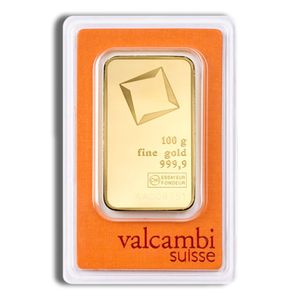
Buy 100 Gram Gold Bars Online
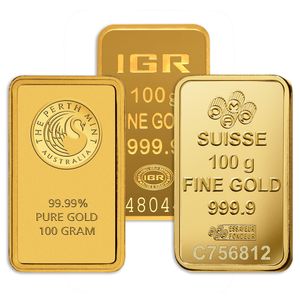
Our catalog of 100 gram gold bars brings together some of the most recognized names in the global bullion market, including PAMP Suisse, Valcambi, Perth Mint, Geiger Edelmetalle, and Istanbul Gold Refinery (IGR). Each bar contains 3.215 troy ounces of .9999 fine gold and is available in assay card packaging that provides tamper-evident protection and mint-stamped authentication. For buyers who prefer flexibility on branding, we also carry random brand options in both assay and non-assay formats.
The 100 gram weight occupies a practical middle ground in the gold bar market. It offers enough metal content to make premium-per-ounce efficiency meaningful while remaining a manageable acquisition for buyers who are not yet ready to commit to 10 oz or kilo-sized bars. Whether you're drawn to a specific refinery's reputation or simply looking for the most cost-effective way to acquire a meaningful quantity of gold, this weight class delivers strong options across multiple price points and packaging formats.
Bullion Standard's pricing is updated in real time to reflect current spot market conditions, and every product listed here comes with full transparency into the premium paid above spot. Our two-way market model means you can both purchase and sell within the same ecosystem, with buyback pricing displayed alongside acquisition costs so you understand the complete picture before committing to a purchase.
What Are 100 Gram Gold Bars?
A 100 gram gold bar is a minted or cast rectangular gold product containing exactly 100 grams of refined gold, which converts to approximately 3.215 troy ounces. Unlike coins, which are struck by government mints and carry legal tender status, gold bars are produced by private refineries and accredited mints operating under internationally recognized refining standards. The 100 gram format is common in both retail and institutional bullion markets and is widely traded across Europe, Asia, and North America.
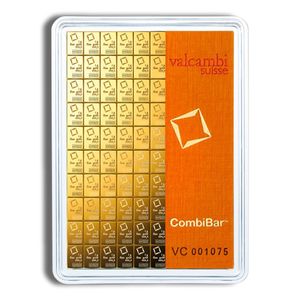
Most 100 gram bars available in today's market are minted rather than cast, meaning they are precision-cut from flat sheets of refined gold and then stamped with weight, purity, and refinery markings. Minted bars tend to feature cleaner surfaces and sharper edges than cast bars, which are poured from molten metal into molds. The products listed here are all minted bars unless otherwise noted, with the Valcambi CombiBar representing a distinct format that allows the 100 gram unit to be separated into 100 individual 1 gram sections.
Buyers choose 100 gram bars for several practical reasons. The format is widely recognized by dealers and refiners worldwide, making resale straightforward. The premium per ounce is generally lower than fractional bars or coins, and the physical size is compact enough to store efficiently without specialized equipment. For buyers accumulating gold over time, the 100 gram bar represents a logical building block that balances cost efficiency with broad market liquidity.
History and Background
The modern gold bar market evolved significantly during the latter half of the twentieth century as private refineries in Europe expanded their capacity to serve growing retail and institutional demand. Swiss refineries played a central role in establishing the minted bar format that remains dominant today. Companies like Valcambi and PAMP Suisse, both headquartered in the Swiss canton of Ticino, were among the first to develop serialized, assay-card-packaged minted bars that could be authenticated and traded internationally with a high degree of confidence.
The 100 gram denomination became particularly popular in Asian markets, where weight-based gold transactions have deep cultural roots and retail buyers often prefer gram-denominated products over troy ounce formats. This demand helped establish the 100 gram bar as a globally recognized standard, and refineries from Germany, Turkey, and Australia eventually entered the market with competing products aimed at both European and international buyers. Geiger Edelmetalle, founded in Leipzig, and the Perth Mint, operating under the backing of the government of Western Australia, brought distinct regional traditions to the same weight class.
Istanbul Gold Refinery entered the market as Turkey emerged as one of the world's leading gold refining hubs, driven by strong domestic demand and a well-developed jewelry manufacturing sector. Today the 100 gram bar is produced by dozens of accredited refineries worldwide, and the format is recognized by the London Bullion Market Association (LBMA) as a standard retail bullion product. The assay card packaging that accompanies most modern minted bars became widespread in the 1990s as concerns about authenticity and chain of custody grew alongside rising retail participation in physical gold markets.
Purity, Weight, and Specifications
Every 100 gram gold bar in our catalog carries a stated purity of .9999 fine gold, which represents 99.99% gold content and is the highest commercially produced purity standard for gold bars. This level of fineness exceeds the LBMA's minimum requirement of .9950 for Good Delivery bars and meets the standards required for gold-backed financial instruments and regulated bullion programs in multiple jurisdictions. Each bar is stamped directly with its purity, gold content, and the refinery's hallmark as part of the manufacturing process.
The physical dimensions of 100 gram bars vary by manufacturer. The PAMP Suisse and Valcambi bars measure approximately 47 mm by 27 mm with thicknesses around 4.3 mm and 4.5 mm respectively. The Perth Mint bar is slightly larger at 47.6 mm by 27.6 mm with a thickness of 5.4 mm. The IGR bar measures 49.96 mm by 28.86 mm with a thickness of 3.72 mm, while the Geiger bar takes a square format at 49.4 mm by 49.4 mm. These dimensional variations are normal across refineries and do not affect the gold content or purity of the product.
Most minted bars are individually serialized with a unique bar number stamped on the reverse or recorded within the assay card documentation. This serial number connects the physical bar to its certificate of authenticity and is one of the primary mechanisms used to verify that a bar has not been tampered with or substituted. Buyers should confirm that the serial number on the bar matches the number on the assay card at the time of receipt.
Available Brands, Mints, and Product Variations
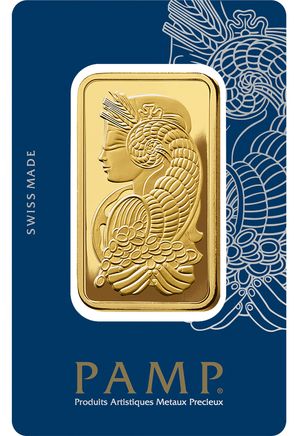
PAMP Suisse is among the most recognized names in the global gold bar market. Their 100 gram Lady Fortuna bar features the iconic Roman goddess design on the obverse, first introduced in 1979, and comes sealed in a Veriscan-enabled assay card that allows the bar's surface to be authenticated using PAMP's proprietary anti-counterfeiting technology. This bar is widely accepted by dealers and financial institutions worldwide and commands strong secondary market recognition.
Valcambi Suisse offers two distinct products at the 100 gram weight. The standard minted bar comes in an assay card format similar to PAMP and features clean, minimalist design aesthetics consistent with Swiss refinery tradition. The Valcambi CombiBar is a fundamentally different format: a single 100 gram gold sheet pre-scored into 100 individual 1 gram sections that can be physically separated without tools. This design appeals to buyers who want the premium efficiency of a larger bar combined with the divisibility of fractional units.
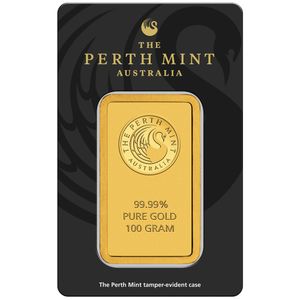
The Perth Mint's 100 gram bar carries the backing of the Government of Western Australia and is produced at one of the world's most technically advanced minting facilities. Geiger Edelmetalle, operating from one of Germany's most storied precious metals refineries, produces a distinctively square bar that reflects the refinery's Central European manufacturing tradition. IGR's bar, sourced from Istanbul Gold Refinery, reflects Turkey's position as a major global refining center and is particularly well recognized in Middle Eastern and European markets. For buyers less focused on specific brand identity, our random brand assay and non-assay options provide access to the same .9999 fine gold content at the most cost-effective premiums available.
Pricing, Premiums, and Market Factors
The price of a 100 gram gold bar is determined by two components: the current spot price of gold multiplied by the bar's troy ounce content, plus a premium above that spot price. The premium reflects the combined costs of refining, minting, packaging, distribution, and dealer margin. Because 100 gram bars involve more processing and per-unit overhead than larger formats like kilo bars, their premiums are typically higher on a per-ounce basis than institutional-grade bars, but lower than most fractional coins and rounds.
Brand and mint reputation have a measurable effect on premium levels. Bars from PAMP Suisse and Perth Mint tend to carry higher premiums than generic or random brand alternatives, reflecting their broader secondary market recognition, stronger authentication infrastructure, and consistent global demand. Assay card packaging also influences pricing: bars sealed in original, intact assay cards typically command slightly higher premiums than equivalent bars sold without packaging, because the assay card provides an additional layer of authentication and simplifies resale.
Bullion Standard's pricing is structured around real-time market conditions rather than fixed retail markups. Each product page displays both the purchase price and the current bid price, giving buyers a transparent view of the bid/ask spread before completing a transaction. This structure reflects our commitment to providing buyers with a complete cost-of-ownership picture rather than focusing narrowly on the acquisition premium. Market conditions, product availability, and wholesale supply dynamics all influence premiums over time, and our pricing updates continuously to reflect those changes.
Condition, Packaging, and What to Expect
Minted gold bars are produced to a commercial bullion standard rather than a numismatic one. Minor surface marks, handling abrasions, or small contact marks are common and do not affect the gold content, purity, or resale value of the bar. Buyers accustomed to coin collecting standards should understand that bullion bars are evaluated differently: condition matters primarily in terms of whether the bar is intact, properly weighted, and free of material damage rather than cosmetic perfection.
Bars purchased in assay card packaging will be delivered with the original sealed card intact. The assay card encases the bar in a tamper-evident holder that should not be opened, as a broken seal can reduce the bar's secondary market appeal and complicate future resale. Random brand bars may arrive in a variety of assay card styles depending on which brands are available in inventory at the time of fulfillment. These products will always meet the stated weight and purity specifications regardless of the brand received.
The non-assay version of the random brand 100 gram bar is sold loose, meaning it is not sealed in an assay card or blister pack. These bars are visually indistinguishable in terms of gold content but may show additional surface handling from storage and transit. They are a cost-effective option for buyers who plan to store bars in a private vault or safe and are less focused on maintaining packaging for resale purposes.
Authenticity and Verification
Every 100 gram gold bar sold through Bullion Standard is verified for authenticity, weight, and purity before reaching a customer. We source products exclusively from reputable mints, refineries, and authorized wholesale distributors, and our receiving process includes physical inspection to confirm that products match their stated specifications. Bars received in assay card packaging are verified to confirm the card's seal integrity and the match between the bar's serial number and the card's certificate documentation.
Modern minted bars from established refineries incorporate a range of anti-counterfeiting measures. PAMP Suisse's Veriscan technology creates a unique microscopic fingerprint of each bar's surface that can be compared against a reference scan to confirm authenticity. Perth Mint bars carry the mint's official assay certificate, and Valcambi bars include security printing on the assay card itself. Geiger and IGR bars rely on consistent hallmarking, serialization, and the reputation of established refining programs. Buyers seeking additional third-party verification can submit bars to independent assayers or precious metals verification services.
For buyers concerned about counterfeit risk in the secondary market, purchasing bars in original, intact assay card packaging from an established dealer is the most reliable way to ensure authenticity. Bullion Standard maintains an A rating with the Better Business Bureau and holds memberships in the American Numismatic Association and the National Coin and Bullion Association. These affiliations reflect our commitment to professional standards and ethical sourcing practices within the industry.
Liquidity and Resale Considerations
The 100 gram gold bar is a broadly recognized format with active resale markets across North America, Europe, and Asia. Bars from major refineries like PAMP Suisse, Valcambi, and Perth Mint are accepted by most bullion dealers, banks, and precious metals brokers without additional verification delays, which makes the liquidation process relatively straightforward compared to less familiar formats or obscure mint programs. The LBMA's accreditation of the major refineries that produce these bars further supports their international acceptance.
Original assay card packaging materially affects resale conditions. Dealers and buyback programs consistently offer better pricing for bars in intact, sealed assay cards than for equivalent bars that have been removed from their packaging. For this reason, buyers who may wish to sell in the future should store assay-packaged bars carefully and avoid opening the card unless absolutely necessary. Random brand bars without assay cards are still broadly tradeable but may require additional verification steps at the point of sale depending on the dealer's procedures.
The Valcambi CombiBar introduces a unique liquidity consideration. While the full 100 gram unit is traded as a standard bar, separated individual 1 gram sections may be treated differently by dealers and may carry higher per-gram premiums or require individual verification. Buyers who purchase the CombiBar primarily as a divisibility tool should clarify resale expectations with their dealer before separating the units, as policies vary across the marketplace.
Storage and Security
At approximately 100 grams per bar, this format is compact and easy to store in a variety of secure environments. A quality home safe with fire and theft resistance is the most accessible option for buyers who prefer direct personal custody. Bars in assay card packaging can be stored flat in a small safe or lockbox without taking up significant space, and the hard plastic assay card provides additional protection against surface contact and environmental moisture.
Bank safe deposit boxes offer an alternative for buyers who prefer institutional storage infrastructure, though access is limited to banking hours and availability varies by institution. Private vault storage through a third-party precious metals depository is a common choice for buyers accumulating larger quantities of gold, as these facilities typically provide insurance coverage, 24/7 security, and segregated storage options that keep your specific bars separate from pooled inventory.
Regardless of storage method, it's worth keeping 100 gram bars in their original assay card packaging whenever possible. The sealed card protects the bar's surface from contact marks and environmental exposure while also preserving the chain-of-custody documentation that simplifies future resale. For bars stored outside of assay cards, individual hard plastic cases or coin capsules sized appropriately for the bar's dimensions offer a practical alternative.
Selling and Buyback Options
Selling a 100 gram gold bar follows a straightforward process through most established bullion dealers. Products are evaluated based on their mint of origin, condition, packaging integrity, and current spot market pricing. Bars from well-known refineries in intact assay card packaging consistently receive the most competitive buyback bids, reflecting their easier resale into the secondary market and reduced verification requirements. Random brand bars and bars without assay card documentation are still broadly tradeable but may be subject to additional inspection or slightly wider bid/ask spreads depending on the buyer.
Bullion Standard operates a two-way market that allows customers to sell back precious metals within the same platform where they made their original purchase. Our purchasing team evaluates products using current market pricing rather than fixed schedules, and bid prices are displayed transparently on product pages so customers can assess their liquidation options at any time. This structure is designed to remove the friction typically associated with finding a buyer and negotiating resale terms independently.
When preparing to sell, buyers should have the original assay card intact and be ready to provide basic product information including the bar's serial number and refinery. Bullion Standard's buyback process is designed to be operationally efficient and pricing-transparent, with terms communicated clearly before a transaction is confirmed. Understanding the current bid price relative to the purchase price gives sellers a realistic picture of where they stand in the market at any given moment.
Why Buy 100 Gram Gold Bars?
The 100 gram bar appeals to buyers who want meaningful gold content in a compact, cost-efficient format. Compared to smaller fractional bars and most gold coins, 100 gram bars carry lower premiums per troy ounce, which means more of the purchase price goes toward gold content rather than manufacturing and distribution costs. This premium efficiency makes the format particularly practical for buyers accumulating gold methodically over time.
The gram-based weight denomination also makes 100 gram bars useful for buyers who prefer to track holdings in metric rather than troy ounce terms, which is common in European, Middle Eastern, and Asian markets. The format bridges the gap between the high accessibility of smaller bars and the institutional scale of kilo bars, making it a natural fit for buyers who have outgrown fractional products but aren't yet ready to commit to larger single-bar purchases.
Brand diversity at this weight is another advantage. Buyers can choose between Swiss refineries like PAMP Suisse and Valcambi, the government-backed Perth Mint, Germany's Geiger Edelmetalle, Turkey's IGR, or cost-effective random brand alternatives, depending on their priorities around provenance, aesthetics, authentication technology, and pricing. This range of options within a single weight class allows buyers to align their purchasing decisions with their specific preferences rather than defaulting to a one-size-fits-all product.
Why Buy from Bullion Standard?
Bullion Standard has operated as a nationally recognized precious metals marketplace since 2010, and our approach has remained consistent throughout: transparent pricing, verified sourcing, and a platform designed to put the buyer's interests first. Every product we list is authenticated before it reaches our customers, and our pricing reflects live market conditions rather than fixed retail markups designed to obscure the true cost of ownership.
Our marketplace is structured around a two-way model, which means we take both buying and selling seriously. Buyback pricing is displayed alongside acquisition costs on each product page, so you can evaluate the spread you're accepting before making a purchase rather than discovering it only when you're ready to sell. This transparency is central to how we operate and how we've built lasting relationships with customers across the country.
We support a wide range of payment methods, including major credit cards, PayPal, bank-connected payments through Plaid, wire transfer, paper check, and cryptocurrency through BitPay, giving buyers flexibility in how they fund their purchases. Our fulfillment process is reliable and secure, and our customer service team is accessible throughout the buying and selling process. Bullion Standard holds an A rating with the Better Business Bureau, maintains memberships with the ANA and NCBA, and is an authorized dealer for PCGS and NGC, providing an additional layer of institutional credibility that matters in this industry.
Get Near-Spot Pricing with Bullion Standard Pro
Bullion Standard Pro is designed for buyers who want to transact closer to the wholesale level. Members gain access to live executable wholesale bid and ask pricing across a broad range of bullion products, including 100 gram gold bars. Unlike standard retail pricing, which reflects fixed dealer margins layered on top of spot, Pro pricing fluctuates naturally based on real-time wholesale market supply and demand. This means the spread you see reflects actual market conditions rather than a predetermined retail structure.
For buyers acquiring 100 gram bars at regular intervals, the pricing efficiency available through Pro can represent a meaningful difference over time. Because no additional dealer markup is applied on top of wholesale market prices, members are transacting at the same level as institutional participants rather than absorbing a retail premium on every order. Portfolio valuations through Pro are also calculated using live executable wholesale bid pricing, giving members a more realistic and current picture of what their holdings are actually worth in today's market.
Pro members also gain access to Bullion Standard's proprietary market intelligence tools, which include historical premium analysis, bid/ask spread tracking, liquidity metrics, and product comparison tools that allow buyers to evaluate 100 gram bars from different refineries using objective market data. These tools are designed to reduce information asymmetry and help buyers make purchasing decisions based on transparent, measurable market conditions rather than marketing claims alone.


 (833) 278-4653