Buy Burnished Silver Eagles Online
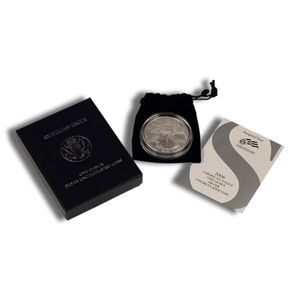
Our catalog of burnished silver eagles spans nearly two decades of annual releases from the United States Mint, covering individual coins from 2006 through 2025. Each coin carries the West Point "W" mint mark, is struck in 1 troy ounce of .999 fine silver, and comes packaged with the original government-issued box and Certificate of Authenticity. Whether you're looking for a specific date, a professionally graded example, or a more accessible raw coin, the selection here reflects the full range of formats this series has produced over the years.
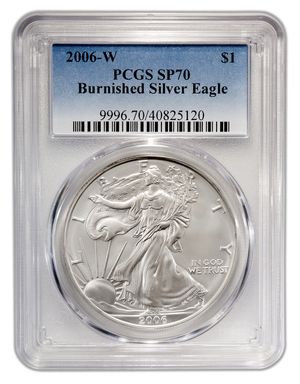
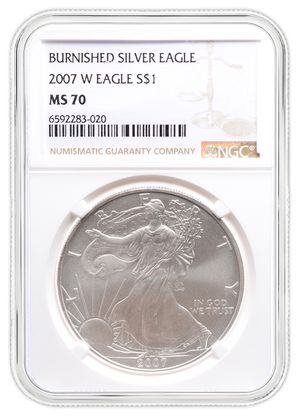
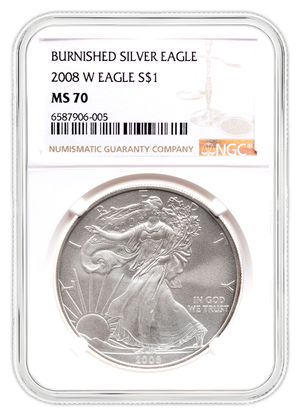
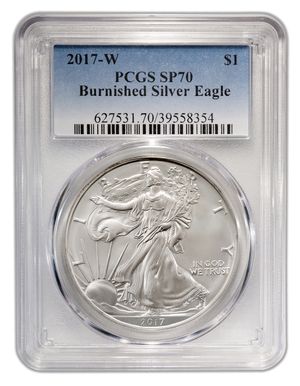
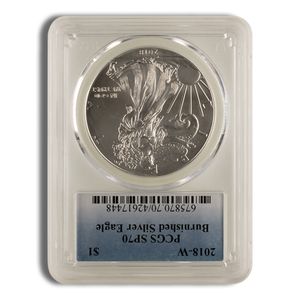
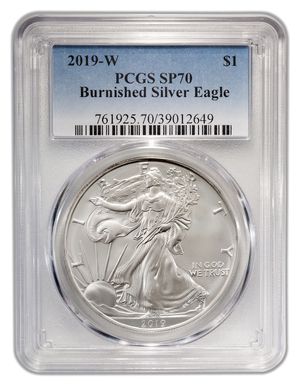
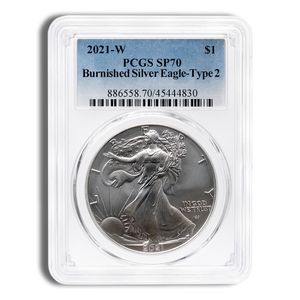
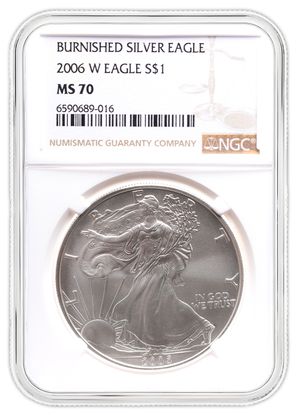
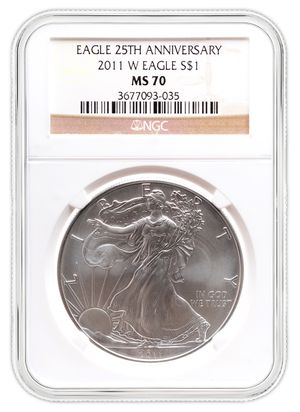
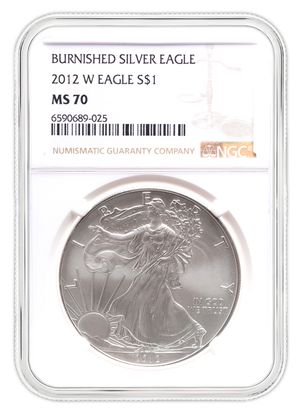
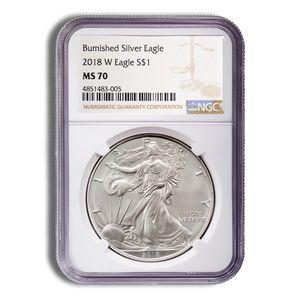
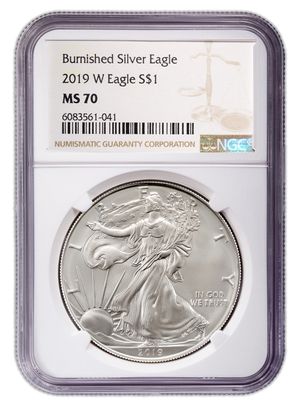
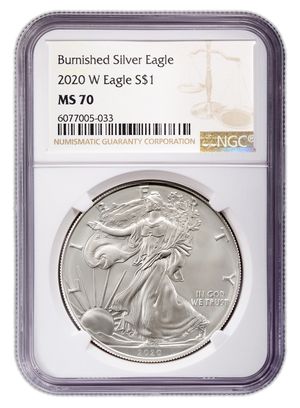
Alongside standard boxed examples, the catalog includes third-party certified coins graded MS70 by NGC and SP70 by PCGS, representing the highest achievable grades from the two most recognized certification services in the industry. Notable entries include the 2008-W Reverse of 2007 variant, the 2021-W Type 2 release, and random-year options that offer access to the series at various price points. Every product listed has been sourced through verified channels and authenticated before reaching Bullion Standard's inventory.
Bullion Standard operates as a transparent, two-way precious metals marketplace, which means you can buy and sell within the same platform using real-time competitive pricing. For buyers focused on this series, that structure matters because it reflects the actual liquidity profile of the coins rather than presenting inflated or opaque valuations on either side of the transaction.
What Are Burnished Silver Eagles?
Burnished silver eagles are a distinct finish variant of the American Silver Eagle coin program. Unlike standard bullion strikes, which are produced using high-speed presses on pre-burnished blanks, burnished coins are struck on specially burnished planchets that give the finished coin a softer, satin-like surface texture rather than the reflective mirror or frosty appearance seen on proof or standard bullion issues. The result is a coin that occupies a middle ground between a standard bullion strike and a collectible proof, offering a refined finish without the deep cameo contrast of a proof coin.
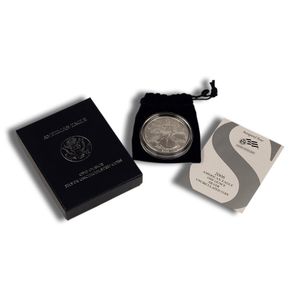
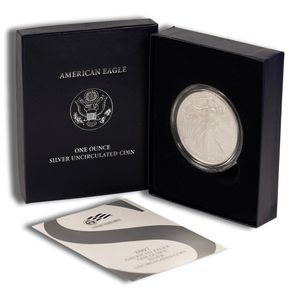
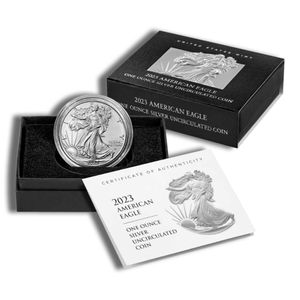
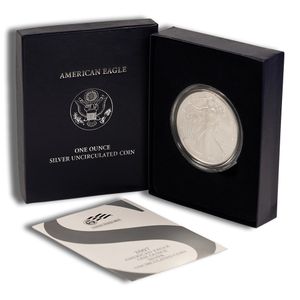
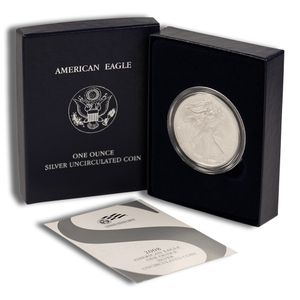
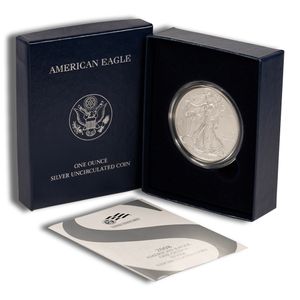
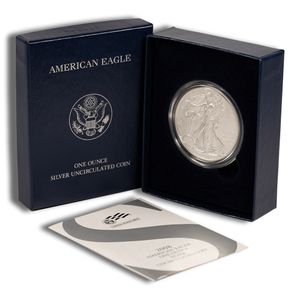
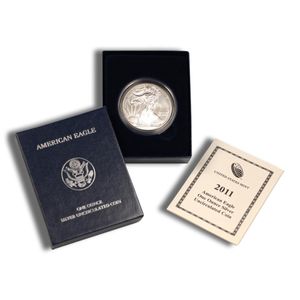
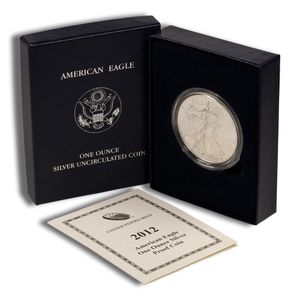
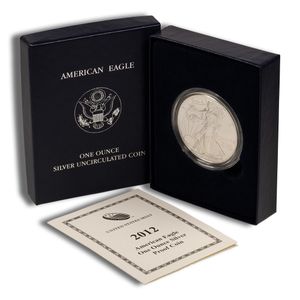
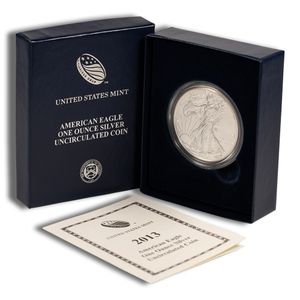
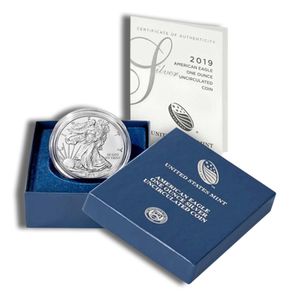
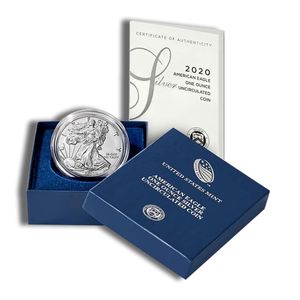
These coins are sometimes referred to as "uncirculated" issues in older literature, which reflects how the United States Mint originally marketed them. The W mint mark distinguishes them from Philadelphia or San Francisco strikes, and the original government packaging, which includes a capsule, protective outer box, and a numbered Certificate of Authenticity, is considered standard for raw examples in the series. Collectors who acquire these coins without original packaging are generally purchasing what the market refers to as "cap-only" or "OGP-removed" examples.
Burnished eagles appeal to a specific segment of the silver market: buyers who want the government-backed authenticity and iconic design of the American Silver Eagle program but prefer a more refined surface quality than a standard bullion coin. They're not typically purchased as bulk silver, but rather as single-coin collectibles or as additions to a date-run collection spanning the years the burnished format was produced.
History and Background
The American Silver Eagle program launched in 1986 as the official silver bullion coin of the United States, authorized by the Liberty Coin Act and backed by the full faith and credit of the U.S. government. For the first two decades of the program, the Mint produced proof and bullion versions but did not offer a burnished variant. That changed in 2006, when the West Point Mint introduced the burnished finish coin as part of a broader expansion of the American Eagle collector coin lineup, coinciding with the program's 20th anniversary year.
Production continued annually through 2008, after which the Mint suspended the burnished eagle program. The series resumed in 2011 and has been issued with occasional gaps since then, creating a relatively short and defined date run compared to many other government-issued series. The 2008 release is particularly notable for including a reverse die design variation, known as the Reverse of 2007, which was struck in limited quantities and has since developed a strong collector following. The 2021 Type 2 issue reflects the broader American Silver Eagle redesign that modernized the reverse of the coin for the first time in the program's history.
Third-party certification of burnished eagles became common early in the series. Because these coins are produced with greater care than standard bullion strikes and come directly from the Mint in protective packaging, a significant portion of the population achieves perfect or near-perfect grades. NGC and PCGS both developed specific population reports for this series, and the demand for certified examples at the MS70 and SP70 levels has shaped how the secondary market prices individual date-grade combinations.
Purity, Weight, and Specifications
Every burnished silver eagle in this catalog is struck to the same government-mandated specifications. Each coin contains exactly 1 troy ounce of .999 fine silver, which is the purity standard required by U.S. law for all American Silver Eagles regardless of finish or mint mark. The coin measures 40.6 millimeters in diameter and 2.98 millimeters in thickness, dimensions that have remained consistent throughout the production history of the series.
The face denomination is one dollar, which gives each coin legal tender status in the United States, though the silver content value far exceeds the nominal face value in any meaningful market context. The W mint mark, struck at the West Point Mint in New York, appears on all burnished examples and is one of the primary distinguishing characteristics between these coins and standard bullion strikes produced at Philadelphia or San Francisco. No serial numbers are applied to individual coins, but each set of original government packaging includes a unique Certificate of Authenticity with a corresponding identification number.
For buyers comparing burnished eagles against other silver coin formats, the 1 oz size and .999 purity place them firmly within the most liquid and recognizable tier of the silver coin market. Fractional silver coins exist in other government programs, but the American Silver Eagle has historically been produced only in the 1 oz denomination, which keeps the burnished series standardized and straightforward to evaluate.
Available Brands, Mints, and Product Variations
All burnished silver eagles are produced exclusively by the United States Mint at the West Point facility. Unlike many private mint products where multiple refineries offer comparable alternatives, the burnished eagle series is a government-controlled program with no private equivalent. That exclusivity is part of what drives collector interest and supports the premium structure of the series relative to generic silver bullion.
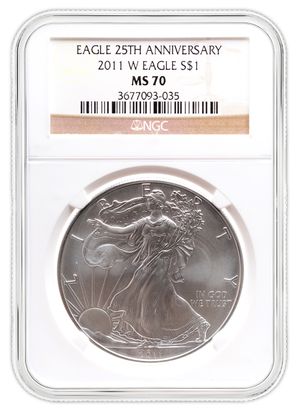
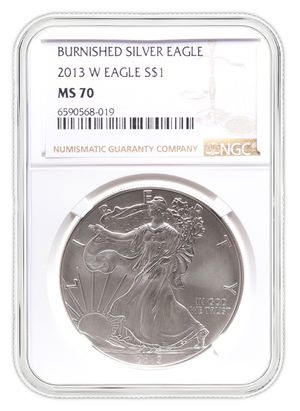
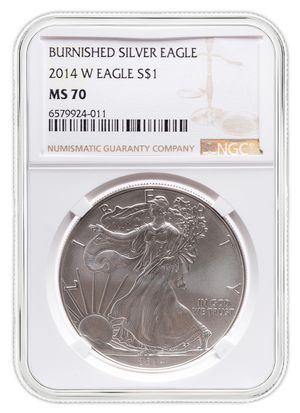
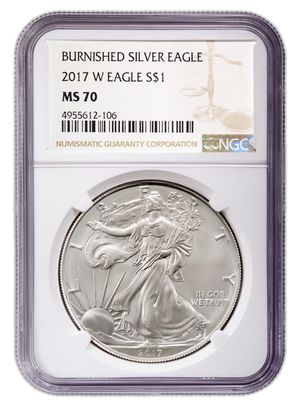
Within the catalog, the primary variations are year, packaging, and certification status. Raw coins with original government packaging and COA represent the standard collectible format. Coins graded MS70 by NGC carry a designation that reflects a perfectly struck example with no post-production flaws visible under magnification, while PCGS-graded examples carry the SP70 designation, which the service applies to burnished and special mint finish coins to distinguish the grading methodology from standard business-strike grading. The 2008-W Reverse of 2007 is a distinct variety within the series that carries its own market pricing and should not be confused with the standard 2008-W burnished issue. The 2021-W Type 2 similarly reflects a redesigned reverse die that applies to all American Silver Eagle production from mid-2021 onward.
The catalog also includes cap-only examples, which are coins that have been removed from their original government packaging, and random-year options for buyers who are less focused on a specific date. These options provide entry points at varying price levels while still offering authentic, government-issued burnished coins backed by the same .999 fine silver content.
Pricing, Premiums, and Market Factors
Burnished silver eagles trade at a premium above the spot price of silver that is generally higher than standard bullion American Silver Eagles. Several factors contribute to this. The burnished finish production process involves additional handling and quality control steps, the mintage figures for burnished issues are considerably lower than standard bullion strikes, and the original government packaging adds both perceived and practical value. These factors combine to create a premium structure that reflects the collector orientation of the product rather than pure silver content alone.
Certified examples carry additional premiums tied to the grade and the grading service. MS70 and SP70 coins command the highest prices within the burnished series because the population of perfect-grade examples is limited relative to total mintage, and certification provides a standardized quality assurance that many collectors require before purchasing. Date scarcity also influences pricing, with years like 2008-W Reverse of 2007 carrying significantly higher premiums than more common dates regardless of certification status.
Bullion Standard's pricing on burnished eagles reflects real-time market conditions and is structured to provide clear visibility into the spot-to-premium relationship on each product page. The bid/ask spread displayed on individual product listings gives buyers a transparent view of both the acquisition cost and the expected resale value, which is important when evaluating a product that carries a meaningful premium above silver's intrinsic metal value. Understanding the full spread, not just the purchase premium, provides a more complete picture of the cost of ownership for any burnished coin purchase.
Condition, Packaging, and What to Expect
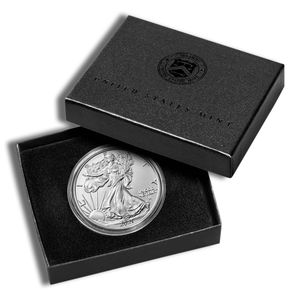
Burnished silver eagles sold with original government packaging arrive in the Mint-issued plastic capsule that protects the coin surface, housed within the official outer box and accompanied by the numbered Certificate of Authenticity. This is the standard presentation format for new and near-new examples of the series and is generally expected by collectors who intend to hold coins in collectible condition. Products listed as "cap only" or without OGP have had the outer box and COA removed but typically retain the original capsule, which continues to protect the coin's surface.
Because burnished coins are struck with greater care than standard bullion, they are more susceptible to surface marks from handling than a typical business-strike coin. Even coins classified as raw and ungraded are expected to show minimal contact marks, consistent with the careful handling expected of a collector-oriented product. Buyers should understand that minor bag marks or capsule rub are possible on raw examples that have changed hands, and that this is a normal characteristic of the product class rather than a defect.
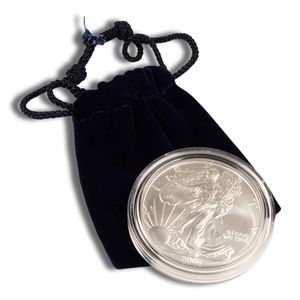
For randomly dated options, specific years are assigned based on current inventory availability. The year received may vary from what is shown in any product image, and the pricing reflects the series broadly rather than a specific date. Buyers seeking a particular year should select date-specific listings within the catalog to ensure they receive the correct coin.
Authenticity and Verification
Every burnished silver eagle is produced by the United States Mint under federal authorization and is struck to published government specifications. The inclusion of the W mint mark, the specific dimensions, and the physical characteristics of the burnished finish all serve as baseline authenticity indicators that experienced buyers and dealers can assess through visual inspection and weight verification. Coins remain in the Mint-issued capsule from production, which limits handling and preserves the original surface condition.
For certified examples, the NGC or PCGS holder provides an additional layer of verification. Both services examine coins for authenticity, grade them against published standards, and encapsulate them in tamper-evident holders with label information that can be cross-referenced against the services' online population databases. Bullion Standard is an authorized dealer for both NGC and PCGS, which means the certified coins listed in our catalog have been sourced through verified channels consistent with the standards both services require of their authorized dealer network.
For buyers who want to independently verify a certified coin's authenticity, NGC's and PCGS's verification tools are publicly accessible online and allow any holder barcode or certification number to be checked against their respective population registries. Bullion Standard encourages buyers to use these tools and supports a transparent purchasing experience grounded in verifiable, publicly available data rather than dealer claims alone.
Liquidity and Resale Considerations
The American Silver Eagle is among the most widely traded silver coin programs in the world, and the burnished variant benefits significantly from that broad market recognition. Dealers, collectors, and buyers across North America are familiar with the series, the relevant date run, and the grading conventions associated with certified examples. This familiarity supports resale across multiple channels, including direct dealer buyback, auction platforms, and peer-to-peer numismatic marketplaces.
That said, burnished eagles trade somewhat differently from standard bullion eagles. Because the premium above spot is higher and the collector orientation is more pronounced, resale value depends more heavily on condition, certification status, date, and packaging than a standard bullion silver coin. Coins with original government packaging in excellent condition hold their collector appeal better than loose or damaged examples, and certified coins at MS70 or SP70 have the clearest price references available through published population and auction data.
Certain dates carry noticeably different liquidity characteristics than others. The 2008-W Reverse of 2007 and the 2021-W Type 2, for example, represent varieties with distinct collector demand profiles that make them easier to value and trade in the secondary market than more common dates. Buyers who understand these distinctions before making a purchase are better positioned to manage expectations around future resale conditions.
Storage and Security
Burnished silver eagles should be stored in a way that protects both the coin and its original packaging. The government-issued capsule provides adequate protection against fingerprints, environmental exposure, and minor physical contact, and coins should remain in that capsule whenever possible. For certified examples, the NGC or PCGS holder serves the same function and should not be opened under any circumstances, as doing so invalidates the certification.
For larger collections, a dedicated coin storage box or album that accommodates the capsule or slab format is a practical solution. Collectors who own multiple years of the series often use purpose-built display boxes or slab storage systems that keep coins organized, accessible, and protected. Storing coins in a climate-controlled environment, away from significant humidity fluctuations, helps prevent toning and surface changes that can affect the coin's appearance over time.
At larger quantities, a home safe with fireproofing and a secure mounting point provides a reasonable balance of accessibility and security. For holdings that extend into significant dollar values, professional vault storage or a safe deposit box at an insured financial institution may be worth considering. Bullion Standard can provide guidance on storage options through our customer support team for buyers who want help evaluating their situation.
Selling and Buyback Options
Bullion Standard operates as a two-way market, which means customers who purchased burnished silver eagles through our platform, or who acquired them elsewhere, can sell directly to us through our established buyback program. Buyback pricing is tied to real-time market conditions and reflects the current spot price of silver alongside the premium profile applicable to each specific product, date, certification status, and packaging format. Buyers who understand this at the time of purchase are better positioned to evaluate the full economics of ownership before committing.
Several factors influence the buyback price offered on any burnished eagle. Certification status and the specific grade hold significant weight, as a PCGS SP70 or NGC MS70 coin commands a different market price than a raw example in the same date. Original government packaging, including the box and COA, adds to the resale value of uncertified coins. Date rarity, current market demand, and overall silver price conditions at the time of sale also factor into the final offer. Products that arrive in damaged capsules or with missing documentation may receive adjusted offers that reflect reduced collector appeal.
The selling process through Bullion Standard is designed to be straightforward and transparent. Sellers initiate a quote request, receive a competitive offer based on current market pricing, and can complete the transaction with shipping arranged through our secure fulfillment process. Our purchasing team evaluates each product based on observable market conditions rather than subjective assessments, which keeps the process consistent and predictable for sellers at every level.
Why Buy Burnished Silver Eagles?
The burnished silver eagle occupies a specific and well-defined niche within the silver coin market. For collectors building a complete set of American Silver Eagle variants, the burnished series represents an essential component of the full collection, covering a date run that includes notable varieties and design changes that distinguish it from the more common bullion and proof issues. The limited production quantities relative to standard bullion strikes give the series a distinct character that appeals to buyers who want something beyond a commodity silver coin.
Government backing and legal tender status provide a baseline assurance that is not always available with private mint products. Every burnished eagle has been produced under the authority of the U.S. government, struck to federally mandated specifications, and comes with a COA from the issuing mint. That institutional credibility translates into broad dealer recognition and consistent market acceptance across the collector coin community.
Third-party certification also makes this series particularly accessible for buyers who want an objective, standardized quality assessment. The availability of MS70 and SP70 certified examples across most dates in the series allows buyers to acquire coins with documented grades and population data, which supports clearer price discovery and simplifies future resale regardless of the channel used.
Why Buy from Bullion Standard?
Bullion Standard was founded in San Diego in 2010 with a straightforward operating principle: transparency and trust are non-negotiable in the precious metals industry. That philosophy shapes every part of the buying experience, from how prices are displayed and structured to how products are sourced, authenticated, and fulfilled. We are an authorized dealer for both NGC and PCGS, a member of the American Numismatic Association and the National Coin and Bullion Association, and hold an A rating with the Better Business Bureau, which reflects more than a decade of consistent, customer-first operations.
Our pricing is structured around real-time market conditions, not static markups or opaque fee layers. The bid/ask spread displayed on each product page gives buyers a transparent view of both the purchase price and the expected buyback value, which is information that many buyers in the precious metals market have historically had to seek out through separate channels. We believe the complete transaction deserves visibility before a purchase is made, and that commitment to clarity extends to our buyback program, our product sourcing practices, and our customer service model.
Bullion Standard's secure checkout supports a wide range of payment methods including Visa, Mastercard, American Express, Discover, PayPal, bank-connected payments through Plaid, wire transfer, paper check, and cryptocurrency through BitPay. Products are verified for authenticity and condition before shipping, and our fulfillment process is designed to deliver coins safely and efficiently. For collectors who want ongoing support, our team is accessible and equipped to answer questions across the full buying, holding, and selling cycle.
Get Near-Spot Pricing with Bullion Standard Pro
Bullion Standard Pro is designed for buyers who want direct access to wholesale market pricing rather than the layered retail structure common to most precious metals dealers. Members transact at live, executable wholesale bid and ask prices that reflect real-time supply and demand conditions in the wholesale market, without additional dealer markups or spread padding applied on top. For buyers who purchase silver coins regularly or who are particularly sensitive to the premium paid above spot, this structure provides a meaningful efficiency advantage over standard retail pricing.
Beyond pricing, Bullion Standard Pro gives members access to a suite of proprietary market intelligence tools that go beyond what is typically available through a standard bullion dealer. These tools include historical premium analysis, premium percentile rankings, spread analysis, liquidity and volatility metrics, and wholesale market activity data that aggregates pricing and order-flow information across the broader silver market. For buyers evaluating the burnished silver eagle series, where premiums can vary significantly by date, grade, and market cycle, this kind of historical context allows for more informed purchasing decisions grounded in observable data rather than assumptions.
Portfolio valuation through Bullion Standard Pro reflects live executable wholesale bid pricing rather than estimated retail values, which gives members a realistic view of their holdings' current liquidation value at any point in time. For collectors with meaningful exposure to the burnished eagle series or the broader American Silver Eagle program, having accurate, real-time portfolio data integrated into the same platform where purchases and sales are executed represents a level of operational clarity that is rarely available in the traditional precious metals dealer model.


 (833) 278-4653