Buy Roosevelt Silver Dimes Online
Our catalog of roosevelt silver dimes brings together some of the most widely recognized 90% silver coinage in the American bullion market. Buyers will find circulated 10-coin lots in average circulated condition, brilliant uncirculated examples, and proof-finish pieces spanning the classic 1946 to 1964 production window, all struck by the U.S. Mint and sold in $1 face value increments. Each listing clearly identifies the grade, finish, and silver content so you can compare options without guessing.
The catalog also includes two graded America the Beautiful five-ounce silver coins tied to the Theodore Roosevelt National Park design, certified by NGC in MS69PL and SP70 grades respectively. While these larger coins occupy a different market segment, they connect thematically to the Roosevelt name and represent a higher-tier certified option for buyers who want graded silver in their holdings.
Bullion Standard presents each of these products with transparent, real-time pricing and displayed bid/ask spreads so buyers can evaluate the full cost of ownership before committing to a purchase. There are no hidden markups and no pressure to act quickly. The goal is informed buying from the start.
What Are Roosevelt Silver Dimes?
Roosevelt silver dimes are ten-cent coins struck by the U.S. Mint from 1946 through 1964, composed of 90% silver and 10% copper. Each individual coin contains approximately 0.07234 troy ounces of pure silver, and a $1 face value lot of ten coins carries roughly 0.715 troy ounces of silver content in aggregate. That silver content is what drives bullion demand and establishes the coins as a practical, divisible form of physical silver.
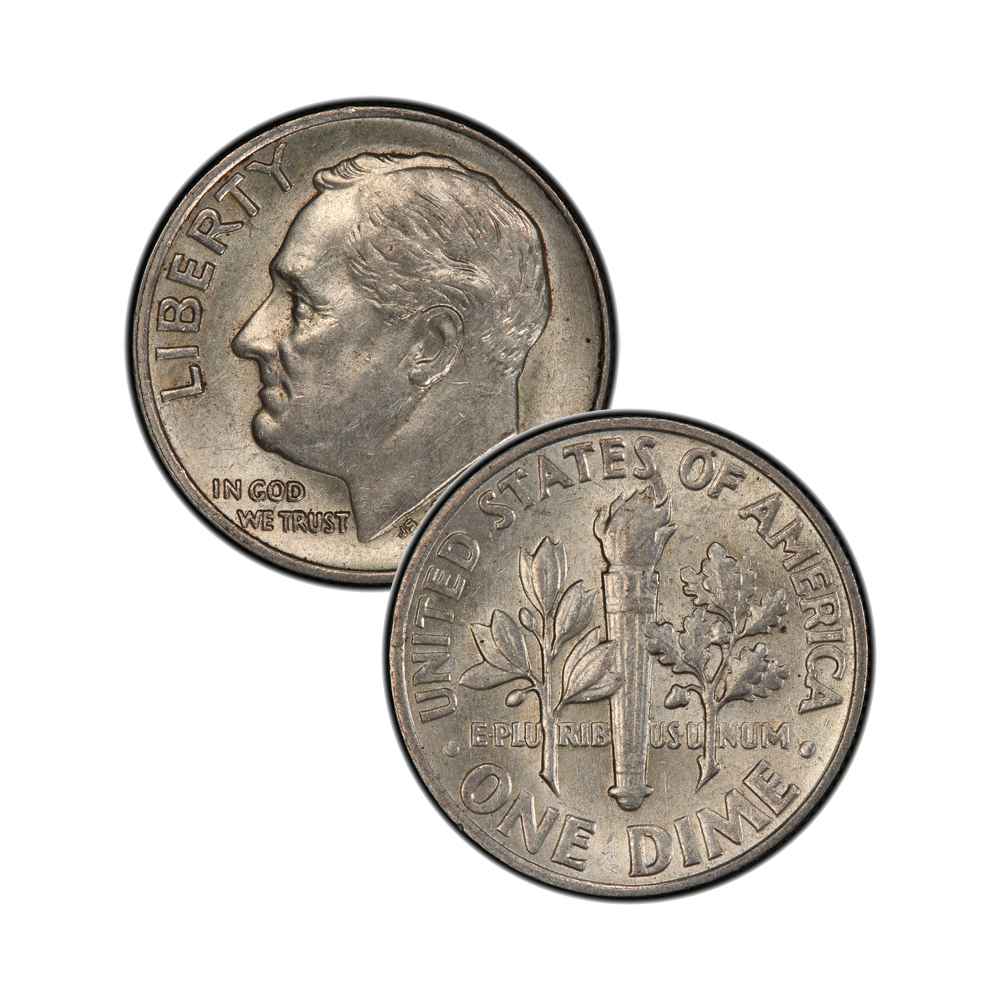
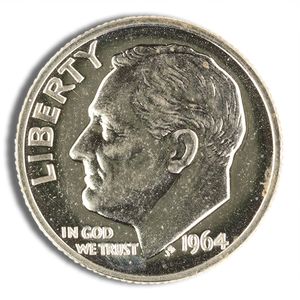
The design features a left-facing portrait of Franklin D. Roosevelt on the obverse, introduced in 1946 following his death in April 1945. The reverse carries a torch flanked by an olive branch and an oak branch, symbolizing liberty, peace, and strength. Designer John R. Sinnock's initials appear on the lower right of the obverse, which famously sparked brief conspiracy theories at the time of issue.
Buyers typically choose roosevelt silver dimes for their small per-unit silver weight, which allows precise, flexible accumulation without committing to larger quantities at once. They're also one of the most liquid forms of junk silver in the U.S. market, recognized by nearly every coin and bullion dealer in the country. That broad familiarity makes them easy to buy, sell, or trade across a wide range of market conditions.
History and Background
The Roosevelt dime entered circulation in January 1946, replacing the Mercury dime design that had been used since 1916. The transition was unusually swift by Mint standards, driven by a public groundswell of support following Roosevelt's death. Congress authorized the change without the typical waiting period, and the coin was issued within nine months of his passing, making it one of the faster design transitions in modern U.S. coinage history.
From 1946 through 1964, the dime was struck in 90% silver at the Philadelphia, Denver, and San Francisco Mints. Philadelphia coins carried no mint mark during this era, while Denver coins bear a "D" and San Francisco pieces carry an "S." In 1965, the Mint transitioned to a copper-nickel clad composition in response to rising silver prices and widespread hoarding of silver coinage. The silver-content dimes disappeared from circulation rapidly, absorbed by collectors and silver buyers almost immediately.
Today, the pre-1965 roosevelt silver dime occupies a well-established position in the junk silver market. The term "junk silver" refers to circulated legal tender coinage valued primarily for its silver content rather than numismatic premium. Decades of dealer activity and standardized face-value-based pricing have made these coins a benchmark product across the broader secondary bullion market.
Purity, Weight, and Specifications
Each roosevelt silver dime struck between 1946 and 1964 is composed of 90% silver and 10% copper, with a gross weight of 2.5 grams per coin. The fine silver weight per coin is approximately 0.07234 troy ounces. A standard $1 face value lot of ten coins carries roughly 0.715 troy ounces of silver in circulated condition, with slight variation depending on wear. Proof examples, due to their sharper strikes and minimal handling, may retain closer to the full 0.7234 troy ounce total.
The coin measures 17.9 millimeters in diameter and 1.35 millimeters in thickness. These dimensions are consistent across all three producing mints and all years within the 90% silver production window. No assay card accompanies these coins, as they are a legal tender government issue whose silver content is established by statute and universally accepted within the dealer community.
The five-ounce America the Beautiful coins in the catalog operate under entirely different specifications: 76.2 millimeters in diameter, struck in .999 fine silver, and available in both burnished and prooflike finishes. These coins are encapsulated and NGC-certified, with their purity, weight, and grade recorded on the label, making verification straightforward for buyers and sellers alike.
Available Brands, Mints, and Product Variations
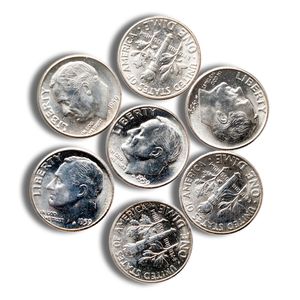
All roosevelt silver dimes in our catalog are products of the U.S. Mint, struck across the Philadelphia, Denver, and San Francisco facilities during the 1946 to 1964 production run. Because these lots are sold as random-year assortments with various mint marks, the specific composition of any given lot will vary. Buyers should expect a representative mix of years and mint marks consistent with normal secondary market supply.
Three distinct condition grades are available. The circulated lot is graded "Average Circulated," reflecting coins that have seen typical commercial use and exhibit expected wear. The brilliant uncirculated lot offers coins in BU condition, meaning they retain original mint luster without significant contact marks or surface wear. The proof lot covers proof-struck examples from the 1946 to 1964 window, distinguished by their mirror-like fields, frosted devices, and sharper detail produced by repeated striking with polished dies.
The two NGC-certified five-ounce coins represent premium certified options within the Roosevelt-themed portion of the catalog. The MS69PL coin carries a prooflike designation, indicating deeply reflective fields visible at arm's length on both sides of the coin. The SP70 burnished example represents a perfect specimen grade, with no post-production imperfections detected under NGC's grading standards. Both come in NGC slabs with full certification documentation.
Pricing, Premiums, and Market Factors
Roosevelt silver dimes are priced based on their silver content relative to the spot price of silver, with a premium added to cover sourcing, handling, and market conditions. The standard pricing convention uses $1 face value as the baseline unit, which corresponds to approximately 0.715 troy ounces of silver in circulated condition. Premiums above spot tend to be lower for junk silver lots than for many fabricated bullion products, partly because these coins require no ongoing manufacturing and are sourced entirely from the secondary market.
Grade and condition meaningfully affect the premium. Circulated lots trade at or near generic junk silver premiums, which fluctuate with overall market demand for 90% silver coinage. BU lots carry a moderate premium above circulated material, reflecting their superior eye appeal and collector crossover demand. Proof examples command the highest premium among the three circulated-coin options due to their limited production quantities and the fact that proof strikes were never intended for general circulation.
The certified five-ounce coins carry premiums reflective of their size, NGC grade, and finish designation. Prooflike and SP70 coins trade within a specialized segment where certification, eye appeal, and registry-set demand all influence pricing. Bullion Standard displays real-time bid and ask pricing on each product page, giving buyers full visibility into current market conditions and the spread between acquisition cost and buyback value before a transaction is ever initiated.
Condition, Packaging, and What to Expect
Circulated roosevelt silver dimes arrive in average circulated condition, meaning buyers should expect visible wear on the high points of the design, some surface marks from circulation, and a range of dates and mint marks without selection. These coins are not sold for their numismatic appeal but for their silver content, and cosmetic variation is entirely normal and expected within junk silver lots.
BU lots are filled with coins that retain original mint luster, though some bag marks or minor contact from handling may be present, as is standard for coins that were never individually protected. Proof examples exhibit the distinctive cameo contrast characteristic of proof coinage but should be handled carefully to preserve their surfaces. The proof lot is also a random-year assortment drawn from the 1946 to 1964 proof production window.
The five-ounce NGC-certified coins arrive encapsulated in NGC plastic slabs with tamper-evident seals. The slab displays the coin's grade, designation, and certification number, which can be verified directly through NGC's online registry. These coins should never be removed from their slabs, as doing so instantly removes the certified grade and typically reduces resale value significantly.
Authenticity and Verification
Roosevelt silver dimes struck by the U.S. Mint between 1946 and 1964 are among the easiest American silver coins to authenticate. The composition is consistent across all years, the design details are well-documented, and the coins were produced in enormous quantities, making reference examples plentiful. Standard verification methods include dimensional checks, weight verification against the 2.5-gram specification, and visual inspection of design details and edge reeding.
While outright counterfeiting of junk silver dimes is relatively uncommon due to the modest silver value per coin, buyers should still source from established dealers. Bullion Standard sources all products from reputable mints, wholesalers, and distributors, and every item is verified for authenticity, weight, and purity before fulfillment. As an authorized NGC and PCGS dealer, our handling of certified coins follows strict authenticity protocols.
The NGC-certified five-ounce coins carry an additional layer of verification. Each NGC slab includes a certification number that can be cross-referenced through NGC's online Cert Verification tool, allowing buyers to confirm the coin's grade, designation, and registry status independently. The tamper-evident slab itself provides physical authentication protection that raw coins cannot offer.
Liquidity and Resale Considerations
Roosevelt silver dimes rank among the most liquid junk silver products in the United States bullion market. Their standardized silver content, universal familiarity, and consistent demand from dealers, collectors, and silver buyers nationwide make them straightforward to resell in virtually any quantity. The $1 face value unit convention is universally understood, simplifying price negotiations in secondary market transactions.
BU and proof examples occupy a slightly different position. While they retain strong silver-content liquidity, their condition premium depends on buyer demand at the time of sale. In active markets with strong collector participation, condition premiums hold well. In slower markets driven primarily by silver content demand, the condition premium may compress. Understanding this dynamic before purchase is part of making an informed decision.
The five-ounce NGC-certified coins are more specialized products with a narrower but active buyer base. Demand from registry-set collectors, NGC population enthusiasts, and grade-specific buyers supports liquidity, though the resale process may involve specialized auction venues or certified-coin dealers rather than the generic junk silver market. Bullion Standard's two-way market model allows customers to request buyback pricing for both the circulated dimes and the certified five-ounce coins within the same platform.
Storage and Security
Junk silver dimes are typically stored in canvas bags, plastic tubes, or sealed rolls. The standard approach for larger accumulations is to keep coins in their original packaging or in labeled coin tubes to prevent mixing with other silver coinage. Bags should be stored in a cool, dry environment to minimize toning and surface oxidation, which doesn't affect silver content but can impact the condition premium on BU and proof coins.
For BU and proof lots, individual coin flips or 2x2 cardboard holders can provide additional protection against contact marks. Proof coins are particularly sensitive to surface damage from handling and should be touched only by the edges. Storage in a moisture-controlled environment using silica gel packets helps preserve the mirror surfaces that define proof coinage.
The NGC-encapsulated five-ounce coins should be stored in their original slabs within a padded container or foam-lined box. Their size and weight require a bit more attention during storage than standard bullion coinage. A quality home safe, bank safe deposit box, or professional vault storage facility offers appropriate security for meaningful quantities of silver, regardless of the product format.
Selling and Buyback Options
Selling roosevelt silver dimes back into the market is generally straightforward due to their high recognition and standardized silver content. Most bullion dealers, coin shops, and online precious metals marketplaces will quote prices based on the silver spot price and the applicable junk silver multiplier, adjusted for condition in the case of BU or proof material. Having coins organized by face value and condition before initiating a sale streamlines the process and typically results in more accurate initial quotes.
Condition and packaging meaningfully affect buyback pricing for BU and proof examples. Coins that have been mixed with circulated material or improperly stored may no longer qualify for the condition premium they carried at purchase. Proof coins with surface hairlines or contact damage will be evaluated at circulated silver content value rather than proof premium. Keeping coins in their original condition and storage format preserves optionality at the time of resale.
Bullion Standard operates a two-way market that allows customers to sell directly back through our platform using competitive, real-time buyback pricing. Our purchasing team evaluates each product based on current market conditions, product type, condition, and liquidity. Customers can request a buyback quote directly through the platform without navigating third-party listing sites or uncertain private transactions. The process is designed to be transparent and operationally efficient from start to finish.
Why Buy Roosevelt Silver Dimes?
The appeal of roosevelt silver dimes starts with divisibility. Because each coin represents a small, fixed unit of silver content, buyers can accumulate silver in precise increments without committing to larger bars or full ounce coins. This granularity is particularly useful when building a position gradually or when planning for potential small-quantity sales over time. The legal tender status of these coins also adds a layer of governmental backing that privately minted rounds and bars cannot offer.
Junk silver in general, and roosevelt silver dimes specifically, benefit from the deepest secondary market recognition of almost any silver product. Coin dealers across the country, from small shops to large online dealers, understand and actively price these coins. That widespread familiarity translates directly into practical liquidity, meaning buyers don't need to search for a specialized audience when it comes time to sell.
For buyers who want something beyond basic junk silver, the BU and proof options provide meaningful upgrades in eye appeal and potential crossover interest from collectors of classic U.S. coinage. The NGC-certified five-ounce coins serve an entirely different function, appealing to buyers focused on certified silver, America the Beautiful series completion, or top-pop registry collecting. The breadth across these formats means buyers at multiple levels of engagement can find what they're looking for in one place.
Why Buy from Bullion Standard?
Bullion Standard was founded in 2010 in San Diego, California, and has built its reputation on pricing transparency and operational integrity rather than sales pressure. Every product on the platform is priced using real-time market data, and the bid/ask spread on each listing makes the full cost of ownership visible before any purchase decision is made. That structure reflects a deliberate choice to treat customers as informed participants rather than captive audiences.
All products are sourced from reputable mints, wholesalers, and distributors and verified for authenticity, weight, and purity before shipment. As an authorized dealer for both NGC and PCGS, Bullion Standard handles certified coins with the protocols and chain-of-custody standards those relationships require. An A rating with the Better Business Bureau, membership in the American Numismatic Association, and membership in the National Coin and Bullion Association reflect the standards we hold ourselves to across every transaction.
The platform supports a wide range of payment methods, including major credit cards, PayPal, bank-connected ACH through Plaid, wire transfer, paper check, and cryptocurrency through BitPay. Fulfillment is handled reliably with secure packaging and shipping protocols appropriate to the product. Post-purchase customer support is accessible and responsive, because we believe the relationship with a customer doesn't end when the order ships.
Get Near-Spot Pricing with Bullion Standard Pro
Bullion Standard Pro is designed for buyers who prioritize pricing efficiency and want access to the same executable wholesale market pricing that professional participants use. Members transact at live wholesale bid and ask prices without the additional dealer markups layered into standard retail pricing structures. For products like junk silver dimes, where premiums above spot are already among the tightest in the silver market, the further compression available through Pro pricing can be meaningful across larger or repeated purchases.
Beyond pricing, Pro members gain access to real-time portfolio valuation based on live wholesale bid pricing, which provides a more accurate picture of current liquidation value than retail-based estimates. Historical premium analysis, spread tracking, liquidity metrics, and proprietary market intelligence tools help members evaluate products using objective market data rather than marketing claims or gut instinct.
For buyers who plan to accumulate roosevelt silver dimes systematically, or who are weighing the certified five-ounce coins against alternative silver products, having access to premium percentile rankings, bid/ask spread comparisons, and wholesale market activity data creates a materially different research environment. The goal of Bullion Standard Pro is to reduce information asymmetry between retail buyers and wholesale market participants, making the experience of buying and selling physical silver more transparent and more efficient for everyone involved.


 (833) 278-4653