Buy 10 oz Platinum Bars Online
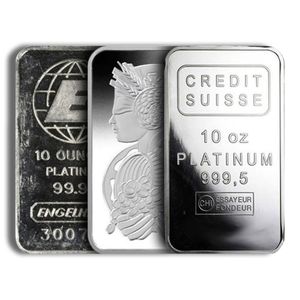
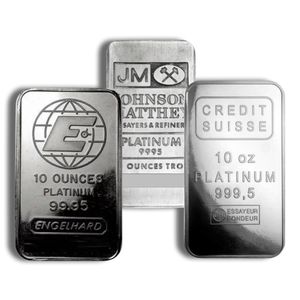
Our catalog currently features two 10 oz platinum bar options designed to suit buyers who prioritize weight efficiency and purity over branding. Both bars carry a fineness of .9995 platinum and are available in distinct packaging configurations: one arrives in an assay card for added verification and protection, while the other is offered without assay packaging for buyers who prefer a more straightforward, no-frills format at a tighter cost basis.
The selection here reflects what most serious platinum buyers are looking for at this size: standardized weight, documented purity, and recognized format. Whether you're sourcing from a specific refinery or comfortable with a random brand from our verified supplier network, both options are authenticated and priced in real time against current platinum spot markets.
Bullion Standard operates as a transparent marketplace, meaning prices are structured around real market conditions rather than inflated retail margins. Every product listed here is verified before fulfillment, and our two-way market model means liquidity is considered on both the buy and sell sides of the transaction.
What Are 10 oz Platinum Bars?
A 10 oz platinum bar is a cast or minted bullion bar produced by a recognized refinery or mint to a standardized weight of ten troy ounces. At .9995 fineness, these bars represent one of the purest commercially available forms of the metal, sitting just below the industrial benchmark of .9999 in most practical comparisons. The 10 oz size sits between the more accessible 1 oz bar and the larger 1 kilogram format, making it a practical middle ground for buyers who want meaningful platinum exposure without committing to kilogram-scale positions.
Bars at this weight are typically produced in two physical formats: cast bars, which are poured into molds and feature a rougher, industrial aesthetic, and minted bars, which are die-struck for a more refined surface finish. Both formats carry the same fundamental content, though minted bars often carry modest premium differences due to additional production steps. The products in our catalog are offered in bar format with assay and without, allowing buyers to choose based on their own verification and packaging preferences.
Buyers drawn to the 10 oz size often value the balance between storage density and transaction flexibility. A single bar at this weight represents a meaningful platinum position without the liquidity constraints that can accompany much larger formats like the 50 oz or 100 oz bars commonly found in institutional trading.
History and Background
Platinum's role as a tradeable bullion product developed significantly later than gold or silver. The metal was largely a byproduct of other mining operations for much of the 20th century, with primary production concentrated in South Africa's Bushveld Igneous Complex and, to a lesser degree, in Russia's Norilsk region. As industrial applications expanded through the latter half of the century, particularly in automotive catalytic converters and electronics manufacturing, platinum's commercial importance grew alongside its recognition as a tradeable commodity.
The standardization of platinum bars as a bullion format gained momentum in the 1970s and 1980s as commodity exchanges began listing platinum futures contracts and refineries developed consistent production standards for investment-grade bars. The London Platinum and Palladium Market, now incorporated under the broader London Bullion Market Association framework, helped establish the benchmarks for acceptable bar formats, weights, and purity thresholds that shaped what buyers know today as investment-grade platinum bullion.
The 10 oz bar format emerged as one of the more practical sizes within that standardization process, offering a weight denomination that was large enough to be taken seriously in institutional contexts while remaining accessible to individual buyers. Today, refineries and mints across North America, Europe, and Asia produce bars at this size to meet demand from a range of buyers, from private collectors to corporate treasury operations.
Purity, Weight, and Specifications
Both products in our catalog are produced to a fineness of .9995, meaning that 9,995 parts out of 10,000 are pure platinum. This purity level meets and exceeds the London Platinum and Palladium Market's good delivery standards and is widely recognized by dealers, refineries, and exchanges worldwide. One product lists a metal content of 9.995 troy ounces, which reflects the actual platinum content at .9995 fineness from a nominal 10 oz bar, while the other lists an even 10 troy ounces of metal content.
Troy ounces are the standard unit of measure in the precious metals industry and should not be confused with avoirdupois ounces used in everyday commerce. A troy ounce equals approximately 31.1 grams, meaning a 10 troy ounce platinum bar weighs roughly 311 grams in total. Bars produced to this specification typically carry stamped markings identifying the weight, purity, and, where applicable, the producing refinery or mint. Assay cards provide a secondary layer of documentation, encasing the bar in a tamper-evident packaging that confirms its specifications at the point of production.
Serial numbers are common on higher-end minted bars but may not appear on all cast or generic formats. For the random brand products offered here, specific hallmarking will vary by the producing refinery, but all bars are verified for weight and purity before shipment regardless of branding.
Available Brands, Mints, and Product Variations
The two listings in our catalog represent the most common approach to sourcing platinum bars at this weight: random brand and generic. The random brand option with assay card is sourced from our verified network of refineries and mints, which may include producers such as Valcambi, Argor-Heraeus, PAMP Suisse, Baird and Co., or similar recognized names depending on current supply availability. Because the specific brand is not guaranteed at the time of purchase, buyers receive whichever refinery's bar is in stock, though all originate from verifiable, reputable producers.
The second option is listed as generic or unbranded, which typically means the bar may come from smaller or less widely marketed refineries. These bars still meet the .9995 purity standard and are verified prior to fulfillment, but they may carry less immediate name recognition in secondary market resale compared to bars from globally branded producers. For buyers who prioritize metal content over branding, this format often comes at a marginally lower premium.
The assay card distinction between the two products is meaningful from both a verification and handling standpoint. An assay card encases the bar in a sealed, tamper-evident package that authenticates the bar's specifications and preserves its condition from the point of manufacture. Bars without assay cards are loose and may show minor surface handling marks consistent with industry-standard storage and transit, which is common and expected for cast format platinum bullion.
Pricing, Premiums, and Market Factors
Platinum bar pricing is calculated by adding a per-ounce premium to the current spot price of platinum, which fluctuates continuously based on trading activity across global commodities markets. The 10 oz bar format typically carries a lower per-ounce premium compared to smaller bars, since production, handling, and fulfillment costs are spread across a larger total weight. Buyers acquiring platinum at this size generally benefit from meaningful premium efficiency relative to 1 oz or fractional products.
Premiums on platinum bars are influenced by several factors beyond just bar size. Packaging format plays a role: bars delivered in assay cards carry a modest incremental cost due to the additional production and certification steps involved. Brand recognition matters as well. Bars from established refineries like Valcambi or PAMP Suisse may command slightly higher premiums in both the primary and secondary markets due to global dealer familiarity. Generic or unbranded bars, by contrast, often carry narrower premiums but may also attract tighter buyback spreads depending on the buyer.
Bullion Standard displays pricing in real time, tied to live spot market conditions. Our bid and ask spreads are visible on each product page and reflect current market dynamics rather than fixed retail markups. For buyers who want to understand the full cost of ownership, seeing both the purchase price and the current buyback value side by side provides a clearer picture of the actual spread you're working within.
Condition, Packaging, and What to Expect
Platinum bars sold as random brand or generic should be understood to arrive in varying conditions consistent with industry norms. Cast bars in particular are more prone to minor surface marks, contact scratches, and patina variation due to the nature of their production process. These characteristics do not affect the platinum content or purity of the bar and are considered normal within the bullion market. Buyers expecting the polished appearance of a collector coin should note that bullion bars are fundamentally industrial products.
The assay-packaged version of our 10 oz bar arrives sealed in a tamper-evident card or holder, which preserves the bar's surface and provides a layer of third-party documentation that confirms its specifications. Opening the assay card is not recommended for buyers who intend to resell the bar in secondary markets, as the intact packaging may support easier verification and potentially tighter dealer buyback pricing.
Random brand products, by definition, do not come with advance notice of the specific refinery or manufacturer. If a particular brand is important to your purchasing decision, our team can advise on current availability, but stock rotation means specific names cannot be guaranteed at checkout. Bars are shipped securely and discretely, and all fulfillment is handled with the security protocols standard across our operations.
Authenticity and Verification
Every platinum bar shipped by Bullion Standard is physically verified for weight and purity before it leaves our facility. We source from reputable refineries, mints, and authorized distributors, and our acquisition process includes chain-of-custody documentation that supports the authenticity of each product. Bars sourced through assay-packaged options carry additional manufacturer verification embedded in the sealed packaging itself.
Platinum presents a lower counterfeiting risk than gold at equivalent melt values due to its distinctive density and appearance, but verification remains standard practice in any serious bullion transaction. Cast bars can be tested using XRF spectrometry, ultrasonic thickness gauges, and electronic density testers without damaging the bar. Buyers who receive assay-packaged bars can rely on the sealed card as primary documentation, provided the seal remains intact and shows no signs of tampering.
Bullion Standard maintains an A rating with the Better Business Bureau and is a member of both the American Numismatic Association and the National Coin and Bullion Association. These affiliations reflect our commitment to operating within professional industry standards and holding ourselves accountable to established codes of conduct in the precious metals trade.
Liquidity and Resale Considerations
The 10 oz bar format is broadly recognized within the wholesale platinum market, which supports its tradability through dealer networks, refineries, and secondary market buyers. While platinum as a metal trades in significantly lower volumes than gold or silver, the standardized bar format at .9995 fineness ensures that any dealer or refinery evaluating the bar can process it against known parameters without additional metallurgical uncertainty.
Bars from globally recognized refineries such as Valcambi, Engelhard, or Johnson Matthey carry inherent name recognition that can smooth the resale process. Generic or unbranded bars, while meeting the same purity standards, may require additional verification steps from some buyers before a bid is confirmed. Maintaining the original assay packaging where present is advisable, as it reduces friction in any downstream verification process.
Platinum's liquidity profile differs from gold or silver in that the buyer pool is narrower at the retail level. Institutional and industrial demand drives a significant portion of platinum trading, and individual retail resale often flows back through dealer networks rather than peer-to-peer channels. Buyers should approach resale planning with that market structure in mind.
Storage and Security
A 10 oz platinum bar is compact in size relative to its value, which makes secure storage straightforward compared to larger silver holdings. A single bar occupies minimal physical space and can be stored effectively in a home safe rated for fire and theft resistance, a bank safe deposit box, or a third-party vault facility that specializes in precious metals storage. At current platinum prices, the dollar-per-cubic-inch value of a 10 oz bar is high enough to justify serious attention to physical security.
Environmental considerations for platinum storage are minimal compared to silver, which is prone to tarnish and sulfide reactions. Platinum is chemically stable and highly resistant to oxidation, so humidity and atmospheric exposure present little risk to the metal's appearance or integrity over time. Bars in assay packaging should be kept in their original sealed card to preserve both condition and documentation integrity.
For buyers holding multiple bars or building a larger position over time, professional vault storage through an insured third-party custodian is worth evaluating. These facilities provide allocated storage, insurance coverage, and documented chain of custody, which can simplify both long-term holding and eventual resale logistics.
Selling and Buyback Options
Selling 10 oz platinum bars through Bullion Standard is straightforward. Our purchasing team evaluates bars based on current spot pricing, product format, packaging condition, and overall market liquidity at the time of the transaction. Bars arriving in intact assay packaging and from recognized refineries typically receive the most competitive bids, as they require less verification time and carry clearer provenance documentation.
Bullion Standard operates a two-way market model, meaning we are actively pricing both the buy and the sell side of platinum bar transactions. Customers can request a buyback quote directly through our platform, and pricing reflects real-time market conditions rather than arbitrary dealer discretion. This structure is designed to give sellers a clear, transparent process rather than one that requires negotiation or comparison shopping across multiple dealers.
Factors that influence the final buyback price include the condition of the bar, whether assay packaging is intact, the specific refinery of origin where known, and prevailing wholesale platinum bid prices at the time of the quote. Bars that arrive damaged, with missing documentation, or in heavily worn condition may be evaluated at a different basis than bars received in standard bullion condition. Contacting our support team before initiating a sale is always recommended for buyers who want upfront clarity on what to expect.
Why Buy 10 oz Platinum Bars?
The 10 oz size represents a meaningful point of efficiency within the platinum bar market. Premiums at this weight are generally lower on a per-ounce basis than smaller formats, which matters when acquiring a metal that already trades at a significant nominal price. For buyers who have already established familiarity with smaller platinum products and want to scale their position without disproportionately increasing their per-ounce acquisition cost, this format offers a practical path forward.
Platinum's role in industrial applications distinguishes it from gold in important ways. Catalytic converters in internal combustion and hydrogen fuel cell vehicles, laboratory instruments, medical devices, and petroleum refining all rely on platinum in meaningful quantities. This industrial demand base creates a structural floor in the market that is driven by physical consumption rather than financial demand alone, which gives platinum a different risk and demand profile compared to purely monetary metals.
The bar format also offers straightforward practicality for buyers who prioritize metal content over numismatic considerations. There's no collector premium built into the price, no concern about graded condition affecting value, and no ambiguity about what the product represents. Ten troy ounces of .9995 platinum is exactly what it says, and the bar format delivers that as efficiently as any format available.
Why Buy from Bullion Standard?
Bullion Standard was founded in San Diego in 2010 with a straightforward premise: the precious metals buying experience should be transparent, operationally reliable, and built around informed customers rather than high-pressure sales tactics. That philosophy has shaped every aspect of how we source, price, and fulfill products across our catalog. Our platform is designed to feel like a marketplace rather than a showroom, with pricing that reflects real market conditions and documentation that supports every transaction.
Our two-way market model means we're not simply a retail seller but a platform through which buyers can also sell. This approach keeps us accountable on both sides of the transaction and creates pricing discipline that benefits our customers. The bid and ask spread displayed on every product page is a direct expression of that accountability. You can see what we'll pay to buy the product back before you decide to purchase it, which is information that most traditional dealers don't readily surface.
Every product we ship is verified for authenticity, weight, and purity. Our A BBB rating, ANA and NCBA memberships, and PCGS and NGC authorized dealer status reflect a track record built over more than a decade of operating with consistency and professionalism. We support a wide range of payment methods including major credit cards, PayPal, wire transfer, bank-connected payments through Plaid, paper check, and cryptocurrency via BitPay, with secure checkout and reliable fulfillment across every transaction.
Get Near-Spot Pricing with Bullion Standard Pro
Bullion Standard Pro is designed for buyers who want to transact closer to wholesale market pricing. Members gain access to live, executable wholesale bid and ask pricing across a broad range of products, including platinum bars, without the additional dealer markups that are built into standard retail pricing structures. This means premiums and spreads fluctuate naturally based on real market supply and demand rather than fixed retail margin schedules.
For buyers making larger purchases or returning to the platform regularly, the pricing efficiency available through Bullion Standard Pro can represent a meaningful cumulative advantage. The platform also provides access to real-time portfolio valuation based on live wholesale bid pricing, which gives members a more accurate picture of their current liquidation value rather than an inflated retail estimate. Historical premium data, spread analysis, liquidity metrics, and other proprietary market intelligence tools are also available to Pro members, allowing platinum bar buyers to evaluate market conditions with more precision than spot price alone would allow.
The core objective of Bullion Standard Pro is to reduce the information asymmetry that has traditionally characterized the physical precious metals market. By making wholesale pricing executable and market data broadly accessible, the platform is designed to give serious buyers the same quality of market transparency that's common in traditional financial markets but has historically been harder to access in the physical bullion space.


 (833) 278-4653