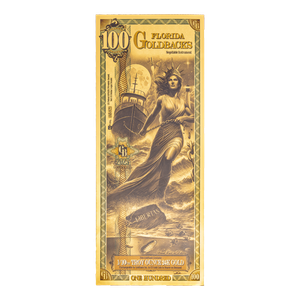
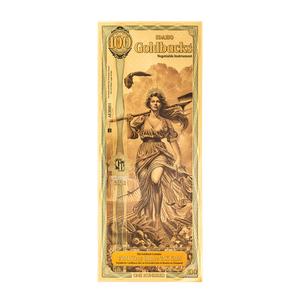
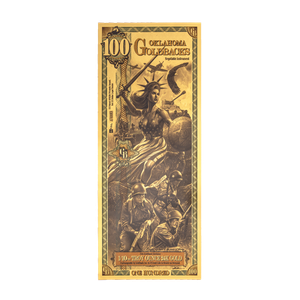
Buy $100 Goldback Notes Online
Our catalog of $100 goldback notes brings together state-series aurum notes from Arizona, Florida, Idaho, and Oklahoma, each containing 1/10 troy oz of genuine 24-karat gold deposited within a polymer note format. These are produced by Valaurum, the company behind the Goldback series, and represent one of the more distinctive formats available in the modern physical gold market. Each denomination is tied to a specific state, giving buyers the option to select individual notes or explore the full series currently available through our platform.
Goldbacks occupy a genuinely different space from traditional bullion coins and bars. At the 100 denomination, these notes carry 0.1 troy oz of gold, making them a fractional gold product with a tangible format that differs from anything else in the market. Bullion Standard lists these at transparent, real-time pricing so buyers can evaluate the premium structure clearly before completing a purchase.
What Are $100 Goldback Notes?
Goldback notes are voluntary local currency products that contain a measurable quantity of pure gold suspended within a durable polymer composite. The denomination system used by Goldback is designed so that 1/1000 of a troy ounce of gold corresponds to 1 goldback, meaning a 100 goldback note contains exactly 1/10 troy oz of gold. The format is neither a coin nor a traditional bar but rather an aurum note, which is the term used to describe this gold-in-polymer construction.
The 100 denomination sits at the upper range of the Goldback series and represents the largest single note available in each state series. For buyers looking to hold fractional gold in a spendable, divisible format, the 100 note is the highest single-unit entry point within the Goldback system. Unlike coins, which carry government legal tender status, goldbacks are privately issued and valued based on their gold content rather than a fixed face value backed by a government authority.
The aurum format is also distinct from cast or minted bars in that the gold content is distributed across the entire surface of the note using a vacuum deposition process. This makes goldbacks visually unique and structurally different from conventional bullion formats, though their market value is still closely tied to the underlying spot price of gold and the applicable premium.
History and Background
The Goldback series was launched by Valaurum, a company that developed and patented the aurum technology used to embed pure gold within polymer sheets. The concept emerged from a broader interest in creating a voluntary, gold-based medium of exchange that could function at a practical everyday scale. The Utah Goldback series was the first to launch, followed by expansions into Nevada, New Hampshire, Wyoming, and subsequently a growing number of additional states including Arizona, Florida, Idaho, and Oklahoma.
Valaurum's aurum process was developed specifically to solve a longstanding problem with fractional gold: how to produce a usable unit of gold in denominations small enough for everyday transactions without making the product impractical to handle or verify. By embedding gold within a polymer matrix using vacuum deposition technology, Valaurum created a format that is tamper-evident, visually verifiable, and durable enough to circulate.
The series has grown substantially since its introduction and has attracted attention both from buyers interested in its novelty as a gold format and from those drawn to the state-specific artistic designs featured on each note. Each state series features original artwork that reflects local iconography and history, produced through a detailed illustration process. The market for goldbacks has developed its own premium structure, which reflects both the gold content and the production costs associated with the aurum format.
Purity, Weight, and Specifications
Each 100 goldback note contains 0.1 troy oz of gold, which is equivalent to approximately 3.11 grams. The purity across the series varies slightly by state: the Arizona and Oklahoma 100 goldbacks are produced at 0.999 fine gold, while the Florida and Idaho notes carry a purity of 0.9999 fine gold. Both purity levels are recognized within the bullion market as high-quality, investment-grade gold standards.
The gold in each note is not a coating or plating but is fully embedded within the polymer using Valaurum's vacuum deposition process, making the gold content consistent and verifiable across the surface of the note. Each note is produced to exacting dimensional tolerances and carries visual indicators that are part of the authenticity verification process. The denomination, state designation, gold content, and purity are all represented on the face and reverse of each note.
Because goldbacks are produced as a note format rather than a struck coin or pressed bar, standard numismatic grading systems do not apply in the conventional sense. Condition assessment for goldbacks focuses primarily on the integrity of the polymer surface, the clarity of the printed design, and the absence of visible damage or contamination to the note body.
Available Brands, Mints, and Product Variations
All four $100 goldback notes currently listed in our catalog are manufactured by Valaurum and issued under the Goldback brand. Valaurum holds the patents on the aurum production process and is the exclusive manufacturer of goldback notes across all state series. This means every note in our catalog comes from a single, identifiable source with a well-documented production process, which is relevant for buyers evaluating authenticity and consistency.
The four state-series notes available here cover Arizona, Florida, Idaho, and Oklahoma. Each features unique original artwork specific to its state, produced through a detailed illustration and engraving process before the final aurum production. While the gold content and denomination are consistent across all four, the designs differ substantially, and some buyers acquire notes across multiple state series for the completeness of the collection or the variation in artwork.
Beyond the state differentiation, the primary variation between notes in this catalog is purity level. The Arizona and Oklahoma notes carry 0.999 purity, while the Florida and Idaho notes are produced at 0.9999 purity. Both are genuine, high-purity gold products. Buyers focused strictly on gold content and purity who prefer the slightly higher fineness standard may opt toward the Florida or Idaho notes, while those prioritizing specific state designs may select based on the artwork alone.
Pricing, Premiums, and Market Factors
Goldbacks carry a premium above spot that is generally higher than what buyers encounter with standard 1 oz gold coins or bars. This reflects the production costs associated with the aurum format, including the vacuum deposition process, polymer substrate, and detailed artwork production, none of which are present in conventional minted or cast gold products. For buyers approaching goldbacks purely as a gold acquisition vehicle, understanding this premium structure upfront is important.
The 100 denomination typically carries a lower per-unit premium than smaller goldback denominations within the same state series, since the cost of production is spread across a larger quantity of gold per note. That said, premiums across the goldback market are also influenced by collector demand, state series popularity, and the relative scarcity of individual state issues. Market pricing for goldbacks can diverge meaningfully from pure spot-based pricing during periods of strong collector demand.
At Bullion Standard, pricing for each note reflects real-time market conditions and is displayed with full transparency. The bid/ask spread shown on each product page reflects current market dynamics and provides buyers with a complete picture of both the acquisition cost and the expected resale value, which is a more complete measure of the true cost of ownership than the premium above spot alone.
Condition, Packaging, and What to Expect
Goldback notes are packaged individually and typically arrive in protective sleeves or holders designed to preserve the integrity of the polymer surface. Because these are notes rather than coins, they do not ship in standard coin tubes or mint capsules, and buyers should expect packaging that is specific to the note format. Valaurum notes are produced to high quality standards, and notes arriving through Bullion Standard are inspected to confirm they meet those standards before fulfillment.
Minor surface variation in the polymer, such as subtle texture differences or slight tonal shifts in the gold deposition layer, can occur during production and is generally considered normal for this format. These variations do not affect the gold content or the authenticity of the note. Buyers accustomed to the rigid uniformity of struck coins should be aware that the aurum production process introduces slightly different visual characteristics than conventional bullion formats.
Goldbacks are not graded by PCGS or NGC in the same manner as coins, so there is no standard slab or certification holder associated with these products in typical secondary market transactions. Buyers should evaluate notes based on the condition of the polymer and the clarity of the printed design rather than traditional coin grading criteria.
Authenticity and Verification
Valaurum's aurum production process incorporates several characteristics that support authenticity verification. The gold deposition layer, embedded within the polymer substrate, cannot be replicated by conventional printing, plating, or foil-stamping methods. The visual complexity of the artwork, combined with the specific optical characteristics of the embedded gold, makes goldbacks significantly more difficult to counterfeit than simpler printed notes or foil-based products.
Buyers can perform basic visual verification by holding a note up to a light source, which will reveal the distributed gold layer within the polymer body. Authentic notes will display a consistent, translucent gold quality across the surface that differs visibly from surface coatings or printed approximations. The denomination, purity marking, gold content declaration, and Goldback series designation should all be clearly legible on genuine notes.
All products sourced and listed by Bullion Standard are verified for authenticity and gold content before being made available for purchase. Our sourcing relationships are maintained with established distributors and authorized channels, and every product is subject to our internal verification process to confirm it meets the stated specifications before it reaches a customer.
Liquidity and Resale Considerations
Goldbacks trade within a secondary market that is more specialized than the market for standard sovereign coins or widely distributed gold bars. Because the goldback series is relatively newer and carries a premium that reflects production costs in addition to gold content, the resale environment differs from what buyers encounter with products like American Gold Eagles or generic 1 oz gold bars. That said, the market for goldbacks has grown over time as the series has expanded and collector awareness has increased.
Liquidity for goldback notes is generally higher for the most widely issued state series and for higher denominations such as the 100 note, where the gold content per unit is more substantial. Buyers looking to resell goldbacks should expect pricing to be influenced by both the current spot price of gold and the prevailing secondary market premium for the specific state series and denomination involved.
Bullion Standard operates a two-way market structure, which means buyers can also explore resale options within our platform when the time comes. Understanding the resale side of any purchase before the transaction is made is part of our approach to helping customers think through the full cost of ownership rather than focusing only on the purchase price.
Storage and Security
Goldback notes are lightweight and compact, which makes them straightforward to store in small quantities. Because they are polymer-based rather than metal, they require slightly different handling considerations than coins or bars. Notes should be kept away from excessive heat, direct sunlight, and sharp edges that could damage the polymer surface. Individual protective sleeves or rigid holders provide the best protection for the surface and edges of each note.
For buyers accumulating multiple notes, a small fireproof safe or secure home storage option is sufficient for modest quantities. Larger accumulations may warrant a bank safe deposit box or a professional vault storage arrangement, particularly if the combined gold value becomes significant. The note format stacks efficiently and takes up minimal space, making storage of multiple notes relatively convenient compared to larger bullion formats.
Avoiding high humidity environments is particularly relevant for polymer-based products, as prolonged moisture exposure can affect the surface quality of the note over time. Standard climate-controlled storage at typical indoor temperatures is generally adequate for long-term preservation of the polymer and the embedded gold layer.
Selling and Buyback Options
Selling goldback notes back into the market involves a slightly different process than selling standard coin or bar products, primarily because the market for goldbacks is more specialized. Dealer buyback pricing for goldbacks reflects the current spot price of gold, the prevailing premium environment for the specific series and denomination, the condition of the polymer note, and current demand from buyers looking for these products specifically.
Notes in original, undamaged condition with no surface defects or contamination to the polymer will typically command the strongest buyback pricing. Because goldbacks carry a meaningful production premium, buyers should be aware that the buyback spread may differ from what they experience with more liquid standard bullion products, particularly during periods when collector demand for specific state series is lower.
Bullion Standard's purchasing team evaluates goldback notes as part of our broader buyback program. Our two-way market approach means we actively price both the buying and selling sides of the transaction, and our buyback process is designed to be transparent and straightforward. Customers looking to sell can contact our team for a current quote based on real-time market conditions and the specific product details involved.
Why Buy $100 Goldback Notes?
The 100 goldback note appeals to buyers for reasons that don't apply to conventional gold coins or bars. The aurum format is genuinely unique within the broader bullion market, and the state-specific artwork gives each note a regional character and collectibility that standard gold products simply don't offer. For buyers who appreciate design and craftsmanship alongside the gold content itself, these notes occupy a distinct position in the market.
At 0.1 troy oz per note, the 100 denomination represents a meaningful fractional gold holding in a format that is physically divisible and recognizable within the growing goldback community. For buyers building a diversified physical gold holding that includes fractional formats, the 100 goldback note provides an option that differs structurally from fractional coins while still offering genuine, verifiable gold content.
The practical appeal of goldbacks also extends to those interested in the voluntary currency concept behind the series. Goldbacks are designed to function as a usable, spendable form of gold at a scale that larger bullion products can't accommodate, and the 100 denomination sits at the top of that system for single-note transactions. That combination of practical gold content, state-specific design, and the unique aurum format distinguishes these notes within any broader physical gold holding.
Why Buy from Bullion Standard?
Bullion Standard has been operating as a precious metals marketplace since 2010, and our approach to pricing and product sourcing is built around transparency rather than pressure. Every product listed on our platform, including all four state-series $100 goldback notes, is priced in real time with the bid/ask spread displayed directly on the product page. There are no hidden markups or manufactured urgency, just clear pricing that reflects actual market conditions.
Our sourcing standards mean that every goldback note we sell is verified for authenticity and gold content before fulfillment. We maintain an A rating with the Better Business Bureau and hold memberships with the American Numismatic Association and the National Coin and Bullion Association, reflecting our commitment to operating according to established industry standards. Customers can purchase with confidence knowing that what they receive matches exactly what is described.
Checkout is supported by a wide range of payment options, including Visa, Mastercard, American Express, Discover, PayPal, wire transfer, paper check, bank-connected payments through Plaid, and cryptocurrency through BitPay. Our customer service team is available to answer questions before and after a purchase, and our platform is designed to support informed buyers rather than push transactions. That philosophy extends to everything from how we display pricing to how we handle buyback requests.
Get Near-Spot Pricing with Bullion Standard Pro
Bullion Standard Pro is designed for buyers who want to transact closer to the wholesale market level across a broad range of precious metals products. Members gain access to live, executable wholesale bid and ask pricing, which reflects real-time supply and demand within the wholesale bullion market rather than fixed retail price structures. Unlike the standard retail model, Pro membership does not layer additional dealer markups onto member pricing, allowing premiums and spreads to fluctuate based on actual market conditions.
For buyers purchasing goldback notes with some regularity, the pricing efficiency available through Bullion Standard Pro can meaningfully reduce the cost of each transaction over time. Members also gain access to portfolio valuation based on live wholesale bid pricing, which provides a more realistic picture of current liquidation value than retail-based estimates. That level of transparency into both sides of the transaction is part of what distinguishes the Pro experience from a standard retail purchase.
Beyond pricing, Bullion Standard Pro members benefit from proprietary market intelligence tools, historical premium analytics, and spread analysis that provide deeper context for evaluating individual products. For buyers who want to understand how a product like the Arizona or Idaho 100 goldback is priced relative to historical norms or current wholesale market conditions, these tools provide objective data rather than marketing-driven framing. The goal is to give members access to the kind of market information that has traditionally been fragmented or difficult to obtain in the physical precious metals space.


 (833) 278-4653