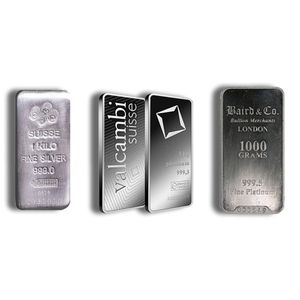
Buy 1 Kilo Platinum Bars Online
Our catalog currently features a 1 kilo platinum bar available from various reputable refineries, offering buyers one of the most practical large-format options in the platinum bullion market. Each bar contains 32.1507 troy ounces of platinum at a purity of .9995, making it one of the most refined and standardized formats available for serious bullion buyers. Whether you're consolidating platinum holdings or acquiring a single large-format piece, the 1 kilo bar sits at an efficient intersection of weight, cost-per-ounce, and storage density.
At Bullion Standard, pricing is structured around real-time market conditions and full transparency. The bid/ask spread is displayed directly on each product page, giving buyers a complete picture of both acquisition cost and current liquidation value before any purchase is made. That approach reflects our broader philosophy: informed buyers make better decisions, and better decisions build long-term relationships.
What Are 1 Kilo Platinum Bars?
A 1 kilo platinum bar is a cast or minted bullion product containing exactly one kilogram of platinum, which equates to approximately 32.15 troy ounces. This format is distinctly different from fractional bars, coins, or rounds in that it prioritizes metal density over handling convenience. The result is a product that typically carries tighter per-ounce premiums than smaller formats while still being physically manageable.
Buyers who favor this format tend to be focused on accumulating significant platinum weight in a compact, straightforward product. Unlike government-issued platinum coins, 1 kilo bars do not carry legal tender status but they derive their value entirely from metal content and refinery credibility rather than numismatic premiums or collector appeal. The format is globally recognized and trades within the broader wholesale platinum market without difficulty.
The bar format also lends itself to straightforward storage. A single kilo bar is dense enough to represent substantial platinum value in a small physical footprint, making it efficient to secure, vault, or transport compared to equivalent weight in smaller denominations.
History and Background
Platinum's role as a tradeable bullion commodity developed significantly later than gold or silver, largely because refining the metal to high purity required industrial-scale techniques that weren't widely available until the 20th century. The metal was first identified in its pure form in the 18th century, but it wasn't until modern refinery infrastructure developed across Europe, North America, and South Africa that large-format platinum bars became a reliable commercial product.
The growth of platinum as an industrial metal throughout the mid-20th century, particularly in automotive catalytic converters, chemical processing equipment, and electronics manufacturing, helped establish the foundation for a deeper and more liquid bullion market. Refineries such as Valcambi, PAMP Suisse, and Engelhard developed standardized bar formats to meet growing demand from both industrial users and institutional buyers. The 1 kilo format emerged as a particularly efficient size for wholesale market participants who needed meaningful platinum weight in a manageable, assay-verified product.
Today, the 1 kilo platinum bar is a recognized standard within the wholesale precious metals market, produced by a range of internationally credentialed refineries and traded globally across institutional, dealer, and retail channels. The format's standardization and high purity make it straightforward to price, verify, and transfer within established bullion market structures.
Purity, Weight, and Specifications
The 1 kilo platinum bar listed in our catalog carries a purity of .9995, which reflects a platinum fineness of 99.95%. This is the industry-standard purity level for investment-grade platinum bars and meets the specifications required for inclusion in most institutional bullion programs and platinum storage accounts. The weight of one kilogram is a fixed metric standard, equivalent to 32.1507 troy ounces, a conversion that appears directly on the product for clarity.
Most 1 kilo platinum bars produced by reputable refineries are stamped with key identifying information directly on the bar's surface. This typically includes the refinery name or hallmark, the platinum weight in both kilograms and troy ounces, the purity fineness, and often a unique serial number. Serial numbers serve both as an anti-counterfeiting measure and as a means of tracking individual bars through the supply chain.
Bars in this format are generally produced using either cast or minted manufacturing processes. Cast bars, formed by pouring molten metal into molds, tend to have a more industrial appearance with natural surface variation. Minted bars are pressed and finished to tighter tolerances, often with polished or frosted surfaces and sharper edge definition. Both formats meet the same purity and weight standards.
Available Brands, Mints, and Product Variations
The 1 kilo platinum bar in our catalog is listed as a random brand product, meaning the specific refinery may vary depending on current inventory and wholesale market availability. In practice, this means a buyer may receive a bar produced by any number of internationally recognized refineries, including names such as Valcambi, PAMP Suisse, Credit Suisse, Engelhard, Johnson Matthey, Argor-Heraeus, or other credentialed manufacturers. All bars supplied under this listing meet the .9995 purity standard and carry appropriate hallmarks.
Random brand or random mint products are a well-established format within the wholesale platinum market. They allow buyers to access institutional-grade platinum at pricing that reflects efficient sourcing rather than premium branding. For buyers whose primary focus is platinum weight rather than a specific manufacturer's name or design, this approach offers a practical and cost-effective entry point into large-format platinum bar ownership.
Should specific brand preferences become a priority, understanding the refinery landscape is useful context. European refineries such as Valcambi and Argor-Heraeus operate under Swiss Good Delivery standards, while PAMP Suisse products are widely recognized across global dealer networks. Legacy American refineries like Engelhard and Johnson Matthey produced bars that remain actively traded in secondary markets, further demonstrating the broad recognition that comes with hallmarked, assay-verified platinum bars regardless of manufacturer.
Pricing, Premiums, and Market Factors
Platinum bar pricing is derived from the live spot price of platinum, quoted in U.S. dollars per troy ounce, with a premium added to reflect manufacturing costs, refinery margins, distribution, and dealer operating costs. Because the 1 kilo bar contains just over 32 troy ounces, even modest per-ounce premium differences compound meaningfully at this weight. Buyers considering large-format bars are generally working toward tighter per-ounce costs compared to smaller denominations, which is one of the primary practical reasons this format exists.
Premium levels on platinum bars fluctuate based on several factors beyond basic spot pricing. Wholesale market supply and demand conditions, refinery availability, shipping logistics, and overall market activity all influence the premium structure at any given time. Because platinum is a narrower and less liquid market than gold or silver, supply constraints and demand spikes can move premiums more sharply and quickly than buyers accustomed to gold markets might expect. Random brand products tend to carry slightly tighter premiums than named-brand bars, reflecting the flexibility that comes with sourcing from the broader wholesale market.
Bullion Standard displays the full bid/ask spread on each product page, providing a transparent view of both the purchase price and the current buyback pricing before a transaction is completed. This structure removes the ambiguity that exists in many traditional dealer environments and allows buyers to evaluate the true cost of ownership, including the spread they'd be working against on a near-term resale. That level of pricing transparency is central to how we operate.
Condition, Packaging, and What to Expect
Most 1 kilo platinum bars are delivered in assay packaging, which typically consists of a sealed card or certificate that displays the bar's weight, purity, refinery information, and serial number. Assay packaging serves both as a verification document and a protective enclosure that helps maintain the bar's surface condition during handling and storage. Bars received in intact assay packaging are generally easier to resell and may command slightly better pricing in certain dealer or secondary market contexts.
Because this product is listed as a random brand item, packaging presentation will vary by refinery. Some bars arrive in credit-card-style assay holders, others in laminated certificates, and some in simple protective sleeves. All formats are considered standard within the wholesale platinum market. Buyers should not expect uniform packaging across different sourcing periods.
As with most large bullion bars, minor surface marks, handling scuffs, or toning variations are considered normal and acceptable. These cosmetic characteristics do not affect the metal content, purity, or fundamental market value of the bar. The bullion market generally evaluates platinum bars on weight and purity rather than surface appearance, which distinguishes the bar format from numismatic products where visual condition carries premium significance.
Authenticity and Verification
Every 1 kilo platinum bar offered through Bullion Standard is sourced from reputable mints, refineries, wholesalers, and distributors within established industry channels. Each product is verified for authenticity, weight, and purity before reaching our customers. This verification process is a non-negotiable part of our sourcing standards, not a marketing distinction.
Hallmarks and serial numbers stamped directly onto platinum bars are the primary authentication features for large-format bullion. These markings allow individual bars to be traced through the refinery supply chain and cross-referenced against assay documentation. For bars accompanied by assay cards, the serial number on the bar should match the number printed on the certificate, which is one of the first checks a buyer or dealer performs upon receipt.
At the industry level, platinum bars produced by refineries recognized under Good Delivery standards set by the London Platinum and Palladium Market (LPPM) carry additional credibility within the institutional market. These standards specify acceptable weight tolerances, purity requirements, and hallmarking conventions that participating refineries must maintain. Bars from LPPM-accredited refineries carry broad market recognition across dealer networks worldwide. Bullion Standard's membership in the American Numismatic Association and the National Coin and Bullion Association, along with our A Better Business Bureau rating, reflects the same commitment to product integrity at the retail level.
Liquidity and Resale Considerations
The 1 kilo platinum bar format is well-recognized within wholesale and retail precious metals markets globally. Its standardized weight and documented purity make it straightforward to evaluate, price, and transfer within established dealer networks. That standardization is a meaningful practical advantage when resale eventually becomes relevant, as buyers and dealers can assess the product quickly without extensive verification beyond confirming the hallmark and assay documentation.
Platinum as a market is narrower than gold, which means liquidity conditions can vary more noticeably depending on current industrial demand patterns and broader macroeconomic factors. Within that context, the 1 kilo bar format generally performs well in terms of resale accessibility because it aligns with the weight conventions used by institutional buyers and wholesale market participants. Smaller fractional formats may appeal to a broader retail audience, but the kilo bar's alignment with wholesale market sizing gives it natural relevance in dealer-to-dealer and institutional transactions.
Random brand bars are fully tradeable in the secondary market, though some buyers prefer the added recognizability of a specific major refinery's hallmark. In practice, the price difference between a named-brand kilo bar and a random brand bar of equivalent purity tends to be modest in the wholesale market, since both are evaluated primarily on platinum content and verification rather than branding alone.
Storage and Security
A single 1 kilo platinum bar is compact relative to its value, which simplifies storage compared to equivalent holdings spread across many smaller pieces. Its density means it fits easily within a standard home safe, bank safe deposit box, or professional vault without requiring significant space planning. That compactness is one of the genuine practical advantages of the kilo bar format for buyers consolidating meaningful platinum weight.
Home storage is workable for many buyers, provided adequate security measures are in place. A quality home safe with fire resistance and anchoring capability is the minimum standard for storing platinum bars at this value level. For larger holdings or buyers who prefer institutional security, allocated storage through a third-party vault service or a bank safe deposit box offers additional protection without transferring ownership or creating counterparty exposure.
Maintaining the original assay packaging is worth prioritizing in any storage arrangement. Bars that arrive in sealed assay holders should remain in that packaging wherever possible, as intact assay documentation can influence resale ease and dealer acceptance. Environmental factors such as humidity and temperature are less of a concern for platinum than for silver, but keeping bars in a dry, stable environment remains good practice for preserving surface condition over time.
Selling and Buyback Options
Selling a 1 kilo platinum bar involves the same core considerations as any large-format bullion transaction: product verification, current market pricing, and finding a buyer who can transact efficiently at fair value. Dealer buyback programs represent one of the most direct resale channels, as established dealers have the infrastructure to verify, price, and absorb large-format bars quickly. The premium paid above spot on purchase and the buyback price offered are the two figures that together define the real cost of ownership, which is why understanding both from the start matters.
Factors that influence buyback pricing include current platinum spot prices, wholesale market conditions, the bar's refinery brand and hallmark, assay documentation status, and general demand within the dealer network at the time of sale. Bars with intact assay packaging, clear hallmarks, and serial numbers that match their documentation are easier for dealers to process and typically command more competitive buyback pricing as a result.
Bullion Standard operates as a two-way market, meaning customers can both purchase and sell platinum bars within the same platform. Our purchasing team evaluates buyback requests using competitive pricing informed by live wholesale market conditions. The bid price displayed on each product page reflects current buyback pricing in real time, so sellers can assess the current market before initiating a transaction. This structure is designed to make the resale process as transparent and straightforward as the purchase process itself.
Why Buy 1 Kilo Platinum Bars?
The 1 kilo platinum bar appeals primarily to buyers focused on acquiring meaningful platinum weight with a relatively efficient per-ounce cost structure. Compared to fractional bars or 1 oz platinum bars, the kilo format typically carries lower per-ounce premiums, which reflects the economies of scale that come with larger denomination bullion. For buyers whose goal is maximizing platinum content per dollar spent, this format represents a logical step up from smaller denominations.
Platinum's role in industrial applications, particularly catalytic converters, hydrogen fuel cell technology, petroleum refining, and chemical manufacturing, means the underlying demand for the metal extends well beyond the bullion market. That industrial foundation gives platinum a fundamentally different market dynamic compared to gold, where investment and jewelry demand dominate. Buyers who want exposure to a metal with active industrial consumption alongside a recognized bullion format often find the kilo bar a practical choice.
The format also offers meaningful storage efficiency. One kilogram of platinum in a single bar takes up considerably less space than the same weight in smaller denominations while remaining a globally recognized, assay-verified product. For buyers with allocated storage arrangements or limited safe capacity, that density advantage translates directly into reduced storage costs and simpler inventory management.
Why Buy from Bullion Standard?
Bullion Standard was founded in 2010 and is headquartered in San Diego, California. Over more than a decade in operation, we've built our reputation on pricing transparency, product integrity, and a customer-first structure that doesn't rely on pressure-based selling. Our goal has always been straightforward: create an environment where buyers can make informed decisions based on real data rather than marketing claims.
Every product in our catalog is sourced from reputable mints, refineries, wholesalers, and distributors, and verified for authenticity, weight, and purity before it reaches our customers. Our platform displays live bid and ask pricing on each product page, giving buyers a clear view of both the purchase price and current buyback value simultaneously. That transparency extends to our payment options as well, which include major credit cards, PayPal, wire transfer, bank-connected payments through Plaid, paper check, and cryptocurrency through BitPay.
We hold an A rating with the Better Business Bureau and maintain active memberships in the American Numismatic Association and the National Coin and Bullion Association. We are also an authorized dealer for both PCGS and NGC. These affiliations reflect a commitment to industry standards that goes beyond a checkout experience. Our two-way market model means we're as focused on helping customers sell efficiently as we are on the purchase side, which we think is the only honest way to operate in this market.
Get Near-Spot Pricing with Bullion Standard Pro
Bullion Standard Pro is designed for buyers who want to transact as close to wholesale market pricing as possible. Members gain access to live, executable wholesale bid and ask pricing across our catalog, including large-format platinum bars. Unlike the standard retail model where dealer spreads are fixed on top of spot, Pro pricing fluctuates naturally based on real-time supply and demand within the wholesale platinum market. There are no additional dealer markups applied to member transactions.
For buyers acquiring a 1 kilo platinum bar, where the value per transaction is substantial, even modest spread improvements translate into meaningful real-dollar differences. The Pro platform is structured to make that efficiency accessible through a transparent, data-driven pricing environment rather than through negotiation or volume commitments. Members can also view live portfolio valuations based on executable wholesale bid pricing, giving a more accurate picture of current liquidation value than estimated retail prices provide.
Beyond pricing, Bullion Standard Pro provides access to proprietary market intelligence tools including historical premium analysis, spread analytics, liquidity metrics, and wholesale market activity data. For platinum buyers evaluating whether a particular moment is an efficient time to acquire or liquidate a kilo bar, having access to that level of market data within the same platform where transactions are executed represents a meaningful advantage over traditional retail purchasing environments.


 (833) 278-4653