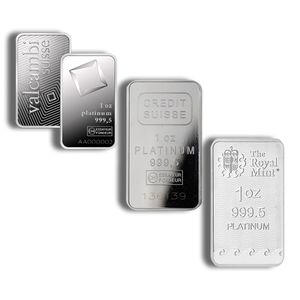
Buy 1 oz Platinum Bars Online
Our catalog of 1 oz platinum bars brings together some of the most recognized names in the global refinery market, including Argor-Heraeus, PAMP Suisse, Valcambi, and Engelhard, alongside competitively priced random brand options available with or without an assay card. Each bar contains one troy ounce of platinum in minted bar format, making this an efficient and widely traded size for buyers who want direct exposure to physical platinum without the higher premiums often associated with coins or fractional formats.
Whether you're drawn to the design and assay-certified presentation of the PAMP Suisse Lady Fortuna or prefer the straightforward utility of a random brand bar, the selection here reflects genuine market depth across brands, origins, and packaging configurations. Bullion Standard prices every product based on real-time market conditions, and our transparent bid and ask structure means you can evaluate each option with full clarity before making a purchase.
Every 1 oz platinum bar in our catalog has been verified for authenticity, weight, and purity before it ships. Our sourcing network spans reputable mints, refineries, and authorized wholesale distributors, and our fulfillment process is built around reliability and security from the moment you place your order to the moment your bar arrives.
What Are 1 oz Platinum Bars?
A 1 oz platinum bar is a refined precious metals product that contains exactly one troy ounce of platinum, typically struck or pressed to a minted finish with identifying marks that include the refinery name, weight, and purity. Unlike cast bars, which are poured from molten metal and tend to have a rougher, more industrial appearance, minted bars are produced from pre-rolled platinum blanks that are precision-cut and struck under high pressure to produce clean edges and a refined surface. All of the bars in our catalog fall into the minted category.
The one-ounce weight is the most liquid and commonly traded size in the platinum bar market. It's large enough to represent meaningful metal content while remaining accessible in terms of cost and practical to handle, store, and resell. Buyers often prefer this size over platinum coins because the premiums above spot tend to be lower, and the bar format is universally recognized across the wholesale and retail markets globally.
Platinum bars at this weight are typically purchased by buyers who want direct exposure to the metal itself rather than the design or legal tender status associated with platinum coins like the American Platinum Eagle or the Platinum Maple Leaf. The bar format keeps the focus on metal content and pricing efficiency.
History and Background
Platinum has a shorter commercial history than gold or silver, but it has developed a well-established presence in the refined bullion market over the past several decades. The metal was largely unavailable to general commerce until the late 18th century, when European chemists and metallurgists began isolating and refining it with enough consistency to make commercial use practical. By the 20th century, industrial demand, particularly from the automotive and chemical sectors, had turned platinum into one of the most actively monitored precious metals on global commodity exchanges.
The development of the modern platinum bar market followed closely behind the growth of major Swiss refineries. Firms like PAMP Suisse, Valcambi, and Argor-Heraeus built their reputations on producing investment-grade gold and silver bars during the 1970s and 1980s, and platinum bars followed naturally as institutional and retail demand for the metal expanded. Engelhard, a legendary American refinery with deep roots in industrial precious metals processing, became one of the most recognized platinum bar producers in North America before its acquisition by BASF.
Today, the 1 oz platinum bar format is a standard product across most major precious metals refineries and is recognized by wholesale dealers and buyback programs around the world. The LBMA (London Bullion Market Association) and other industry bodies have helped standardize purity requirements and refinery accountability, which contributes to the broad acceptance of bars from established producers.
Purity, Weight, and Specifications
The bars in our catalog are produced to two purity standards: 0.9999 fine platinum and 0.9995 fine platinum. The Argor-Heraeus bar is the only one in this group struck to 0.9999 fineness, representing the highest commercially available purity standard for minted platinum bars. The remaining bars, including those from PAMP Suisse, Valcambi, Engelhard, and the random brand options, are produced to 0.9995 fineness, which is the more widely adopted standard in the platinum bar market and fully acceptable across all major wholesale and retail platforms.
All bars weigh one troy ounce, which is the standard unit of measure in the precious metals industry and is equivalent to approximately 31.103 grams. Physical dimensions vary by manufacturer. The Argor-Heraeus bar measures 40.4 mm by 23.3 mm with a thickness of 1.7 mm, while the Engelhard bar is slightly larger at 45 mm by 27 mm and 3 mm thick. The PAMP Suisse bar comes in at 41 mm by 24 mm, and the Valcambi bar is among the most compact in the group at 38 mm by 22 mm. These dimensional differences are normal across refineries and do not affect metal content.
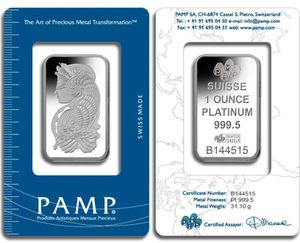
Each bar is stamped with the refinery name or logo, the weight designation, and the purity mark. Assay-certified bars include an assay card, which is a tamper-evident document issued by the refinery that certifies the bar's metal content and authenticity. Bars presented in assay cards should always be kept in their original sealed packaging to preserve verifiability and resale appeal.
Available Brands, Mints, and Product Variations
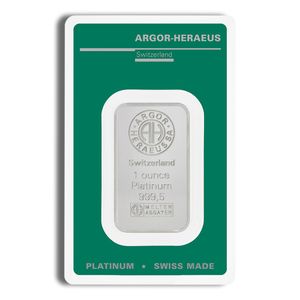
The Argor-Heraeus 1 oz platinum bar is produced in Mendrisio, Switzerland by one of the most technically advanced refineries in the world. Argor-Heraeus holds LBMA Good Delivery status and is recognized globally for its exacting quality standards. This bar is presented in a sealed assay card and struck to 0.9999 fineness, making it one of the purest platinum bars commercially available. The clean, minimalist design typical of Argor-Heraeus products appeals to buyers who prioritize precision and refinery reputation.
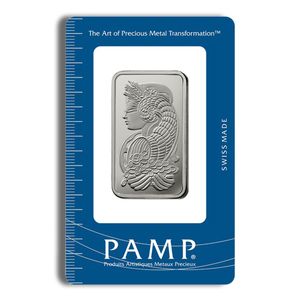
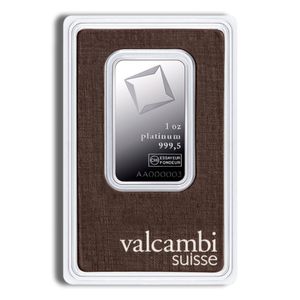
PAMP Suisse is perhaps the most recognized name in minted bar production worldwide, and the Lady Fortuna design is among its most iconic. The 1 oz platinum Lady Fortuna bar features the goddess Fortuna on the obverse, presented in PAMP's signature high-relief minted style. It ships in a sealed assay card and carries 0.9995 fine platinum. Valcambi, also headquartered in Switzerland, produces a similarly assay-certified bar with a clean design that emphasizes the refinery's branding and purity credentials. Both PAMP and Valcambi are trusted across the global wholesale market.
The Engelhard bar represents a distinctly American pedigree. Engelhard was one of the most influential precious metals refiners in U.S. history, and its bars remain highly recognizable among domestic buyers. The 1 oz platinum Engelhard bar ships in sealed packaging and carries 0.9995 fineness. For buyers who prefer flexibility over brand specificity, the random brand options offer 0.9995 fine platinum bars from various reputable refineries, available either in assay card or without, at pricing that typically reflects a tighter premium structure. The specific brand received may vary based on current inventory, but all random brand bars meet the same purity standards.
Pricing, Premiums, and Market Factors
The price of any 1 oz platinum bar is determined by two components: the spot price of platinum and the premium charged above that spot price. Spot price represents the current market price for one troy ounce of raw platinum and fluctuates continuously during trading hours based on global supply and demand, futures activity, currency movements, and industrial market conditions. The premium represents the cost of refining, fabricating, packaging, distributing, and retailing the finished product.
Premiums on 1 oz platinum bars vary based on several factors. Bars from internationally recognized refineries like PAMP Suisse and Argor-Heraeus typically carry a modest premium above more generic products, reflecting their brand recognition and the quality of their assay packaging. Bars with assay cards generally command slightly higher premiums than unassayed bars because the certification adds verifiability that matters in resale markets. Random brand bars typically represent one of the more premium-efficient options in the platinum bar segment, trading closer to spot than brand-specific products.
Platinum spot prices are also influenced by factors that don't apply to gold or silver in the same way. Platinum production is geographically concentrated, with South Africa accounting for the majority of global mine supply, which means supply disruptions, labor actions, and energy costs in that region can affect platinum pricing more acutely than more geographically distributed metals. Automotive and industrial demand also plays a meaningful role. Bullion Standard's pricing reflects real-time market conditions, and our product pages display both the ask price and the bid price so buyers can evaluate the full cost of ownership, including what they might expect to receive when they eventually sell.
Condition, Packaging, and What to Expect
Most of the bars in this catalog are new, mint-condition products presented in sealed assay cards or sealed refinery packaging. Assay-carded bars arrive in a tamper-evident plastic enclosure with a certificate of authenticity printed directly on or within the card. These should not be removed from their packaging, as doing so reduces both verifiability and resale value. The Engelhard bar ships in its original sealed packaging, which may differ in style from Swiss assay cards but serves the same function of confirming authenticity and preserving condition.
Random brand bars come from a rotating pool of inventory sourced from reputable refineries and may not match a specific brand on any given order. Buyers selecting these options should expect a bar that meets the stated purity and weight specifications but may vary in visual design, packaging presentation, and country of origin. Bars ordered without an assay card may arrive loose or in basic protective packaging rather than a certified enclosure.
Minor surface marks or handling variations are not uncommon on bars that have moved through wholesale distribution channels and do not indicate inauthenticity or deviation from weight and purity standards. Bars are inspected before shipment, and any product that does not meet our quality standards is removed from fulfillment inventory prior to shipping.
Authenticity and Verification
Every 1 oz platinum bar sold through Bullion Standard is sourced from established mints, refineries, authorized wholesalers, and distributors with verifiable supply chains. Before any product reaches a customer, it is inspected for authenticity, weight accuracy, and purity consistency. Bars that arrive in assay cards are kept in their sealed original packaging throughout the fulfillment process to preserve the integrity of the factory certification.
Assay cards from refineries like PAMP Suisse, Valcambi, and Argor-Heraeus are produced with embedded security features, including holographic elements, serial numbers, and tamper-evident seals that allow buyers and dealers to verify authenticity without opening the packaging. The assay card itself is issued by the producing refinery and carries the weight, purity, and serial data directly tied to the bar it contains.
For buyers who want additional verification, platinum bars can also be tested using professional XRF (X-ray fluorescence) analysis, ultrasonic testing, or professional dealer appraisal. Bullion Standard maintains memberships with the American Numismatic Association and the National Coin and Bullion Association, and we operate as an authorized dealer for PCGS and NGC. Our sourcing practices and verification procedures are designed to give buyers confidence in every product that ships from our facility.
Liquidity and Resale Considerations
The 1 oz size is the most actively traded weight in the platinum bar market, and bars from well-known refineries like PAMP Suisse, Argor-Heraeus, Valcambi, and Engelhard are accepted by dealers, buyback programs, and secondary market buyers around the world. Refinery recognition plays a meaningful role in resale ease, and products from LBMA-affiliated refineries tend to transact with less friction than bars from unknown or unverifiable sources.
Bars kept in their original assay packaging generally receive better buyback pricing than bars that have been removed or handled extensively. Packaging integrity signals authenticity and reduces the due diligence burden for buyers and dealers during resale. Random brand bars without assay cards may face slightly more scrutiny during resale, but they still transact normally when verified through standard testing procedures.
Platinum as a metal trades in a smaller market than gold, which can affect liquidity at the retail level during periods of low demand. Sticking with established brands and standard formats like the 1 oz minted bar helps maintain consistent resale options regardless of where market conditions happen to be at the time of sale.
Storage and Security
One troy ounce platinum bars are compact and relatively easy to store. Their small physical footprint means a meaningful quantity can be secured in a modestly sized safe without requiring significant space. For buyers holding multiple bars, a quality home safe with fire and moisture resistance provides a practical first line of defense, though it should be bolted to a structural surface to prevent removal.
Bars stored in assay cards are already in protective packaging that guards against scratches and environmental exposure, but they should still be kept away from excess humidity, temperature fluctuations, and direct contact with other metals that could cause surface damage. Platinum is highly resistant to tarnish and corrosion, but assay card materials can degrade if stored improperly over long periods.
For buyers holding substantial quantities of platinum bars, third-party vault storage through an insured and audited facility offers an alternative to home storage. Bank safe deposit boxes are another option for smaller quantities, though they typically don't carry insurance coverage for precious metals contents without a separate policy. Bullion Standard can provide guidance on storage solutions as part of our broader customer support resources.
Selling and Buyback Options
Bullion Standard operates as a two-way market, meaning customers can sell platinum bars back to us directly rather than having to seek out a third-party buyer. Our buyback pricing is based on current wholesale bid levels and is updated in real time alongside our ask pricing. Each product page on our platform displays both the buy price and the bid price, giving buyers a clear view of the spread before they make a purchasing decision.
When selling bars back to Bullion Standard, several factors influence the buyback price you'll receive. Refinery brand recognition matters, as bars from PAMP Suisse, Argor-Heraeus, Valcambi, and Engelhard are widely known and easy to verify, which supports tighter spreads. Condition and packaging integrity also factor in. Bars in original sealed assay cards typically receive the most straightforward buyback pricing because authenticity can be confirmed without additional testing. Bars that have been removed from their packaging or show significant surface damage may require manual review before a final offer is confirmed.
The process of selling to Bullion Standard is designed to be operationally simple. Our purchasing team handles verification, and the transaction is settled through the same secure payment infrastructure that supports our buying side. We encourage buyers to think about liquidity before completing a purchase, not only when it's time to sell, which is why we make bid pricing visible at the point of purchase rather than waiting until after the fact.
Why Buy 1 oz Platinum Bars?
Platinum bars at the one-ounce weight occupy an interesting space in the bullion market. They offer the premium efficiency of bar format without the high absolute cost of larger bar sizes, and they're compact enough to acquire incrementally over time without requiring a large outlay in a single transaction. For buyers who want meaningful platinum exposure without the additional design and legal tender premiums baked into platinum coins, the bar format typically represents the most cost-effective entry point.
Platinum is one of the rarest naturally occurring elements, with annual mine production a fraction of what is produced in gold or silver. Its supply is heavily concentrated in a small number of geographic regions, primarily South Africa, Russia, and Zimbabwe, which gives it a supply profile that's meaningfully different from more geographically diversified metals. Industrial demand from automotive catalytic converter manufacturing, petroleum refining, electronics, and the hydrogen fuel cell sector gives platinum functional demand drivers that exist independent of financial market sentiment.
The 1 oz minted bar format also benefits from standardization. Because the size and format are consistent across major refineries, these bars are easy to compare, appraise, and transact regardless of which brand is on the face. That standardization contributes to the format's position as the most traded and recognized size in the global platinum bar market.
Why Buy from Bullion Standard?
Bullion Standard was founded in 2010 and has grown into a nationally recognized precious metals marketplace by building its model around transparency, pricing integrity, and long-term customer trust. Our pricing reflects live market conditions, and our product pages display both the purchase price and the buyback bid so buyers can see the complete picture before they commit. There are no hidden fees or deliberately obscured spreads.
Every platinum bar in our catalog is verified for authenticity, weight, and purity before it ships. We source from reputable refineries, authorized wholesalers, and established distributors, and our fulfillment process is designed around security and reliability. We carry an A rating with the Better Business Bureau, hold memberships with the American Numismatic Association and the National Coin and Bullion Association, and operate as an authorized dealer for both PCGS and NGC.
Our checkout supports a wide range of payment methods, including Visa, Mastercard, American Express, Discover, PayPal, bank-connected payments through Plaid, wire transfer, paper check, and cryptocurrency through BitPay. Whether you're making your first platinum purchase or adding to an existing position, Bullion Standard is built to make the experience straightforward, secure, and free from unnecessary pressure. Our customer service team is accessible and responsive, and our post-purchase support reflects the same transparency we apply to pricing.
Get Near-Spot Pricing with Bullion Standard Pro
Bullion Standard Pro is designed for buyers who want to transact at wholesale market pricing rather than standard retail premiums. Members gain access to live, executable wholesale bid and ask prices across our full catalog, including platinum bars, with spreads that reflect real-time supply and demand in the wholesale market rather than fixed retail structures. Unlike traditional dealer models, Pro pricing does not layer additional markups on top of market levels, which means the premium you pay reflects actual market conditions.
For platinum, where premiums and spreads can be more sensitive to market liquidity conditions than in gold or silver, the ability to transact at or near executable wholesale pricing can represent a meaningful difference in total acquisition cost. Bullion Standard Pro also provides access to historical premium data, spread analysis, and proprietary market intelligence tools that allow members to evaluate when and how to acquire platinum relative to historical norms, rather than making decisions based on current price alone.
Portfolio valuation through Bullion Standard Pro uses live executable wholesale bid pricing, so members can see what their platinum holdings are worth based on current wholesale liquidation values rather than estimated retail figures. For buyers who plan to hold platinum for a meaningful period and intend to sell eventually through the same platform, this level of pricing transparency provides a more accurate and operationally useful picture of their position at any given time.


 (833) 278-4653