1 oz Silver Coins | Bullion Standard
Buy 1 oz Silver Coins Online
Our catalog of 1 oz silver coins brings together some of the most widely recognized government-issued silver bullion programs in the world, sourced directly from sovereign mints and authorized distributors. Buyers will find flagship series from the United States Mint, the Royal Canadian Mint, The Perth Mint, The Royal Mint of Great Britain, the Austrian Mint, South African Mint, and Casa de Moneda de México, among others. Whether you're looking for a classic Silver American Eagle, a Canadian Silver Maple Leaf, an Australian Silver Kangaroo, or an Armenian Noah's Ark coin, the breadth of options here reflects the full scope of the modern silver bullion market.
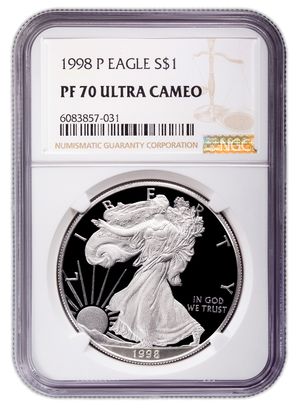
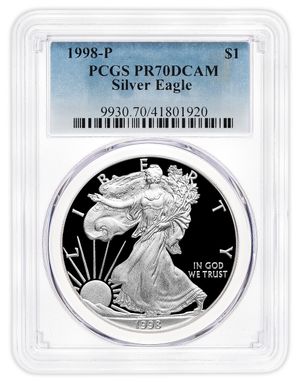
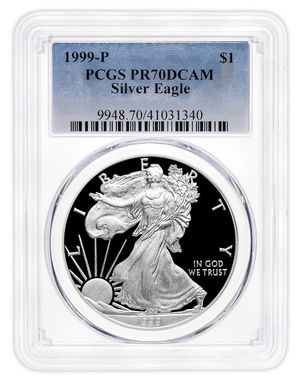
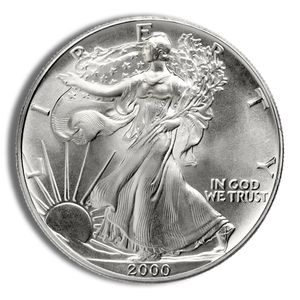
Products are available in multiple conditions and packaging formats, including raw brilliant uncirculated coins, certified examples graded by NGC and PCGS, proof and proof-like issues with original government packaging, and random year selections offered at a tighter premium. The catalog also includes date-specific releases spanning decades of production, giving both bullion buyers and date-run collectors meaningful options within a single format.
Bullion Standard sources these coins through established wholesale channels and reputable distributors, and every product is verified for authenticity, weight, and purity before it reaches our customers. Pricing reflects real-time market conditions, with bid and ask spreads displayed directly on each product page so buyers can evaluate the full cost of ownership before committing to a purchase.
What Are 1 oz Silver Coins?
A 1 oz silver coin is a government-minted bullion coin containing one troy ounce of silver, produced by a sovereign mint and typically issued as legal tender within its country of origin. Unlike silver rounds, which are privately minted and carry no legal tender status, 1 oz silver coins are official government products backed by the issuing nation's treasury or central bank. This distinction makes them among the most universally recognized forms of physical silver available to buyers worldwide.
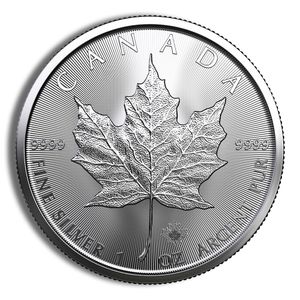
Most 1 oz silver coins in this segment are struck in .999 or .9999 fine silver, with the specific purity varying by mint and series. Common examples include the Silver American Eagle at .999 fine, the Canadian Silver Maple Leaf at .9999 fine, and the Australian Silver Kangaroo at .9999 fine. Coins struck at .999 purity contain 31.10 grams of silver, while those at .9999 approach theoretical maximum purity and are among the cleanest silver products available in bullion coin format.
The 1 oz format occupies a practical middle ground in the silver market. It's large enough to carry meaningful silver content while remaining affordable enough to buy in quantity, and its standardized size makes it easy to store, handle, and resell. Compared to larger silver bars or kilo coins, 1 oz coins offer greater divisibility, making them a commonly chosen format for buyers building physical silver holdings incrementally over time.
History and Background
The modern 1 oz silver bullion coin market took shape largely in the 1980s, beginning with the launch of the Silver American Eagle in 1986, which was established under the Liberty Coin Act of 1985. The program was the first U.S. government-issued silver bullion coin program since the Morgan and Peace dollar eras and was specifically designed for investors seeking a government-backed silver product at a standardized weight. That same decade saw the introduction of the Mexican Silver Libertad in 1982, making it one of the earliest modern sovereign silver bullion coins and a predecessor to the wave of programs that followed.
The Austrian Philharmonic, first issued in gold in 1989 and later extended to silver in 1992, brought European sovereign minting into the mainstream bullion market with a culturally distinctive design celebrating the Vienna Philharmonic Orchestra. The Perth Mint's Australian silver programs, including the Kookaburra and Koala series launched in the early 1990s, introduced the concept of annually rotating designs to the sovereign bullion coin market, attracting both bullion buyers and collectors drawn to year-specific imagery. The Canadian Silver Maple Leaf, introduced in 1988, quickly became one of the most widely traded silver coins in the world due to its .9999 fineness and the Royal Canadian Mint's reputation for production quality and security innovation.
Over the following decades, additional sovereign programs entered the market, including the South African Silver Krugerrand, which extended the legendary Krugerrand name into silver beginning in 2017, the British Silver Britannia from The Royal Mint, and the Armenian Noah's Ark series produced by Geiger Edelmetalle. Each of these programs has developed its own buyer base and market presence, contributing to a global ecosystem of 1 oz silver coins that spans continents and minting traditions. The depth of this catalog reflects how broadly the 1 oz silver coin format has been adopted as a global standard for sovereign silver bullion.
Purity, Weight, and Specifications
The 1 oz silver coin format is defined by a standardized silver content of one troy ounce, equivalent to 31.1035 grams. Purity levels across the coins in this catalog range from .925 fine silver, as seen in certain early Mexican Onza Balance Scale issues, to .999 fine for the majority of sovereign programs, and .9999 fine for coins from the Royal Canadian Mint and The Perth Mint's Kangaroo series. These purity standards are struck directly into each coin's design or edge and are independently verifiable through assay testing.
Physical dimensions vary by series. The Silver American Eagle measures 40.6 mm in diameter with a thickness of approximately 2.98 mm, while the Austrian Philharmonic is slightly narrower at 37 mm with a 3.2 mm profile. The Canadian Silver Maple Leaf comes in at 38 mm with a 3.29 mm thickness, and Australian Perth Mint coins including the Kookaburra and Kangaroo measure 40.6 mm and 40.9 mm respectively depending on the specific issue. Understanding these dimensions matters for buyers selecting capsules, storage tubes, or coin holders sized for specific series.
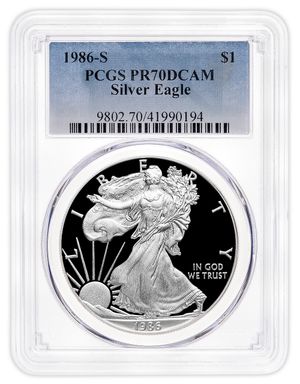
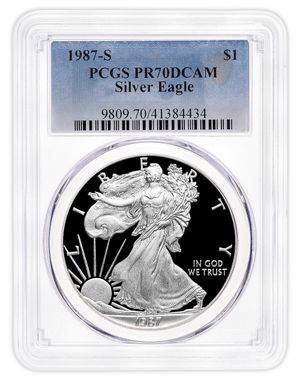
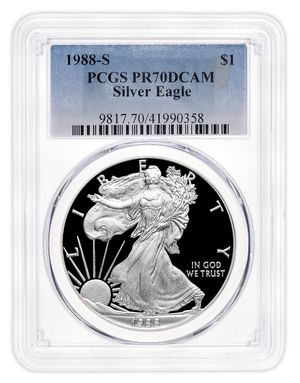
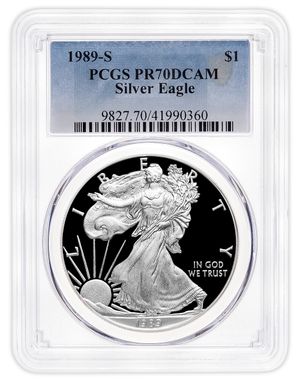
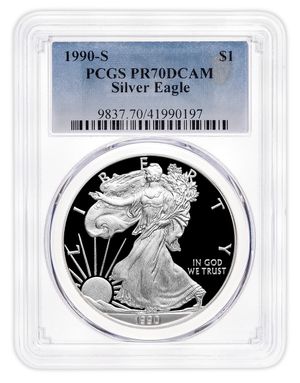
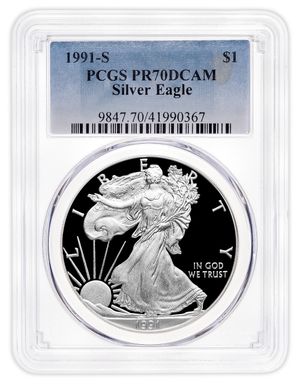
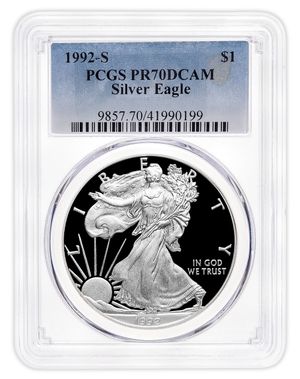
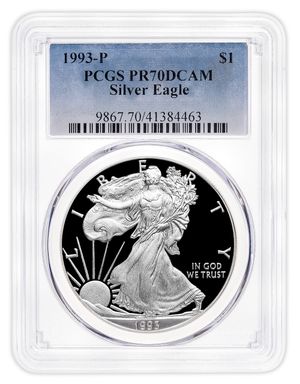
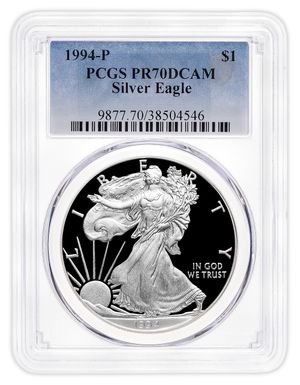
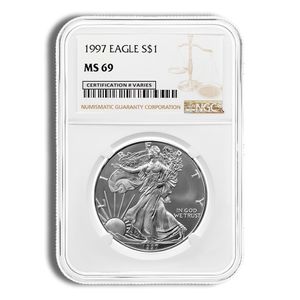
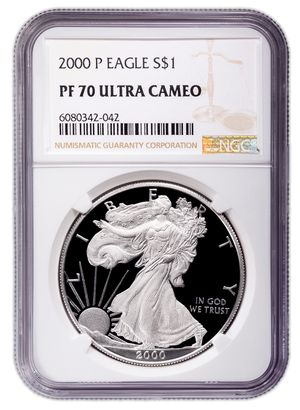
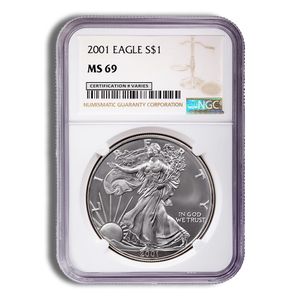
Certified examples from NGC and PCGS are encapsulated in tamper-evident plastic slabs that display the coin's grade, series, year, and certification number. These slabs protect the coin's surfaces and allow grade verification through the respective grading service's online registry. Raw bullion coins are typically delivered in original mint-issued packaging, including sealed tubes of 20 or 25 coins depending on the series, and outer sealed monster boxes where applicable.
Available Brands, Mints, and Product Variations
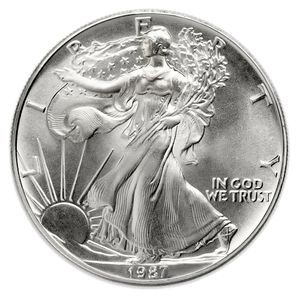
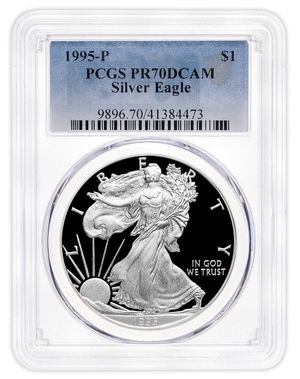
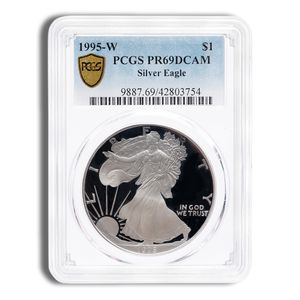
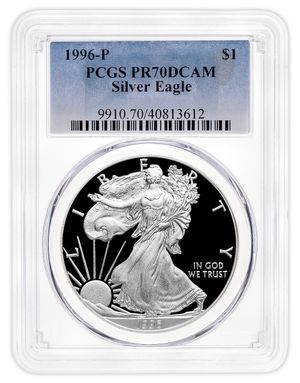
The United States Mint's Silver American Eagle program represents the largest single series in this catalog, with date-specific BU examples available from 1986 through 1997, alongside certified grades from NGC and PCGS ranging from MS69 to MS70. Proof issues struck at the San Francisco and Philadelphia Mint facilities, including the rare 1995-W Proof Silver Eagle, are available in original government packaging with box and Certificate of Authenticity. The 1995-W issue in particular occupies a distinct position in the Silver Eagle series due to its relatively limited mintage as part of the 10th Anniversary Gold and Silver Proof Set, making certified examples from NGC and PCGS among the more notable entries in this portion of the catalog.
The Royal Canadian Mint's Silver Maple Leaf is offered in both standard BU and imperfect condition variants, reflecting the full spectrum of market availability. The Perth Mint contributes multiple Australian series including the Silver Kangaroo at .9999 fineness, the Silver Kookaburra, and the Silver Koala, each with distinct dimensions and packaging configurations. The Austrian Philharmonic from the Austrian Mint, the Silver Britannia from The Royal Mint of Great Britain, and the South African Silver Krugerrand from the South African Mint round out the major sovereign offerings. Specialty items include the Armenian Noah's Ark coin produced by Geiger Edelmetalle, the ECCB Grand Canyon Silver Coin from the Eastern Caribbean Central Bank, and the Queen Elizabeth Silver Laurel from Commonwealth Mint.
The Mexican Silver Libertad series from Casa de Moneda de México is represented extensively with individual year-dated BU coins from 1982 through 1997, in addition to a random year option. Early Libertad issues from 1982 through 1995 carry slightly different physical dimensions than the later standard format, with 36 mm diameter and 4 mm thickness distinguishing them from the post-1996 standard profile of 40 mm diameter and 3 mm thickness. The Mexican Onza Balance Scale coin from 1978 to 1980, struck at .925 fine silver, adds further historical depth to the catalog's Mexican silver representation.
Pricing, Premiums, and Market Factors
Every 1 oz silver coin is priced relative to the spot price of silver, with a premium added above the raw metal value to account for minting costs, distribution, handling, and dealer operations. Premiums across this catalog vary significantly based on the product type. Raw bullion coins in random year format typically carry narrower premiums than date-specific coins, while certified examples graded MS70 or PF69 command the highest premiums due to their population scarcity and collector demand. Proof coins with original government packaging also carry elevated premiums relative to standard BU issues.
Mint reputation plays a meaningful role in premium structure. Coins from the United States Mint, the Royal Canadian Mint, and The Perth Mint consistently attract tighter bid/ask spreads in the secondary market due to their global recognition and deep liquidity. Products from smaller or less widely distributed programs may carry higher premiums on the buy side and wider spreads when reselling. Packaging integrity also influences pricing: sealed tubes of 20 or 25 coins and intact monster boxes of 500 coins typically command tighter premiums per coin than individually purchased loose coins.
Bullion Standard displays real-time bid and ask pricing on each product page, giving buyers visibility into both the acquisition cost and the current wholesale buyback value. This approach reflects the company's broader commitment to pricing transparency, allowing buyers to understand the complete picture of what they're paying and what the product is worth in the current market rather than relying on opaque dealer pricing structures.
Condition, Packaging, and What to Expect
Brilliant uncirculated coins arrive in the condition described at time of purchase, either in original sealed mint tubes, individual capsules, or as loose coins depending on the specific product. Random year products are drawn from available inventory and may feature any date within the stated range. Surface marks consistent with contact during the minting and tube-packing process are normal for BU coins and do not affect silver content, weight, or purity. Buyers seeking pristine, mark-free surfaces should consider certified MS69 or MS70 examples where available.
Proof coins listed with original box and Certificate of Authenticity are shipped in their original government-issued presentation cases. These products are particularly condition-sensitive and are handled accordingly during fulfillment. Products listed as impaired, circulated, or in imperfect condition reflect genuine market availability at reduced premiums and may show visible handling wear. These listings are clearly identified so buyers can make informed decisions based on their intended use.
Certified coins from NGC and PCGS arrive in their original graded slabs, which serve as tamper-evident holders and should not be opened or cracked out unless the buyer understands how this affects grade certification status. Shipping is conducted in secure packaging appropriate to the product type, with insured transit options available to protect against loss or damage in transit.
Authenticity and Verification
Every coin sold through Bullion Standard is sourced from authorized distributors, reputable wholesalers, or directly from sovereign mints and their licensed resellers. Products are verified for authenticity, weight, and purity before fulfillment. Bullion Standard maintains authorization as a dealer for both NGC and PCGS, ensuring that certified products meet the grading standards established by these independent services and can be verified through their respective online registries using the certification number displayed on each slab.
Modern sovereign bullion coins incorporate a range of anti-counterfeiting technologies that aid in verification. The Canadian Silver Maple Leaf features laser-engraved micro-text on the maple leaf design and a radial line security background that is difficult to replicate. The Silver American Eagle's design details, edge reeding pattern, and weight specifications provide measurable reference points for authentication. Coins such as the Armenian Noah's Ark and the South African Silver Krugerrand carry distinct design characteristics tied to their sovereign programs that can be cross-referenced against published mint specifications.
For buyers who want to independently verify silver content, third-party testing options include XRF spectrometry, ultrasonic thickness testing, and sigma metalytics verification. These non-destructive methods are widely used by dealers and collectors and provide objective confirmation of metal composition without altering the coin. Bullion Standard's sourcing practices and verification processes are designed to make this level of due diligence straightforward rather than necessary by default.
Liquidity and Resale Considerations
The 1 oz silver coin format is among the most liquid physical silver products available in the global bullion market. Coins from major sovereign programs such as the Silver American Eagle, the Canadian Silver Maple Leaf, and the Australian Silver Kangaroo are recognized and accepted by dealers, coin shops, and wholesale buyers worldwide. This broad recognition makes them easier to sell quickly at competitive prices compared to privately minted rounds or less familiar government programs. The standardized one troy ounce weight further simplifies the transaction process since buyers and sellers can immediately reference spot price without the need to calculate partial weights.
Certified coins carry a distinct liquidity profile. NGC and PCGS graded examples, particularly those in MS69, MS70, PF69, or PF70 grades, have established secondary markets through auction platforms, coin dealers, and certified coin exchanges. However, their liquidity is tied to collector demand for specific grades and dates rather than raw silver content alone, which means price realization can vary more widely than standard bullion. Random year coins and standard BU issues generally trade most efficiently within wholesale and dealer buyback channels.
Factors that can affect resale value include the coin's condition relative to its stated grade, the integrity of original packaging, the mint of origin, and current silver spot pricing. Products with impaired, circulated, or damaged packaging may be accepted at different pricing tiers than mint-sealed or certified equivalents. Understanding these distinctions before purchasing helps buyers align their expectations with the product's actual position in the resale market.
Storage and Security
Proper storage preserves both the physical condition and long-term resale potential of 1 oz silver coins. Silver is susceptible to toning and tarnish when exposed to humidity, sulfur compounds, and airborne pollutants, so controlling the storage environment is important. Individual coins in capsules or airtight holders are well protected against surface reaction, while coins stored in original sealed mint tubes benefit from the tube's limited air exposure during transit and short-term holding.
For larger quantities, a home safe rated for both fire and burglary protection provides a practical baseline for security. Buyers holding significant volumes of silver should consider allocated storage through a third-party vault or depository service, which provides insurance coverage, climate control, and professional security infrastructure not typically available in residential settings. Bank safety deposit boxes offer a more accessible alternative for moderate holdings, though insurance coverage and access hours vary by institution.
Certified coins in NGC or PCGS slabs are best stored vertically to avoid slab stress and surface pressure marks. Proof coins should remain in their original presentation cases whenever possible. For standard BU coins stored in tubes, keeping tubes upright and in a stable temperature environment minimizes internal movement that can cause contact marks over time.
Selling and Buyback Options
Bullion Standard operates a two-way market, meaning customers can sell silver coins back through the same platform they purchased from. This structure is central to the company's philosophy that liquidity should be considered before a purchase is made, not only when it's time to sell. Buyback pricing is based on current wholesale bid levels and is updated continuously to reflect real-time market conditions. Sellers can request a quote directly through the platform and, once accepted, ship their coins using Bullion Standard's insured shipping process.
Buyback pricing is influenced by several product-specific factors. Coins from widely recognized sovereign programs with intact original packaging or certification typically receive the most competitive bids. Raw coins in impaired or circulated condition are accepted at adjusted pricing that reflects their position in the secondary market. Certified coins graded by NGC or PCGS are evaluated based on grade, population data, and current demand for that specific year and grade combination rather than purely on silver content.
For sellers with larger quantities of tube-packed or monster-box-sealed coins, the buyback process is structured to accommodate efficient processing. Bullion Standard's purchasing team evaluates products against current wholesale market conditions and provides clear pricing before any transaction is finalized. The goal is to make the selling process as straightforward and transparent as the buying experience, with no hidden deductions or opaque pricing adjustments introduced after the initial quote.
Why Buy 1 oz Silver Coins?
The 1 oz silver coin format combines standardization, government backing, and global market recognition in a single, accessible package. Because these coins are issued by sovereign mints as legal tender, they carry an inherent credibility that privately minted products don't share. That credibility translates into easier resale, broader dealer acceptance, and a more predictable market presence over time. For buyers who value those qualities, 1 oz silver coins represent the clearest path to owning widely recognized physical silver.
Silver also carries meaningful industrial demand that distinguishes it from gold within the precious metals market. Applications in photovoltaic solar panels, electronics, medical equipment, electric vehicle components, and industrial manufacturing contribute to ongoing demand for refined silver beyond the bullion market. While this industrial demand doesn't drive daily bullion pricing in isolation, it reflects the metal's broader functional role in the modern economy and adds context to why silver maintains active spot markets globally.
The format's divisibility is another practical advantage. Unlike larger bars or kilo coins, 1 oz coins can be bought, held, and sold individually, allowing buyers to add to or reduce their physical silver holdings in precisely sized increments. Combined with the wide variety of sovereign programs available in this catalog, from date-specific collector-grade issues to competitively priced random year bullion, the 1 oz silver coin format offers meaningful flexibility across a range of buyer needs and budgets.
Why Buy from Bullion Standard?
Bullion Standard was founded in 2010 in San Diego, California, and has grown into a nationally recognized precious metals marketplace built on transparency, pricing integrity, and long-term customer trust. The company maintains an A rating with the Better Business Bureau and is a member of both the American Numismatic Association and the National Coin and Bullion Association. As an authorized dealer for both NGC and PCGS, Bullion Standard is positioned to source, verify, and represent certified products with the credibility those designations require.
Every product in the catalog is sourced from reputable mints, licensed distributors, and established wholesale channels, and each coin is verified for authenticity, weight, and purity before shipment. The buying experience is designed to feel transparent rather than transactional, with real-time pricing, visible bid/ask spreads on each product page, and a customer support structure oriented toward informed decision-making rather than high-pressure sales. Payment options include Visa, Mastercard, American Express, Discover, PayPal, bank-connected payments through Plaid, wire transfer, paper check, and cryptocurrency through BitPay.
The two-way market model sets Bullion Standard apart from conventional dealer arrangements. Rather than treating the buying and selling sides of the transaction as separate events, the platform integrates competitive buyback pricing alongside the purchasing experience, so customers understand the full economics of ownership from the moment they consider a purchase. That approach, grounded in data transparency and operational accountability, is the foundation on which the company's reputation has been built over more than a decade.
Get Near-Spot Pricing with Bullion Standard Pro
Bullion Standard Pro is designed for buyers who want direct access to executable wholesale market pricing without the dealer markups and fixed retail spreads that characterize traditional bullion purchasing. Members transact at live bid and ask prices drawn from actual wholesale market activity, allowing premiums and spreads to reflect real supply and demand conditions rather than static dealer pricing structures. For buyers who purchase silver regularly or in meaningful quantities, the pricing efficiency available through Pro can make a measurable difference in the true cost of ownership over time.
Beyond pricing, Pro members gain access to a suite of proprietary market intelligence tools that provide deeper visibility into the silver bullion market. These include historical premium analysis, premium percentile rankings, spread analysis, liquidity metrics, and buy/sell ratio indicators that aggregate wholesale market activity across a range of products. For buyers evaluating 1 oz silver coins across multiple programs and mints, these tools allow objective comparison using measurable data rather than marketing claims or subjective assessments.
Portfolio valuation through Bullion Standard Pro uses live executable wholesale bid pricing rather than estimated retail values, giving members a more accurate and realistic view of what their holdings are worth at current market conditions. Combined with real-time pricing, product research tools, and access to wholesale market intelligence, Bullion Standard Pro is structured to reduce the information asymmetry that has traditionally made it difficult for individual buyers to evaluate physical silver with the same clarity available in more transparent financial markets.


 (833) 278-4653