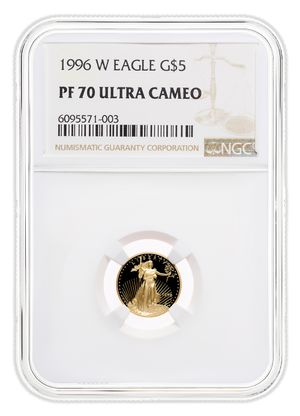
The 1999-W 1/10 oz Gold Eagle Unfinished Proof Die is one of the most recognized error coins in modern United States Mint history. Struck in 22-karat gold at 0.9167 fineness and weighing one-tenth of a troy ounce, this coin carries the same foundational specifications as a standard 1/10 oz American Gold Eagle but with a significant distinction: it was accidentally struck using an unfinished proof die rather than a standard bullion die, producing a surface appearance that falls between a bullion strike and a full proof finish.
This coin was produced at the West Point Mint and carries the "W" mintmark, a detail that immediately sets it apart from standard uncirculated 1/10 oz Gold Eagles of the same year. For collectors focused on United States coinage and mint errors, this issue holds a well-documented place in the modern numismatic record.
The American Gold Eagle series was authorized by the Gold Bullion Coin Act of 1985 and entered production in 1986. The series established a tiered family of coins struck in 22-karat gold, with fractional sizes including the 1/10, 1/4, and 1/2 oz denomination
…The 1999-W 1/10 oz Gold Eagle Unfinished Proof Die is one of the most recognized error coins in modern United States Mint history. Struck in 22-karat gold at 0.9167 fineness and weighing one-tenth of a troy ounce, this coin carries the same foundational specifications as a standard 1/10 oz American Gold Eagle but with a significant distinction: it was accidentally struck using an unfinished proof die rather than a standard bullion die, producing a surface appearance that falls between a bullion strike and a full proof finish.
This coin was produced at the West Point Mint and carries the "W" mintmark, a detail that immediately sets it apart from standard uncirculated 1/10 oz Gold Eagles of the same year. For collectors focused on United States coinage and mint errors, this issue holds a well-documented place in the modern numismatic record.
The American Gold Eagle series was authorized by the Gold Bullion Coin Act of 1985 and entered production in 1986. The series established a tiered family of coins struck in 22-karat gold, with fractional sizes including the 1/10, 1/4, and 1/2 oz denominations alongside the full one-ounce coin. West Point became the primary facility for Gold Eagle production and has continued in that role throughout the series.
The 1999-W Unfinished Proof Die error emerged during a period when the West Point Mint was producing both standard bullion strikes and proof versions of the Gold Eagle. An unfinished proof die, which had not completed the full polishing and preparation process required for a true proof coin, was inadvertently used during the production run. The resulting coins display partially frosted design elements and a surface texture that distinguishes them from both standard bullion strikes and fully finished proofs. The United States Mint did not initially acknowledge the error, and the coins circulated through the normal bullion distribution channels before numismatists began identifying them.
The 1999-W 1/10 oz denomination is considered the most accessible entry point into this error series and has attracted sustained interest from error coin specialists and Gold Eagle collectors alike. The broader recognition of this issue by major grading services helped solidify its standing as a legitimate mint error rather than a post-mint alteration.
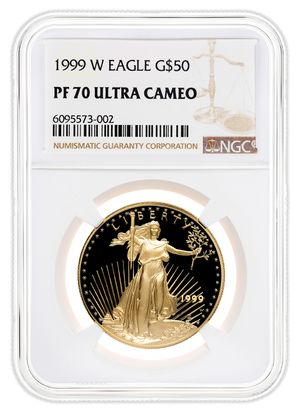
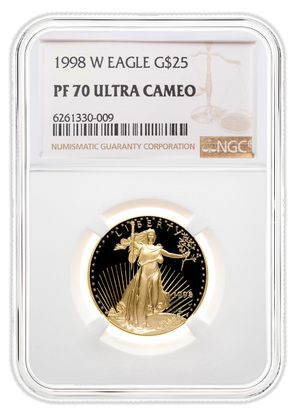
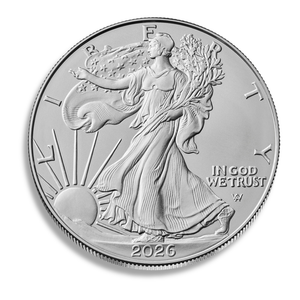
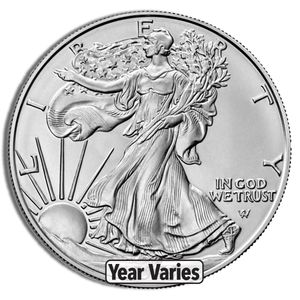
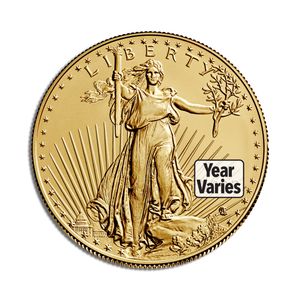
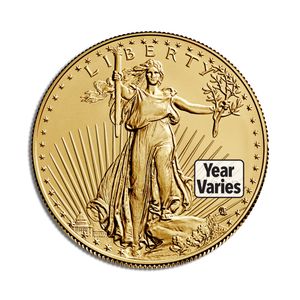
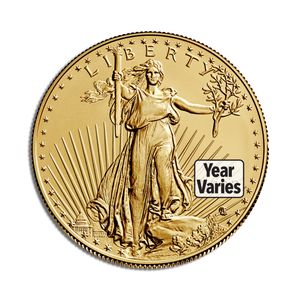
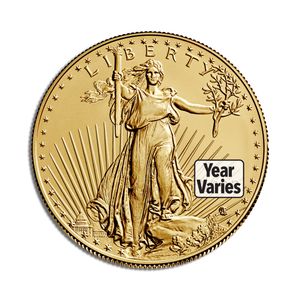
The obverse features Augustus Saint-Gaudens' iconic depiction of Liberty striding forward, torch raised in her right hand and olive branch in her left, with rays of sunlight emanating from behind her figure and the Capitol building visible in the background. The inscription "LIBERTY" arcs across the top, and the date appears at the base. The design is drawn directly from Saint-Gaudens' celebrated 1907 double eagle and is widely regarded as one of the most artistically accomplished designs in American coinage history.
The reverse carries Miley Busiek's family of eagles design, depicting a male eagle in flight returning to a nest where a female eagle shelters her young. The inscriptions include "UNITED STATES OF AMERICA," "IN GOD WE TRUST," the denomination "FIVE DOLLARS," and the gold content and purity statement. The "W" mintmark appears on the obverse below the date.
What visually distinguishes the Unfinished Proof Die version is the surface character of the coin itself. The dies used to strike these pieces had undergone some but not all of the preparation steps that produce the mirrored fields and fully frosted devices of a finished proof. The result is a coin with partially developed proof-like qualities, including subtle reflectivity and frosting, that does not match either a standard bullion strike or a completed proof. This surface character is the defining diagnostic feature of the error.
At one-tenth of a troy ounce, this coin represents the smallest denomination in the American Gold Eagle series and carries a face value of five dollars. The compact size makes it physically easy to handle, store, and present, while the lower gold content relative to larger denominations means the acquisition price is more modest in absolute terms. For collectors building a set of 1999-W Unfinished Proof Die errors across all available fractional sizes, the 1/10 oz coin is the natural starting point.
The fractional format also makes this coin a practical choice for collectors who want exposure to the error series without committing to the premium associated with a full-ounce example. The smaller size does not diminish the numismatic significance of the error itself, as the surface characteristics and diagnostic features are fully present regardless of denomination.
The 1999-W Unfinished Proof Die coins have been examined and certified by both PCGS and NGC, the two leading third-party grading services in the industry. Certified examples provide independent verification of the error designation, the coin's authenticity, and its assigned grade. We are authorized dealers for both PCGS and NGC, which means we can help customers navigate the grading and certification process with direct access to these services.
The coin's gold content is guaranteed by the United States government at 0.1 troy ounces of gold at .9167 fineness, consistent with all American Gold Eagles of this denomination. The West Point Mint operates to the exacting standards expected of a United States federal facility, and the specifications of every coin produced there are backed by the full authority of the issuing government. For collectors evaluating raw examples, familiarity with the specific surface diagnostics of this error is essential to distinguishing genuine examples from standard bullion strikes.
The condition of any given example of this coin reflects its production circumstances and subsequent handling. Because these coins were released through standard bullion distribution channels rather than packaged as collector issues, raw examples may exhibit contact marks, light abrasions, or handling signs consistent with their journey through the normal distribution process. These characteristics do not affect the gold content or the numismatic designation of the coin.
Certified examples will arrive in tamper-evident slabs from PCGS or NGC and should be stored accordingly to maintain the integrity of the holder. Raw examples ship in protective plastic flips for individual purchases. If you have questions about the specific condition of an available example, our team is equipped to assist with details prior to purchase.
Pricing for the 1999-W Unfinished Proof Die 1/10 oz Gold Eagle reflects both the underlying gold content and a numismatic premium driven by the coin's recognized error status. The gold content component moves with the live spot price of gold, while the collector premium is shaped by demand among error coin specialists, certified population reports from PCGS and NGC, and the relative scarcity of examples in any given grade tier.
Because this is a recognized mint error with a documented and finite mintage, its premium behavior does not follow the same pattern as standard bullion products. Supply is fixed, and demand within the specialized collector market directly influences how premiums shift over time. Our pricing reflects current market conditions for both the metal content and the numismatic premium, and we display bid and ask information transparently so buyers can evaluate the full cost structure before making a decision.
Recognized mint errors from the United States Mint, particularly those documented by major grading services, maintain an active secondary market among numismatists and error coin collectors. The 1999-W Unfinished Proof Die series is well-documented and consistently appears in auction records and dealer inventory, which provides a meaningful reference point for resale pricing. Certified examples from PCGS or NGC tend to transact more efficiently because the third-party grade and error designation remove ambiguity for buyers.
We operate a two-way market that supports both purchases and sales within the same platform. Customers who acquired this coin through us or elsewhere can take advantage of our competitive buyback pricing. Understanding the liquidity profile of a numismatic error coin before purchasing is important, and we encourage buyers to consider the bid side of the transaction alongside the ask price from the outset.
This coin occupies a specific and well-supported position in the American Gold Eagle series as a recognized mint error with documented production history and third-party certification from the industry's leading grading services. Unlike generic bullion products, its numismatic significance gives it a character that extends beyond the underlying metal content. For collectors focused on modern United States coinage errors, it is a foundational piece.
The 1/10 oz size offers a practical entry point into this error series, making it the most accessible denomination for collectors building a complete set or acquiring their first example. The combination of government-backed gold content, a historically significant error designation, and a fully traceable production history makes this a meaningful addition to any serious collection of modern American coinage.
We have been operating in the physical precious metals market since 2010, and our approach has always centered on transparency, accurate product representation, and long-term customer relationships. For numismatic products like the 1999-W Unfinished Proof Die, accurate representation is especially important, and we take that responsibility seriously. Every product is verified for authenticity before it reaches a customer.
Our authorized dealer relationships with both PCGS and NGC reflect a commitment to the highest standards in the industry. We maintain an A rating with the Better Business Bureau, hold membership in the American Numismatic Association and the National Coin and Bullion Association, and operate a two-way marketplace that allows customers to buy and sell within the same platform using competitive pricing. Whether you are adding to an existing collection or evaluating this coin for the first time, our team provides the knowledge and support needed to make a confident, informed decision.
Bullion Standard Pro gives members access to live, executable wholesale bid and ask pricing across our catalog, including numismatic products where premium dynamics can shift meaningfully based on collector demand and certified population data. For a coin like the 1999-W Unfinished Proof Die, understanding the spread between the buy and sell sides of the market at any given moment is particularly useful, and Pro surfaces that information in real time rather than through static estimates.
Pro members also benefit from real-time portfolio valuation based on current wholesale bid pricing, proprietary market intelligence tools, and product research capabilities that allow direct comparisons across premiums, spreads, and liquidity metrics. For collectors who own multiple numismatic or bullion holdings, the ability to view the full portfolio through a live wholesale pricing lens provides a more grounded picture of current market value than retail price estimates alone.
We support a broad range of payment methods to make every transaction as convenient and secure as possible. Accepted payment options include Visa, Mastercard, American Express, Discover, PayPal, bank-connected payments through Plaid, wire transfer, paper check, and cryptocurrency payments through BitPay. Each method is integrated into a secure checkout process designed to protect your transaction from start to finish.
Regardless of which payment method you choose, the experience is built around clarity and reliability. Our fulfillment process is designed to move quickly once payment is confirmed, and our customer support team is available to assist at any point in the buying or selling process.
Product ID: BST-002885E905
| Year | 1999 |
|---|---|
| Precious Metal Type | Gold |
| Bullion Coin Type | Eagle |
| Format | Coin |
| Country of Origin | United States |
| Brand/Mint | U.S. Mint |
| Mint Mark | W - West Point |
| Purity | 0.9167 |
| Weight | 0.1 oz |
| Thickness (mm) | 1.26 mm |
| Diameter (mm) | 16.5 mm |
The 1999-W 1/10 oz Gold Eagle Unfinished Proof Die is one of the most recognized error coins in modern United States Mint history. Struck in 22-karat gold at 0.9167 fineness and weighing one-tenth of a troy ounce, this coin carries the same foundational specifications as a standard 1/10 oz American Gold Eagle but with a significant distinction: it was accidentally struck using an unfinished proof die rather than a standard bullion die, producing a surface appearance that falls between a bullion strike and a full proof finish.
This coin was produced at the West Point Mint and carries the "W" mintmark, a detail that immediately sets it apart from standard uncirculated 1/10 oz Gold Eagles of the same year. For collectors focused on United States coinage and mint errors, this issue holds a well-documented place in the modern numismatic record.
The American Gold Eagle series was authorized by the Gold Bullion Coin Act of 1985 and entered production in 1986. The series established a tiered family of coins struck in 22-karat gold, with fractional sizes including the 1/10, 1/4, and 1/2 oz denomination
…The 1999-W 1/10 oz Gold Eagle Unfinished Proof Die is one of the most recognized error coins in modern United States Mint history. Struck in 22-karat gold at 0.9167 fineness and weighing one-tenth of a troy ounce, this coin carries the same foundational specifications as a standard 1/10 oz American Gold Eagle but with a significant distinction: it was accidentally struck using an unfinished proof die rather than a standard bullion die, producing a surface appearance that falls between a bullion strike and a full proof finish.
This coin was produced at the West Point Mint and carries the "W" mintmark, a detail that immediately sets it apart from standard uncirculated 1/10 oz Gold Eagles of the same year. For collectors focused on United States coinage and mint errors, this issue holds a well-documented place in the modern numismatic record.
The American Gold Eagle series was authorized by the Gold Bullion Coin Act of 1985 and entered production in 1986. The series established a tiered family of coins struck in 22-karat gold, with fractional sizes including the 1/10, 1/4, and 1/2 oz denominations alongside the full one-ounce coin. West Point became the primary facility for Gold Eagle production and has continued in that role throughout the series.
The 1999-W Unfinished Proof Die error emerged during a period when the West Point Mint was producing both standard bullion strikes and proof versions of the Gold Eagle. An unfinished proof die, which had not completed the full polishing and preparation process required for a true proof coin, was inadvertently used during the production run. The resulting coins display partially frosted design elements and a surface texture that distinguishes them from both standard bullion strikes and fully finished proofs. The United States Mint did not initially acknowledge the error, and the coins circulated through the normal bullion distribution channels before numismatists began identifying them.
The 1999-W 1/10 oz denomination is considered the most accessible entry point into this error series and has attracted sustained interest from error coin specialists and Gold Eagle collectors alike. The broader recognition of this issue by major grading services helped solidify its standing as a legitimate mint error rather than a post-mint alteration.
The obverse features Augustus Saint-Gaudens' iconic depiction of Liberty striding forward, torch raised in her right hand and olive branch in her left, with rays of sunlight emanating from behind her figure and the Capitol building visible in the background. The inscription "LIBERTY" arcs across the top, and the date appears at the base. The design is drawn directly from Saint-Gaudens' celebrated 1907 double eagle and is widely regarded as one of the most artistically accomplished designs in American coinage history.
The reverse carries Miley Busiek's family of eagles design, depicting a male eagle in flight returning to a nest where a female eagle shelters her young. The inscriptions include "UNITED STATES OF AMERICA," "IN GOD WE TRUST," the denomination "FIVE DOLLARS," and the gold content and purity statement. The "W" mintmark appears on the obverse below the date.
What visually distinguishes the Unfinished Proof Die version is the surface character of the coin itself. The dies used to strike these pieces had undergone some but not all of the preparation steps that produce the mirrored fields and fully frosted devices of a finished proof. The result is a coin with partially developed proof-like qualities, including subtle reflectivity and frosting, that does not match either a standard bullion strike or a completed proof. This surface character is the defining diagnostic feature of the error.
At one-tenth of a troy ounce, this coin represents the smallest denomination in the American Gold Eagle series and carries a face value of five dollars. The compact size makes it physically easy to handle, store, and present, while the lower gold content relative to larger denominations means the acquisition price is more modest in absolute terms. For collectors building a set of 1999-W Unfinished Proof Die errors across all available fractional sizes, the 1/10 oz coin is the natural starting point.
The fractional format also makes this coin a practical choice for collectors who want exposure to the error series without committing to the premium associated with a full-ounce example. The smaller size does not diminish the numismatic significance of the error itself, as the surface characteristics and diagnostic features are fully present regardless of denomination.
The 1999-W Unfinished Proof Die coins have been examined and certified by both PCGS and NGC, the two leading third-party grading services in the industry. Certified examples provide independent verification of the error designation, the coin's authenticity, and its assigned grade. We are authorized dealers for both PCGS and NGC, which means we can help customers navigate the grading and certification process with direct access to these services.
The coin's gold content is guaranteed by the United States government at 0.1 troy ounces of gold at .9167 fineness, consistent with all American Gold Eagles of this denomination. The West Point Mint operates to the exacting standards expected of a United States federal facility, and the specifications of every coin produced there are backed by the full authority of the issuing government. For collectors evaluating raw examples, familiarity with the specific surface diagnostics of this error is essential to distinguishing genuine examples from standard bullion strikes.
The condition of any given example of this coin reflects its production circumstances and subsequent handling. Because these coins were released through standard bullion distribution channels rather than packaged as collector issues, raw examples may exhibit contact marks, light abrasions, or handling signs consistent with their journey through the normal distribution process. These characteristics do not affect the gold content or the numismatic designation of the coin.
Certified examples will arrive in tamper-evident slabs from PCGS or NGC and should be stored accordingly to maintain the integrity of the holder. Raw examples ship in protective plastic flips for individual purchases. If you have questions about the specific condition of an available example, our team is equipped to assist with details prior to purchase.
Pricing for the 1999-W Unfinished Proof Die 1/10 oz Gold Eagle reflects both the underlying gold content and a numismatic premium driven by the coin's recognized error status. The gold content component moves with the live spot price of gold, while the collector premium is shaped by demand among error coin specialists, certified population reports from PCGS and NGC, and the relative scarcity of examples in any given grade tier.
Because this is a recognized mint error with a documented and finite mintage, its premium behavior does not follow the same pattern as standard bullion products. Supply is fixed, and demand within the specialized collector market directly influences how premiums shift over time. Our pricing reflects current market conditions for both the metal content and the numismatic premium, and we display bid and ask information transparently so buyers can evaluate the full cost structure before making a decision.
Recognized mint errors from the United States Mint, particularly those documented by major grading services, maintain an active secondary market among numismatists and error coin collectors. The 1999-W Unfinished Proof Die series is well-documented and consistently appears in auction records and dealer inventory, which provides a meaningful reference point for resale pricing. Certified examples from PCGS or NGC tend to transact more efficiently because the third-party grade and error designation remove ambiguity for buyers.
We operate a two-way market that supports both purchases and sales within the same platform. Customers who acquired this coin through us or elsewhere can take advantage of our competitive buyback pricing. Understanding the liquidity profile of a numismatic error coin before purchasing is important, and we encourage buyers to consider the bid side of the transaction alongside the ask price from the outset.
This coin occupies a specific and well-supported position in the American Gold Eagle series as a recognized mint error with documented production history and third-party certification from the industry's leading grading services. Unlike generic bullion products, its numismatic significance gives it a character that extends beyond the underlying metal content. For collectors focused on modern United States coinage errors, it is a foundational piece.
The 1/10 oz size offers a practical entry point into this error series, making it the most accessible denomination for collectors building a complete set or acquiring their first example. The combination of government-backed gold content, a historically significant error designation, and a fully traceable production history makes this a meaningful addition to any serious collection of modern American coinage.
We have been operating in the physical precious metals market since 2010, and our approach has always centered on transparency, accurate product representation, and long-term customer relationships. For numismatic products like the 1999-W Unfinished Proof Die, accurate representation is especially important, and we take that responsibility seriously. Every product is verified for authenticity before it reaches a customer.
Our authorized dealer relationships with both PCGS and NGC reflect a commitment to the highest standards in the industry. We maintain an A rating with the Better Business Bureau, hold membership in the American Numismatic Association and the National Coin and Bullion Association, and operate a two-way marketplace that allows customers to buy and sell within the same platform using competitive pricing. Whether you are adding to an existing collection or evaluating this coin for the first time, our team provides the knowledge and support needed to make a confident, informed decision.
Bullion Standard Pro gives members access to live, executable wholesale bid and ask pricing across our catalog, including numismatic products where premium dynamics can shift meaningfully based on collector demand and certified population data. For a coin like the 1999-W Unfinished Proof Die, understanding the spread between the buy and sell sides of the market at any given moment is particularly useful, and Pro surfaces that information in real time rather than through static estimates.
Pro members also benefit from real-time portfolio valuation based on current wholesale bid pricing, proprietary market intelligence tools, and product research capabilities that allow direct comparisons across premiums, spreads, and liquidity metrics. For collectors who own multiple numismatic or bullion holdings, the ability to view the full portfolio through a live wholesale pricing lens provides a more grounded picture of current market value than retail price estimates alone.
We support a broad range of payment methods to make every transaction as convenient and secure as possible. Accepted payment options include Visa, Mastercard, American Express, Discover, PayPal, bank-connected payments through Plaid, wire transfer, paper check, and cryptocurrency payments through BitPay. Each method is integrated into a secure checkout process designed to protect your transaction from start to finish.
Regardless of which payment method you choose, the experience is built around clarity and reliability. Our fulfillment process is designed to move quickly once payment is confirmed, and our customer support team is available to assist at any point in the buying or selling process.