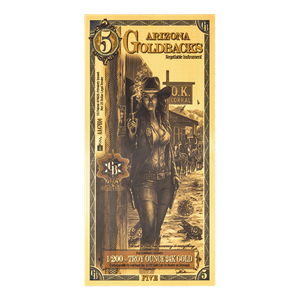
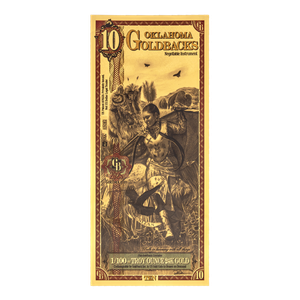
The Arizona 100 Goldback is a fractional gold note produced by Goldback, Inc., representing one of the most distinctive formats in the modern physical gold market. Each note contains 1/100 of a troy ounce of .999 fine gold, deposited in ultra-thin layers within a durable, flexible substrate that gives the note its signature currency-like appearance. The Arizona series is part of a state-specific line designed to reflect local heritage and artistry while maintaining consistent metal content across the Goldback product family. We carry the Arizona 100 alongside other denominations and state series for buyers seeking tangible gold in a format that functions more like a note than a coin or bar.
History and Background
Goldback, Inc. introduced its first series in Utah in 2019, drawing on that state's legacy as the first in the modern era to recognize gold and silver as legal tender for certain transactions. The concept behind Goldbacks was to create a functional, standardized fractional gold product that could be exchanged, collected, and stored in denominations small enough for everyday use. The success of the Utah series prompted the company to expa…
Overview of Arizona 100 Goldback
The Arizona 100 Goldback is a fractional gold note produced by Goldback, Inc., representing one of the most distinctive formats in the modern physical gold market. Each note contains 1/100 of a troy ounce of .999 fine gold, deposited in ultra-thin layers within a durable, flexible substrate that gives the note its signature currency-like appearance. The Arizona series is part of a state-specific line designed to reflect local heritage and artistry while maintaining consistent metal content across the Goldback product family. We carry the Arizona 100 alongside other denominations and state series for buyers seeking tangible gold in a format that functions more like a note than a coin or bar.
History and Background
Goldback, Inc. introduced its first series in Utah in 2019, drawing on that state's legacy as the first in the modern era to recognize gold and silver as legal tender for certain transactions. The concept behind Goldbacks was to create a functional, standardized fractional gold product that could be exchanged, collected, and stored in denominations small enough for everyday use. The success of the Utah series prompted the company to expand into other states, including Arizona, Nevada, New Hampshire, Wyoming, and South Dakota, each featuring unique artwork tied to local culture and symbolism.
The Arizona series arrived as part of this expansion, designed to carry imagery reflecting the landscape, history, and character of the state. Goldback produces each note using a patented vacuum deposition process that allows microscopic layers of gold to be applied with precision, making the format possible at fractional weights that would otherwise be impractical. The 100 denomination sits at the top of the Goldback scale, containing 1/10 of a gram more than lower denominations, making it the highest-value single note in the series.
Design and Aesthetics
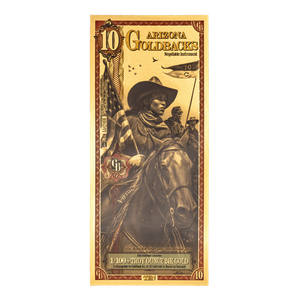
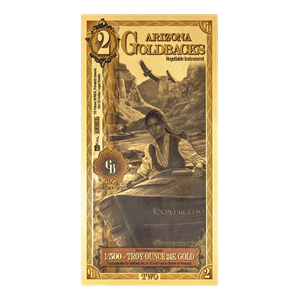
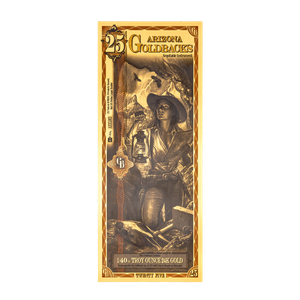
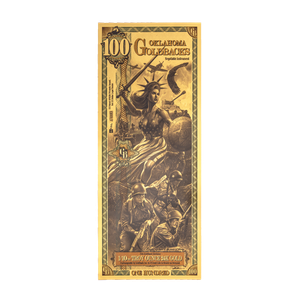
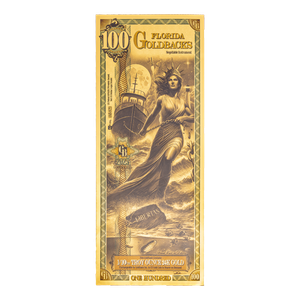
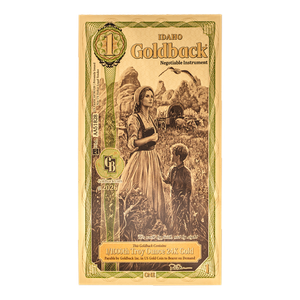
The Arizona 100 Goldback features original artwork commissioned specifically for the state series, blending allegorical imagery with Arizona-specific iconography. The design incorporates figures, natural landmarks, and symbolic elements drawn from the state's identity, rendered in full color against a gold-toned background that catches light in a way no coin or bar can replicate. The layered construction gives the note a luminous quality, with the deposited gold visible through the transparent substrate as a warm, reflective surface beneath the printed imagery.
The reverse side carries the denomination, series identification, and the Goldback name alongside additional decorative elements consistent with the broader series aesthetic. Intricate border patterns and fine-line detail work reflect the attention given to the visual design, making the Arizona 100 as much an art object as a gold product. The overall format is roughly the size of a standard banknote, giving it immediate familiarity while remaining unmistakably distinct from paper currency.
Fractional Size and Accessibility
At 1/100 of a troy ounce, the Arizona 100 Goldback offers a level of fractional precision that is difficult to match in any other gold format. For buyers who want to hold physical gold without committing to the cost of a full ounce or even a quarter-ounce coin, the 100 denomination provides a meaningful entry point that keeps the per-unit price accessible without sacrificing the tangibility of real gold. The note format also makes it easy to handle, store, and transfer without the size constraints of small-denomination coins.
The Goldback structure lends itself naturally to buyers who want to accumulate gold gradually or diversify across denominations within the same series. Pairing the 100 with lower-denomination Goldbacks allows for flexible fractional stacking across a range of price points, and the uniform note format makes storage and organization straightforward without the need for specialized holders or tubes.
Authenticity and Product Integrity
Each Arizona 100 Goldback is manufactured using a proprietary vacuum deposition process that bonds .999 fine gold to the note substrate with measurable precision. The gold content in each note is independently verified through third-party assaying, and Goldback publishes its assay results to support transparency across the product line. The layered construction itself serves as an inherent anti-counterfeiting feature, as replicating the deposition process without the correct equipment and materials is not commercially viable.
We verify the weight and purity of Goldback products consistent with the standards we apply across our full catalog. The Goldback format, while unconventional compared to minted coins and bars, meets recognized standards for fractional gold authenticity and is supported by a growing body of third-party assay documentation.
Condition and Packaging
Arizona 100 Goldbacks are sold in new condition. Individual notes are typically delivered in a clear protective sleeve that preserves the surface of the substrate and prevents handling damage. Goldback notes are more resistant to surface marks than soft metal coins due to their layered construction, but the protective sleeve remains the standard format for individual sales to maintain the note's appearance over time.
Larger quantities are typically packaged in sealed packs consistent with Goldback's standard production packaging. Buyers purchasing multiple notes should expect them to arrive in factory-sealed sleeves or packs depending on the quantity ordered. We ship all orders with care appropriate to the product format to ensure notes arrive in the condition described.
Pricing and Market Factors
Pricing for the Arizona 100 Goldback is tied to the current spot price of gold, with a premium applied that reflects the cost of the patented manufacturing process, the commissioned artwork, and the relatively small mintage quantities associated with state-specific series. The vacuum deposition process is more labor and equipment intensive than standard coin or bar production, which contributes to a higher premium per troy ounce compared to sovereign bullion coins or large bars. Collectors and buyers who value the format and design pay for that distinction directly in the premium structure.
Demand within the Goldback market is also influenced by regional interest, series completeness among collectors, and the broader appeal of fractional gold in a note format. Our pricing reflects real-time spot conditions and is updated consistently to maintain accuracy relative to the underlying gold market.
Selling and Liquidity
Goldbacks occupy a niche within the broader gold market that sits between standard bullion and numismatic collectibles. The product carries verified gold content and standardized weight and purity, which supports its recognition in resale contexts, but liquidity characteristics differ from sovereign bullion coins or widely traded bars. Buyers in the Goldback market are often motivated by the format, the state-specific design, or the fractional denomination structure, which means resale demand can vary more than it does for mainstream bullion products.
We operate a two-way market that supports both buying and selling, and we encourage buyers to consider liquidity alongside acquisition cost before any purchase. Understanding how premiums and bid/ask spreads behave for Goldback notes over time is part of making a well-informed decision in this product category.
Why Buy Arizona 100 Goldback?
The Arizona 100 Goldback appeals to buyers who want fractional gold in a format that stands apart from traditional coins and bars. The 1/100 troy ounce denomination fills a gap in the fractional gold market, offering a unit of gold small enough to be approachable in cost while remaining distinctive enough to serve both accumulation and collection purposes. The Arizona series artwork gives the note a regional identity that resonates with buyers connected to the state, and the layered gold construction provides a visual presentation that no standard minted product can replicate.
For buyers building a diversified physical gold position, the 100 denomination functions as a flexible, high-unit-count addition that complements larger holdings. Its note format, verified gold content, and state-specific character make it a product that occupies its own space within the physical gold market rather than competing directly with coins or bars on the same terms.
Why Buy from Bullion Standard?
We have built our reputation on transparent pricing, reliable sourcing, and a buying experience designed around the customer rather than the transaction. Every product we carry, including the Arizona 100 Goldback, is verified for authenticity and metal content before it reaches our customers. Our pricing reflects real-time market conditions, and we display bid/ask spreads directly on product pages so buyers can evaluate the full cost of ownership rather than focusing only on the acquisition price.
Our A rating with the Better Business Bureau and our memberships in the American Numismatic Association and the National Coin and Bullion Association reflect the standards we hold ourselves to across every product category. We are also authorized dealers for both PCGS and NGC, which speaks to the level of authentication and product integrity we maintain throughout our catalog. When you purchase through us, you have access to both sides of the market, buying and selling, within the same platform, and our support team is available to assist at every stage of the process.
Get Near-Spot Pricing with Bullion Standard Pro
Bullion Standard Pro gives members access to live, executable wholesale bid and ask pricing across the precious metals catalog, including fractional gold products like the Arizona 100 Goldback. For a product where the premium structure can be more variable than standard bullion, having real-time visibility into wholesale pricing and bid/ask spread data makes it easier to evaluate whether current market conditions align with your buying or selling objectives. Pro members can also track portfolio values using live wholesale bid pricing rather than estimated retail figures, which provides a more grounded view of current liquidation value.
The platform also includes proprietary product research tools that allow you to compare premiums, spread tightness, and historical pricing trends across the catalog. For Goldback buyers who want to understand how the premium on the Arizona 100 has moved over time relative to other fractional gold formats, these tools provide objective data that supports more deliberate decision-making without relying on marketing claims or incomplete pricing information.
Flexible and Secure Payment Options
We support a broad range of payment methods to make purchasing the Arizona 100 Goldback straightforward and secure. Buyers can pay using major credit cards including Visa, Mastercard, American Express, and Discover, as well as PayPal, bank-connected payments through Plaid, wire transfer, paper check, and cryptocurrency via BitPay. Each payment method is processed through a secure transaction environment, and our fulfillment process is designed to ensure orders are handled reliably from confirmation through delivery.
Volume Discount Pricing
Orders paid by debit card, credit card, and PayPal are an item's full
list
price
and receive no discount. Orders paid by cryptocurrency receive a 3%
discount
from an item's full list price. Orders paid by eCheck (ACH), paper
check,
and
bank wire receive a 4% discount from an item's full list price.
Quantity
(e)Check/Wire
Crypto
CC/PayPal
1+
$737.89
$753.26
$768.63
1+
$731.31
$746.55
$761.78
In Stock
Ships within 1 business day of cleared payment
Select Your Quantity
For Non-Members:
Free shipping on orders
$497+
.
PRO
Pro Member Delivery:
$23.97 flat-rate, true
wholesale pricing. Free shipping on orders
$10,000+.
Product ID: BST-00316091BA
Specifications
Precious Metal Type
Gold
Format
Note/Aurum
Country of Origin
United States
Brand/Mint
Valaurum
Purity
0.999
Weight
0.1 oz
Product Details
Overview of Arizona 100 Goldback
The Arizona 100 Goldback is a fractional gold note produced by Goldback, Inc., representing one of the most distinctive formats in the modern physical gold market. Each note contains 1/100 of a troy ounce of .999 fine gold, deposited in ultra-thin layers within a durable, flexible substrate that gives the note its signature currency-like appearance. The Arizona series is part of a state-specific line designed to reflect local heritage and artistry while maintaining consistent metal content across the Goldback product family. We carry the Arizona 100 alongside other denominations and state series for buyers seeking tangible gold in a format that functions more like a note than a coin or bar.
History and Background
Goldback, Inc. introduced its first series in Utah in 2019, drawing on that state's legacy as the first in the modern era to recognize gold and silver as legal tender for certain transactions. The concept behind Goldbacks was to create a functional, standardized fractional gold product that could be exchanged, collected, and stored in denominations small enough for everyday use. The success of the Utah series prompted the company to expa…
Overview of Arizona 100 Goldback
The Arizona 100 Goldback is a fractional gold note produced by Goldback, Inc., representing one of the most distinctive formats in the modern physical gold market. Each note contains 1/100 of a troy ounce of .999 fine gold, deposited in ultra-thin layers within a durable, flexible substrate that gives the note its signature currency-like appearance. The Arizona series is part of a state-specific line designed to reflect local heritage and artistry while maintaining consistent metal content across the Goldback product family. We carry the Arizona 100 alongside other denominations and state series for buyers seeking tangible gold in a format that functions more like a note than a coin or bar.
History and Background
Goldback, Inc. introduced its first series in Utah in 2019, drawing on that state's legacy as the first in the modern era to recognize gold and silver as legal tender for certain transactions. The concept behind Goldbacks was to create a functional, standardized fractional gold product that could be exchanged, collected, and stored in denominations small enough for everyday use. The success of the Utah series prompted the company to expand into other states, including Arizona, Nevada, New Hampshire, Wyoming, and South Dakota, each featuring unique artwork tied to local culture and symbolism.
The Arizona series arrived as part of this expansion, designed to carry imagery reflecting the landscape, history, and character of the state. Goldback produces each note using a patented vacuum deposition process that allows microscopic layers of gold to be applied with precision, making the format possible at fractional weights that would otherwise be impractical. The 100 denomination sits at the top of the Goldback scale, containing 1/10 of a gram more than lower denominations, making it the highest-value single note in the series.
Design and Aesthetics
The Arizona 100 Goldback features original artwork commissioned specifically for the state series, blending allegorical imagery with Arizona-specific iconography. The design incorporates figures, natural landmarks, and symbolic elements drawn from the state's identity, rendered in full color against a gold-toned background that catches light in a way no coin or bar can replicate. The layered construction gives the note a luminous quality, with the deposited gold visible through the transparent substrate as a warm, reflective surface beneath the printed imagery.
The reverse side carries the denomination, series identification, and the Goldback name alongside additional decorative elements consistent with the broader series aesthetic. Intricate border patterns and fine-line detail work reflect the attention given to the visual design, making the Arizona 100 as much an art object as a gold product. The overall format is roughly the size of a standard banknote, giving it immediate familiarity while remaining unmistakably distinct from paper currency.
Fractional Size and Accessibility
At 1/100 of a troy ounce, the Arizona 100 Goldback offers a level of fractional precision that is difficult to match in any other gold format. For buyers who want to hold physical gold without committing to the cost of a full ounce or even a quarter-ounce coin, the 100 denomination provides a meaningful entry point that keeps the per-unit price accessible without sacrificing the tangibility of real gold. The note format also makes it easy to handle, store, and transfer without the size constraints of small-denomination coins.
The Goldback structure lends itself naturally to buyers who want to accumulate gold gradually or diversify across denominations within the same series. Pairing the 100 with lower-denomination Goldbacks allows for flexible fractional stacking across a range of price points, and the uniform note format makes storage and organization straightforward without the need for specialized holders or tubes.
Authenticity and Product Integrity
Each Arizona 100 Goldback is manufactured using a proprietary vacuum deposition process that bonds .999 fine gold to the note substrate with measurable precision. The gold content in each note is independently verified through third-party assaying, and Goldback publishes its assay results to support transparency across the product line. The layered construction itself serves as an inherent anti-counterfeiting feature, as replicating the deposition process without the correct equipment and materials is not commercially viable.
We verify the weight and purity of Goldback products consistent with the standards we apply across our full catalog. The Goldback format, while unconventional compared to minted coins and bars, meets recognized standards for fractional gold authenticity and is supported by a growing body of third-party assay documentation.
Condition and Packaging
Arizona 100 Goldbacks are sold in new condition. Individual notes are typically delivered in a clear protective sleeve that preserves the surface of the substrate and prevents handling damage. Goldback notes are more resistant to surface marks than soft metal coins due to their layered construction, but the protective sleeve remains the standard format for individual sales to maintain the note's appearance over time.
Larger quantities are typically packaged in sealed packs consistent with Goldback's standard production packaging. Buyers purchasing multiple notes should expect them to arrive in factory-sealed sleeves or packs depending on the quantity ordered. We ship all orders with care appropriate to the product format to ensure notes arrive in the condition described.
Pricing and Market Factors
Pricing for the Arizona 100 Goldback is tied to the current spot price of gold, with a premium applied that reflects the cost of the patented manufacturing process, the commissioned artwork, and the relatively small mintage quantities associated with state-specific series. The vacuum deposition process is more labor and equipment intensive than standard coin or bar production, which contributes to a higher premium per troy ounce compared to sovereign bullion coins or large bars. Collectors and buyers who value the format and design pay for that distinction directly in the premium structure.
Demand within the Goldback market is also influenced by regional interest, series completeness among collectors, and the broader appeal of fractional gold in a note format. Our pricing reflects real-time spot conditions and is updated consistently to maintain accuracy relative to the underlying gold market.
Selling and Liquidity
Goldbacks occupy a niche within the broader gold market that sits between standard bullion and numismatic collectibles. The product carries verified gold content and standardized weight and purity, which supports its recognition in resale contexts, but liquidity characteristics differ from sovereign bullion coins or widely traded bars. Buyers in the Goldback market are often motivated by the format, the state-specific design, or the fractional denomination structure, which means resale demand can vary more than it does for mainstream bullion products.
We operate a two-way market that supports both buying and selling, and we encourage buyers to consider liquidity alongside acquisition cost before any purchase. Understanding how premiums and bid/ask spreads behave for Goldback notes over time is part of making a well-informed decision in this product category.
Why Buy Arizona 100 Goldback?
The Arizona 100 Goldback appeals to buyers who want fractional gold in a format that stands apart from traditional coins and bars. The 1/100 troy ounce denomination fills a gap in the fractional gold market, offering a unit of gold small enough to be approachable in cost while remaining distinctive enough to serve both accumulation and collection purposes. The Arizona series artwork gives the note a regional identity that resonates with buyers connected to the state, and the layered gold construction provides a visual presentation that no standard minted product can replicate.
For buyers building a diversified physical gold position, the 100 denomination functions as a flexible, high-unit-count addition that complements larger holdings. Its note format, verified gold content, and state-specific character make it a product that occupies its own space within the physical gold market rather than competing directly with coins or bars on the same terms.
Why Buy from Bullion Standard?
We have built our reputation on transparent pricing, reliable sourcing, and a buying experience designed around the customer rather than the transaction. Every product we carry, including the Arizona 100 Goldback, is verified for authenticity and metal content before it reaches our customers. Our pricing reflects real-time market conditions, and we display bid/ask spreads directly on product pages so buyers can evaluate the full cost of ownership rather than focusing only on the acquisition price.
Our A rating with the Better Business Bureau and our memberships in the American Numismatic Association and the National Coin and Bullion Association reflect the standards we hold ourselves to across every product category. We are also authorized dealers for both PCGS and NGC, which speaks to the level of authentication and product integrity we maintain throughout our catalog. When you purchase through us, you have access to both sides of the market, buying and selling, within the same platform, and our support team is available to assist at every stage of the process.
Get Near-Spot Pricing with Bullion Standard Pro
Bullion Standard Pro gives members access to live, executable wholesale bid and ask pricing across the precious metals catalog, including fractional gold products like the Arizona 100 Goldback. For a product where the premium structure can be more variable than standard bullion, having real-time visibility into wholesale pricing and bid/ask spread data makes it easier to evaluate whether current market conditions align with your buying or selling objectives. Pro members can also track portfolio values using live wholesale bid pricing rather than estimated retail figures, which provides a more grounded view of current liquidation value.
The platform also includes proprietary product research tools that allow you to compare premiums, spread tightness, and historical pricing trends across the catalog. For Goldback buyers who want to understand how the premium on the Arizona 100 has moved over time relative to other fractional gold formats, these tools provide objective data that supports more deliberate decision-making without relying on marketing claims or incomplete pricing information.
Flexible and Secure Payment Options
We support a broad range of payment methods to make purchasing the Arizona 100 Goldback straightforward and secure. Buyers can pay using major credit cards including Visa, Mastercard, American Express, and Discover, as well as PayPal, bank-connected payments through Plaid, wire transfer, paper check, and cryptocurrency via BitPay. Each payment method is processed through a secure transaction environment, and our fulfillment process is designed to ensure orders are handled reliably from confirmation through delivery.
This website uses cookies for analytics and to deliver personalized content. By continuing to
use our site, you acknowledge that you have read and agree to our Privacy Policy and Cookie
Policy.
Current Quantities Available
Unfortunately, we only have 0
of
this item in
stock.
Please call us at (833) 278-4653
or email us at support@bullionstandard.com
if you wish to purchase a larger quantity than what is available on our website.
We can often locate additional quantities.

 (833) 278-4653

.png)