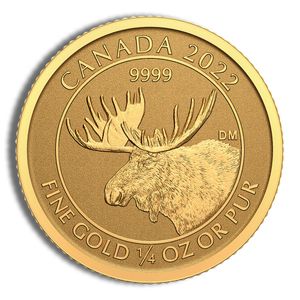
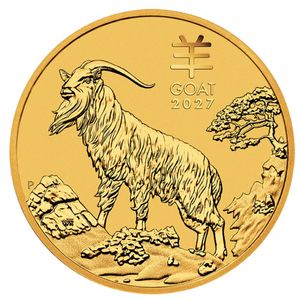
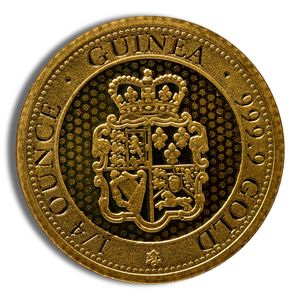
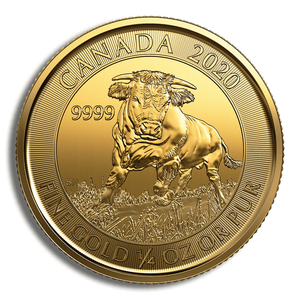
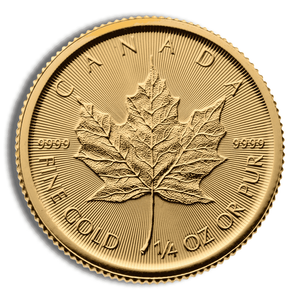
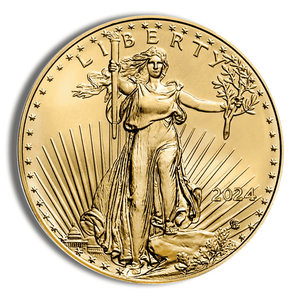
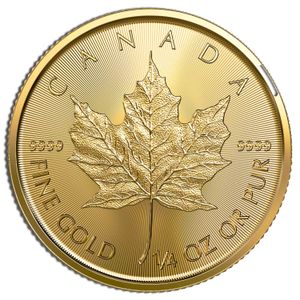
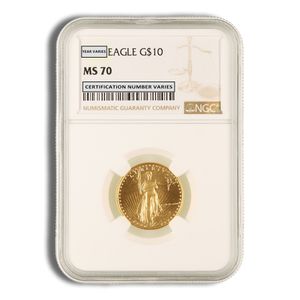
Buy 1/4 oz Gold Coins Online
Our catalog of 1/4 oz gold coins brings together some of the most recognized bullion programs in the world, sourced directly from government and sovereign mints and verified for authenticity before fulfillment. Whether you're drawn to the Gold American Eagle from the United States Mint, the Gold Maple Leaf from the Royal Canadian Mint, the Gold Britannia from The Royal Mint, or the Gold Philharmonic from the Austrian Mint, you'll find these programs represented here in a range of years, grades, and packaging configurations.
The selection spans raw BU coins available at tighter premiums, professionally graded examples certified by NGC and PCGS, sealed and unsealed packaging variants, proof strikes with original box and Certificate of Authenticity, and limited-issue commemorative releases. Products from Perth Mint's Australian Lunar Series, the Chinese Gold Panda, the South African Krugerrand, and the Mexican Gold Libertad are also included, reflecting the global depth of this format.
Bullion Standard is a San Diego-based precious metals marketplace committed to pricing transparency, reliable sourcing, and a two-way market structure that gives buyers visibility into both acquisition cost and resale value before they transact. The product grid above reflects live inventory across this segment of the gold bullion market.
What Are 1/4 oz Gold Coins?
A 1/4 oz gold coin contains exactly one-quarter troy ounce of gold, making it a fractional bullion coin positioned between the more common 1 oz format and smaller denominations such as 1/10 oz. This size is particularly practical for buyers who want direct gold exposure without the per-unit cost of a full ounce, and it remains one of the most liquid fractional formats traded in the wholesale bullion market.
Most 1/4 oz gold coins are struck by sovereign or government-affiliated mints and carry an official legal tender face value in their country of issue, though that nominal value bears no relationship to actual market price. The coins typically measure between 20 and 22 millimeters in diameter and carry purity markings, mint marks, and design elements specific to each issuing program. Some series, such as the Gold American Eagle and South African Krugerrand, use a 22-karat alloy at 0.9167 fineness, while programs like the Maple Leaf, Britannia, and Philharmonic are struck in 24-karat gold at 0.9999 fineness.
Within this format, buyers will encounter raw BU coins intended primarily for bullion value, proof strikes produced for collectors with polished dies and mirror finishes, and professionally graded coins encapsulated by PCGS or NGC. Each variant carries a different premium structure and serves a different purpose within a collection or portfolio.
History and Background
The 1/4 oz gold coin format emerged largely as a response to demand for fractional bullion access following the reintroduction of private gold ownership in the United States in 1975. When the U.S. Mint launched the American Gold Eagle program in 1986, it released four denominations simultaneously, including the 1/4 oz, giving buyers a formal entry point into fractional gold ownership that carried the backing of a sovereign government. That program set a precedent followed by several other major minting authorities in the decades that followed.
The Royal Canadian Mint introduced the 1/4 oz Gold Maple Leaf alongside its full-ounce counterpart as part of an effort to broaden accessibility to the Maple Leaf program. The Austrian Mint followed a similar path with the Philharmonic series, while Perth Mint developed the Australian Lunar Series and Kangaroo programs that have become staple offerings within the fractional gold market. Each mint brought its own design traditions, security features, and packaging conventions to the format over time.
China's Gold Panda program, dating to 1982, also produced 1/4 oz coins with annually rotating designs that developed a following among collectors. The South African Krugerrand, originally introduced in 1 oz form in 1967, expanded into fractional sizes including the 1/4 oz by 1980 as demand for accessible gold ownership grew globally. Together, these programs established the 1/4 oz coin as a standardized and broadly recognized denomination within the international bullion market.
Purity, Weight, and Specifications
The majority of 1/4 oz gold coins in our catalog are struck at either 0.9999 fineness (24-karat gold) or 0.9167 fineness (22-karat gold). Programs struck at 0.9999 include the Gold Maple Leaf, Gold Philharmonic, Gold Britannia, Gold Kangaroo, Australian Lunar Series, and the Commonwealth Gold Laurel. The Gold American Eagle and South African Krugerrand are struck at 0.9167 fineness, meaning they contain additional copper and silver in the alloy for added durability, while still delivering a full 0.25 troy ounce of gold content per coin. The Chinese Gold Panda is struck at 0.999 fineness.
Physical dimensions vary by program. Most 1/4 oz coins fall between 20 and 22 millimeters in diameter, with thickness ranging from approximately 1.2 to 2.3 millimeters depending on the specific design and alloy. Each coin is stamped with the official weight, purity, and country of issue on either the obverse or reverse. Mint marks, such as the "W" for West Point on American Eagles or the "P" for Perth on Australian Lunar coins, are present on many issues and carry significance for collectors and graders evaluating specific strikes.
Graded coins encapsulated by NGC or PCGS are assessed on the standard Sheldon numeric scale, with MS69 and MS70 designations representing near-perfect and perfect mint state strikes respectively. Proof coins, identified by a highly reflective field and frosted relief, are typically issued with a "Proof" grade designation and are distinguished from standard BU strikes in both finish and production process.
Available Brands, Mints, and Product Variations
The United States Mint's Gold American Eagle program is the most extensively represented series in this segment of our catalog, with BU, proof, NGC-graded, and PCGS-graded examples spanning every year from the program's inaugural 1986 release through the early 2000s. Collectors will find year-specific BU coins bearing Roman numeral dates on early issues, alongside NGC MS69, MS70, and PCGS MS69 certified examples that reflect market premiums above raw BU pricing. Proof Eagles carrying the "P" Philadelphia Mint mark or "W" West Point mark, complete with original box and Certificate of Authenticity, are also available.
The Royal Canadian Mint is represented through the Gold Maple Leaf in sealed and unsealed configurations, the Wildlife series, the Twin Maple Leaf, the Bison, and the 1987 to 2005 Canadian $100 14-karat gold coin series. Perth Mint offerings include the Australian Kangaroo, the Florin coin, and the Lunar Series I coins for the Rat (1996), Ox (1997), Tiger (1998), Rabbit (1999), Dragon (2000), Snake (2001), Horse (2002), and Goat (2003). The Austrian Mint's Philharmonic, The Royal Mint's Britannia and Queen's Beasts, the Mexican Mint's Libertad, and the Chinese Gold Panda in both sealed and unsealed packaging round out the international depth of the catalog.
Random year products are clearly identified throughout the grid and represent a cost-efficient option for buyers focused on gold content rather than a specific date. Year-specific coins and professionally graded examples carry higher premiums that reflect collector demand, certification costs, and year-based scarcity. The 2024 Commonwealth Gold Laurel and Liberty and Gold Britannia collaborative issue from the U.S. Mint and Royal Mint represent newer limited releases that sit alongside the broader vintage and contemporary offerings.
Pricing, Premiums, and Market Factors
The price of a 1/4 oz gold coin is derived from the spot price of gold, expressed in troy ounces, multiplied by 0.25, with a premium added to reflect the cost of minting, distribution, dealer operations, and market supply and demand. Premiums on fractional gold coins tend to run higher on a per-ounce basis compared to full-ounce coins, reflecting the proportionally greater per-unit production cost. This is a structural feature of the fractional gold market rather than a dealer-specific markup.
Within the 1/4 oz format, premium levels vary meaningfully based on mint reputation, certification status, packaging, and year. Raw BU coins from high-volume programs such as the Maple Leaf and American Eagle typically carry the tightest premiums. Certified coins graded MS69 or MS70 by NGC or PCGS carry additional premiums that reflect grading fees and collector demand for specific grades and years. Proof coins, particularly those in original government-issued packaging with a Certificate of Authenticity, command further premiums that reflect their collector orientation and lower mintage figures compared to standard bullion strikes.
Bullion Standard's pricing reflects real-time market conditions and is structured to provide clarity into both the buy and sell sides of the transaction. Our product pages display the bid/ask spread, giving buyers direct visibility into the relationship between acquisition cost and current wholesale buyback value. This transparency is central to our marketplace model and helps buyers evaluate the total cost of ownership rather than focusing solely on the premium paid at purchase.
Condition, Packaging, and What to Expect
BU-grade 1/4 oz gold coins are struck for bullion distribution and are handled and packaged accordingly. Coins may arrive in tubes, mint-sealed rolls, individual flips, or loose depending on the product and how it was sourced. Minor contact marks, bag marks, or light handling evidence are consistent with BU grade and do not indicate a defect. Buyers focused on pristine visual presentation should consider certified or proof options rather than raw BU bullion.
Sealed packaging products, such as the Gold Maple Leaf in sealed packaging or the Chinese Gold Panda in original sealed mint packaging, arrive in their factory-sealed state and offer additional assurance of authenticity and original mint condition. Unsealed or "random year" products are pulled from existing inventory and may arrive in a variety of individual packaging formats. Year selection for random year items is made at the time of fulfillment and is not individually selectable.
Proof coins listed as including box and Certificate of Authenticity are government-issued presentation products that arrive in their original mint packaging. These should be stored in their original cases to preserve both condition and collectible presentation. Certified coins encapsulated by NGC or PCGS arrive in tamper-evident hard plastic slabs with an identification number that can be verified directly through each grading service's online registry.
Authenticity and Verification
Every 1/4 oz gold coin sold through Bullion Standard is sourced from reputable mints, sovereign government programs, authorized distributors, and vetted wholesale suppliers. Before reaching customers, products are verified for authenticity, weight, and declared purity. Our position as an authorized dealer for both PCGS and NGC reflects the operational standards we maintain across our sourcing and verification processes.
Modern sovereign gold coins incorporate multiple layers of anti-counterfeiting technology. The Royal Canadian Mint uses a radial lines background pattern and laser-etched micro-text on Maple Leaf coins. The Royal Mint embeds security features into recent Britannia releases. Perth Mint coins are issued with registered mint marks and tamper-evident packaging where applicable. The United States Mint uses detailed raised relief and design elements that require industrial-grade production equipment to replicate accurately.
For buyers seeking the highest level of independent verification, NGC and PCGS-certified coins provide third-party authentication from recognized grading authorities. Each certified coin is encapsulated in a tamper-evident holder bearing a unique barcode and registry number that can be confirmed online. For raw bullion, certified scales and electronic verification tools are widely available for buyers who want to conduct their own basic dimensional and weight checks consistent with published mint specifications.
Liquidity and Resale Considerations
1/4 oz gold coins from major sovereign programs rank among the most recognizable and tradeable fractional gold products in the global bullion market. The Gold American Eagle, Gold Maple Leaf, Gold Philharmonic, Gold Britannia, Gold Krugerrand, and Gold Kangaroo are accepted by dealers, refineries, and buyback programs worldwide without the need for additional assay verification under most circumstances. This broad recognition translates into more efficient resale and tighter bid/ask spreads compared to less familiar products.
Year-specific coins, particularly those certified MS69 or MS70 by NGC or PCGS, trade in a more specialized collector market where premiums above melt can be significant but where the buyer pool is narrower. Resale for certified coins is often best executed through platforms and dealers familiar with the numismatic segment of the gold market. Proof coins in original government packaging also retain stronger collector premiums when the box and Certificate of Authenticity are intact and in good condition.
Random year BU coins generally trade closest to spot with the smallest bid/ask spread and represent the most straightforward resale proposition within the 1/4 oz gold coin format. Understanding the liquidity profile of a specific product before purchase is a meaningful part of evaluating total cost of ownership, and Bullion Standard's product pages are designed to surface this information through displayed bid/ask spreads and real-time pricing.
Storage and Security
Fractional gold coins are compact and relatively easy to store compared to larger bullion formats, but their small size makes organized storage particularly important. Coins stored in original tubes or mint-sealed rolls are best kept in that packaging to protect surfaces and maintain identification. Loose coins should be stored in individual flips, coin capsules, or padded holders that prevent direct metal-to-metal contact and surface degradation.
Home storage in a quality burglary and fire-resistant safe is a practical option for moderate holdings. The safe should be anchored to a structural element of the home where possible and kept in a location that minimizes visibility to visitors. For larger or more valuable holdings, professional vault storage through a third-party custodian or private vault facility offers insured, climate-controlled security without the liability of home storage.
Certified coins in NGC or PCGS slabs benefit from the protection of their tamper-evident encapsulation, but slabs should still be stored away from extreme temperatures, direct sunlight, and high humidity. Bank safe deposit boxes are an accessible intermediate option for smaller holdings, though coverage under standard homeowner's insurance policies typically does not extend to precious metals stored off-premises without a specific rider.
Selling and Buyback Options
Selling 1/4 oz gold coins back into the market is a straightforward process for widely recognized programs in standard BU condition. Bullion Standard operates a two-way market structure, meaning customers can both purchase and sell precious metals within the same platform. Our buyback pricing is competitive and is driven by real-time wholesale market conditions rather than arbitrary dealer-set spreads. The goal is to provide customers with a clear and efficient path to liquidity when they're ready to sell.
Buyback pricing for specific coins is influenced by product type, mint of origin, year, grade, condition, and packaging. Sealed and certified products typically command tighter spreads than loose or mishandled coins. Proof coins with original box and Certificate of Authenticity intact are valued differently than proof coins sold without original packaging. Raw BU coins from major sovereign programs generally receive the most consistent and efficient buyback pricing due to their broad market recognition and standardized specifications.
Customers interested in selling can initiate the process through our platform, where our purchasing team evaluates current wholesale market conditions to provide a competitive and transparent offer. We believe liquidity should be a consideration before a purchase is made rather than only when it comes time to sell, and our platform is structured to make both sides of the transaction visible from the outset.
Why Buy 1/4 oz Gold Coins?
The 1/4 oz coin format offers a meaningful balance between accessibility and per-unit gold content. For buyers who want meaningful gold exposure without committing to the cost of a full ounce, fractional coins provide a practical middle ground. They're compact, widely recognized, easy to handle and transport, and supported by a deep secondary market across both dealer and private channels.
Government-issued 1/4 oz gold coins carry the additional credibility of sovereign backing, which supports their recognition globally. Programs like the American Eagle, Maple Leaf, Philharmonic, and Britannia are accepted by virtually every bullion dealer worldwide, reducing friction in both purchase and resale transactions. For collectors, year-specific and certified examples from these programs provide additional layers of interest beyond raw gold content.
The format also provides flexibility in how a gold holding is managed over time. Fractional coins can be used to rebalance or reduce a position in smaller increments compared to full-ounce coins, which is a practical advantage for buyers who want to maintain flexibility without splitting the liquidation of larger units.
Why Buy from Bullion Standard?
Bullion Standard was founded in 2010 in San Diego, California, and has built its reputation on a straightforward principle: pricing and sourcing should be transparent, and customers should have access to the same quality of market information that has traditionally been available only to institutional participants. Our A Better Business Bureau rating, membership in the American Numismatic Association and National Coin and Bullion Association, and our status as an authorized dealer for both PCGS and NGC reflect the standards we maintain across every aspect of operations.
Our two-way market model means we take buying and selling equally seriously. Customers are not simply purchasing a product and walking away; they are entering a marketplace designed to support the entire lifecycle of a precious metals holding. Bid/ask spreads are displayed on product pages, buyback pricing is competitive and data-driven, and our purchasing team is structured to provide efficient service on both sides of the transaction.
Secure checkout, a broad range of payment options including Visa, Mastercard, American Express, PayPal, wire transfer, check, and cryptocurrency through BitPay, and a responsive customer service team complete the experience. Every product is verified for authenticity, weight, and purity before fulfillment, and our sourcing network is built around reputable mints, authorized distributors, and vetted wholesale suppliers.
Get Near-Spot Pricing with Bullion Standard Pro
Bullion Standard Pro is designed for buyers who want to transact closer to wholesale market pricing. Members gain access to live, executable wholesale bid and ask pricing across a broad range of precious metals products, including 1/4 oz gold coins from the programs represented in this catalog. Rather than applying standard retail markups, Pro pricing is structured around real-time wholesale market conditions, allowing premiums and spreads to reflect actual supply and demand rather than fixed dealer pricing structures.
Pro members also receive access to real-time portfolio valuation based on live executable bid pricing, historical premium analysis, premium percentile rankings, bid/ask spread analysis, and additional proprietary market intelligence tools. These analytics help members evaluate specific products across dimensions such as liquidity, spread tightness, volatility, and historical premium behavior, providing a more complete picture than spot price alone can offer.
For buyers who transact frequently or who are price-sensitive to the premium paid above spot, the efficiency gains available through Bullion Standard Pro represent a meaningful advantage. The platform is designed to bring the analytical depth and pricing transparency commonly found in traditional financial markets to the physical precious metals space, reducing the information gap that has historically worked against buyers in this market.


 (833) 278-4653