Platinum bars in the one troy ounce format represent one of the most straightforward ways to own physical platinum at or near spot pricing. Each bar in this listing contains one troy ounce of platinum refined to .9995 fineness, meeting the standard purity threshold recognized across wholesale and retail markets. Because these bars ship without an assay card, they trade at leaner premiums than fully certified alternatives, which appeals to buyers focused on metal content over packaging.
The brand on any given bar varies depending on current inventory, which is standard for this type of offering across the industry. Bars sourced for this listing come from recognized refineries and fabricators, and each piece meets the weight and purity specifications regardless of the specific brand stamped on the surface. We carry these alongside a broader platinum inventory to give buyers a cost-effective option within this metal.
Platinum entered commercial refining on a meaningful scale in the nineteenth century, though industrial demand for the metal expanded dramatically through the twentieth century as its c
…Platinum bars in the one troy ounce format represent one of the most straightforward ways to own physical platinum at or near spot pricing. Each bar in this listing contains one troy ounce of platinum refined to .9995 fineness, meeting the standard purity threshold recognized across wholesale and retail markets. Because these bars ship without an assay card, they trade at leaner premiums than fully certified alternatives, which appeals to buyers focused on metal content over packaging.
The brand on any given bar varies depending on current inventory, which is standard for this type of offering across the industry. Bars sourced for this listing come from recognized refineries and fabricators, and each piece meets the weight and purity specifications regardless of the specific brand stamped on the surface. We carry these alongside a broader platinum inventory to give buyers a cost-effective option within this metal.
Platinum entered commercial refining on a meaningful scale in the nineteenth century, though industrial demand for the metal expanded dramatically through the twentieth century as its catalytic properties became essential across automotive, chemical, and electronics manufacturing. Unlike gold and silver, platinum has never been adopted as a primary monetary metal by any major economy, which shapes how it trades and how premiums are structured in the bullion market.
The modern platinum bar market developed largely in parallel with the growth of industrial demand and institutional commodities trading. Refineries across Europe, North America, Russia, and Japan established platinum bar production to serve both industrial buyers and retail bullion buyers. Brands such as Valcambi, Engelhard, Johnson Matthey, and PAMP Suisse have been among the most widely recognized fabricators in this category over the decades, though the secondary market includes bars from a broad range of credible producers.
The one troy ounce bar format became a practical standard for retail buyers because it aligns with the common unit of measurement used in spot price quotations. This weight makes platinum accessible to buyers who want measurable, countable holdings in a format that corresponds directly to published market prices.
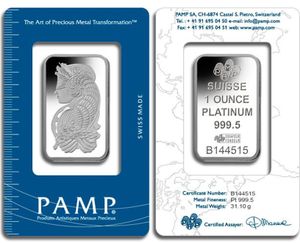
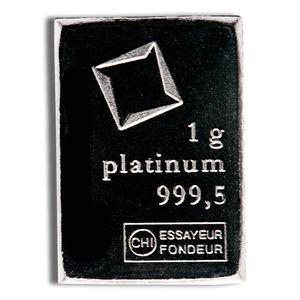
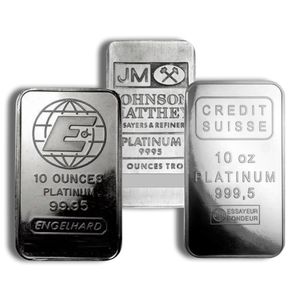
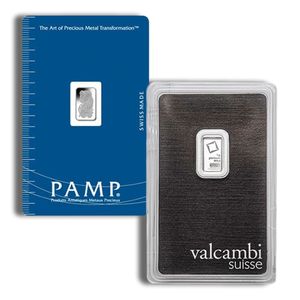
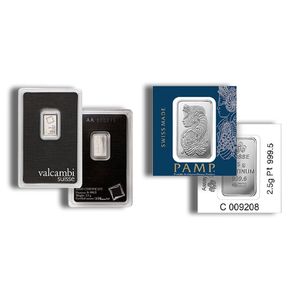
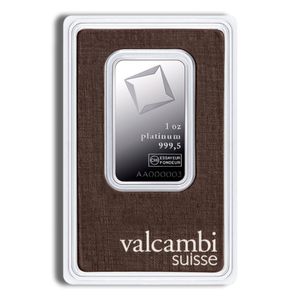
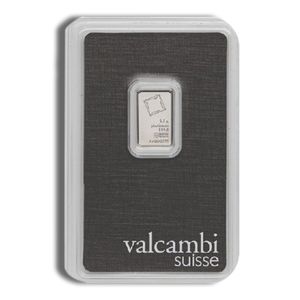
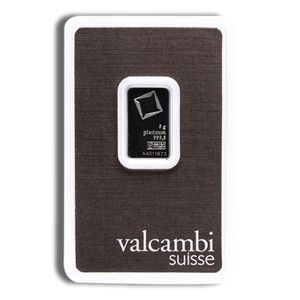
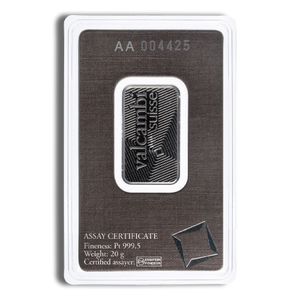
Because these bars ship from random brands, the specific design and engraving will vary from piece to piece. Typical platinum bars in this format feature the refinery or fabricator name stamped prominently on the obverse, accompanied by the weight designation, purity mark, and in many cases a serial number or lot identifier. The surface is generally flat with a brushed or matte finish, though some fabricators apply a polished face to distinguish their products.
Text-based engravings dominate the design on most one ounce platinum bars, with minimal decorative elements beyond the producer's logo or assay mark. The understated appearance is characteristic of this bar category, where functional information takes priority over artistic presentation. Regardless of which brand arrives, the stamped specifications convey the essential information a buyer or reseller needs to assess the piece at a glance.
Every bar we handle is verified for weight and purity before it reaches a customer. Platinum presents unique authentication challenges compared to gold and silver because its density closely resembles certain tungsten alloys, which makes professional verification more important than with some other metals. We rely on established testing methods and work with reputable refineries and distributors to ensure each bar conforms to its stated specifications.
Bars in this listing originate from credible fabricators operating under recognized industry standards. While they ship without an assay card, the absence of certification packaging does not diminish the integrity of the metal itself. The stamped specifications on each bar reflect the refinery's own quality controls, and our handling procedures provide an additional layer of verification before fulfillment.
Bars in this listing are sold in bullion condition, which reflects their status as metal products rather than collectibles. Because these bars are drawn from the secondary market as well as primary distribution channels, minor contact marks, light surface toning, or handling signs may be present on individual pieces. This is normal and expected for bars traded in this format, and it has no bearing on the metal content or the value of the product.
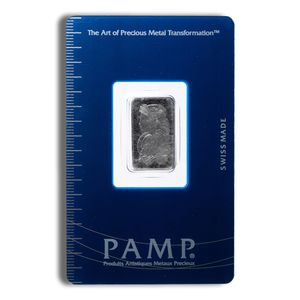
Individual bars ship in a protective plastic flip to prevent surface contact during transit. Larger quantity orders ship in tubes or trays consistent with the standard packaging configuration for one ounce platinum bars, and orders at the outer pack level ship in a sealed box. Exact tube and box quantities depend on the brand, as packaging standards vary by fabricator. If you have questions about how a specific quantity will be packaged, our team can clarify before your order ships.
Platinum bar pricing is derived directly from the live spot price of platinum, with a premium added to cover production, distribution, and dealer costs. Because these bars ship without assay cards and under a random brand designation, the premium is typically lower than what you would pay for a named brand bar in sealed assay packaging. For buyers whose priority is platinum content rather than presentation, this format offers a more cost-efficient entry point.
Platinum premiums are also influenced by the metal's relatively thin market compared to gold and silver. Lower trading volumes and a smaller pool of active retail buyers can cause premiums to widen during periods of reduced demand or supply disruption. Understanding that dynamic helps set realistic expectations when evaluating the total cost of owning platinum in bar form at any given time. Our pricing reflects current wholesale market conditions and is updated in real time to stay consistent with live spot movements.
Platinum bars at the one troy ounce weight are recognizable across the wholesale market and are accepted by dealers, refineries, and institutional buyers. The standardized weight and .9995 purity make these bars straightforward to evaluate for resale purposes, even without an assay card. Any reputable buyer with testing equipment can confirm the specifications quickly, which supports reasonably efficient resale in most market environments.
That said, platinum trades with less retail liquidity than gold or silver, and buyers should approach it with that characteristic in mind. We operate a two-way market that supports both buying and selling within the same platform, giving customers a direct channel to sell back at competitive wholesale bid pricing. Knowing the buyback path before purchasing is a practical consideration we encourage with any platinum product.
The primary appeal of this product is straightforward access to one troy ounce of .9995 fine platinum at a leaner premium than branded, assay-certified alternatives. For buyers accumulating platinum by weight, the absence of an assay card is an acceptable tradeoff that reduces the per-ounce cost meaningfully over time. The metal content is identical to any other .9995 platinum bar at this weight regardless of which brand is stamped on the surface.
Random brand bars also give buyers exposure to bars from a range of credible fabricators rather than locking them into a single producer's product. For buyers focused on building platinum holdings efficiently, this flexibility offers a practical advantage without compromising on purity or weight standards.
We have operated in the precious metals market since 2010, and our approach has always centered on transparency rather than pressure. Pricing on every product reflects real-time market conditions, and we display the bid/ask spread on each product page so buyers can assess the full cost of ownership before committing. That kind of pricing clarity is not universal in this industry, and we consider it a foundational part of how we operate.
Our two-way market model means customers can both purchase and sell within the same platform at competitive wholesale pricing, without being directed to a separate process or a different counterparty. We hold an A rating with the Better Business Bureau, maintain active memberships in the American Numismatic Association and the National Coin and Bullion Association, and are an authorized dealer for both PCGS and NGC. Every product we fulfill has been verified for authenticity, weight, and purity, and our customer service team is accessible throughout the buying and selling process.
Bullion Standard Pro gives members access to live, executable wholesale bid and ask pricing on platinum bars and across the broader catalog. Rather than working from static retail price sheets, Pro members see real-time pricing that reflects actual wholesale market conditions, including how premiums and spreads on platinum bars shift as supply, demand, and market sentiment change. For buyers acquiring platinum in this format, that level of pricing visibility is a meaningful advantage.
Pro also includes proprietary research tools that allow members to compare platinum products by premium, spread tightness, and liquidity metrics, helping buyers identify where platinum bars are trading relative to historical norms. Portfolio valuations within Pro use live wholesale bid pricing, which provides a more accurate read on current liquidation value than retail-based estimates. For buyers who want to understand their platinum holdings in the context of live market conditions, these tools add a layer of analytical depth that is difficult to find elsewhere.
We support a wide range of payment methods to accommodate how different buyers prefer to transact. Accepted options include Visa, Mastercard, American Express, Discover, PayPal, bank-connected payments through Plaid, wire transfer, paper check, and cryptocurrency through BitPay. Each method is processed through a secure environment designed to protect buyer information at every step.
Whether you are completing a single bar purchase or a larger order, the checkout experience is built for simplicity and security. Our team is available to assist with any questions about payment processing, order status, or fulfillment before and after your purchase is placed.
Volume Discount Pricing Orders paid by debit card, credit card, and PayPal are an item's full list price and receive no discount. Orders paid by cryptocurrency receive a 3% discount from an item's full list price. Orders paid by eCheck (ACH), paper check, and bank wire receive a 4% discount from an item's full list price.
| Quantity | (e)Check/Wire | Crypto | CC/PayPal |
|---|---|---|---|
| 1 - 4 | $1,703.06 | $1,738.54 | $1,774.02 |
| 5 - 9 | $1,697.48 | $1,732.85 | $1,768.21 |
| 10 - 24 | $1,691.92 | $1,727.17 | $1,762.42 |
| 25+ | $1,686.36 | $1,721.50 | $1,756.63 |
1+
|
$1,654.79 | $1,689.26 | $1,723.74 |
Product ID: BST-0000749808
| Precious Metal Type | Platinum |
|---|---|
| Format | Bar (Minted) |

| Brand/Mint | Various |
| Purity | 0.9995 |
| Weight | 1 oz |
| Thickness (mm) | 2.05 mm |
| Bar Length (mm) | 38 mm |
| Bar Width (mm) | 22 mm |
Platinum bars in the one troy ounce format represent one of the most straightforward ways to own physical platinum at or near spot pricing. Each bar in this listing contains one troy ounce of platinum refined to .9995 fineness, meeting the standard purity threshold recognized across wholesale and retail markets. Because these bars ship without an assay card, they trade at leaner premiums than fully certified alternatives, which appeals to buyers focused on metal content over packaging.
The brand on any given bar varies depending on current inventory, which is standard for this type of offering across the industry. Bars sourced for this listing come from recognized refineries and fabricators, and each piece meets the weight and purity specifications regardless of the specific brand stamped on the surface. We carry these alongside a broader platinum inventory to give buyers a cost-effective option within this metal.
Platinum entered commercial refining on a meaningful scale in the nineteenth century, though industrial demand for the metal expanded dramatically through the twentieth century as its c
…Platinum bars in the one troy ounce format represent one of the most straightforward ways to own physical platinum at or near spot pricing. Each bar in this listing contains one troy ounce of platinum refined to .9995 fineness, meeting the standard purity threshold recognized across wholesale and retail markets. Because these bars ship without an assay card, they trade at leaner premiums than fully certified alternatives, which appeals to buyers focused on metal content over packaging.
The brand on any given bar varies depending on current inventory, which is standard for this type of offering across the industry. Bars sourced for this listing come from recognized refineries and fabricators, and each piece meets the weight and purity specifications regardless of the specific brand stamped on the surface. We carry these alongside a broader platinum inventory to give buyers a cost-effective option within this metal.
Platinum entered commercial refining on a meaningful scale in the nineteenth century, though industrial demand for the metal expanded dramatically through the twentieth century as its catalytic properties became essential across automotive, chemical, and electronics manufacturing. Unlike gold and silver, platinum has never been adopted as a primary monetary metal by any major economy, which shapes how it trades and how premiums are structured in the bullion market.
The modern platinum bar market developed largely in parallel with the growth of industrial demand and institutional commodities trading. Refineries across Europe, North America, Russia, and Japan established platinum bar production to serve both industrial buyers and retail bullion buyers. Brands such as Valcambi, Engelhard, Johnson Matthey, and PAMP Suisse have been among the most widely recognized fabricators in this category over the decades, though the secondary market includes bars from a broad range of credible producers.
The one troy ounce bar format became a practical standard for retail buyers because it aligns with the common unit of measurement used in spot price quotations. This weight makes platinum accessible to buyers who want measurable, countable holdings in a format that corresponds directly to published market prices.
Because these bars ship from random brands, the specific design and engraving will vary from piece to piece. Typical platinum bars in this format feature the refinery or fabricator name stamped prominently on the obverse, accompanied by the weight designation, purity mark, and in many cases a serial number or lot identifier. The surface is generally flat with a brushed or matte finish, though some fabricators apply a polished face to distinguish their products.
Text-based engravings dominate the design on most one ounce platinum bars, with minimal decorative elements beyond the producer's logo or assay mark. The understated appearance is characteristic of this bar category, where functional information takes priority over artistic presentation. Regardless of which brand arrives, the stamped specifications convey the essential information a buyer or reseller needs to assess the piece at a glance.
Every bar we handle is verified for weight and purity before it reaches a customer. Platinum presents unique authentication challenges compared to gold and silver because its density closely resembles certain tungsten alloys, which makes professional verification more important than with some other metals. We rely on established testing methods and work with reputable refineries and distributors to ensure each bar conforms to its stated specifications.
Bars in this listing originate from credible fabricators operating under recognized industry standards. While they ship without an assay card, the absence of certification packaging does not diminish the integrity of the metal itself. The stamped specifications on each bar reflect the refinery's own quality controls, and our handling procedures provide an additional layer of verification before fulfillment.
Bars in this listing are sold in bullion condition, which reflects their status as metal products rather than collectibles. Because these bars are drawn from the secondary market as well as primary distribution channels, minor contact marks, light surface toning, or handling signs may be present on individual pieces. This is normal and expected for bars traded in this format, and it has no bearing on the metal content or the value of the product.
Individual bars ship in a protective plastic flip to prevent surface contact during transit. Larger quantity orders ship in tubes or trays consistent with the standard packaging configuration for one ounce platinum bars, and orders at the outer pack level ship in a sealed box. Exact tube and box quantities depend on the brand, as packaging standards vary by fabricator. If you have questions about how a specific quantity will be packaged, our team can clarify before your order ships.
Platinum bar pricing is derived directly from the live spot price of platinum, with a premium added to cover production, distribution, and dealer costs. Because these bars ship without assay cards and under a random brand designation, the premium is typically lower than what you would pay for a named brand bar in sealed assay packaging. For buyers whose priority is platinum content rather than presentation, this format offers a more cost-efficient entry point.
Platinum premiums are also influenced by the metal's relatively thin market compared to gold and silver. Lower trading volumes and a smaller pool of active retail buyers can cause premiums to widen during periods of reduced demand or supply disruption. Understanding that dynamic helps set realistic expectations when evaluating the total cost of owning platinum in bar form at any given time. Our pricing reflects current wholesale market conditions and is updated in real time to stay consistent with live spot movements.
Platinum bars at the one troy ounce weight are recognizable across the wholesale market and are accepted by dealers, refineries, and institutional buyers. The standardized weight and .9995 purity make these bars straightforward to evaluate for resale purposes, even without an assay card. Any reputable buyer with testing equipment can confirm the specifications quickly, which supports reasonably efficient resale in most market environments.
That said, platinum trades with less retail liquidity than gold or silver, and buyers should approach it with that characteristic in mind. We operate a two-way market that supports both buying and selling within the same platform, giving customers a direct channel to sell back at competitive wholesale bid pricing. Knowing the buyback path before purchasing is a practical consideration we encourage with any platinum product.
The primary appeal of this product is straightforward access to one troy ounce of .9995 fine platinum at a leaner premium than branded, assay-certified alternatives. For buyers accumulating platinum by weight, the absence of an assay card is an acceptable tradeoff that reduces the per-ounce cost meaningfully over time. The metal content is identical to any other .9995 platinum bar at this weight regardless of which brand is stamped on the surface.
Random brand bars also give buyers exposure to bars from a range of credible fabricators rather than locking them into a single producer's product. For buyers focused on building platinum holdings efficiently, this flexibility offers a practical advantage without compromising on purity or weight standards.
We have operated in the precious metals market since 2010, and our approach has always centered on transparency rather than pressure. Pricing on every product reflects real-time market conditions, and we display the bid/ask spread on each product page so buyers can assess the full cost of ownership before committing. That kind of pricing clarity is not universal in this industry, and we consider it a foundational part of how we operate.
Our two-way market model means customers can both purchase and sell within the same platform at competitive wholesale pricing, without being directed to a separate process or a different counterparty. We hold an A rating with the Better Business Bureau, maintain active memberships in the American Numismatic Association and the National Coin and Bullion Association, and are an authorized dealer for both PCGS and NGC. Every product we fulfill has been verified for authenticity, weight, and purity, and our customer service team is accessible throughout the buying and selling process.
Bullion Standard Pro gives members access to live, executable wholesale bid and ask pricing on platinum bars and across the broader catalog. Rather than working from static retail price sheets, Pro members see real-time pricing that reflects actual wholesale market conditions, including how premiums and spreads on platinum bars shift as supply, demand, and market sentiment change. For buyers acquiring platinum in this format, that level of pricing visibility is a meaningful advantage.
Pro also includes proprietary research tools that allow members to compare platinum products by premium, spread tightness, and liquidity metrics, helping buyers identify where platinum bars are trading relative to historical norms. Portfolio valuations within Pro use live wholesale bid pricing, which provides a more accurate read on current liquidation value than retail-based estimates. For buyers who want to understand their platinum holdings in the context of live market conditions, these tools add a layer of analytical depth that is difficult to find elsewhere.
We support a wide range of payment methods to accommodate how different buyers prefer to transact. Accepted options include Visa, Mastercard, American Express, Discover, PayPal, bank-connected payments through Plaid, wire transfer, paper check, and cryptocurrency through BitPay. Each method is processed through a secure environment designed to protect buyer information at every step.
Whether you are completing a single bar purchase or a larger order, the checkout experience is built for simplicity and security. Our team is available to assist with any questions about payment processing, order status, or fulfillment before and after your purchase is placed.