Buy 2.5 Gram Gold Bars Online
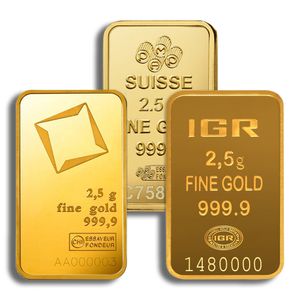
Our catalog of 2.5 gram gold bars brings together some of the most respected names in the global refinery market, including PAMP Suisse, Valcambi, Geiger Edelmetalle, and Istanbul Gold Refinery (IGR), alongside random brand options that offer straightforward exposure to gold at this fractional weight. Each bar carries a purity of .9999 fine gold and is available in a range of packaging formats, from sealed assay cards to unpackaged loose bars, giving buyers the flexibility to choose based on their preferences and budget.
Whether you're drawn to the precision craftsmanship of a PAMP Suisse Lady Fortuna in an assay card or the cost efficiency of a random brand 2.5 gram bar without packaging, you'll find options here that reflect real market availability rather than a curated showcase of premium products alone. Bullion Standard operates as a transparent marketplace, which means pricing reflects current spot conditions and premiums are presented clearly so you can evaluate the true cost of ownership before completing a purchase.
This weight sits in a practical middle ground within the fractional gold segment, offering more gold per bar than a 1 gram piece while remaining more accessible than a full gram bar at 5 or 10 grams. For buyers building a position in small increments or seeking portable, divisible gold in a compact form, the 2.5 gram size delivers meaningful substance without requiring a large upfront commitment.
What Are 2.5 Gram Gold Bars?
A 2.5 gram gold bar is a small minted gold bar containing exactly 2.5 grams of fine gold, equivalent to approximately 0.0804 troy ounces. The bars in this weight class are almost universally produced through a minted process, meaning they are struck or pressed from refined gold blanks and finished to a higher visual standard than cast bars, which are poured and often have a more raw, textured appearance. The minted format is standard for this weight because the small dimensions make casting impractical and precision striking allows refiners to incorporate detailed designs, anti-counterfeiting features, and assay markings efficiently.
Buyers in this segment typically fall into a few distinct groups. Some are building a fractional gold position gradually, preferring the flexibility of smaller units over a single large bar. Others are purchasing for gift-giving, as the compact assay card format common at this weight presents well and includes visible authentication markings. There are also buyers who simply want to own gold at an entry point below what a 1 oz bar or coin requires, without accepting the higher per-gram premiums that come with 1 gram bars.
Compared to fractional gold coins at similar weights, 2.5 gram bars typically carry lower premiums because they lack the government-backed legal tender status and collector demand that can push coin premiums higher. That said, branded bars from refineries like PAMP Suisse or Valcambi do carry a premium over generic or random brand options, reflecting the reputation, packaging quality, and secondary market recognition associated with those names.
History and Background
The modern small gold bar market developed substantially in the latter half of the twentieth century as Swiss and European refineries sought to serve growing retail demand for divisible gold products. Refineries like Valcambi and PAMP Suisse, both headquartered in Switzerland, became central to this shift, industrializing the production of minted bars at a range of fractional weights that could be distributed through banks, dealers, and jewelry channels worldwide. The 2.5 gram weight emerged as part of this fractional expansion, sitting alongside 1 gram, 5 gram, and 10 gram bars as a standardized retail format.
Geiger Edelmetalle, based in Germany, represents a different tradition within the European refinery landscape. Founded as a precious metals trading house with origins in Leipzig, Geiger developed a reputation for distinctive security features and a consistent minting standard that helped establish its bars as recognizable products in the secondary market. The IGR, or Istanbul Gold Refinery, reflects the broader geographic diversification of gold refining that occurred as demand expanded across the Middle East and Asia, with Turkey becoming a significant processing hub for gold moving between mining regions and retail markets.
The assay card, now standard packaging for most branded bars at this weight, became widely adopted as both an authentication tool and a retail presentation format. By encasing the bar in a sealed card that displays the refiner's hallmark, weight, purity, and often a serial number, refineries created a verifiable chain of custody that simplified distribution and gave buyers a clear point of reference for authenticity. This packaging format became especially important as the secondary market for small gold bars grew and resale through dealers and exchanges required consistent, verifiable product specifications.
Purity, Weight, and Specifications
Every 2.5 gram gold bar in our catalog carries a purity of .9999 fine gold, also expressed as 24 karat or 99.99% pure. This is the highest commercially standard purity for investment-grade gold bars and is the benchmark maintained by the major Swiss, German, and Turkish refineries producing products at this weight. The .9999 designation distinguishes these bars from older .995 or .9990 fine standards that were common in earlier eras of bullion production.
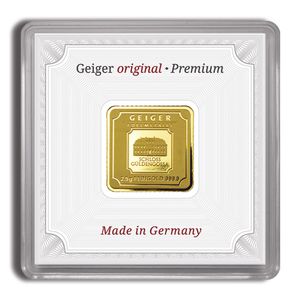
At 2.5 grams, each bar contains approximately 0.0804 troy ounces of fine gold. The troy ounce remains the universal unit of measurement for precious metals pricing globally, so the gram-to-troy-ounce conversion is relevant when calculating the spot value of any bar at this weight. Dimensions vary by refiner. The PAMP Suisse 2.5 gram bar measures 22.1 mm by 13.1 mm with a thickness of 0.46 mm, while the Valcambi version comes in at 19 mm by 11.5 mm with a 0.8 mm thickness. The Geiger bar measures 15 mm by 15 mm, reflecting a squarer format more typical of that refinery's house style.
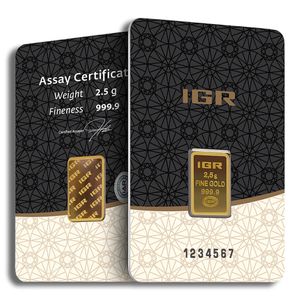
Branded bars typically display the refiner's name or logo, the stated weight in grams, the purity marking, and in many cases a unique serial number for lot or individual tracking. Assay cards add an outer layer of documentation, printing these details on tamper-evident packaging that serves as both a visual authenticator and a resale credential. Random brand bars at this weight meet the same purity standard but may not include serial numbers or branded packaging, which can affect how they trade in the secondary market.
Available Brands, Mints, and Product Variations
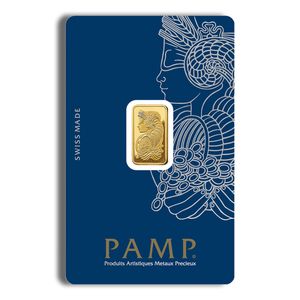
The PAMP Suisse Lady Fortuna 2.5 gram bar is among the most recognized products at this weight globally. PAMP, which stands for Produits Artistiques Métaux Précieux, has produced the Lady Fortuna design since 1979, and its combination of artistic detail and rigorous refinery certification has made it one of the most widely traded branded bar designs across dealer networks worldwide. The bar ships in a sealed assay card that includes a certificate of authenticity and the bar's individual serial number.
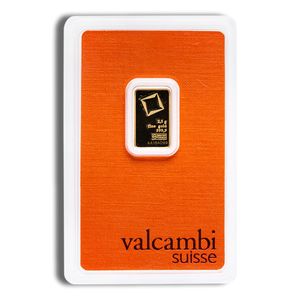
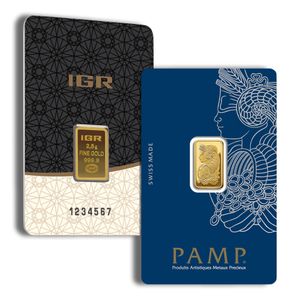
Valcambi Suisse offers its own 2.5 gram bar in assay card packaging with similarly precise specifications and a clean, minimalist design. Valcambi operates one of the largest precious metals refinery complexes in the world and is known for consistent production standards and broad acceptance in the secondary market. Geiger Edelmetalle brings a distinctly European sensibility, with its 2.5 gram bar featuring the refinery's signature design elements and a square format that differentiates it visually from most Swiss competitors. The IGR bar from Istanbul Gold Refinery rounds out the branded offerings and carries the same .9999 purity standard with assay card presentation.
For buyers less focused on brand recognition, the random brand options in our catalog offer a practical alternative. The random brand bar in assay card packaging meets the same purity standard as its branded counterparts and arrives sealed, though the specific refiner will vary based on current inventory. The no-assay version of the random brand bar offers the lowest entry point in this weight class, trading in loose form without accompanying documentation. Both options are appropriate for buyers whose primary interest is gold content rather than specific branding or collectibility.
Pricing, Premiums, and Market Factors
The price of any 2.5 gram gold bar is tied directly to the spot price of gold, which fluctuates continuously based on global trading activity across futures markets, physical markets, and currency dynamics. The premium above spot is the additional cost paid per bar beyond the raw gold content value, and at this fractional weight, premiums are typically higher on a percentage basis than those seen on 1 oz bars because the fixed production and packaging costs are spread across a smaller amount of gold.
Brand and packaging significantly influence where a specific bar falls within the premium range. PAMP Suisse and Valcambi bars command higher premiums than random brand options because of their global recognition, assay card packaging, and established secondary market demand. The no-assay random brand bar carries the lowest premium in this group, reflecting the reduced packaging cost and the wider pool of refineries that may supply the product. Geiger's pricing sits somewhere between the premium Swiss brands and the generic alternatives, benefiting from a solid reputation in European and North American markets without quite reaching the premium floor of PAMP.
Bullion Standard structures pricing to reflect real-time market conditions rather than fixed retail markups. Each product page displays the bid and ask spread, which gives buyers a transparent view of both the acquisition cost and the estimated resale value at any given moment. Understanding that relationship before completing a purchase provides a clearer picture of the total cost of ownership, which is a more honest framework for evaluating any bullion purchase than focusing solely on the premium paid.
Condition, Packaging, and What to Expect
Most 2.5 gram gold bars in our catalog arrive in new condition, sealed in either an individual assay card or protective packaging appropriate to the product type. Assay-packaged bars from PAMP Suisse, Valcambi, Geiger, and IGR are delivered in intact, tamper-evident cards that should not be opened if you plan to maintain the bar's resale presentation. Once an assay card is broken, the bar is generally treated as loose bullion in the secondary market, which can affect its buyback value.
Random brand bars sourced for our catalog are drawn from current inventory and may carry any of several recognized refineries depending on what is available at the time of fulfillment. If you purchase a random brand bar in assay card format, you'll receive a sealed product, but the specific brand or design will vary. The no-assay version ships as a loose bar without accompanying documentation, which is entirely functional for buyers focused purely on gold content.
Minor surface handling marks or light contact marks are considered normal and acceptable for bullion products at this weight, particularly on loose bars. These cosmetic variations do not affect the gold content or intrinsic value of the bar. Products are shipped securely packaged to prevent transit damage, and all orders go through our fulfillment and verification process before leaving our facility.
Authenticity and Verification
Every product that ships from Bullion Standard is verified for authenticity, weight, and purity before reaching a customer. We source 2.5 gram gold bars exclusively from reputable refineries, wholesalers, and distributors operating within established industry channels. Bars from PAMP Suisse, Valcambi, Geiger, and IGR are produced at certified refineries that maintain LBMA-recognized or equivalent quality standards, meaning their production processes and purity claims are subject to external auditing.
Assay cards provide a built-in layer of authentication. The tamper-evident packaging, refinery hallmark, weight designation, purity marking, and serial number printed on the card create a verifiable record that makes substitution or tampering immediately detectable. For bars with individual serial numbers, the number can be cross-referenced with the issuing refinery's verification systems in many cases, adding an additional layer of traceability beyond physical inspection.
For random brand bars, our sourcing process ensures that all products meet the stated .9999 purity standard regardless of which specific refinery produced them. Our purchasing team applies consistent verification protocols across all incoming inventory to confirm that weight and purity specifications are met before any product enters our catalog. Bullion Standard holds an A rating with the Better Business Bureau and is a member of both the American Numismatic Association and the National Coin and Bullion Association, commitments that reflect our operational standards across all product categories.
Liquidity and Resale Considerations
Liquidity for 2.5 gram gold bars is shaped primarily by brand recognition, packaging integrity, and the depth of the secondary market for fractional gold at this weight. Bars from PAMP Suisse and Valcambi benefit from the widest global recognition and are accepted by the broadest range of dealers, exchanges, and buyback programs. Their assay-packaged presentation means they arrive to the secondary market with clear documentation, which simplifies verification and pricing.
Random brand bars and no-assay products trade with somewhat less efficiency because they lack the immediate visual identification and documentation that branded products carry. Dealers and buyers in the secondary market typically apply a wider spread to unpackaged or unbranded fractional bars because verification requires more time and the pool of potential buyers willing to accept the product without documentation is narrower. This doesn't make these products illiquid, but it does mean the bid-ask spread is generally wider than for a sealed, named-brand bar.
At this weight specifically, the fractional nature of the product means secondary market depth is thinner than for standard 1 oz formats. Buyers considering 2.5 gram bars should factor in that the ease and efficiency of resale is somewhat more variable than it would be for more widely standardized weights. Understanding this before purchasing helps set realistic expectations about the full transaction cycle.
Storage and Security
The compact dimensions of a 2.5 gram gold bar make storage physically straightforward, as even a substantial quantity of bars takes up minimal space. That said, small size also means individual bars are easy to misplace or lose if stored loosely without a consistent organizational system. Keeping assay-packaged bars in their original sealed cards simplifies both storage and eventual resale by preserving the presentation in the condition it was received.
For home storage, a quality fireproof and tamper-resistant safe is a practical first layer of security. Bank safe deposit boxes offer a lower-cost alternative for buyers who prefer institutional storage without the complexity of a full vault account. For larger holdings or for buyers who want segregated, insured storage with documented inventory, third-party vault services provide a more robust solution, typically with options for allocated or segregated storage that keeps your specific bars identifiable rather than pooled.
Environmental factors matter less for gold than for silver, since gold doesn't oxidize or tarnish under normal conditions. However, keeping bars away from prolonged humidity exposure is still advisable, particularly for bars stored outside of sealed assay packaging. Capsules or individual holders designed for small bars can provide adequate protection for loose products stored long-term.
Selling and Buyback Options
Selling 2.5 gram gold bars follows the same general process as selling other bullion products, but a few product-specific factors shape the experience. Packaging integrity is the first consideration. Sealed assay bars from named refineries like PAMP Suisse, Valcambi, or Geiger typically receive stronger bids than loose or random brand bars because the documentation reduces verification time and increases buyer confidence in the secondary market. If you've kept your bars in their original assay cards, that presentation supports a smoother and often more favorable buyback transaction.
Bullion Standard operates a two-way market, meaning we purchase products as well as sell them. Our buyback pricing is driven by current spot prices, the wholesale bid for the specific product, and factors like condition, brand, and packaging. Because we place equal weight on both sides of the transaction, buyers can check current bid pricing before they ever make a purchase, which gives a clearer view of what a complete transaction actually looks like from acquisition to liquidation.
For random brand bars and no-assay products, buyback pricing reflects the additional verification steps involved and the narrower dealer demand for unpackaged fractional gold. These products are still saleable, but buyers should understand that the spread between purchase price and resale price will generally be wider than for premium branded bars in sealed packaging. Working with a dealer like Bullion Standard that maintains consistent, transparent buyback pricing removes much of the uncertainty from the resale process.
Why Buy 2.5 Gram Gold Bars?
The 2.5 gram format occupies a useful position within the fractional gold market, offering more substance than a 1 gram bar while remaining below the premium tier associated with fractional coins or specialty collectibles. For buyers who want to accumulate gold in small increments without the higher per-gram cost of 1 gram bars, this weight provides a modest efficiency advantage while keeping the entry price manageable.
Divisibility is a practical consideration for many buyers at this level. Holding gold across multiple small bars rather than a single large one provides flexibility when it comes time to sell, gift, or distribute a portion of a holding without liquidating an entire position. The compact assay card format also makes 2.5 gram bars a natural choice for gift-giving contexts where the visual presentation and authenticity documentation matter as much as the gold content itself.
The range of brands available at this weight, from the globally recognized PAMP Suisse Lady Fortuna to cost-conscious random brand options, means buyers can calibrate the premium they pay to match their specific priorities. Someone who values brand recognition and secondary market familiarity will gravitate toward the Swiss refineries. Someone focused primarily on gold content at the lowest available premium will find the random brand options a more direct path to that goal. Both approaches are rational depending on what the buyer is actually trying to accomplish.
Why Buy from Bullion Standard?
Bullion Standard has operated as a precious metals dealer since 2010, building its reputation on pricing transparency, consistent product sourcing, and a customer experience designed around informed decision-making rather than pressure-driven sales. Our platform displays real-time pricing tied to spot market conditions, and each product page includes the current bid and ask spread so buyers can evaluate the full cost of a transaction before committing. That level of transparency isn't universal in this industry, and we think it's the baseline any serious buyer deserves.
Every product in our catalog, including all 2.5 gram gold bars, is verified for authenticity, weight, and purity before shipping. We source exclusively from reputable mints, refineries, wholesalers, and distributors, and our verification process applies consistently regardless of whether the product is a branded Swiss bar or a random brand option. Our A BBB rating and memberships in the ANA and NCBA reflect the operational standards we've maintained since founding.
We also support a wide range of payment options, including major credit cards, PayPal, bank-connected payments through Plaid, wire transfer, paper check, and cryptocurrency through BitPay, giving buyers flexibility in how they complete their purchase. Responsive customer service and reliable fulfillment round out an experience that's built to support long-term relationships rather than one-time transactions. Our two-way market structure means that when you're ready to sell, you're working within the same ecosystem rather than starting from scratch with an unfamiliar buyer.
Get Near-Spot Pricing with Bullion Standard Pro
Bullion Standard Pro is designed for buyers who want to transact closer to wholesale market conditions rather than standard retail pricing. Members gain access to live, executable wholesale bid and ask pricing across a broad range of precious metals products, including fractional gold bars at the 2.5 gram weight. Because Pro pricing reflects real-time supply and demand within the wholesale market rather than fixed retail structures, premiums and spreads fluctuate naturally based on actual market conditions.
Unlike the traditional dealer model where a fixed retail markup is applied on top of spot, Bullion Standard Pro does not layer additional dealer spreads onto member pricing. This means buyers transact at pricing that more accurately reflects the current wholesale market, which is particularly meaningful for fractional products where premiums at the retail level can be disproportionately wide relative to the gold content. Over multiple transactions, that pricing efficiency compounds in ways that matter to serious buyers.
Pro membership also provides access to proprietary market intelligence tools, including historical premium data, premium percentile rankings, bid/ask spread analysis, and liquidity metrics that allow buyers to evaluate specific products based on objective data rather than marketing claims. For buyers accumulating fractional gold systematically, having visibility into how a product like a 2.5 gram PAMP Suisse or Valcambi bar trades at the wholesale level, including where current premiums sit relative to historical ranges, supports more deliberate and well-informed purchasing decisions.


 (833) 278-4653