Buy 2 Gram Gold Bars Online
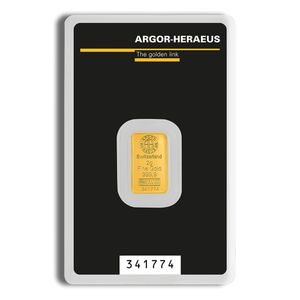
Our catalog currently features the 2 gram gold bar from Argor-Heraeus, one of Switzerland's most respected precious metals refineries. Each bar is presented in a sealed assay card that confirms its weight, purity, and authenticity, making it a compact and well-documented option for buyers seeking entry-level gold in minted bar format.
Bullion Standard is built around transparent pricing and sourcing integrity, and that philosophy extends to smaller fractional gold products like these. Whether you're adding a single bar to an existing holding or exploring the 2 gram format for the first time, the product information, current premiums, and bid/ask spread are all clearly visible before you commit to a purchase.
At 0.0643 troy ounces of .9999 fine gold, the 2 gram format occupies a practical middle ground between the smallest fractional sizes and larger standard denominations. It's a format worth understanding on its own terms rather than simply as a smaller version of something else.
What Are 2 Gram Gold Bars?
A 2 gram gold bar is a minted fractional gold bar produced by a refinery to precise weight and purity standards. Unlike cast bars, which are poured and tend to have a more industrial appearance, minted bars like those from Argor-Heraeus are struck from rolled gold blanks and typically feature clean, defined edges, polished surfaces, and detailed engraving. The result is a finished product that balances portability with a refined aesthetic.
The 2 gram denomination fits within a broader family of fractional gold bars that includes 1 gram, 2.5 gram, 5 gram, and 10 gram options. Buyers often choose 2 gram bars specifically because the size is manageable in terms of cost per unit while still offering meaningful gold content per bar. This makes individual bars easier to trade, gift, or transfer without needing to divide a larger holding.
Assay card packaging is standard for this format. The bar is sealed within a tamper-evident card that typically includes identifying information printed directly on the packaging, confirming the metal type, weight, purity, and the issuing refinery. This packaging serves both a practical and a verification function, and it's one of the reasons 2 gram minted bars tend to carry reliable market recognition.
History and Background
The modern fractional gold bar market developed alongside growing retail interest in physically held gold during the latter half of the 20th century. As refineries expanded their product lines to reach buyers who wanted exposure to gold without committing to full-ounce or multi-ounce denominations, smaller minted bars became an increasingly standardized part of the global bullion market. The 2 gram format emerged as part of this broader product ecosystem.
Argor-Heraeus has been at the center of that evolution. Founded in Mendrisio, Switzerland in 1951, the refinery has grown into one of the largest and most technically sophisticated precious metals processing facilities in the world. Its history includes a long-standing relationship with some of the most prominent names in global banking and commodity trading, and its minting capabilities have made it a benchmark refinery for small-format gold bars across international markets.
Swiss refineries more broadly have held a defining role in the modern bullion bar market. Switzerland's position as a global financial center, combined with strict regulatory frameworks and deep metallurgical expertise, helped establish Swiss-produced bars as a benchmark for quality and standardization across the industry. Argor-Heraeus, alongside names like PAMP Suisse and Valcambi, has contributed directly to the market's expectations around precision, packaging, and verifiable purity.
Purity, Weight, and Specifications
The Argor-Heraeus 2 gram gold bar carries a purity of .9999 fine gold, which is the highest standard commonly found in modern minted bullion bars. This four-nines purity level means the bar contains 99.99% pure gold with minimal trace elements. It is also referred to in the industry as 24 karat gold, and it meets the standards required for inclusion in many gold-backed financial accounts and programs internationally.
At 2 grams, the bar contains 0.0643 troy ounces of gold. Troy ounces are the standard unit of measure across the precious metals industry and differ from avoirdupois ounces used in everyday commerce. One troy ounce equals approximately 31.1 grams, which means a 2 gram bar represents a small but precisely measured fraction of a troy ounce. The bar's physical dimensions reflect its compact size: 19 millimeters in length, 11.4 millimeters in width, and 0.6 millimeters in thickness.
Each bar produced by Argor-Heraeus is stamped with the refinery's name and logo, the bar's weight, and its fineness designation. These markings, combined with the sealed assay card, form the standard documentation that market participants use to verify a bar's specifications without requiring additional testing at the point of sale or resale.
Available Brands, Mints, and Product Variations
Our current selection in this format includes the Argor-Heraeus 2 gram gold bar in an assay card, which represents one of the most recognized products in the small-format minted gold bar segment. Argor-Heraeus bars are produced at the refinery's Swiss facility and are widely accepted across dealer networks globally. The assay card packaging used for this bar includes the refinery's security features and clearly displays the product's specifications.
Argor-Heraeus is known for the quality of its minting process and the consistency of its bar production. The refinery's products regularly appear in dealer inventories, banking institutions, and retail markets across Europe, Asia, and North America. That widespread distribution and recognition is a meaningful factor when considering any small-format gold product, since market familiarity directly affects how straightforward a product is to trade or liquidate.
While our catalog currently reflects a single product in this format, the 2 gram segment more broadly includes bars from other Swiss and European refineries such as PAMP Suisse, Valcambi, and Metalor, as well as products from Perth Mint and various secondary market sources. Each producer brings its own assay card design, surface finish, and security features, which can influence buyer preference and resale dynamics.
Pricing, Premiums, and Market Factors
Like all gold products, 2 gram bars are priced based on the current spot price of gold, with a premium added above that spot price to account for refining, minting, packaging, distribution, and dealer margins. The premium on fractional gold bars is typically higher on a per-ounce basis than larger bars because the fixed costs of production are spread across a smaller amount of metal. This is a consistent characteristic of the fractional gold market and applies across all producers and formats at this weight.
Assay card packaging adds a modest cost component but also preserves the bar's marketability and reduces the need for additional verification at the point of resale. Products sold within intact, original assay cards typically attract better resale pricing than loose bars of equivalent weight, which is worth considering when evaluating total cost of ownership from the outset.
Bullion Standard displays live premiums, bid prices, and ask prices directly on each product page. The bid/ask spread visible on the listing reflects current market conditions, including supply and demand dynamics for this specific product, and is updated in real time. Understanding both the cost to acquire and the current buyback price gives a clearer view of the actual spread you're working within, which is a more complete way to evaluate a purchase than focusing on the premium alone.
Condition, Packaging, and What to Expect
The Argor-Heraeus 2 gram gold bar is delivered sealed within its original assay card. The card itself serves as the primary packaging layer and should be kept intact. Opening or damaging the assay card can affect resale value, since buyers and dealers use the sealed card as a proxy for undisturbed, unaltered bar condition.
Minted gold bars at this size are precision products, and minor surface variations within the sealed card are normal for this format. Very small marks or handling traces visible through the card's window are considered acceptable and do not affect the bar's weight or gold content. The assay card protects the bar from direct contact during shipping and storage, so the bar itself typically arrives in clean, mint-fresh condition.
Orders ship in secure, discreet packaging without identifying branding on the exterior. All shipments are fully insured through transit, and tracking information is provided once the order has been fulfilled. Products are verified before shipment to confirm that each item meets Bullion Standard's sourcing and authenticity standards.
Authenticity and Verification
The sealed assay card is the primary verification mechanism for this product. Argor-Heraeus assay cards include security features designed to make tampering evident, and the card itself lists the bar's weight, fineness, and refinery identification. As long as the card is intact and unsealed, the contents are considered verified by the refinery's production process.
Bullion Standard sources products from established refineries, wholesalers, and authorized distributors, and every product in our inventory is inspected before fulfillment. We do not list products from unverified or unrecognized sources. Our sourcing standards are consistent with the practices expected of dealers that are members of the National Coin and Bullion Association and the American Numismatic Association, both of which Bullion Standard holds membership in.
For buyers who want additional verification beyond the assay card, professional testing options include X-ray fluorescence analysis and ultrasonic thickness testing, both of which can confirm purity and dimensions without damaging the bar or its packaging. These testing methods are widely available through numismatic shops and precious metals dealers and are more commonly used for bars that are loose, unsealed, or of unknown origin.
Liquidity and Resale Considerations
Small-format minted gold bars from recognized refineries are among the more liquid products in the fractional gold segment. Argor-Heraeus in particular is a globally recognized name, and its bars are accepted by a broad range of dealers, banks, and secondary market buyers. That recognition reduces friction when it comes time to sell, since buyers don't need to be educated about the product's origin or purity credentials.
The assay card format plays a meaningful role in resale outcomes. Bars presented in their original sealed assay cards trade more efficiently than loose bars of identical weight because the packaging removes uncertainty about the bar's condition and handling history. Keeping the assay card intact from purchase through eventual resale is the simplest way to preserve the bar's full market value.
Liquidity in the fractional gold bar market does vary by size. The 2 gram denomination is smaller than the most actively traded formats like 1 oz and 10 gram bars, which means the pool of immediate buyers may be somewhat narrower. That said, widely recognized refineries like Argor-Heraeus help offset that limitation by making the product identifiable across the global bullion trade.
Storage and Security
The compact size of a 2 gram gold bar makes storage straightforward. A single bar or a small collection of assay-packaged bars can fit comfortably in a home safe, a bank safe deposit box, or a dedicated bullion storage vault. Because the bars are sealed in rigid assay cards, they don't require additional protective sleeves or cases the way loose coins or unsealed bars might.
Home storage is workable for modest quantities, provided the safe is bolted to a fixed structure and rated for fire resistance. For larger accumulations of fractional bars over time, professional vault storage offers better security and, in some cases, more favorable insurance terms. Several third-party precious metals vault services provide allocated storage where specific bars are assigned to individual account holders rather than pooled with other clients' metal.
Environmental factors are less of a concern for gold than they are for silver, since gold does not tarnish or oxidize under normal storage conditions. Keeping bars in their original assay cards provides adequate protection against surface contact and minor humidity. The main storage priority for any gold product is physical security rather than environmental control.
Selling and Buyback Options
Selling a 2 gram gold bar follows the same general process as selling larger bullion products, though fractional formats have a few characteristics worth understanding. Buyback pricing is based on the current spot price of gold adjusted by the refinery's product-specific bid premium, which fluctuates with market conditions. Products in original, sealed assay cards typically receive stronger buyback offers than loose or visibly damaged bars.
Bullion Standard operates a two-way market, meaning customers can sell metals back to us within the same platform they used to purchase them. This structure is designed to give buyers visibility into the exit side of a transaction before they commit to buying, rather than only discovering resale options after the fact. The buyback price for each product is displayed on our product pages and reflects current executable pricing rather than indicative estimates.
When selling, the product's condition, packaging integrity, and refinery recognition all factor into the final offer. An Argor-Heraeus bar in its original assay card is one of the more straightforward fractional products to sell back, given the refinery's market profile. Our purchasing team evaluates incoming products against current wholesale market conditions to ensure that offers are grounded in real-time pricing rather than static schedules.
Why Buy 2 Gram Gold Bars?
The 2 gram format appeals to buyers who want physical gold in a denomination that balances accessibility with genuine metal content. At roughly 0.0643 troy ounces per bar, the cost of a single unit is low enough to make it practical as a standalone purchase or as a component of a gradual accumulation strategy. The assay card presentation also makes individual bars easy to identify, transfer, or give as a gift without additional documentation.
For buyers who prefer not to commit to larger denominations right away, fractional minted bars offer a way to hold gold in discrete, standardized units. Each bar stands on its own as a verified, hallmarked product with documented purity and weight. This makes the format more flexible than larger bars when partial liquidation or incremental selling is a consideration.
The Argor-Heraeus name also carries weight in this context. Buying a fractional product from a globally recognized Swiss refinery means the bar carries refinery-backed credentials that support its resale recognizability across a wide range of markets and buyer types, which is not always guaranteed with smaller or less-established producers.
Why Buy from Bullion Standard?
Bullion Standard was founded in 2010 and is headquartered in San Diego, California. Over the past decade and a half, we've built a nationally recognized precious metals marketplace by prioritizing transparent pricing, verified sourcing, and a customer experience that emphasizes informed decision-making over high-pressure sales tactics. Our A rating with the Better Business Bureau reflects that approach consistently applied across thousands of transactions.
Every product listed on our platform is sourced through established supply chains and verified for authenticity before fulfillment. We are members of the American Numismatic Association and the National Coin and Bullion Association, and we are authorized dealers for both PCGS and NGC. These affiliations reflect our commitment to industry standards and accountability, not just marketing credentials.
Our pricing is structured around real-time market conditions, and the bid/ask spread is displayed clearly on every product page so buyers can understand both sides of the transaction before purchasing. Customers can pay using a wide range of methods including Visa, Mastercard, American Express, Discover, PayPal, bank-connected payments through Plaid, wire transfer, paper check, and cryptocurrency through BitPay. Our goal is to make the purchasing process secure, transparent, and straightforward from first click through delivery.
Get Near-Spot Pricing with Bullion Standard Pro
Bullion Standard Pro is designed for buyers who want direct access to executable wholesale bid and ask pricing across the precious metals market. Rather than paying standard retail markups, Pro members transact at live wholesale market prices that reflect real-time supply and demand conditions rather than fixed dealer pricing structures. For fractional gold products like 2 gram bars, where per-ounce premiums are already elevated relative to larger formats, the pricing efficiency available through Pro can represent a meaningful difference over time.
Beyond pricing, Pro members gain access to proprietary market intelligence tools including historical premium analysis, premium percentile rankings, bid/ask spread analysis, and liquidity metrics. These tools are designed to help buyers evaluate specific products based on objective data rather than marketing claims, so decisions around timing, product selection, and relative value can be grounded in measurable market conditions.
Portfolio valuation within Bullion Standard Pro uses live executable wholesale bid pricing rather than estimated retail values, giving members a more accurate view of current liquidation value at any point in time. The platform is built around the principle that better information leads to better decisions, and Pro is the fullest expression of that philosophy within our marketplace.

 (833) 278-4653