Buy Apollo 11 Commemorative Coins Online
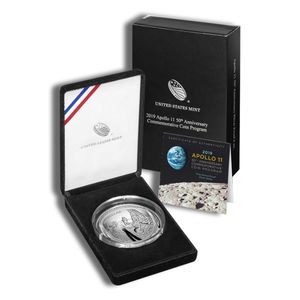
Our catalog of Apollo 11 commemorative coins is built around one of the most unusual pieces the U.S. Mint has ever struck: the curved 2019-P silver dollar issued for the 50th anniversary of the first crewed Moon landing. You'll find it in both of its finishes from the Philadelphia Mint, the proof with mirrored fields and frosted relief, and the brilliant uncirculated version with a softer satin surface.
Both versions carry a $1 face value and are struck in .999 fine silver, a higher fineness than the 90% silver used in most earlier commemorative dollars. Every listing is a specific 2019-dated coin with a P mint mark, so there's no random year selection involved.
Each product page shows the live ask alongside the current bid. For an Apollo 11 commemorative coin, where the price reflects collector interest and finish far more than the silver it contains, seeing both sides of the market up front makes it easier to judge what you're paying for.
What Are Apollo 11 Commemorative Coins?
Apollo 11 commemorative coins are legal tender issues authorized by Congress to honor the July 20, 1969 landing of Neil Armstrong and Buzz Aldrin on the Moon, while Michael Collins orbited above in the command module Columbia. Like every modern U.S. commemorative, they were sold by the Mint for a limited time at a price that included a surcharge for designated organizations, and production was capped by law.
That sets them apart from bullion coins such as the American Silver Eagle, which the Mint strikes every year in large quantities and distributes through dealers at modest premiums over spot. A commemorative silver dollar is a one-time issue sold first to collectors, and its market afterward is shaped by how many were made and how many people want one.
The curve is what most buyers notice first. One face is concave and the other convex, like a shallow dish, so the coin rests on its rim rather than lying flat. Collectors choose it for display, as a gift tied to the space program, or to sit beside the Mint's other curved commemoratives.
History and Background
Congress authorized the program in late 2016, and the Mint released the coins in January 2019, months ahead of the anniversary that July. The program included a clad half dollar, the standard silver dollar, a five-ounce proof silver dollar and a $5 gold coin, all sharing the same curved designs. Surcharges supported the Smithsonian's National Air and Space Museum along with foundations that honor astronauts and fund science scholarships.
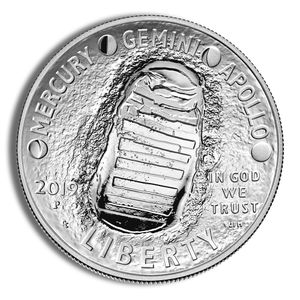
The law called for the obverse to be chosen through a design competition. The winning design shows a single bootprint on the lunar surface, encircled by the names of NASA's Mercury, Gemini and Apollo programs separated by phases of the Moon. The convex reverse is a close view of an astronaut's helmet visor, based on Armstrong's well-known photograph of Aldrin, with the reflection of Armstrong, the American flag and the lunar module in the glass.
The curved format debuted on the 2014 National Baseball Hall of Fame coins, and Apollo 11 was the second U.S. program to use it. The mission had appeared on American coinage before, too: the Eisenhower dollar introduced in 1971 and the Susan B. Anthony dollar that followed in 1979 both carried a reverse adapted from the Apollo 11 mission insignia. Those earlier dollars are history here rather than part of our Apollo 11 selection.
Purity, Weight, and Specifications
The 2019-P Apollo 11 silver dollar weighs 26.73 grams and is struck in .999 fine silver, which works out to a little under 0.86 troy ounces of pure silver. The Mint kept the weight it has long used for commemorative silver dollars but raised the fineness, so this coin holds more silver than the 0.7734 troy ounces in a traditional 90% commemorative dollar.
Proof and uncirculated versions share identical metal content. What separates them is production: proofs are struck more than once on specially prepared blanks with polished dies, giving them deep mirror fields and frosted devices, while the uncirculated version shows an even satin luster without that contrast. The P mint mark identifies Philadelphia on both, and the denomination and legally required inscriptions are worked into the curved design.
Available Brands, Mints, and Product Variations
Every coin in our Apollo 11 selection is a U.S. Mint product from the Philadelphia Mint. Two listings are the proof version and one is the brilliant uncirculated version, so the main decision is finish rather than date, design or metal. If you want the cameo contrast that photographs best, the proof is the natural pick, while the uncirculated coin shows the curved relief in a quieter, more even surface.
All three are raw coins rather than third-party graded examples. Coins sold directly by the Mint originally shipped in a protective capsule set into a presentation case with a certificate of authenticity, and each product page describes the packaging that comes with that listing. The gold, half dollar and five-ounce silver coins from the same program are separate issues and aren't part of this page.
Pricing, Premiums, and Market Factors
Like any commemorative, the Apollo 11 silver dollar sells at a collector premium rather than near its melt value. The silver content sets a baseline that moves with the spot price, but most of what you pay reflects numismatic factors: the program's mintage, the coin's condition, whether it's a proof or uncirculated strike, and whether it still has its original government packaging with the box and certificate of authenticity.
Subject matter carries real weight here. Space history draws buyers well beyond regular coin collectors, and the curved format adds to that appeal, so demand for this coin doesn't track silver closely. Proof and uncirculated versions can trade at different levels depending on how many of each were struck and sold, and examples with complete Mint packaging generally command more than loose coins.
We publish the bid next to the ask on every product page, which shows the spread on a particular Apollo coin rather than hiding it. Because we buy back what we sell, that bid reflects a working two-way market, and it's a useful reference when deciding which finish suits you.
Condition, Packaging, and What to Expect
These are raw coins, so their condition depends on how each was stored after it left the Mint. Expect a coin consistent with its listed finish, protected in a capsule, with packaging as described on its product page. Small marks on a capsule or shelf wear on a presentation box are normal and don't affect the coin inside.
The curve creates a few handling quirks. The coin won't fit a standard flat capsule or 2x2 holder, and the high points of the convex side are exposed if it's set face down on a hard surface. Fine silver can also develop small white spots or light toning over time, which is common on .999 silver proofs and worth knowing before you buy.
Authenticity and Verification
Counterfeiters have copied curved commemoratives, so we verify each Apollo 11 coin before it ships. Inspection covers weight, the sharpness of the relief on both the concave and convex faces, the character of the mirrored or satin surfaces, and whether the coin and its packaging match the listing.
A certificate of authenticity documents what the Mint originally shipped, but it can be separated from its coin and isn't proof on its own. Buying from an authorized PCGS and NGC dealer that sources through established wholesale channels, and keeping the coin with its original packaging, gives you a far stronger record than paper alone. If you ever submit the coin for grading, either service will authenticate it as part of that process.
Liquidity and Resale Considerations
The Apollo 11 silver dollar is recognizable to dealers and collectors across the country, but it isn't standardized the way bullion is. It trades in the numismatic market, where buyers are collectors and space enthusiasts, and interest in the subject tends to follow anniversaries and milestones in spaceflight.
Finish and packaging matter when you sell. A proof or uncirculated coin with its original box and COA is simpler to price than a loose coin, while spotting or handling marks can reduce what a coin brings. Comparing our bid with the ask before you buy gives a grounded view of how the coin trades today, without assuming anything about future prices.
Storage and Security
Keep each Apollo coin in its original capsule and presentation case where possible, since the Mint packaging is shaped to hold the curve securely. Store it somewhere cool, dry and dark, away from paper, rubber and household chemicals that can tone silver.
A fire-rated home safe is usually enough for a few commemoratives, while a bank safe deposit box suits a larger collection. Keep a record of each coin's finish and packaging, with photos, for insurance purposes. Never clean the coin, since even light rubbing leaves permanent hairlines on proof surfaces.
Selling and Buyback Options
When you're ready to sell, our purchasing team can buy Apollo 11 silver dollars back through the same marketplace where you bought them. The current bid on each product page is the starting point, and the team confirms a price, verifies the coin on arrival and handles payment.
Buyback offers depend on the finish, the coin's condition, whether the original box and certificate are present, current collector demand and the silver price on the day. A clean proof in complete Mint packaging is usually the simplest version to place, while coins with spotting or missing packaging are priced individually.
Why Buy Apollo 11 Commemorative Coins?
For most buyers, it's the subject. Apollo 11 is one of the defining achievements of the twentieth century, and this coin captures it in a format that suits it, with the bootprint pressed into a concave face and the visor bulging outward like a real helmet. Few coins connect shape and subject this directly.
It's also a government-issued legal tender coin in .999 fine silver from the U.S. Mint, made for a single year under a capped mintage. That mix of recognizability, real silver content and a fixed supply is what gives the Apollo 11 commemorative coin its place among modern U.S. commemoratives.
Why Buy from Bullion Standard?
Trust is earned once in this business, and Bullion Standard has been built on that idea since its founding in San Diego, California, in 2010. What began as a local operation is now a national online marketplace, and the same discipline applies to a single Apollo dollar as to a large bullion order: accurate descriptions, verified product and clear pricing.
Our credentials include an A+ rating with the Better Business Bureau, membership in the American Numismatic Association and the National Coin and Bullion Association, and authorized dealer status with PCGS and NGC. Checkout accepts Visa, Mastercard, American Express, Discover, PayPal, bank payments through Plaid, wire transfer, paper check and BitPay cryptocurrency, and our research tools let you compare premiums and spreads across the products you're considering.
Get Near-Spot Pricing with Bullion Standard Pro
Bullion Standard Pro is our membership platform for buyers who want to see wholesale pricing directly. Members get live, executable bid and ask prices across a broad range of precious metals products, with no added dealer markup or dealer spread, so premiums move with actual wholesale supply and demand. On bullion that means pricing close to spot, and on collector coins it means seeing where the wholesale market really sits.
Pro also values members' holdings at live wholesale bid and adds research tools such as historical premium analysis, spread comparisons and liquidity metrics. If you buy regularly, or simply want to understand how a commemorative's premium compares with the silver inside it, Pro puts that information in front of you.


 (833) 278-4653